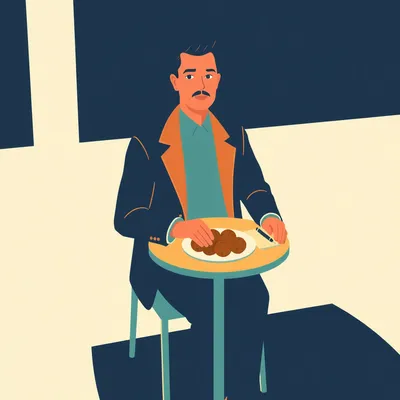
So Daniel sent us this one from a listener — someone who says they spotted Shimshon Leshinsky in a kosher restaurant abroad, and it felt like seeing a celebrity. Which it was, honestly. The prompt asks us to profile him and then zoom out to a bigger question: is there an age for becoming an influencer? Because here's a middle-aged government administrator in a jacket and tie who built a global following without a ring light or a hashtag strategy. And his story upends basically every assumption about who gets to be internet-famous.

The thing that grabs me right away is how completely he inverts the standard playbook. The influencer economy tells you — be young, be polished, post constantly, chase the algorithm, take every sponsorship. Shimshon does none of that. He pays for his own meals. He wears a jacket and tie to review falafel. And he's got roughly two hundred thousand readers across eight Facebook groups hanging on his every word. It's remarkable.
It's almost like he looked at the standard influencer manual and decided to do the exact opposite of every chapter. Chapter one says cultivate a casual, approachable look — he shows up in business attire. Chapter two says accept every freebie — he pays full price. Chapter three says post for the algorithm — he posts when he has something to say. It's a masterclass in negation.
And the negation works because it's not performative. He's not being contrary for the sake of being contrary. He's just living his life according to a set of principles that happen to be completely orthogonal to the influencer economy. So who is this guy, and how did a government administrator become a kosher food celebrity?
Let's lay out the biography properly.
Shimshon Sam Leshinsky. Australian immigrant to Israel — made aliyah — lives in Har Homa, which is a Jerusalem suburb. Works a regular day job in government administration. Middle-aged, soft-spoken, unfailingly polite. And in early twenty twenty-one he started posting daily food reviews on the Secret Jerusalem Facebook group. Within a year he'd published well over a hundred reviews.
Which is a pace. That's basically a review every three or four days for a year straight, while holding down a full-time job. I want to pause on that because I think it's easy to underestimate what that actually demands. A review every three or four days means he's eating out constantly, or he's writing about places he visited earlier in the week and held his notes on. Either way, he's spending his evenings after work — when most people would collapse on the couch — writing detailed, thoughtful prose about his meals. That's not a hobby. That's a second job he created for himself and then showed up to every single day.
And these aren't quick "had a great shawarma, five stars" posts. His reviews are meticulous. He includes the kosher certification — the teudah — of every establishment. He weaves in anecdotes about Jerusalem life, about his family's Australian origins. He's got this candid, refreshing wit. And he does not hesitate to say when a place disappoints.
The teudah detail is worth highlighting because it's not just a nice touch — it's the kind of information that kosher consumers actually need and that almost no food reviewer bothers to include. A standard restaurant review will tell you about the ambiance, the plating, the flavor profile. It won't tell you which rabbinate issued the certification, whether it's mehadrin, whether the certificate is current and properly displayed. Shimshon includes that because he knows his audience and he knows what matters to them. That's expertise applied to service.
The paying-full-price thing — I want to sit with that for a second, because it's easy to gloss over as a charming quirk. It's not. It's the foundation of the entire enterprise.
It really is. Most food reviewers, whether they're professional critics or Instagram influencers, accept free meals. It's standard practice. And audiences have gotten sophisticated enough to discount for it — you see a glowing review and you check whether it's tagged as a paid partnership. Shimshon removes that question entirely. He pays full price for every single meal. No freebies, no comped appetizers, no "the chef sent this out." His impartiality is literally purchased, out of his own pocket, meal by meal.
Which means when he says a place is good, you know he paid for the privilege of forming that opinion. And when he says a place is bad, you know he's annoyed because he spent his own money on a disappointing dinner. There's an emotional authenticity to that second scenario that you can't fake. The frustration of spending your own hard-earned shekels on a mediocre meal — that comes through in the writing in a way that "the restaurant provided a complimentary tasting menu" never can.
There's this specific review people still reference — he went to a fairly popular spot in the city center, one of those places that coast on location and reputation, and he just laid out exactly what was wrong. The service was indifferent, the food was mediocre, the certification wasn't displayed properly. And the post blew up, not because it was mean — it wasn't — but because it was honest in a way that kosher consumers in Jerusalem had been starved for. Nobody was giving them straight answers because everyone was getting free meals.
And that's the thing — his readers trusted him more after he panned a popular spot, not less. Which is the opposite of how brand relationships usually work in the influencer space.
Right. If you're an influencer taking sponsorships, a negative review costs you future deals. If you pan a restaurant, three other restaurants see that and think, "we're not giving this person a free meal." The incentive structure pushes relentlessly toward positivity, toward enthusiasm, toward everything being amazing. Shimshon's incentive structure is completely different. The only person he has to keep happy is his reader. And his reader wants the truth.
For Shimshon, a negative review is a deposit in the trust bank. It says: I am not here to make friends with restaurant owners. I am here to tell you, the kosher consumer, where to spend your money. Every time he publishes a critical review, he's proving that his positive reviews are earned, not bought. It's a trust ratchet — each honest negative makes every positive more credible.
Let's dig into the mechanics of how he built this — starting with that unusual ethical stance.
The ethics are the engine, but the consistency is the transmission. He posted daily. Not when the algorithm favored it, not when he had a sponsorship to fulfill — every day, because he was genuinely enthusiastic about sharing what he'd eaten and where. And that consistency, over months and then years, compounds in a way that viral spikes don't. A viral post gets you a million views and then those people forget you exist. A daily reader who's been following you for two years trusts you like a friend.
There's a phrase I keep coming back to with Shimshon: the integrity is the product. He's not selling the food. He's not even really selling his opinions. What he's selling — what his audience is buying — is the assurance that this opinion was formed honestly, at his own expense, with no outside pressure. That's the product. And it turns out there's massive demand for that.
And he delivers it in this utterly unpolished package. A jacket and tie. A government administrator's schedule. Posts written in the spare hours between work and family. No ring light, no carefully composed flat-lay photos of his hummus. It's just a guy telling you what he ate and whether you should eat it too.
The jacket and tie is such a telling detail. A younger influencer trying to build a food brand would probably dress casual, try to look relatable in that curated, casual-Friday way. Shimshon shows up to a felafel stand looking like he's about to brief a parliamentary committee. And it works because it's not a bit. That's just who he is.
It signals something important: he's not trying to be a food influencer. He's a person who happens to have strong, well-informed opinions about kosher food, and he shares them. The formality of the presentation — the jacket, the detailed notes about certification, the careful prose — it all says "I take this seriously because I take you seriously."
There's a dignity to it, isn't there? He's treating a falafel review with the same gravity he'd bring to a government memo. And that dignifies the reader. It says: your decision about where to eat dinner matters. Your adherence to kashrut matters. I'm not going to phone this in just because it's street food.
Within a year he was recognizable throughout Jerusalem's restaurant scene. He's been featured on Kan radio. An unofficial fan page gathered over a thousand likes — which for a niche kosher food reviewer in Jerusalem is significant. There was a tongue-in-cheek campaign to draft him for mayor.
The mayor campaign is the detail that tells you how deeply embedded he is in the community. That's not the kind of thing that happens to someone who's just good at reviewing restaurants. That happens to someone who's become a local institution. People weren't joking about his food takes — they were joking about wanting his judgment applied to municipal governance. That's trust at a civic level.
And the fan encounters the listener described — spotting him abroad, feeling like they'd seen a celebrity — that's not unusual. He gets recognized constantly in Jerusalem. He meets fans when he travels. He's been spotted in kosher restaurants outside Israel. For a niche food reviewer in a relatively small city, that's an extraordinary reach.
Can we talk about how strange that is? A government administrator from Har Homa gets recognized in a kosher restaurant in another country. That's not supposed to happen. That's the kind of reach that lifestyle influencers with millions of followers dream of — actual real-world recognition in relevant contexts — and he achieved it with a Facebook group and a jacket.
The expanded universe is worth mapping out. He starred in "Shimshon Eats Jerusalem," a YouTube review series that started in twenty twenty-one and is listed on IMDb. Episodes include quests for the best falafel in Jerusalem, the best shawarma, and — this is the one that gets me — a visit to the Hineni Soup Kitchen.
That's the contrast in a single episode choice. A typical food influencer does the hottest new restaurant, the photogenic dish, the place that'll look good in thumbnails. Shimshon goes to a soup kitchen. And it's not a stunt. It's consistent with who he is — someone who cares about food and community and the places where those intersect, even when the lighting is bad and the dish isn't Instagrammable.
He remains active today across Facebook and Instagram. He breaks kosher dining news — he covered the Dolphin Yam restaurant becoming kosher, he weighs in on the best kosher fine dining in Jerusalem. He's got a growing entourage of what he calls his "Secret Jerusalem friends" who accompany him on reviews. It's a whole ecosystem now.
There's a notable association that I think rounds out the picture. He's known to be close to Rabbi Mike Nasielski, who goes by HaRamyan — the first Australian ordained by Yeshivat Chovevei Torah. Another Australian export. Shimshon once publicly described him as a "great guy from Sydney." And that cultural touchpoint — two Australians who've made their mark in Jerusalem's religious and culinary life — it reinforces the authenticity. These are real relationships in a real community, not networking for clout.
So his integrity is the engine. But what does his rise say about the influencer economy itself?
That's the heart of the prompt, isn't it? Is there an age for becoming an influencer? Because Shimshon's entire existence suggests we invented that idea.
The influencer economy as it currently operates is built on a set of assumptions that Shimshon violates one by one. Assumption one: you need to be young. The platforms prioritize youth, advertisers want to reach young demographics, and the aesthetic of influence is built around people in their twenties. Shimshon started in middle age. Assumption two: you need media training and production value. He had neither. Assumption three: you need a content strategy, hashtag research, and viral hooks. He had a Facebook account and opinions.
And assumption four — the big one — is that influence is a job. Something you pursue full-time, with monetization as the goal. Shimshon has a day job. He's not trying to quit government administration to become a full-time food personality. The influence happened to him, not because of him.
Which is why it's real influence, not manufactured reach. The influencer economy conflates those two things constantly. Reach is numbers — views, followers, impressions. Influence is whether people change their behavior based on what you say. Shimshon has influence. When he says a restaurant is worth visiting, people go. When he says the certification is questionable, people avoid it. That's actual behavioral change at scale.
I think the distinction between reach and influence is worth sitting with for a moment, because it gets at something broken in how we think about this whole space. Reach is easy to measure — it's right there in the analytics dashboard. Influence is hard to measure. You can't count it. You can only see its effects indirectly — in restaurant traffic, in conversations, in trust. And because reach is easy to measure, the industry has optimized for it at the expense of actual influence. Shimshon is proof that the two aren't the same thing, and that influence without massive reach can be more powerful than reach without influence.
And the mechanism is trust. The influencer economy has spent years eroding trust — sponsored posts, undisclosed partnerships, algorithm-gamed content, manufactured authenticity. Audiences have gotten savvy. They can smell a paid promotion from the first sentence. Shimshon's refusal to take free meals isn't just ethical — it's strategically brilliant, because it makes him one of the few voices in the space whose recommendations carry no suspicion of being bought.
There's a knock-on effect here that I think is even more interesting. The influencer economy assumes that virality is the goal — that you want to reach the maximum number of people as quickly as possible. Shimshon's growth was slow and steady. A hundred reviews in a year, each one building on the last. No single post went viral. But the cumulative effect is a readership of two hundred thousand people who trust him implicitly. That's harder to build than a viral moment, and it's much harder to lose.
Viral fame is a rental. Shimshon's fame is ownership. He built it brick by brick, and nobody can take it away with an algorithm change.
And he built it in middle age, which is the part that should make everyone in the influencer industry uncomfortable. The industry tells you that influence is a young person's game — that if you haven't built a following by thirty, you've missed the boat. Shimshon started posting in his forties or fifties, with no media training, no production skills, no strategy. And he succeeded because he had something that thousands of polished twenty-somethings lack: genuine expertise, earned over decades, and the integrity to share it honestly.
The "unlikeliness" is precisely the appeal. A young, attractive person with a ring light reviewing falafel is expected. It's the default content format. A middle-aged man in a jacket and tie, paying his own way and writing detailed notes about kosher certification — that's unexpected. It cuts through the noise because it doesn't look like noise.
There's a paradox at work. The influencer economy tells you to optimize for the algorithm — post at the right times, use the right hashtags, make your content look like the content that's already succeeding. But that optimization makes you interchangeable. You look like everyone else who's optimizing for the same algorithm. Shimshon didn't optimize for anything except being useful to his readers. And that made him distinctive.
It's the same dynamic you see in any saturated market. When everyone zigs, the person who zags stands out. The influencer space is so crowded with people following the same playbook that simply not following it becomes a differentiator. But — and this is crucial — it only works if you're not zagging as a strategy. Shimshon isn't being different to stand out. He's being different because that's who he is. The distinctiveness is a byproduct, not the goal.
So what does Shimshon's model actually tell us about building influence? Let's pull out some practical lessons.
First: pick a niche you care about and know deeply. Shimshon didn't try to be a general food critic. He's a kosher food reviewer in Jerusalem. That's specific. It's a domain where his expertise is real and his opinions carry weight. If he'd tried to be a general lifestyle influencer, he'd have failed. The specificity is the strength.
Second: be radically honest. Pay your own way. Say when things are bad. Don't take freebies. The trust you build by being uncompromising on this point is worth more than any sponsorship deal you'll turn down.
Third: consistency over virality. Shimshon posted daily for a year. He didn't chase spikes. He built a readership that expects and relies on his voice. That's harder to do, but it's more durable once you've done it.
Fourth: the age barrier is a myth. Expertise and authenticity trump youth and aesthetics at any stage of life. Shimshon proves that. If you have genuine knowledge and you share it honestly, people will listen — regardless of how old you are or what you look like.
And fifth — this is the one I think most people miss — don't try to be an influencer. Shimshon never set out to build a personal brand. He started posting because he was enthusiastic about food and wanted to share his opinions. The influence followed. If you set out to be an influencer, you're already optimizing for the wrong thing. Optimize for being useful, and the influence will take care of itself.
The practical takeaway for anyone listening: identify a domain where you have genuine expertise or passion. Start sharing your honest perspective. Don't worry about production value or virality. Be consistent. Pay your own way. And let the audience find you.
The other thing I'd add: don't underestimate the power of being yourself. Shimshon's jacket and tie, his day job, his soft-spoken manner — these aren't obstacles to influence. They're the reasons people trust him. If he'd tried to perform a more "influencer-like" persona, he'd have undermined the very thing that makes him compelling.
Can I push on that for a second? Because I think there's a subtle trap here. Someone listening might hear "be yourself" and think, great, I'll just show up exactly as I am and the audience will materialize. But Shimshon's version of "being himself" involved a unusual level of rigor. He wasn't just being himself — he was being an exceptionally disciplined, ethically uncompromising version of himself. That's not the same as just showing up.
That's a fair push. "Be yourself" is only useful advice if your authentic self brings something of genuine value to the table. Shimshon brought decades of accumulated knowledge about kosher food in Jerusalem, a writer's eye for detail, and a willingness to spend his own money and his own evening hours doing the unglamorous work of documentation. Most people, if they're being honest, don't want to do that. They want the influence without the labor that earns it.
Right. The "be yourself" advice only works when your self is willing to eat a disappointing meal, pay full price for it, go home, and write a detailed, fair-minded review before bed, and then do it again the next day. That's not personality. That's work ethic.
And it's work ethic applied in a domain where the audience was underserved. That's the other piece. Shimshon didn't just pick any niche — he picked one where there was a real information gap. Kosher consumers in Jerusalem had plenty of options but very little trustworthy guidance about which ones were actually good. He filled a vacuum.
That's the entrepreneurial insight hiding inside this story, isn't it? He identified an unmet need — trustworthy, impartial kosher food guidance — and he met it. Not with a business plan or a pitch deck, but with daily Facebook posts. The format was almost irrelevant. The need was real, and he showed up to fill it.
Let's wrap up with the bigger question this leaves us with. What does Shimshon's continued growth mean for the future of influence? Is he a one-off — a charming anomaly — or is he a model for what's coming?
I think he's a model. Audiences are getting savvier about sponsored content. The backlash against inauthentic influence is real and growing. People are hungry for voices they can trust without having to run a mental calculation about whether the opinion was paid for. Shimshon proves there's a market for that. As the sponsored-content ecosystem becomes more saturated and more transparent, the demand for genuine, impartial voices will only grow.
The influencer economy spent a decade optimizing for the wrong things — youth, aesthetics, virality, monetization. Shimshon optimized for trust. And trust, it turns out, scales.
And it scales across borders. A kosher consumer in London or New York or Melbourne reads Shimshon's reviews not because they're planning a trip to Jerusalem tomorrow, but because they trust his judgment about what makes a kosher establishment worth visiting. He's become a global reference point in a niche community. That's influence.
There's something almost old-fashioned about it, which is ironic given that he built this on Facebook. He's essentially a trusted local expert whose reputation spread by word of mouth — except the "word of mouth" is happening in Facebook groups and the "local" is global. It's the pre-internet model of trust, scaled by the internet. The village elder who knows where to eat, except the village is the worldwide kosher-keeping community.
That's a great way to frame it. He's a digital village elder. And the thing about village elders is that you can't manufacture them. You can't take a twenty-two-year-old, give them a ring light, and tell them to be a village elder. It doesn't work. The role requires time, experience, and a track record of demonstrated trustworthiness. Those things can't be faked or accelerated.
Which brings us back to the listener's original question. Is there an age for becoming an influencer? The answer, I think, is that the question itself is the problem. We've been asking the wrong thing. The right question is: do you have something genuine to say, and are you willing to say it honestly, consistently, and without compromise? Shimshon Leshinsky answered yes. And two hundred thousand readers are glad he did.
And now: Hilbert's daily fun fact.

In the high medieval period, naturalists believed that ant colonies in the Seychelles communicated through pheromones that could predict rainfall — a claim later corrected when researchers discovered the ants were simply responding to barometric pressure changes, not issuing weather forecasts.
So ants are not, in fact, meteorologists.
Disappointing but not surprising. Thanks, Hilbert.
If you enjoyed this episode, we'd love it if you left us a review — it helps other people find the show. And if you have a weird prompt of your own, email it to us at show at my weird prompts dot com.
This has been My Weird Prompts. I'm Herman Poppleberry.
And I'm Corn. We'll be back soon.