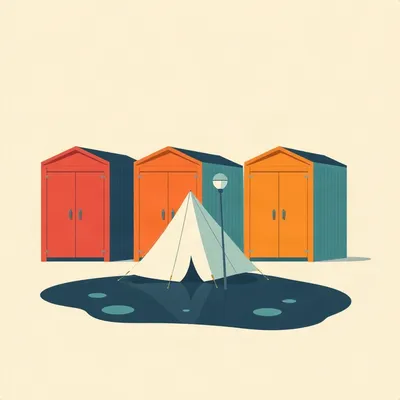
Daniel's been turning over the international aid machinery again, and the image he keeps coming back to is the sea of white tents. The default. The thing everybody pictures when they hear the words displaced people. And his point is that this default is a choice, not an inevitability. He's been looking at examples, especially from China, where emergency response teams stood up field hospitals and emergency accommodation that amounted to real construction projects. Not tents. Bona fide buildings, with plumbing and insulation and doors that lock. And then he contrasts that with Gaza, where huge numbers of people were put in tents, and then the tents flooded, and disease spread, and nobody will be citing that as a model for anything except failure. So his actual question is: where have people been treated more compassionately? Where has the response been more dignified, when permanent housing couldn't meet the need?

And the thing is, the examples exist. They're not hypothetical. China's done it, Turkey's done it at a scale that's hard to wrap your head around. The question underneath Daniel's question is why those examples don't become the default. Why do tents persist?
Let's start with the engineering problem underneath all of this. What does it actually take to build a city in a week?
First, a distinction that most coverage blurs. Emergency shelter versus emergency housing. Shelter is a tarp and a tent. It keeps rain off for weeks. Maybe months if you're lucky. Housing is a structure with plumbing, power, insulation, and a door that locks. It keeps dignity intact for years. The central tension is that the faster you build, the more likely you are to build something temporary. The more dignified you build, the slower it gets. The interesting cases are the ones that broke that tradeoff entirely.
And the three cases that break it cleanly are China's post-earthquake response, Turkey's container cities, and Gaza as the cautionary tale where the tradeoff was never even attempted. What I want to know is whether this is a technology problem, a logistics problem, or a political problem. Because the answer determines whether any of this is fixable.
It's all three, but not equally. The technology is solved. That's the part people don't realize. The logistics are solved in specific places. The politics is where it falls apart. Let me start with China as the proof of concept, because that's where Daniel pointed and he's right to point there. January 2025, a six point eight magnitude earthquake in Tibet's Shigatse region. Chinese relief teams deployed foldable container homes within days. Not tents. These were prefabricated, insulated units designed to be assembled on-site with minimal equipment. The speed was the point, but the speed was possible because the infrastructure existed before the disaster. It was stockpiled and standardized.
So the earthquake happens, and the response is essentially a warehouse operation. You're not building anything. You're shipping things that were already built.
China treats emergency housing as a manufacturing problem, not a construction problem. The units are built in factories, shipped flat, and unfolded on-site. It's flat-pack furniture scaled to a city. A foldable container home arrives as a compact unit, gets lifted into place, the walls fold out, the roof locks in, and you've got a structure with insulation, a real floor, a door. A few hours of assembly, minimal heavy equipment. The same logic applies to their medical infrastructure. After the 2008 Sichuan earthquake, mobile field hospitals were deployed within twenty-four to forty-eight hours. Fully equipped surgical units in expandable containers. Same thing in Yushu in 2010. The operating rooms, the sterilization equipment, the patient wards, all pre-built and pre-positioned.
So the phrase that matters here is surge infrastructure. You don't build emergency capacity during the emergency. You build it before, stockpile it, and then deploy it when the ground shakes.
And that's the opposite of how most international aid works. Most aid is ad hoc and donation-driven. Someone donates tents, someone donates blankets, the stuff arrives in a chaotic stream, and you assemble a response out of whatever showed up. China's model is: we know earthquakes happen in this region, we know the failure modes, so we built the answer in advance and parked it in a warehouse.
The obvious objection is cost. A foldable container home costs a few thousand dollars. A tent costs a couple hundred. So on the spreadsheet, the tent wins. But compare the cost of keeping a family in a tent for three years. The tent has to be replaced multiple times. It fails in winter. It fails in rain. And the health and economic costs of tent life are enormous. The spreadsheet comparison only works if you assume the emergency lasts two weeks.
And emergencies don't last two weeks. The average displacement after a major disaster is measured in years. The average refugee displacement is measured in decades. So the cheap option is only cheap if you refuse to look past the first month. The foldable container home is actually the frugal choice. It just requires spending the money up front instead of leaking it out over years of replacement tents and cholera outbreaks.
I want to sit with that cost point for a second, because I think it's where the conversation usually derails. People hear "container home" and they picture something luxurious. But we're not talking about luxury. We're talking about a metal box with insulation and a door. The gap between that and a tent is the gap between a functioning society and a humanitarian crisis.
Right. And the cost comparison people make is always the purchase price of one tent versus the purchase price of one container unit. That's not the comparison. The comparison is the total cost of sheltering a family for the actual duration of their displacement. When you run that number, the tent is a money pit. You're buying the same thing over and over, and you're paying for the health crises and the social breakdown on top of it.
So China shows it can be done at speed. But what happens when you need to do it at scale, for millions of people, not thousands?
Turkey. February 2023, the earthquakes in the south. Eleven provinces, something like fifty thousand dead, and millions displaced. And Turkey's response was container cities. Real settlements with streets, plumbing, electricity, schools, clinics. Hundreds of thousands of container units deployed across the affected region. The scale was unprecedented. You had container cities with named streets. With markets. With schools where kids went to class while their parents waited for permanent housing to be rebuilt.
The difference between a container city and a tent city is infrastructure. A container city has water and sewer lines, electrical grids, roads, communal buildings. A tent city has none of that. A container city is a temporary town. A tent city is a holding pen.
And the dignity angle is concrete, not abstract. A container home has a lockable door. A kitchen. A bathroom. Privacy. A family can close the door and be a family. A tent has none of that. The psychological difference between living in a container home and living in a tent is the difference between being a displaced person and being a refugee. One of those is a status. The other is a condition.
I think the lockable door is the whole thing. Everything else follows from that. If you can lock the door, you have something to protect. If you have something to protect, you have a reason to maintain it. If you maintain it, it becomes a home.
And some of Turkey's container cities became permanent. Schools, markets, the whole thing. People stayed because the temporary solution was good enough to become the permanent one. That's not a failure. That's a sign that the temporary solution was built to a standard that could last.
That's a point worth pausing on. The idea that a temporary solution becoming permanent is a failure is one of those assumptions that falls apart the moment you look at it. If the temporary solution is good enough to become permanent, then it wasn't temporary. It was just housing that happened to be deployed quickly.
And that reframes the whole thing. The goal isn't to build something that will be torn down. The goal is to build something that could be torn down but doesn't have to be. That's a much higher standard, and it's the standard that actually serves people.
Now pivot to Gaza, because that's the emotional center of Daniel's question and it should be. The Gaza response relied almost entirely on tents. After the 2025 ceasefire, with winter rains coming, the tent cities flooded repeatedly. November 2025 was particularly severe. Tents washed away. Sewage mixed with floodwater. Disease spread through the camps. The infrastructure that would have prevented this, drainage, raised platforms, proper housing, was never built.
And here's the thing that should make people angry. It wasn't a technology problem. The same foldable container homes existed. The same container city models existed. Turkey had just demonstrated them at massive scale two years earlier. The technology was sitting in factories. The failure was political and logistical. Border crossings restricted. Funding uncertain. Political will absent. The tents were a choice, not a necessity.
That's the sentence that should land hardest. The tents were a choice. Somebody, or some set of somebodies, decided that two million displaced people would get fabric and poles while the container units sat on the other side of a border.
And the contrast with Turkey is stark. Turkey built container cities for millions in months. Gaza couldn't build them for two million in years. The difference wasn't engineering. It wasn't know-how. It was politics, funding, and the willingness to treat displaced people as people who deserve walls.
The knock-on effect are where it gets grim. Tent cities don't just fail physically, they fail socially. They concentrate poverty. They destroy privacy. They make women and children vulnerable in ways that are predictable and documented. A tent city creates a permanent underclass of displaced people. A container city, by contrast, can become a real neighborhood. It can have a school that kids actually attend. It can have a market where people run small businesses. It can have the texture of ordinary life.
The health angle, I can speak to this from the clinical side. A tent in winter is a respiratory infection factory. A tent in summer is a heatstroke risk. A tent in rain is a sewage exposure event. The disease burden of tent cities isn't a side effect. It's the primary feature. You're putting people in structures that actively make them sick, and then you're surprised when there's an outbreak.
There's a grim irony in that. The tent is supposed to be the humanitarian response, but it creates the conditions for the worst humanitarian outcomes. You're not sheltering people. You're concentrating them in a way that makes them sicker and more vulnerable than they were before.
I remember reading reports from the Gaza camps during the floods. Children with skin infections from standing water. Elderly people with pneumonia. The tents weren't just failing to protect people. They were actively harming them. And the response was always more tents. More of the thing that was failing.
The technology exists. The models exist. The question is why we keep choosing tents. And I think the answer is that tents are what you give people when you've decided their displacement is temporary, even when all the evidence says it won't be. The tent is a promise that this will be over soon. The container home is an admission that it won't be, and that admission is politically expensive.
There's also a procurement inertia. The aid industry has tent supply chains. It has tent manufacturers. It has tent logistics. Switching to container homes means switching to a different set of suppliers, a different set of skills, a different set of assumptions about what a response looks like. The tent is the incumbent technology, and incumbents don't get displaced just because they're worse.
The tent is visible. A sea of white tents photographs well. It looks like something is being done. A container city looks like a construction project, which is harder to sell as an emergency response. The tent is the iconography of aid. The container home is the iconography of housing, and housing is boring.
Housing is also expensive up front, and donors like cheap up front. The cost accounting of aid is broken. Nobody gets credit for the cholera outbreak that didn't happen. Nobody gets credit for the tent that didn't need replacing. The incentives reward visible, cheap, fast interventions, and the tent is all three. The fact that it's worse in every other dimension doesn't matter to the incentive structure.
That's a profound point about accountability. The aid system is accountable for what it spends, not for what it achieves. A donor can point to a million tents and say "look what we did." They can't point to the absence of disease and say "look what we prevented." Prevention is invisible. The tent is visible. So the tent wins.
The people who live in the tents pay the cost of that visibility. They're the ones who get sick. They're the ones who freeze. They're the ones who lose whatever dignity they had left. But they're not the ones who write the reports.
What would it actually take to make container cities the default? China has the manufacturing capacity. Turkey has demonstrated the deployment model. The design is proven. The cost comparison, over any realistic timeline, favors the container home. What's missing is the political will to treat displacement as a long-term condition rather than a short-term emergency.
That's a hard sell, because admitting that displacement is long-term feels like admitting defeat. The tent is a form of denial. It says: this is temporary, we'll be out of here soon, we don't need to build anything real. The container home says: we're going to be here for a while, so let's make it livable. That's a more honest statement, and honesty about displacement is politically radioactive.
There's a version of this conversation that ends with a to-do list. I don't think that's the right ending. The right ending is a question. If the technology exists, and the models exist, and the cost comparison favors the dignified option, why do tents remain the default? Is it cost, politics, or something deeper about how we value displaced people?
I think it's the third one. The tent is what you give people when you've decided, somewhere in the back of your mind, that they're not quite people. That their suffering is sad but not urgent. That their dignity is a nice-to-have rather than a requirement. The container home is what you give people when you've decided they matter.
That's the thing Daniel's question is really poking at. He's not asking about engineering. He's asking about whether we've ever treated displaced people as if they matter, and the answer is yes, in China and Turkey, and the follow-up question is why not everywhere.

You're both missing the foundation problem.
Say more.
I spent six months in twenty eleven as a logistics coordinator for a modular building company shipping prefab units to Christchurch after the earthquake there. The units were beautiful. Insulated, double-glazed, real kitchens. They sat on the dock in Lyttelton for weeks because nobody could agree on who was responsible for the foundations. The foundations were the bottleneck. You can build a thousand homes in a factory, but you can't pour a thousand slabs without a permit, a contractor, and a political fight.
That's the part the Chinese model actually solves, isn't it? The unit comes with its own base, its own leveling system, its own connection points. The foundation is part of the product.
That's the difference. The Chinese and the Turks treated the foundation as part of the product. The West treats the foundation as a construction project. So the factory can produce all the homes it wants, and they pile up on the dock while the local council argues about zoning.
The bottleneck was never manufacturing. It was the interface between the manufactured unit and the ground it sits on.
The interface. That's the word. Nobody talks about the interface. They talk about the units. The units are the easy part. The units are just boxes. The hard part is the six inches between the box and the earth, because that six inches involves a building permit and a property line and a man named Graham who doesn't want a container home visible from his veranda.
Did you ever get them off the dock?
Most of them. Took two months. By then winter was coming and people were still in garages. I still have one of the prototype units in my backyard. Use it as a workshop. It's got a small crack in the corner from when a forklift dropped it in twenty eleven. Never fixed it. Still keeps the rain out.
The crack is load-bearing at this point. It's part of the structure.
It's part of the character. The unit's been through an earthquake, a dock strike, and a forklift. The crack is its service record.
The forklift incident is the part I want to know about. Was that on the dock, or during transport?
On the dock. Driver was in a hurry. Unit was on the sling, swung wide, clipped a bollard. Cracked the corner. We wrote it off, but I bought it for scrap price and had it trucked to my place. Twenty eleven. Still level.
The unit that survived the forklift is sitting in your backyard while the units that made it to Christchurch intact were stuck on the dock because of Graham's veranda.
That's about the shape of it. The technology was never the problem. The problem was always the paperwork and the people who didn't want it near them. You can solve the engineering in a factory. You can't solve the politics in a factory.
That's the thing I keep coming back to. The Chinese model works because the state can just decide. The land is allocated, the units arrive, the deployment happens. Turkey works because the central government declared an emergency and overrode the local objections. The Western model fails because it's democratic all the way down, and every layer of democracy is a layer of delay.
The container home is a solved problem, and the container city is a solved problem, and the only unsolved problem is whether the political system will let the solved problems be deployed. That's a much darker conclusion than I wanted to reach.
It's not dark. It's just specific. The foundation is a metaphor, but it's also a foundation. The six inches between the box and the ground is where the whole thing lives or dies.
In Gaza, there was no six inches. There was no foundation at all. Just fabric on sand. The entire infrastructure layer was skipped. Not because it was hard, but because someone decided it wasn't worth doing.
The tent is the absence of the foundation. That's what makes it a tent. You don't have to interface with the ground. You just put it down and it's there. The container home requires you to actually engage with the place. The tent lets you pretend you're not staying.
The tent is the thing you use when you've already decided to leave. The problem is the leaving never happens.
The misconception people hold is that emergency housing has to be temporary and flimsy. That the tent is the only option when permanent housing is insufficient. And that's just wrong. Foldable container homes and container cities are permanent-quality structures that can be deployed in days. Turkey and China both demonstrated it.
The Gaza failure wasn't a technology problem. The same technology existed. It was a political and logistical failure. The tents were a choice.
The open question, the thing I'm left with, is whether the tent persists because of cost, because of politics, or because we've quietly decided that displaced people don't deserve walls. And as climate change drives more displacement, that question is going to get asked at scales we haven't seen. The choice between tents and container cities is going to become a moral test for the international community. And I'm not confident we'll pass it.
The difference between a tent and a container home is the difference between surviving and living. The technology exists. The models exist. The question is whether we'll choose to use them.
Thanks to our producer Hilbert Flumingtop for keeping the show running.
This has been My Weird Prompts. If you found this interesting, check out the podcast feed. We're at my weird prompts dot com, and there are thousands of episodes there.
We'll be back soon.