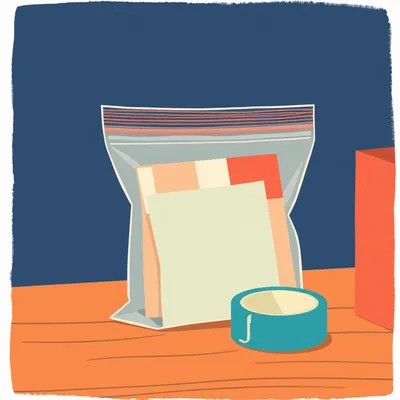
Daniel sent us this one — he's been building this home inventory system, small apartment, lots of tech gear, and he's hit the wall with Ziploc bags. They're the workhorse of his whole operation, but they're expensive at scale, not exactly sustainable, and finding the right size for weird-shaped things like cables is a losing game. The one hard requirement is being able to write an identifier on whatever bag replaces them — paint marker specifically, which has worked best for him. So the question is, what actually replaces the Ziploc in a system like this?

This is one of those problems where the thing you think is the cheap default turns out to be the expensive option once you start doing math on it. A single large Ziploc — say the fifty-five by forty centimeter size — that's running somewhere between fifty cents and a dollar fifty per bag depending on where you buy and quantity. If you've got two hundred SKUs, which is not a crazy number for a tech inventory, you're looking at a hundred to three hundred dollars just in bags that are designed to be thrown away.
The labeling problem is separate from the cost problem. Paint marker on polyethylene — which is what Ziplocs are made of — that's not a great marriage.
Right, and this is where the material science actually matters. Polyethylene is what's called a low-surface-energy plastic. Surface energy is basically how willing a surface is to let things stick to it. High surface energy means adhesives and inks grab on. Low surface energy means they bead up and wipe off. Polyethylene is down around thirty dynes per centimeter. Paint markers want something above thirty-eight, ideally above forty. So you're fighting physics every time you write on a Ziploc.
The bag material and the label surface are two separate problems. Let's look at the material options one by one.
The obvious first candidate is silicone bags — Stasher is the brand everyone knows. They're reusable, they're durable, and here's the interesting thing: silicone has a much higher surface energy than polyethylene. Paint marker grabs onto silicone really well. You can write a SKU directly on a Stasher bag and it's not going anywhere.
What's the catch?
Price and size. A Stasher half-gallon bag retails for about twelve to fifteen dollars. If you need fifty of them, you're looking at six hundred to seven hundred fifty dollars. That's a serious investment for inventory storage. And the size range is limited — the largest Stasher tops out around twenty-eight by twenty-eight centimeters. That's not going to hold a bundle of longer cables or a power supply. They're also thick — the silicone has real heft to it — so when you nest them inside boxes, they take up meaningful volume.
Silicone solves the writability problem and the reusability problem but creates a cost problem and a bulk problem.
And there's another thing — silicone bags are designed for food. The seal mechanism on a Stasher is a pinch-press seal, not a zipper track. It's great for keeping soup in, but for small screws or adapters, it's over-engineered and slower to open and close than a simple zip.
What's the next tier down?
Polypropylene resealable bags. These are what Uline and McMaster-Carr sell by the case. A ten by fifteen centimeter bag — perfect for small connectors, screws, adapters — costs about twelve cents per bag when you buy a case of a thousand. That's a completely different economics. You can bag your entire inventory for thirty or forty dollars instead of three hundred.
We're back to the labeling problem.
We're back to it, but we're not stuck with it. Polypropylene is a higher-surface-energy plastic than polyethylene — it's around thirty-two, thirty-four dynes per centimeter. Paint marker adheres better, but it's still not great. It'll go on, but it can rub off with handling. So here's the fix that costs two cents: a small strip of matte polypropylene tape.
You're not writing on the bag. You're writing on a label zone you've created on the bag.
That's the whole insight. A piece of three M three nine six one matte tape, or an Avery two two eight oh six vinyl label — these are designed to accept ink. The matte surface has the texture and surface energy that paint markers love. You stick a two-by-five-centimeter strip on your twelve-cent bag, and suddenly you've got a perfectly writable surface that costs you fourteen cents total. The tape decouples the bag material from the labeling requirement entirely.
Which means you can use the cheapest bag that fits the item and not worry about whether it takes marker well.
That's the thing most people miss. They go hunting for the perfect label-friendly bag, when what they should be doing is making any bag label-friendly for two cents.
Like adopting a feral cat.
I'm not sure that metaphor tracks, but I appreciate the attempt.
What about the durability side? A twelve-cent polypropylene bag — is that something you're reusing or is it still basically disposable?
It depends on the thickness. The standard Uline bags are two mil — that's two thousandths of an inch. They'll last through multiple opens and closes if you're gentle, but they're not built for daily access. If you're grabbing a cable out of the same bag every week, you'll eventually tear the zip track or puncture the plastic. But for items you access once every few months — which is most of a home inventory — two mil is fine.
If you need something tougher?
That's where Tyvek envelopes come in. Tyvek is that material that feels like paper but tears like denim — it's spun-bonded polyethylene fibers, incredibly tear-resistant, water-resistant, and the surface is basically paper. Paint marker writes on it beautifully. A twenty-five by thirty-three centimeter Tyvek envelope from Staples costs about seventy-nine cents each in a pack of twenty-five. That's the same order of magnitude as a large Ziploc, but it'll outlast twenty Ziplocs.
The obvious downside is you can't see what's inside.
No transparency at all. And that's either a dealbreaker or a feature, depending on what you're storing. If you've got a bin of twenty-five identical-looking cables and each one is in its own opaque Tyvek envelope, you're opening envelopes until you find the right one. But if you're storing bulk quantities of the same item — say you've got fifteen USB-C to HDMI adapters — one Tyvek envelope with a label that says USB-C TO HDMI ADAPTER QTY FIFTEEN is perfect. The opacity doesn't matter because you're not visually identifying individual items.
Tyvek for bulk storage, polypropylene with tape labels for individual small items, and silicone is basically too expensive to scale.
Right, and that covers the disposable and semi-disposable options. But what if we skip the bag entirely and go straight to a reusable pouch?
This is the modular pouch approach.
Clear vinyl zippered pouches. Daiso, MUJI, any office supply store carries them. They come in standard paper sizes — A five, A four, B five — which means they nest beautifully in boxes designed for those dimensions. The vinyl surface is high-energy enough that paint marker grabs on directly. No tape strip needed. They're three to five dollars each, but they last for years. The zipper is robust, the vinyl is thick enough to handle frequent access, and the transparency means you can see exactly what's inside.
You're at three dollars a pouch, which is more than a Ziploc but way less than silicone, and the writability is native.
Here's where the bag-in-bag refinement comes in. You don't need one pouch per SKU. You use the A four or A five zippered pouch as a drawer — it holds five or six smaller polypropylene bags inside. Only the outer pouch gets the paint marker label. So instead of labeling fifty individual bags, you label ten pouches, each containing five sub-categorized bags. The outer pouch says USB CABLES, and inside you've got bags for USB-C to USB-C, USB-A to Micro USB, and so on.
That cuts your labeling labor by eighty percent and your per-item cost drops because the inner bags don't need tape strips — they're identified by which pouch they live in.
The pouch is doing double duty as container and index. And if you reorganize, you just move bags between pouches. The labels are on the pouches, not the bags, so there's no relabeling cost.
What's the break-even math on this versus disposable Ziplocs?
Let's say a two-dollar vinyl pouch replaces twenty Ziploc bags over its lifetime. If Ziplocs are averaging ten cents each for smaller sizes, that's two dollars in Ziplocs versus two dollars for the pouch. Break-even at twenty uses. For someone accessing their inventory weekly, that's three to six months. After that, the pouch is free.
The average American household is going through more than five hundred Ziploc bags a year, according to the EPA's twenty twenty-three data. Even if only a third of those are for non-food storage, that's a hundred and sixty bags a year that could be pouches.
The environmental angle is real, but honestly, for a home inventory system, the operational advantage matters more. A zippered pouch opens and closes faster than a press-seal bag. The vinyl doesn't crinkle. The standardized sizing means your boxes stay organized. It's a better user experience independent of sustainability.
What about the no-bag option entirely? If something doesn't need to be sealed, why bag it?
Small parts bins. Plano tackle boxes for tiny components, Akro-Mils drawer cabinets for larger quantities. These are injection-molded plastic — high surface energy, paint marker works great directly on the drawer front. For screws, connectors, adapters, standoffs — anything rigid and small — a drawer system beats bags every time on retrieval speed. You pull the drawer, you see everything at once. No opening, no dumping out, no resealing.
The tradeoff being portability.
A tackle box full of compartments is mostly air. You can pack fifty bagged items into the volume of one tackle box. If you're in a small apartment — which is the context here — bags and pouches compress. Drawers don't.
For a constrained space, the pouch-and-bag system wins on density, but the drawer system wins on access speed.
That's the real decision matrix. If you access an item weekly or daily, it probably wants a drawer or an open bin. If you access it monthly or less, bag it. If you access it annually, Tyvek envelope in deep storage.
Let's talk about the label zone concept more concretely. You mentioned matte vinyl tape. What are the actual product options?
Avery two two eight oh six is the one I'd recommend — it's a two-by-four-inch matte white vinyl label, permanent adhesive, and a pack of a hundred runs about eight dollars. That's eight cents per label. Paint marker on these is permanent within seconds. The matte finish is key — glossy labels have the same surface energy problem as glossy plastic. Matte creates mechanical tooth for the paint to grip.
Gloss is the enemy of adhesion.
At the microscopic level, yes. A glossy surface is smooth — the paint sits on top and can be scraped off. A matte surface has peaks and valleys — the paint flows into those valleys and mechanically locks in place when it dries. It's the same principle as sanding before painting a wall, just at a much smaller scale.
The three M tape you mentioned?
Three M three nine six one is a matte polypropylene tape, originally designed for labeling in medical and lab settings. It's more expensive — maybe fifteen to twenty cents per strip — but it's aggressively adhesive and the matte surface is basically designed for marker. If you're labeling bags that will be handled a lot, it's worth the premium.
We've got a spectrum. Two-cent tape on twelve-cent bags for bulk items. Three-dollar vinyl pouches for medium-access items. Tackle boxes for high-access small parts. Tyvek for deep storage. What does the actual shopping list look like?
For polypropylene bags, Uline carries every size imaginable. Their ten by fifteen centimeter bags are the sweet spot for small electronics — Arduino boards, sensors, cable adapters. McMaster-Carr has a slightly better selection of thicker bags — four mil instead of two mil — if durability matters more than cost. For the matte tape, Avery two two eight oh six from any office supply store. For zippered pouches, Daiso is the budget option — they're typically a dollar fifty to two dollars each, though quality varies. MUJI is more consistent, around three to four dollars per pouch. Amazon has bulk packs of A five and A four vinyl pouches from various brands in the two-to-three-dollar range if you buy ten or twenty at a time.
Tyvek envelopes — Staples, or any shipping supply store.
The twenty-five by thirty-three centimeter size is the closest equivalent to a large Ziploc, and they're about seventy-nine cents each in quantity. They also come in smaller sizes — fifteen by twenty-two centimeters, ten by fifteen — so you can match the envelope to the item.
What about the paint marker itself? Is there a specific type that works best across these surfaces?
Oil-based paint markers are the standard — Sharpie makes one, Uni Posca is popular in the art world but works on plastic. The key is letting it dry fully. On non-porous surfaces like vinyl, that's thirty seconds to a minute. On Tyvek, it's nearly instant because the fibers absorb the paint.
One thing I've noticed with my own system is that when you label the bag and the bag gets reused for a different item, you're either crossing out the old label or peeling off the tape and applying new tape. The tape approach makes that trivial — you're not defacing the bag, you're just replacing the label strip.
That's the reusability unlock. A twelve-cent bag with a two-cent tape strip can be relabeled indefinitely by replacing the tape. The bag itself doesn't wear out from labeling — it wears out from mechanical use, which takes much longer. So your per-use cost keeps dropping.
Let's get into the edge cases. You mentioned the prompt specifically calls out cables as awkward to bag. They're long, they're floppy, they don't conform to rectangular bag dimensions.
Cables are the worst case for rigid bag sizing. A fifty-five by forty centimeter Ziploc will hold a bundle of cables, but it's mostly air, and the cable ends poke and stress the plastic. The better approach is to coil the cable and use a narrower, longer bag — Uline sells a ten by thirty centimeter polypropylene bag that works well for individual cables. Or, and this is counterintuitive, don't bag individual cables at all if they're frequently accessed. Use a pegboard with hooks, or a cable organizer case with elastic straps. The bag is adding friction to something you already find annoying to manage.
For cables, the recommendation might be no bag at all for the daily-use ones, and Tyvek envelopes for the spares.
Coil, Velcro tie, label the tie with a small tape flag, and drop it in a bin or hang it. The Velcro tie becomes the label surface.
That's elegant. The tie is already there, it's fabric, it takes marker, and you're not adding a bag to something that doesn't need sealing.
It connects back to the cost-of-a-touch framework. Every additional container you have to open is a decision point and a physical action between you and the item. If you can eliminate the container entirely for high-access items, you eliminate that cost of a touch.
What about the NFC tag question? The prompt mentions trying NFC tags and having them fall off. Is there a way to make that work, or is it not worth it yet?
The falling-off problem is real because the adhesive on NFC tags is designed for paper and cardboard, not for flexible plastic that bends and flexes. Every time you handle the bag, the tag is getting micro-sheared off the surface. The solution isn't a stronger adhesive — it's encapsulation. You heat-seal the NFC tag inside a small pocket of the bag material itself, or you sew a small vinyl pocket onto a fabric pouch. The tag is physically trapped, not glued.
It's a manufacturing solution, not an aftermarket solution.
For now, yes. There are pouches starting to appear with integrated NFC pockets — mostly in the travel and tech accessory space — but they're five to ten dollars each and the sizes are limited. In two or three years, I'd expect this to be standard on mid-range organizing pouches. But for a home inventory system today, paint marker on tape is more reliable, cheaper, and faster to read than pulling out your phone to scan a tag.
The paint marker never runs out of battery.
It works in the dark if you have a flashlight. NFC requires a functioning phone, an app, and proximity. For two hundred SKUs, the scan time alone would drive you crazy.
Let's talk about scaling. If someone has two hundred plus SKUs, how does the pouch-and-bag system scale without becoming a management nightmare?
The key is hierarchy. You don't label two hundred individual pouches. You have maybe twenty to thirty pouches at the top level — these are your categories: USB CABLES, POWER SUPPLIES, AUDIO ADAPTERS, NETWORKING, SENSORS, and so on. Inside each category pouch, you have sub-bags that are unlabeled or minimally labeled. The category pouch has the paint marker identifier. The sub-bags are identified by context — they live in that pouch.
The system scales by nesting, not by flat enumeration.
A flat system where every item has its own labeled container breaks down around fifty items. A nested system where categories contain sub-categories can handle thousands. It's the same principle as a file system — you don't put every file in the root directory.
The boxes those pouches live in — are we labeling those too?
Box-level labeling is the coarse index. The box says BOX THREE — CABLES AND ADAPTERS. Inside, you've got five pouches. The pouches say USB-C, DISPLAY, AUDIO, POWER, ETHERNET. Inside each pouch, the individual bags are identified by sight or by a tiny tape flag. Three levels of labeling, each appropriate to its granularity.
This is starting to sound like a fulfillment center in miniature.
That's literally what it is. Shelf number, box number, pouch category, sub-bag. Four levels of addressability. You can find any item in under ten seconds.
Which is the whole point of the inventory system in the first place.
It's worth stepping back to ask: what's the actual problem being solved here? It's not just organization. It's retrieval cost. Every minute you spend looking for the right cable or adapter is a minute you're not doing the thing you needed the cable for. If you've got a home lab or a tech-heavy workspace, the retrieval cost compounds fast.
The cost of a touch.
Every time you open the wrong bag, that's a cost-of-a-touch penalty. A good system minimizes wrong touches.
Let's run through a concrete case study. Say I'm organizing a home server parts inventory — cables, adapters, screws, brackets, small PCBs. Fifty different SKUs, maybe three to five units of each.
You've got roughly two hundred items to store. I'd recommend ten A five zippered pouches at about two fifty each — that's twenty-five dollars. Each pouch holds three to five sub-categories. Inside each pouch, the individual items go in ten-by-fifteen centimeter polypropylene bags with a small tape strip for the specific SKU — say fifty bags at twelve cents each, plus tape, that's about seven dollars. Total system cost: thirty-two dollars. For comparison, fifty Stasher bags at twelve dollars each would be six hundred dollars. Fifty large Ziplocs at a dollar each would be fifty dollars, and you'd replace them within a year.
The Ziplocs wouldn't take the paint marker well, so you'd also have a labeling frustration tax.
The hidden cost of a bad label is misidentification. You pull a bag that says HDMI CABLE but the marker has smeared and you can't tell if it's HDMI or DisplayPort. Now you're opening bags to check, which defeats the purpose.
What about the tackle box alternative for this same inventory?
For fifty SKUs of small components — screws, standoffs, jumper wires, small adapters — a Plano tackle box with adjustable compartments would be around fifteen to twenty dollars. Retrieval is instant: open lid, see everything, grab. The downside is it takes up desk or shelf space and it's not modular — you can't easily add more compartments. Bags and pouches are infinitely expandable. Tackle boxes are fixed capacity.
It's the classic flexibility versus speed tradeoff.
For most home inventories, flexibility wins because the inventory grows over time. You buy a new sensor, you need a new bag. With pouches, you just add a bag to the existing pouch. With a tackle box, you might need a whole new box if the existing compartments are full.
Let's address a misconception that I think a lot of people have: that silicone bags are the only reusable option. We've covered that clearly, but it's worth stating directly.
Silicone bags got the marketing because they're food-safe and dishwasher-safe and come in cheerful colors. But for non-food storage, clear vinyl zippered pouches are cheaper, more writable, and come in standardized paper sizes that play nicely with shelving and boxes. A vinyl pouch at two fifty will outlast a silicone bag at twelve dollars for this use case, because the things that degrade silicone — heat, food acids, dishwasher cycles — never happen in a parts inventory.
Another misconception: that you need to buy special label-friendly bags. The tape strip solution means any bag is label-friendly. You're paying two cents to solve the problem rather than hunting for a premium product.
The third one: that paint marker doesn't work on plastic. It works beautifully on high-surface-energy plastics like vinyl and polypropylene. It fails on polyethylene and silicone. The fix isn't to abandon paint marker — it's to add a tape strip that paint marker loves.
The paint marker isn't the problem. The surface is the problem.
Surface energy dictates everything about adhesion and writability. It's the invisible variable in every labeling failure.
We should probably explain surface energy in a way that doesn't require a materials science degree.
Imagine a freshly waxed car. Water beads up and rolls off. That's low surface energy — the wax doesn't want anything sticking to it. Now imagine a piece of unfinished wood. Water soaks in immediately. That's high surface energy — the wood is practically begging things to bond with it. Plastics range from Teflon at the extreme low end — nothing sticks to Teflon — to vinyl and polycarbonate at the higher end. Polyethylene Ziplocs are closer to the Teflon end. Vinyl pouches are closer to the wood end. Paint marker needs something closer to wood.
Matte tape creates that wood-like surface on top of the Teflon-like bag.
That's the whole trick. A two-cent piece of paper-like tape transforms the surface from waxed-car to unfinished-wood.
What's the one recommendation you'd give someone who wants to overhaul their Ziploc-based system this weekend?
Start with the largest items first. Replace your fifty-five by forty centimeter Ziplocs with Tyvek envelopes — they're cheaper per unit, more durable, and take paint marker beautifully. The opacity is a feature for bulk storage. For medium items, get a ten-pack of A four vinyl zippered pouches and label them with paint marker directly. For small items, order a case of polypropylene bags from Uline in the size you need most, plus a pack of matte vinyl labels. Total investment: maybe forty dollars. You'll have a system that lasts years instead of months.
Coil them, Velcro-tie them, label the tie, put them in a bin or a pouch by category. Stop bagging individual cables unless they're spares in deep storage.
That covers what works. Now let's talk about what's coming. You mentioned NFC tags getting cheaper and more durable. Is there a future where the pouch itself is smart?
I think we're heading toward what I'd call smart pouches — a vinyl pouch with an integrated NFC tag sealed into a pocket, maybe with a writable surface on one side and the electronics on the other. Tap your phone, see the contents, last-accessed date, quantity. But the reliability problem hasn't been solved yet. Tags fail, phones don't read through metal objects, and the scan time per item adds up. For now, paint marker on a matte surface is the most reliable system we have. It works when the power's out, it works when your phone is dead, it works when the tag has been through a hundred open-close cycles.
There's something satisfying about a system that doesn't require a companion app.
The analog fallback is the final fallback. If you can't identify your inventory without a charged device, you don't have an inventory system — you have a dependency chain.
Are there any products on the market right now that combine all of this — the writable surface, the standardized sizing, the durability, the reasonable price?
Not in a single product, which is why the hybrid approach is the real recommendation. But if I had to pick the closest thing, it's the MUJI polypropylene zippered case series. They come in A four, A five, B five, and a few other sizes. The polypropylene surface takes paint marker reasonably well, though a tape strip still improves it. They're about three to four dollars each, the zipper is solid, and they've been making them for years so the sizes are stable. You're not going to buy more next year and find they've changed the dimensions.
For someone who wants to go even cheaper, Daiso's vinyl pouches are the budget pick, but you have to check the zipper quality because it varies by batch.
Daiso is the wild west of organizational products. Sometimes you get a pouch that lasts five years. Sometimes the zipper fails in three months. At a dollar fifty, you're gambling, but the stakes are low.
One thing we haven't touched on — what about the boxes these pouches go into? Does the pouch system change the box requirements?
It actually simplifies them. Because vinyl and polypropylene pouches come in standard paper sizes, you can use document boxes, magazine files, or any container designed for A four paper. IKEA's K V I S S L E magazine files are three dollars each and fit A four pouches perfectly. You're not hunting for specialty storage — the entire system snaps into the existing ecosystem of paper and document storage products.
Which means the whole thing scales horizontally. Need more capacity? Buy another magazine file. The dimensions are standardized across brands and years.
That's the hidden win of the pouch approach. Ziplocs come in arbitrary sizes — quart, gallon, two-gallon — that don't correspond to any shelving standard. Pouches in A four and A five nest into a global ecosystem of boxes, files, and shelves that are all built around those dimensions.
We've basically designed a modular inventory system where the bag layer, the pouch layer, and the box layer are all decoupled and independently replaceable.
That's the architecture principle that makes it sustainable long-term. If your label tape stops being manufactured, you switch to a different tape. If your preferred pouch brand disappears, you buy a different brand in the same A five size. No single point of failure.
Which is the opposite of buying a proprietary organizing system where the bins only fit the specific shelving unit they came with.
Proprietary organizing systems are the inkjet printer of home storage. The hardware is cheap, the consumables are expensive, and you're locked in forever.
Alright, let's land this. For someone with a Ziploc-based inventory system who wants to upgrade, what's the weekend project?
Step one: go to Daiso or MUJI or Amazon and buy ten A four vinyl zippered pouches. Step two: go to Staples and buy a pack of twenty-five Tyvek envelopes in the large size. Step three: order a case of polypropylene bags from Uline in the size you use most. Step four: get a pack of Avery matte vinyl labels and an oil-based paint marker. Total cost around fifty to sixty dollars. Saturday morning, empty your Ziplocs into the new pouches and envelopes, label as you go. By lunchtime, you've got a system that will outlast the Ziplocs by a factor of ten and cost less over two years.
The paint marker stays.
The paint marker is the constant. It's the most reliable identification technology we have for flexible storage. It survived the smartphone revolution and it'll survive whatever comes next.
Which brings up an open question: could a modular bag system with standardized attachment points — something like MOLLE webbing but for home inventory — be the next evolution? Pouches that snap together, stack vertically, and share a common labeling rail?
The military figured this out decades ago with PALS webbing. The consumer market hasn't caught up because most people don't have two hundred SKUs of tech inventory in their apartment. But as remote work and home labs become more common, I think there's a real product category waiting to be built: a modular pouch system with integrated writable surfaces, standardized sizing, and mechanical attachment instead of just nesting.
Something between a tool roll and a filing cabinet.
And the labeling rail is the key innovation — a strip of matte vinyl that runs across the front of every pouch, positioned so that when pouches are stacked or hung, all the labels are visible at once. No digging, no flipping.
For now though, the hybrid system you described does the job with off-the-shelf parts.
It does it at a price that makes sense. You're not spending six hundred dollars on silicone bags. You're spending fifty dollars on a system that works better and lasts longer.
Now: Hilbert's daily fun fact.
Now: Hilbert's daily fun fact.

Turkish oil wrestling — called yagli güreş — gets its name from the practice of coating wrestlers in olive oil before matches. The word yagli literally means oiled or greasy. The sport's oldest documented tournament, the Kirkpinar festival, has been held annually since the seventeen twenties, making it one of the longest-running sporting competitions in the world. Meanwhile, on New Zealand's South Island, there is a town called Greymouth that has absolutely nothing to do with Turkish oil wrestling but does have a suspiciously relevant name.
That felt like a setup for a joke that never arrived.
I have so many questions and I'm not sure I want any of them answered.
This has been My Weird Prompts. Thanks to our producer Hilbert Flumingtop. If you've got a weird prompt for us, send it to prompts at myweirdprompts dot com. Find us at myweirdprompts dot com or on Spotify.
We'll be back next week. Try not to overthink your Ziploc situation in the meantime.