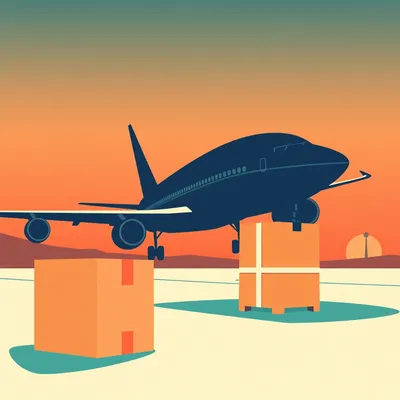
Daniel sent us this one — he's been thinking about the three separate worlds of freight. Air cargo uses ULDs, those curved aluminum containers you see on airport ramps. Sea freight runs on twenty-foot and forty-foot ISO boxes. Inland freight uses both but also standard pallets. His question is: if we could start from scratch, wouldn't it make sense to pick one standardized loading unit that works across all three modes? Something smaller than a twenty-foot container, big enough to aggregate cargo, but designed to slide from a truck straight into a plane and then onto a ship without ever being unpacked. Has anyone actually proposed a specific dimension set for this, or is the industry already moving toward some kind of multimodal bridge unit?

The beautiful thing about Daniel's question is it exposes the central absurdity right up front. A twenty-foot ISO container has about two thousand three hundred fifty cubic feet of internal volume. The entire cargo hold of a Boeing seven-thirty-seven dash eight hundred? About fifteen hundred cubic feet. So one container that we casually stack six high on a ship — that single box holds more volume than an entire passenger jet's belly. Yet we never, ever load that container onto a plane.
The box literally out-volumes the aircraft. That's not a metaphor. That's just geometry.
It's just geometry. And it's the perfect starting point because it forces the question — why did we build three completely incompatible systems, and is there any way out?
Let's start by understanding the three incompatible worlds we're dealing with.
World one is air freight ULDs — unit load devices. These come in a few standard base dimensions. The big one is the hundred twenty-five by ninety-six inch pallet, that's the P-one-P or P-six-P, used on a seven-forty-seven main deck. Then you've got the hundred twenty-five by eighty-eight inch PMC pallet for seven-six-seven and triple-seven lower decks. And the smaller hundred eight by eighty-eight inch PAG for A-three-thirty and A-three-forty lower decks. These are aluminum base plates with either a fiberglass shell or just netting over loose cargo. They're shaped to follow the curve of the fuselage.
World two is the ISO container. Twenty feet long, eight feet wide, eight and a half feet tall externally. Or the forty-foot version. Rectangular steel boxes with corner castings that lock into ship cell guides, truck chassis, and rail cars. This is the box that ate global trade.
World three is the inland pallet. In North America it's the GMA pallet — forty-eight by forty inches. In Europe it's the EUR-pallet — twelve hundred by eight hundred millimeters. These are wood or plastic platforms designed for forklifts and warehouse racking, not for stacking inside a ship hold or locking into an aircraft cargo system.
Every time cargo moves from one of these worlds to another, someone has to unload it, sort it, and reload it into a different box. Each touch adds labor cost, time, damage risk, and tracking complexity. The friction is baked in.
Here's the tension Daniel is pointing at. Bigger units — forty-foot containers — are incredible for consolidation efficiency. Fill one box, move it across an ocean, don't touch the contents. But they can't fit in planes. Smaller units — pallets — are genuinely multimodal. You can put a pallet on a truck, on a plane, on a ship. But they're too small for ocean freight economics. You'd need hundreds of them to equal one container, and they're not designed for the stacking forces in a ship hold.
There's this enormous gap. A twenty-foot container is about two thousand three hundred fifty cubic feet. A standard pallet loaded four feet high is about fifty cubic feet. The ratio is roughly forty-seven to one. There is no standardized unit in the two hundred to five hundred cubic foot range that works across all three modes.
Which brings us to the obvious follow-up — why can't we just make a smaller ISO container that fits in planes? And this is where the dimensional constraints get brutal.
To understand why we can't just pick one box, we need to look at the history and physics of each mode.
The ISO container was standardized in the nineteen fifties and sixties, driven by the US military and then commercialized by Malcom McLean. The eight-foot width was chosen to fit US highway regulations — trucks could carry an eight-foot-wide box without special permits. The eight-and-a-half-foot height was a compromise between internal volume and bridge clearances. The twenty-foot length became the base unit because it worked on truck chassis and rail cars. None of these decisions had anything to do with aircraft. Nobody was thinking about whether this box would fit through a curved fuselage door.
Because why would they? In nineteen fifty-six, air freight barely existed.
The first commercial jet freighter, the seven-oh-seven dash three-twenty-C, didn't fly until nineteen sixty-three. By then the ISO container was already spreading through global shipping. The standards were locked in before air freight was even a meaningful mode.
The container was optimized for ships and trucks, and aircraft designers went their own way. What did they optimize for?
Aircraft cargo doors are curved because the fuselage is a tube. The door isn't a rectangle — it's an arched opening. The maximum width of a lower-deck cargo door on a seven-six-seven is about a hundred and four inches. On a triple-seven it's similar. The main deck of a seven-forty-seven freighter can take a hundred twenty-five inches wide, which is why the big ULD pallets are hundred twenty-five by ninety-six. But the height is the real killer. Lower deck cargo doors max out at about sixty-six inches high on a seven-six-seven, maybe seventy inches on a triple-seven. A standard twenty-foot ISO container is a hundred and two inches tall. Even if you turned it on its side, it's ninety-six inches tall — still too tall for any lower deck door.
Width-wise, a twenty-foot container at ninety-six inches wide could theoretically squeeze through a hundred-four-inch door. But height-wise, it's impossible. And we haven't even talked about length.
Twenty feet is absurd for an aircraft loading system. The powered rollers and ball mats in a freighter are designed for ULDs that are typically ten to twenty feet long — but those ULDs are base plates, not rigid boxes. A twenty-foot rigid steel box would be nearly impossible to maneuver around the corner from the cargo door into the main deck position. The turning radius inside the aircraft simply doesn't accommodate it.
Then there's weight. A loaded twenty-foot container can weigh up to thirty thousand kilograms. Aircraft floor load limits are typically around seven hundred thirty kilograms per square meter for lower decks. A container that heavy would punch straight through.
The answer to "why can't we make a smaller ISO container that fits in planes" is — we can't, because the ISO container's defining features, its steel structure, its corner castings, its stacking strength, make it too heavy and too tall for aircraft. And if you make it light enough and short enough for an aircraft, it's no longer an ISO container capable of stacking nine high in a ship hold.
There's a missing middle problem here. And it's not just theoretical — someone actually tried to fill it.
The US military. During Operation Desert Storm, they experimented with something called the tri-wall container. This was essentially a heavy-duty corrugated box, roughly forty-eight by forty by thirty-six inches. The idea was to have a unit that could move from a warehouse onto a truck, onto a C-five or C-one-forty-one transport aircraft, and then onto a ship — all without being unpacked. It was multimodal in concept.
It worked well enough for a military logistics chain where the same organization controls every node. But it was never adopted commercially. The problem was handling equipment. Forklifts, pallet jacks, warehouse racking, truck restraints — none of the civilian infrastructure was set up for a forty-eight by forty by thirty-six inch box with no standardized corner fittings. The military could impose the standard on its own supply chain. The commercial world couldn't.
Which is a preview of the entire problem. The military can mandate a standard. Nobody else can.
That brings us to the most serious attempt at a commercial multimodal standard — the ISO one-C proposal from the nineteen nineties. This was a ten-foot by eight-foot by eight-foot container. Essentially half a twenty-foot container. The logic was that it would be small enough to fit in some aircraft, while still being compatible with existing container handling equipment — same corner castings, same twist locks, same cell guides if you stacked two of them.
Ten feet long is still too long for most aircraft lower decks. And eight feet tall — ninety-six inches — is still way too tall for a lower deck cargo door.
Correct on both counts. The one-C could theoretically fit on a seven-forty-seven main deck freighter, but those represent a tiny fraction of air cargo capacity. Most air freight moves in the lower decks of passenger aircraft — what the industry calls belly cargo. And the one-C couldn't fit there at all. So it was too small for ocean economics — you'd need twice as many units to equal a twenty-foot container, doubling your handling costs — and it was too large for the vast majority of aircraft. It satisfied no one.
The Goldilocks container that was too big and too small simultaneously.
That's the perfect summary. And it died quietly. Nobody builds one-C containers. They exist only in ISO standards documents.
Given all those constraints, you'd think someone would have tried to build a bridge. And they have — just not the one you'd expect.
The most interesting development isn't a new container size. It's the ULD-pallet hybrid. Some logistics companies are experimenting with what they call air-land pallets — essentially a reinforced pallet with a sixty by forty-eight inch footprint, which fits both aircraft ULD base dimensions and standard truck trailer decks. These have aircraft-grade corner fittings so they can lock into a ULD loading system, but they're flat enough to slide into a standard truck.
Sixty by forty-eight inches. So that's five feet by four feet. About the footprint of a small dining table.
Here's the tradeoff. That unit has about forty percent of the volume of a twenty-foot container. So to move the same amount of cargo, you need roughly two and a half times as many units. More handling, more tracking, more lashing, more individual movements. But — and this is the crucial but — you eliminate the cross-dock transfer entirely for shipments going air-to-truck or truck-to-air. The unit that gets loaded onto the truck at the factory is the same unit that gets loaded onto the plane, and then onto another truck at the destination.
The question becomes — does the elimination of transfer touches outweigh the inefficiency of moving more, smaller units?
The answer is: it depends entirely on the supply chain. For high-value, time-sensitive goods — pharmaceuticals, electronics, aerospace parts — the transfer touches are expensive and risky. Every time you open a container and repack cargo, you introduce the possibility of damage, theft, temperature excursion, or misrouting. For those goods, the air-land pallet makes enormous sense. For bulk commodities like furniture or textiles moving on a slow boat, the consolidation efficiency of a forty-foot container still wins.
Here's the thing. Even if the air-land pallet is the perfect solution for certain supply chains, it runs into the same problem the one-C ran into. The network effects problem.
This is the real answer to Daniel's question. Even if a perfect multimodal unit existed — perfectly dimensioned, perfectly light, perfectly strong — the entire global infrastructure is built around the existing standards. Ship cell guides are spaced for eight-foot-wide containers. Truck trailers have twist locks positioned for twenty-foot and forty-foot boxes. Aircraft cargo loading systems are designed for specific ULD base dimensions. Warehouse racking is built for GMA or EUR pallets. Port cranes, reach stackers, straddle carriers — all of it is locked in.
The switching cost?
The estimate to retrofit just the global container ship fleet is fifty to a hundred billion dollars. That's before you touch port infrastructure, truck chassis, warehouse racking, or aircraft loading systems. The total cost of a global standard change would be in the hundreds of billions, spread across thousands of independent companies who have no incentive to coordinate.
We're locked in. But that doesn't mean nothing is happening. The industry is already moving — just not toward a single global standard.
The real convergence is happening inside integrated carrier networks. FedEx, UPS, DHL — these companies control their own aircraft, their own trucks, their own sorting hubs. They can impose internal standards that work across their own modes without needing anyone else to agree.
FedEx is the clearest example.
FedEx operates a proprietary hundred twenty-five by ninety-six inch base plate that works on their MD-eleven freighter fleet and their over-the-road trailers. It's essentially a ULD pallet that can also lock onto a truck chassis. But it doesn't work on passenger aircraft — so they can't use it on the commercial flights they also book cargo on. And it doesn't work on competitor networks. It's a walled garden.
Which is efficient within the garden and useless outside it.
And this is the trend — fragmentation, not unification. Each major integrator is building its own optimized system. Amazon is doing the same thing with its air fleet and delivery network. The future isn't one box to rule them all. It's multiple proprietary ecosystems that don't talk to each other.
Which brings us to the most interesting proposal I've seen — and it's not a box at all. There's been a concept floated in academic logistics journals called the MULTI-box, roughly ninety-six by sixty by sixty inches. That's eight feet by five feet by five feet. About three hundred cubic feet. It would fit in a seven-forty-seven main deck, and it's small enough to double-stack in a truck trailer.
It's an elegant dimension set. But it's never been prototyped. And the reason gets back to the network effects problem. Who pays for the first MULTI-box? Who builds the handling equipment for it? No single company has enough market power to force adoption, and no consortium of companies has enough alignment to agree on a standard.
The shipping container was invented by the US military because they had the authority to impose a standard. No single commercial entity has that power today.
That's the bookend. The ISO container exists because a single actor — the US Department of Defense — said "this is the box we're using" and had enough procurement power to make it happen. Today, global logistics is too fragmented for anyone to do that. Even Amazon, with all its scale, can only optimize its own network. It can't force Maersk or CMA CGM to change their ship designs.
Where does that leave us? If a single standard is off the table, what can actually be done?
The most realistic path isn't a universal container. It's what I'd call intermodal pallets — standardized corner castings on a pallet-sized unit that can lock into ULD plates, truck decks, and ship cell guides. Think of it as a universal adapter, not a universal container. You're not replacing the twenty-foot box. You're creating a smaller unit that can interface with all three systems without requiring any of them to change.
The pallet itself becomes the multimodal unit, but with aircraft-grade locking hardware.
And the economics are interesting. For a logistics professional, the ROI of switching to a proprietary multimodal unit only makes sense if you control the entire supply chain — like FedEx does. For most shippers, the better strategy is to optimize for the bottleneck mode, which is usually air, and accept the transfer costs at the other end. If your goods are flying, the air ULD is the constraint. Design your packaging and palletization around that, and the truck and ship transfers are just a cost of doing business.
There's another angle here that I think gets overlooked. The next frontier isn't hardware — it's software.
Digital load planning and real-time container tracking can reduce transfer friction more cost-effectively than physical standardization. If you know exactly where every item is, exactly what container it's in, exactly when that container will arrive at the transfer point, and exactly which outbound unit it needs to go into — you can orchestrate the transfer with minimal delay and minimal handling. The multimodal unit of the future might be a data standard, not a box.
That's a provocative idea. Instead of making the physical boxes compatible, you make the information layer so good that the physical incompatibility doesn't matter as much.
You still have to physically move the goods. But if the system knows that pallet number seven-four-two needs to go from ULD A-K-four to container M-S-K-U-six-two-three, and the forklift operator gets that instruction the moment the ULD is unloaded, and the container is positioned and waiting — the transfer happens in minutes instead of hours. The friction doesn't disappear, but it shrinks dramatically.
We're already seeing this. The digital twins of supply chains are getting more sophisticated. Companies like Project Forty-four and Four Kites are building real-time visibility platforms. The container itself becomes less important than the data attached to it.
Which brings us to the question nobody's answered yet — and it might change everything.
What happens when the vehicles themselves change? If autonomous trucks and drone delivery become widespread, the dimensional constraints change entirely. A drone doesn't need a standard pallet. An autonomous truck doesn't need a human-sized cargo door. The entire logic of standardized loading units was built around human operators, human drivers, human cargo handlers. If you remove the human from the equation, do you still need the forty-eight by forty inch pallet?
That's the open question that should keep logistics planners up at night. If your delivery vehicle is an autonomous electric pod that's eight feet long and four feet wide, what's the optimal loading unit? It's probably not a twenty-foot ISO container. It's probably not a GMA pallet either. It might be something we haven't even designed yet.
That's where I think Daniel's question ultimately lands. We're stuck with three incompatible boxes because the standards were locked in during an era of human-operated vehicles and human-designed supply chains. The next era might break all of that open.
The shipping container was a military invention imposed by a single powerful actor. The ULD was an aerospace invention optimized for curved aluminum tubes. The pallet was a warehouse invention optimized for forklifts. None of them were designed to talk to each other. And no one has the authority to force them to.
We live in a world of three boxes. Not because it's optimal, but because it's path-dependent. And the most realistic path forward isn't a fourth box — it's better software, proprietary integration within carrier networks, and a long-term bet that autonomous vehicles will eventually make the whole question obsolete.
Which is a satisfyingly weird answer to a weird prompt.
Now: Hilbert's daily fun fact.

In the early fifteen hundreds, the Songhai Empire in what is now Niger controlled trade routes that passed near the oasis of Timia, where natural springs emerge from a volcanic aquifer system — and chemical analysis of those waters shows unusually high concentrations of lithium, likely leached from the surrounding granite over thousands of years.
Lithium springs in sixteenth-century Niger. Not where I thought that was going.
The one thing I keep coming back to — we've spent this whole episode talking about boxes that don't fit, and the real solution might be making the boxes irrelevant. If the tracking is good enough and the transfers are fast enough, who cares what shape the container is?
If autonomous vehicles reset the dimensional constraints entirely, the whole debate about ULD versus ISO versus pallet becomes a historical curiosity. The next standard won't be designed around a truck driver or a cargo loader. It'll be designed around a robot.
This has been My Weird Prompts. Thanks to our producer Hilbert Flumingtop. If you enjoyed this episode, tell a friend who's ever stared at a shipping container and wondered why it doesn't fit on a plane. We're at my weird prompts dot com.
See you next time.