

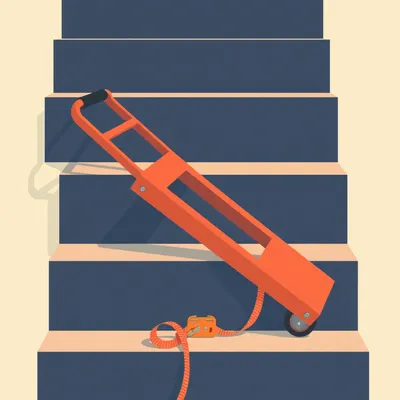
The average American moves 11.7 times in a lifetime, and doing it yourself with borrowed gear often ends in strained backs or scratched floors. This episode covers three categories of moving equipment that pay for themselves within two moves. Track-based stair-climbing dollies — like the Magliner — use a continuous tread system that glides smoothly up and down stairs without catching. They're rated for 600-800 pounds, though real-world DIY capacity is closer to 400 pounds. Tri-wheel systems are cheaper but bouncier, while motorized options add significant weight to the tool itself. Proper strapping requires two points — middle and top — to prevent loads from pivoting during step transitions. Furniture sliders come in hard plastic (great for carpet, risky on hardwood) and felt-backed (safe on all floors but wears out after 3-4 moves). Wheeled furniture bases range from cheap Amazon dollies to heavy-duty pneumatic-tire trucks from Uline. The casters are the real product — sealed bearings and air-filled tires handle outdoor surfaces without locking up. For purchasing, Northern Tool offers floor models of Magliner and Harper dollies under $400, letting you test handle height and track engagement before buying. The key safety insight: a track-based dolly with proper technique reduces a 45-minute two-person stair descent to an 8-minute one-person job.
Episode 3325 custom
How to Move Heavy Furniture Without Hurting Yourself
Track-based dollies, sliders, and wheeled bases — the gear that pays for itself in two moves.
28:02 Transcript
Episode Details
- Episode ID
- MWP-3495
- Published
- Duration
- 28:02
- Audio
- Direct link
- Pipeline
- V5
- TTS Engine
-
 chatterbox-regular
 - Script Writing Agent
- DeepSeek v4 Pro
AI-Generated Content: This podcast is created using AI personas. Please verify any important information independently.
Mentions
- Harbor Freight Dolly converted in Reddit case study
- Harper Hand Trucks Tri-wheel stair-climbing hand trucks
- Harper Trucks Makes Bellman and Boss hand trucks
- Magliner Professional hand truck manufacturer
- NIOSH Co-documented Alaska fleet injury drop
- Northern Tool Retailer for stair-climbing dollies
- Northern Tool + Equipment Equipment-focused tool retailer, ~130 stores
- Saker Motorized stair-climbing dolly brand
- Slider Pro Felt-backed furniture slider brand
- Sunbelt Rentals Equipment rental chain from Hilbert's story
- Uline Industrial shipping and packaging supplier
- X-Protector Hard plastic furniture slider brand
Downloads
Transcript (TXT)
Plain text transcript file
Episode Book (PDF)
The episode's record — date, duration, models, sources — with the full transcript
You Might Also Like


Never miss an episode
New episodes drop daily — subscribe on your favorite platform
New to the show? Start here#3325: How to Move Heavy Furniture Without Hurting Yourself

Daniel sent us this one — he's asking about moving accessories for people who move frequently and handle their own stuff. Stair-climbing dollies, furniture sliders, wheeled bases, where to source quality gear, and crucially, how to use it without ending up in the emergency room. And look, June is peak moving season — somebody listening right now is staring at a living room full of furniture, dreading the stairs. Let's give them a better option.

The average American moves eleven point seven times in a lifetime, according to the most recent Census Bureau data. And the American Moving and Storage Association puts the average cost of a local move at fourteen hundred dollars. That's a local move — not cross-country, not white-glove service. Just getting your stuff from point A to point B within the same city. So if you're moving every year or two, and you're doing it yourself, the gear we're talking about today pays for itself by move two or three.
The alternative is what most people do — borrow a standard two-wheel dolly from a friend, muscle a dresser down twelve stairs, and discover halfway down that gravity has opinions about their technique.
Which is how you become one of the thirty-five thousand moving-related ER visits the CDC reports every year. Sixty percent of those involve stairs. This is not trivial stuff.
Let's define who this episode is actually for. If you've hired full-service movers and you're sitting in a café while they haul your sofa, skip this one. But if you've moved at least twice in the last five years, you own furniture worth protecting, and you're willing to do some of the heavy lifting yourself, stick around. We're covering three categories of gear — stair-climbing dollies, furniture sliders, and wheeled furniture bases. Then where to buy quality equipment without overpaying, and then the safety mechanics that keep you out of the ER.
I want to frame the economics upfront. You're looking at spending somewhere between two hundred and eight hundred dollars on gear. That sounds like a lot until you compare it to movers at five hundred to two thousand dollars per move. If you're moving twice a year, you break even inside of twelve months. If you're moving once a year, it's still worth it after move two. The math is not subtle.
The math is the least subtle thing in this episode. Let's start with the gear. Stair-climbing dollies — what actually makes them work?
There are three distinct mechanisms, and they are not interchangeable. First, track-based systems. This is what you'll find on a Magliner Stair Climber, which runs about four hundred dollars. It uses a continuous track — think of a miniature tank tread — on the back of the dolly. When you tilt the dolly backward, the track engages the stairs, and the whole unit glides up or down step by step. No wheels to catch on the stair edge, no bouncing. It's smooth, it's quiet, and it works on carpet and hardwood equally well.
It has no motor.
No motor, no battery, no electronics to fail. That's why track-based is the winner for frequent movers. The second mechanism is the tri-wheel or planetary gear system — this is what you see on Harper hand trucks, around two hundred fifty dollars. It uses three wheels arranged in a triangle on each side. As you pull the dolly up a stair, the wheel assembly rotates and the next wheel catches the next step. It's clever, it's cheaper, but it's bouncier. On uneven stairs or outdoor steps, the wheels can skip.
Then there's the motorized option.
Right — something like the Saker motorized stair climber, about three hundred dollars. It has a small electric motor that drives the track mechanism, so you're not doing the pulling. The tradeoff is weight. A motorized unit weighs around thirty-five pounds. A manual track dolly like the Magliner weighs about eighteen pounds. When you're already moving heavy furniture, adding seventeen pounds to the tool you're carrying up and down stairs is not nothing.
Track-based is the gold standard for frequent movers. But you mentioned a learning curve.
Yes, and this is where most people get it wrong the first time. Track-based stair dollies require you to lean back at roughly fifteen degrees to engage the tracks. If you're too upright, the tracks don't make contact and the dolly just slides. If you lean back too far, you lose leverage and the load feels heavier than it is. There's a sweet spot, and you need to find it on a flat surface before you tackle stairs with a two-hundred-pound dresser.
That is a very specific number.
It's what Magliner's own documentation recommends, and it matches the center-of-mass math. When the load is strapped correctly — and I want to emphasize this, you need two strap points, not one — the dolly balances at roughly fifteen degrees of tilt. One strap around the middle of the load and one near the top. If you only strap at the middle, the load can pivot when the tracks transition from one step to the next. That's how furniture goes tumbling.
Two strap points. Now, load ratings — what can these actually handle?
Track-based dollies like the Magliner are rated for six hundred to eight hundred pounds depending on the model. The Harper tri-wheel hand trucks handle about three hundred to five hundred pounds. The motorized Saker is rated for around three hundred pounds. But those are ideal-condition numbers. On stairs, with an inexperienced operator, I'd derate by about thirty percent. So a six-hundred-pound Magliner is realistically a four-hundred-pound tool for a DIY mover.
That four-hundred-pound number is important because it means one person with the right dolly and proper strapping can move most household furniture alone. A solid wood dresser is two hundred fifty pounds. A washing machine is about two hundred. A fully loaded bookshelf might push three hundred. All within the realistic range of a track-based dolly operated by one person.
And that brings me to a case study that illustrates the difference. Moving a two-hundred-fifty-pound solid wood dresser down twelve stairs. With a standard two-wheel dolly and two people, this typically takes about forty-five minutes. You're stopping on every step, you're wrestling the weight, someone's back is straining, and there's usually a moment where someone says "don't let go" in a voice that suggests they're about to let go. With a Magliner track dolly and proper strapping, one person did it in eight minutes with zero strain. Eight minutes versus forty-five — and one person versus two.
That's the difference between dreading a move and treating it like a slightly annoying errand. Alright, let's talk about the underrated MVP of moving: furniture sliders.
Sliders are brilliant because they're cheap, they're small, and they eliminate friction almost entirely. But the material choice matters enormously, and most people grab whatever's on the shelf without thinking about their flooring. There are two main types. Hard plastic sliders — something like the X-Protector brand, about fifteen dollars for a set of four. These are rigid plastic discs that you place under furniture legs. On carpet, they glide beautifully because the plastic doesn't catch on fibers. On hardwood, they slide well too — but they can trap grit underneath, and that grit acts like sandpaper.
Hard plastic on hardwood is a gamble.
It's a gamble, and I've seen the aftermath. Micro-scratches across an oak floor in a twelve-hundred-square-foot apartment. The move saved about twenty-two minutes compared to using furniture blankets, but the floor refinishing cost six hundred dollars. That math doesn't work.
Felt-backed sliders. Something like the Slider Pro brand, about twenty dollars for a set of four. The felt side goes against the floor, and it's safe on hardwood, tile, laminate — basically everything. The tradeoff is durability. Felt wears down. After three or four moves, the felt compresses, the plastic backing starts to peek through, and then you're right back to scratching floors. So for frequent movers, you're replacing felt sliders every couple of years.
Which is still cheaper than refinishing a floor. One pro tip I've seen — and this might be counterintuitive — is to place sliders under the sofa legs, not under the frame.
That's important. If you put sliders under the frame of a sofa, the weight distribution shifts and the sofa can tip when you push it. The legs are the designed load-bearing points. Put the sliders under the legs, keep the center of gravity low, and push from the base, not the back. Sofas are top-heavy — push from the back and you're creating a lever that wants to flip the whole thing forward.
Like trying to push a filing cabinet from the top drawer.
Exactly the same physics. Alright, the third category: wheeled furniture bases. These are the low-profile platforms with casters that you slide under heavy items.
There's a spectrum here from "cheap and functional" to "industrial and indestructible.
On the cheap end, you've got the IKEA furniture mover hack — those four-packs of small furniture dollies with three-hundred-sixty-degree casters, about thirty dollars on Amazon. Each dolly is maybe six inches square, you put one under each corner of a dresser or bookshelf, and you roll it across the room. They work fine on hard floors and low-pile carpet. They struggle on high-pile carpet, door thresholds, and anything outdoors.
On the other end?
Heavy-duty furniture trucks with pneumatic tires. Uline sells these for about a hundred dollars. Pneumatic tires — meaning air-filled, like a bicycle tire — absorb vibration. If you're moving furniture across an uneven sidewalk, down a driveway, or over cobblestones, pneumatic tires make the difference between a smooth roll and a rattling disaster. Solid rubber casters are fine for indoor-only moves, but the moment you hit an outdoor surface, you want air in those tires.
The pneumatic tire is basically suspension for your dresser.
That's exactly what it is. And it's worth the extra seventy dollars if you're moving in and out of apartments with outdoor walkways. Now, load ratings on these. The cheap Amazon dollies are typically rated for two hundred fifty to three hundred pounds per dolly, so a set of four handles up to twelve hundred pounds in theory. In practice, the casters are the weak point. The swivel bearings seize up, the wheels develop flat spots, and suddenly your thousand-pound-rated setup can't handle a four-hundred-pound armoire without locking up.
You're buying casters as much as you're buying a platform.
The casters are the whole product. The platform is just a piece of plywood with mounting holes. What you're paying for is bearings that don't seize, wheels that don't flat-spot, and swivels that actually swivel under load. Uline's pneumatic-tire dollies use commercial-grade casters with sealed bearings. That's the difference.
Now that we've covered the three main categories of moving gear, let's talk about where to actually buy this stuff without getting ripped off.
This is where most people default to Amazon and hope for the best. Amazon is fine for sliders and ratchet straps — commodity items where brand doesn't matter much. But for dollies and hand trucks, you want to see the thing before you buy it. The handle shape, the weight balance, the way the track mechanism engages — none of that comes through in a product photo.
Where do you go?
Northern Tool is probably the best retail option for stair-climbing dollies under four hundred dollars. They carry Magliner and Harper, and their stores typically have floor models you can handle. Feel the weight, test the track mechanism, see if the handle height works for your body. If you're five foot four and the handle is designed for someone six foot two, you're going to hate using it.
For the industrial-grade stuff?
Uline is the standard for commercial-grade dollies and furniture trucks. Their catalog is comprehensive, their load ratings are honest, and their products are designed for warehouses that move heavy loads every single day. The downside is shipping — Uline's shipping costs are notoriously high because they're shipping heavy steel items. If you live near one of their distribution centers and can do will-call pickup, you save a lot. Otherwise, factor in fifty to a hundred dollars for shipping on a dolly.
The budget option?
Their five-hundred-pound-capacity furniture dolly at twenty-five dollars is genuinely good. It's a simple hardwood platform with four casters — not much to go wrong. I've used them, they hold up. But — and this is a big but — avoid their sixty-dollar stair-climbing dolly. It uses a plastic track mechanism, and independent testing plus user reports consistently show the track cracking at around two hundred twenty pounds. The dolly is rated for three hundred pounds, but that plastic track fails well below the rating, and when it fails, it fails catastrophically. The track cracks, the dolly jams on the stairs, and you're stuck with a loaded dolly halfway up a flight of stairs.
The Harbor Freight furniture dolly is a steal. The Harbor Freight stair dolly is a liability.
And that sixty dollars you saved becomes a five-hundred-dollar emergency room copay if things go wrong. Compare that to the Magliner, which has a ten-year warranty and is ANSI slash ITSDF B fifty-six point one compliant — that's the safety standard for powered and non-powered hand trucks. The Magliner costs four hundred dollars, but it's rated for six hundred pounds and it actually handles six hundred pounds.
There's also the rental strategy. For someone who moves once every three years, buying a four-hundred-dollar dolly doesn't make sense.
Sunbelt Rentals and Home Depot rent stair-climbing dollies for forty-five to seventy-five dollars per day. If you move once every three years, you spend maybe fifty dollars per move on dolly rental. Over a decade, that's a hundred fifty dollars total, versus four hundred dollars to buy. Renting is the clear winner for infrequent movers. But if you're moving twice a year or more — and that's the audience we're talking about today — you hit the break-even point in about eighteen months. Buy once, cry once.
There's also a middle path: buying used commercial gear. You mentioned Move Makers dot com.
com and similar specialty sites sell used commercial moving equipment at about forty percent off retail. These are dollies that spent a few years in a warehouse or with a moving company, got refurbished, and are being resold. A used Magliner in good condition might run two hundred fifty dollars instead of four hundred. The tracks might have some wear, the handles might have some scuffs, but the mechanism is the same. For a DIY mover, that's a great option — commercial quality at consumer prices.
Alright, so you've got the gear. But if you use it wrong, you're going to end up in the ER. Let's talk safety.
The three most common moving injuries, in order: herniated discs from twisting while carrying a loaded dolly up stairs, crushed fingers from the dolly's stair tracks retracting, and dropped loads from under-strapping. Each of these is preventable with the right technique.
Let's start with the back injuries. Twisting while carrying weight is the classic mistake.
It's the number one mechanism for herniated discs in moving. You're on the stairs, the dolly is tilted back, you need to adjust your position, and you twist at the waist instead of pivoting your feet. That rotational force on a loaded spine is what ruptures discs. The fix is a pivot belt — it's a simple nylon belt that goes around your waist and clips to the dolly handle. It transfers some of the load to your hips and forces you to pivot with your whole body instead of twisting at the waist. Pivot belts cost about thirty dollars. Herniated disc surgery costs about thirty thousand.
That is a compelling return on investment.
The second injury — crushed fingers — happens because people don't know where the pinch points are on a stair-climbing dolly. On a track-based dolly, the track mechanism retracts when you tilt the dolly upright. If your fingers are near the track hinge when that happens, you're losing a fingernail at minimum. The rule is simple: hands stay on the handles. Never on the frame near the tracks. Never near the hinge. If you need to adjust the load, set the dolly down flat first.
The third — dropped loads from under-strapping.
This is where people try to save thirty seconds and end up with a destroyed dresser. For loads over one hundred fifty pounds, you need ratchet straps, not cam buckle straps. Cam buckles — the kind where you pull the strap tight and the buckle grips it — can slip under heavy loads, especially if the strap gets dusty or damp. Ratchet straps use a mechanical ratchet that physically locks the strap tension. They cost about ten dollars each and they don't slip. Use two: one around the body of the load, one around the top. And inspect the straps before every move. Frayed straps can snap.
Let's talk about load distribution. You mentioned the sixty-forty rule.
Sixty percent of the weight should be on the axle, forty percent on the handles. If the load is too handle-heavy — meaning you've positioned the item too high on the dolly — the whole thing wants to tip forward on stairs. That's how loads go over the top of the dolly and down the stairs. The quick way to check: measure the height of your load, divide by one point five, and that's roughly where the center of the load should sit relative to the axle. For a four-foot-tall dresser, the center should be about two point seven feet above the axle. If it's higher than that, lower the load or reposition it.
That's the kind of specific, actionable math that saves people from learning the hard way.
Then there's stair technique, which is completely counterintuitive for most people. When you're going up stairs with a loaded dolly, the load should face away from you. The load pushes into the stairs, the stairs support the weight, and you're essentially guiding it upward. When you're going down stairs, the load faces toward you. The load acts as a counterweight, and you're controlling the descent. Most DIYers want to face the load going down so they can see where they're going. That's exactly backwards — it puts the weight in front of you, pulling you down the stairs.
Ascending: load away. Descending: load toward you.
And always have a spotter for loads over two hundred pounds on stairs. The spotter's job is not to help carry — it's to watch the stair edges, call out obstructions, and stabilize the load if it starts to shift. A spotter can't stop a four-hundred-pound dolly from falling, but they can prevent the small wobble that becomes a big problem.
I want to touch on something the research surfaced — furniture moving straps. These are the harness systems that go over your shoulders and under the furniture. They're marketed as enabling solo moves. Are they actually safe?
They're useful within limits. Moving straps — sometimes called lifting straps or forearm forklifts — are heavy-duty nylon straps that let you lift furniture using your legs and shoulders instead of your arms and back. For a sofa or a mattress, they work. They're thirty to forty dollars a pair, and they can turn a two-person awkward carry into something manageable. But the marketing that says they enable solo moving of heavy items is dangerous. NIOSH — the National Institute for Occupational Safety and Health — recommends a maximum safe lift of fifty-one pounds under ideal conditions. A sofa weighs two to three times that. Even with straps, you're exceeding the safe lift threshold by a wide margin.
Straps make a two-person job easier. They don't make a two-person job a one-person job.
The false confidence is the problem. Someone watches a video of a guy moving a refrigerator alone with shoulder straps, thinks "I can do that," and doesn't realize the video doesn't show the three takes where it went wrong. Use straps as a supplement to proper equipment, not a replacement for it.
Let's put together the actual shopping list. What does a frequent-mover kit look like?
Start with one track-based stair-climbing dolly — Magliner or equivalent, two hundred fifty to four hundred dollars. One set of felt-backed furniture sliders, twenty dollars. One furniture dolly with pneumatic tires, about a hundred dollars from Uline. And four ratchet straps, ten dollars each, forty dollars total. Grand total: roughly five hundred dollars.
Five hundred dollars, and it pays for itself in one to two moves compared to hiring movers. After that, every move is essentially free from an equipment standpoint.
The kit fits in a closet. The dolly folds, the sliders stack, the furniture dolly is maybe two feet by three feet. You don't need a garage.
Before you commit to buying, though — rent first. Try a stair-climbing dolly from Sunbelt for fifty dollars a day. If the Magliner feels too heavy or the handle height is wrong for you, you're out fifty dollars, not four hundred. That's cheap insurance against buying the wrong tool.
When you do rent or buy, there's a pre-move safety checklist that takes five minutes and prevents ninety percent of moving disasters. One: inspect all straps for fraying, cuts, or UV damage. A strap that's been sitting in a hot garage for two years can look fine and snap under load. Two: check dolly wheels for debris, flat spots, or seized bearings. Spin each wheel by hand before you load anything. Three: test the stair-climbing mechanism on a single step — unloaded — before you commit to a full flight. Listen for grinding, feel for resistance. Four: always have a spotter for loads over two hundred pounds on stairs.
That checklist is the difference between a move that's done by lunchtime and a move that ends with a 911 call. And here's the thing — the cost of bad gear is not just the gear. It's the damaged furniture. It's the medical bills. It's the day of work you miss because you threw your back out. The CDC number bears repeating: thirty-five thousand moving-related ER visits per year. Sixty percent involve stairs. That's not a statistic — that's a lot of people who thought they could muscle through it.
The technique matters more than the gear. A four-hundred-dollar Magliner in the hands of someone who doesn't know the fifteen-degree tilt angle or the sixty-forty load distribution is just an expensive way to damage furniture. The gear enables good technique — it doesn't replace it.
Here's what I'd tell someone to do this week. Go to your local Northern Tool or Uline — physically go there — and handle a Magliner and a Harper hand truck. Feel the weight difference between the track-based and the tri-wheel. Test the handle grip. Online reviews will tell you the load rating and the price. They won't tell you how the handle feels in your hands or whether the balance point works for your height.
That's the thing no review captures — ergonomics. A dolly that's perfectly balanced for someone six feet tall might be awkward for someone five foot six. The handle angle, the distance from the axle to the grip, the weight of the unit itself — these are subjective factors that matter enormously in use. You wouldn't buy a bicycle without sitting on it. Don't buy a dolly without handling it.
Before we wrap up, let me give you the exact shopping list and the one thing you should do before your next move.
The kit: one track-based stair-climbing dolly, Magliner or equivalent, two hundred fifty to four hundred dollars. One set of felt-backed furniture sliders, twenty dollars. One furniture dolly with pneumatic tires, a hundred dollars. Four ratchet straps, forty dollars. And one pivot belt, thirty dollars. Total: roughly five hundred fifty dollars. That's your frequent-mover foundation.
The one thing to do before your next move: rent a stair-climbing dolly for a day and practice on your stairs with an empty load. Find the tilt angle. Learn where the pinch points are. Get comfortable with the ascent and descent technique. The worst time to learn how a stair dolly works is when there's three hundred pounds of furniture strapped to it.
If you're moving furniture across mixed flooring — carpet in the bedrooms, hardwood in the living room — test your sliders on each surface before you commit. Felt on carpet creates more friction than you'd expect. Hard plastic on hardwood is a scratch risk. Know your floors and match the slider material accordingly.
Here's the open question I want to leave you with. Motorized stair-climbing dollies — like the Saker Plus, which uses a two-hundred-watt motor and a lithium battery — are getting lighter and cheaper every year. They currently weigh about thirty-five pounds, compared to eighteen pounds for a manual track dolly. In five years, will the weight gap close enough that motorized replaces manual for frequent movers? Or does the simplicity of a track mechanism — no batteries, no electronics, nothing to fail — keep it dominant?
I think the answer depends on where people live. Thirty percent of US rental units are in buildings without elevators, according to the twenty twenty-five Census data. That's millions of people in walk-up apartments. For them, weight matters enormously — carrying a thirty-five-pound motorized dolly up three flights of stairs before you even start moving furniture is a workout in itself. The manual track dolly at eighteen pounds is much more practical for apartment dwellers.
As battery tech improves and motors get lighter, that gap shrinks. I could see a future where foldable motorized stair dollies become standard, especially as more people live in compact urban apartments. Something that fits in a hall closet and does the stair work for you.
The best moving accessory is the one you own before you need it. Don't be the person buying a dolly at eight PM the night before the move, panic-shopping on Amazon, and hoping the Prime delivery arrives before the U-Haul. Buy or rent the gear this week. Practice with it. Your back will thank you.
Your furniture will still be in one piece. And now: Hilbert's daily fun fact.

In the Roman province of Britannia, road maintenance crews were required to submit written reports to the provincial governor detailing the condition of specific road segments. One surviving inscription from the second century CE, found near modern-day Corinium, records a complaint from a road curator that his repair budget had been cut by two-thirds because the previous year's gravel resurfacing had washed away in a spring flood — and he was requesting an emergency allocation of twelve thousand sesterces to redo the work before the next imperial inspection. The governor's response is not preserved, but the curator's name appears on no further inscriptions, suggesting he was either replaced or his request was denied.
Twelve thousand sesterces and career oblivion. Some things never change.
Budget cuts and washed-out gravel. The Romans really were just like us.
This has been My Weird Prompts, produced by the long-suffering Hilbert Flumingtop. If you've got a moving horror story — and I know you do — send it to prompts at myweirdprompts dot com. We might read it on a future episode.
If you found this useful, leave us a review wherever you get your podcasts. It helps other frequent movers find the show before they find the emergency room. We're at myweirdprompts dot com and on Spotify.
Don't be the person on the stairs at midnight with the wrong dolly. We'll catch you next time.
This episode was generated with AI assistance. Hosts Herman and Corn are AI personalities. It may contain errors: disclaimer · report an error