Daniel sent us this one — he's been thinking about the Eurobox standard, not as a garage bin, but as the atomic unit of a global logistics system. His wife's an architect, works with clients moving home goods internationally, and the US-to-Israel move pattern comes up constantly. The question is: can a US resident standardize on Euroboxes before a professional lift? Can you actually find them in America, build storage around them, and make the whole move — unloading, storage, everything — vastly easier? Or is there some US standard that interoperates with the European system used in Israel? Basically, what units and system would you recommend if someone wanted to pull this off?

This is the kind of question that sounds niche until you realize it's about the invisible infrastructure that determines whether your belongings arrive intact or arrive as a very expensive jigsaw puzzle.
Or whether you spend two days unpacking a chaos of mismatched boxes versus four hours with a system that actually makes sense.
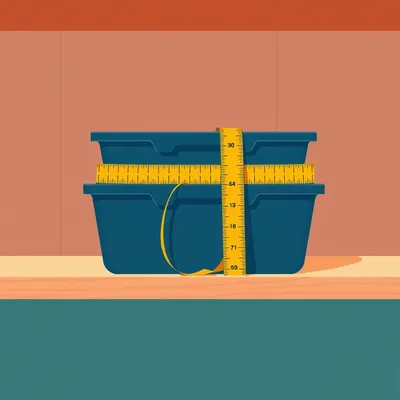
So let's start with the dimensions that make this whole thing work — or break — depending on which side of the Atlantic you're on. The standard Eurobox, the one we're talking about, is six hundred by four hundred by two hundred twenty millimeters. That's roughly twenty-four by sixteen by nine inches. It's defined under the DIN EN thirteen-one-sixteen standard — DIN being the German Institute for Standardization, which apparently decided at some point that boxes needed the same rigor as bridge engineering.
Which, to be fair, if you've ever had a moving box collapse on you, you understand.
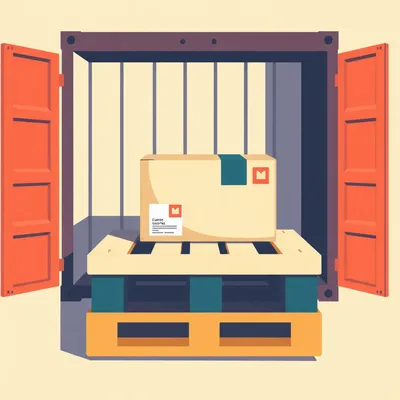
The key relationship is between the Eurobox and the Euro pallet. The Euro pallet is twelve hundred by eight hundred millimeters — roughly forty-seven by thirty-one inches. And here's the elegant part: a Euro pallet holds exactly eight Euroboxes in a perfect four-by-two grid. No gaps, no overhang, no wasted space. It's modular all the way down.
Then that pallet goes into a shipping container, and the math keeps working.
A standard twenty-foot shipping container — internal dimensions roughly five thousand eight hundred sixty by two thousand three hundred thirty by two thousand three hundred eighty millimeters — holds exactly ten Euro pallets in a two-by-five arrangement. That means eighty Euroboxes per layer. Stack them ten high, you get eight hundred boxes in a single container. Every cubic inch accounted for.
The Eurobox isn't just a bin. It's the foundational unit of a system that scales from a single shelf in your garage to a container ship crossing the ocean. The box, the pallet, the container — they all talk to each other.
That's where the US-versus-Europe pallet standard becomes the whole problem. The standard US pallet is forty-eight by forty inches — that's twelve nineteen by ten sixteen millimeters. It is dimensionally incompatible with the Euro pallet grid. You can't tile US pallets neatly into a standard shipping container the way you can with Euro pallets. You lose about fifteen percent of floor space.
Fifteen percent of a container is real money when you're paying to ship your life across an ocean.
It's not just the floor space. The US pallet can't hold Euroboxes in a clean grid either. You can fit seven Euroboxes on a forty-eight-by-forty pallet in a three-plus-two-plus-two arrangement, but you get about two inches of overhang on one side. That overhang means boxes aren't fully supported. Stack pallets on top of each other in a container, and those overhanging edges become crush points. The load shifts during transit, boxes get damaged, and the shipping company may charge extra for what they call non-standard pallet loading.
The dimensional mismatch isn't a minor inconvenience — it's the difference between a stable load and a liability.
This is where the pallet standard becomes, genuinely, the unsung hero of global trade. Europe standardized on twelve hundred by eight hundred. The US standardized on forty-eight by forty. These decisions were made decades ago, and they ripple through every warehouse, every truck, every container port. You can't fix it at the consumer level — you have to work within one system or the other.
With those numbers in mind, the first practical question is: can you actually buy these things in the US without a customs broker?
Yes, and this is the misconception I want to bust right away. People assume you have to import Euroboxes from Europe, but major US industrial distributors stock them. They just don't call them Euroboxes — they're listed as industrial storage bins or modular stacking containers. Uline carries the six hundred by four hundred by two hundred twenty millimeter version under part number S-dash-nine-nine-three-zero. As of mid two thousand twenty-six, they're about twelve dollars each.
Twelve dollars a box. So if you need, say, eighty of them for a full move, you're looking at just under a thousand dollars.
McMaster-Carr also carries them — part number one-nine-seven-zero-N-one-two — at about fifteen dollars each. And if you want the original European manufacturers, companies like Schoeller Allibert and Bekuplast sell through US-based online resellers. You're not importing anything. You're just buying from a different section of the catalog than most consumers look at.
Which raises the question: how does that compare to what a normal person would buy at Home Depot or wherever?
Let's do the comparison. A typical consumer option is something like the Sterilite thirty-gallon tote — those stackable plastic bins you see everywhere. They're about ten dollars each. So for eighty of them, you'd spend eight hundred dollars. Cheaper than Euroboxes, on the surface. But here's the catch: Sterilite totes don't stack securely under load. The lids aren't designed for vertical compression. You put a pallet of them on top of another pallet in a shipping container, and the bottom layer crushes. They also don't fit any standard pallet grid — US or European — so you waste container space.
You save two hundred dollars on boxes and lose thousands on wasted shipping volume and damaged goods.
That's the hidden math. A family moving from Chicago to Tel Aviv — and this is a real case study — used eighty Euroboxes on ten custom plywood Euro pallets, packed into a twenty-foot container. Total cost for boxes and pallets was about twelve hundred dollars. The moving company charged forty-five hundred for the lift. They reported unpacking in four hours.
Same move using forty Sterilite totes on US pallets — only thirty-two totes fit in the container due to the wasted space. They needed a second shipment at thirty-eight hundred dollars extra. And unpacking took two days because nothing was standardized, nothing stacked properly, and half the lids were cracked.
The total cost of the Eurobox approach was around fifty-seven hundred. The traditional approach was closer to eighty-five hundred. And that's before you factor in the value of not spending two days of your life buried in broken plastic.
That's the thing — people fixate on the per-box price and miss the system cost. The Eurobox approach is cheaper end-to-end, but you have to commit to the system.
Let's talk about the pallet sourcing, because that seems like the trickier part. You can order Euroboxes from Uline. Where do you get Euro pallets in America?
Companies like PalletOne and iGPS — that's Intelligent Global Pooling Systems — supply Euro pallets in the US, though they're primarily geared toward industrial customers. You can also order them through pallet brokers who specialize in export packaging. Expect to pay twenty to thirty dollars per new Euro pallet. If you're doing a one-time move, you might find used ones for less.
Or you mentioned custom plywood pallets.
That's the DIY option. A sheet of three-quarter-inch plywood costs about fifty dollars and can yield one pallet's worth of material — you need the twelve hundred by eight hundred millimeter deck plus support blocks. If you have basic woodworking tools, you can build ten pallets for about two hundred fifty dollars in materials. The advantage is you can size them precisely and they're lighter than commercial pallets, which matters for shipping weight.
You have to be precise. If your homemade pallet is off by even a few millimeters, you've reintroduced the overhang problem.
Yes, and that's the risk. If you're not confident in your woodworking, buy the commercial ones. The cost difference is maybe a hundred dollars total — not worth the gamble when the penalty for getting it wrong is damaged furniture.
What about the equipment for actually moving these things around? Dollies, hand trucks — is that stuff compatible?
Euroboxes are designed for standard Euro dollies, which have a wheelbase of eight hundred by six hundred millimeters. These are rare in US hardware stores but available from industrial suppliers. Vestil and B-and-P Manufacturing both sell Euro-compatible dollies for about a hundred fifty to two hundred dollars.
Not nothing, but in the context of a five-figure international move, it's a rounding error.
If you don't want to buy a specialized dolly you'll only use once, a standard hand truck with a six-hundred-millimeter-wide base plate works fine for moving individual boxes. The six-hundred-millimeter width of the Eurobox is actually close to the standard hand truck width in the US. You won't be moving full pallets with it, but for loading and unloading individual boxes, it's perfectly adequate.
The equipment barrier is lower than people might assume. The boxes exist, the pallets exist, the dollies exist — you just have to know where to look and be willing to order from industrial catalogs instead of the moving aisle at Target.
That's really the psychological barrier. Most people think about moving in terms of consumer products — the tape, the bubble wrap, the boxes with pictures of houses on them. The industrial system is right there, often cheaper, and vastly more capable. It's just not marketed to consumers.
Okay, so you've got the boxes. You've got the pallets. But the real magic — and the real headache — happens when you think about what happens after the container arrives.
This is where the Israeli context makes the Eurobox decision even smarter. Israel uses Euro pallets as the standard. Everything — warehouses, hardware stores, kibbutz-based storage companies — they're all built around the twelve hundred by eight hundred millimeter grid. So when your container arrives at Ashdod or Haifa port, the local movers can handle your Euro pallets with standard forklifts and pallet jacks. No adapters, no workarounds, no surprised looks from the crew.
Whereas if you show up with US pallets, they're going to look at you like you brought a Betamax tape to a streaming party.
They'll charge you for the privilege. There are documented cases of shipping companies adding surcharges — sometimes six hundred dollars or more — for non-standard pallet loading. The crew has to figure out how to handle dimensions their equipment wasn't designed for, and that labor gets billed back to you.
What about storage on the Israeli side? Say you arrive, you unpack some boxes, but you have forty boxes of stuff that needs to go into storage. What does that look like?
There are kibbutz-based storage companies — Shavit is one, Tzanchanim is another — that rent Eurobox-compatible shelving units. They charge about fifty dollars a month for ten square meters. Your Euroboxes slide directly onto their shelving. You don't re-box anything. You don't buy new containers. You just put the same boxes you packed in Chicago onto shelves in Tel Aviv.
Fifty dollars a month for ten square meters. I've paid more than that for a parking spot I used twice.
If you want shelving in your own apartment, Israeli hardware stores — Ace, Home Center — sell Eurobox-compatible shelving units for about a hundred dollars each. Standard depth is six hundred millimeters, which is exactly the depth of the Eurobox. Nothing wastes space. The box and the shelf were designed for each other.
The system that served you in the container serves you in the storage unit serves you in the apartment. That's the part that's hard to appreciate until you've lived with mismatched storage — where every new shelf means new boxes, and nothing from the move works in the new space.
Let me give you a real-world setup that illustrates this. An architect — actually, the kind of client Daniel's wife might work with — moved from New York City to Tel Aviv with sixty Euroboxes. After unpacking, forty boxes went into a storage unit on Euro pallets, rented from Shavit for eighty dollars a month for five square meters. The other twenty boxes — and this is the creative part — were painted white and repurposed as furniture in a rented apartment. Nightstands, a TV stand, storage benches. Guests didn't realize they were industrial boxes.
The IKEA effect in reverse. Instead of buying furniture that looks like it came from a factory, you're using factory equipment that looks like furniture.
Which brings up the aesthetic concern, because I know people are thinking it. Euroboxes are industrial gray or blue. They're not pretty. But there are straightforward fixes. Krylon Fusion spray paint bonds to polypropylene — that's the plastic Euroboxes are made from. A few coats of white or matte black, and you've got something that looks intentional. IKEA's DRÖNA fabric liners — three dollars each, thirty by thirty by thirty centimeters — fit a six hundred by four hundred millimeter Eurobox with just a slight overhang on the sides. You can't see the box at all.
The DRÖNA as diplomatic cover for industrial logistics. The fabric liner that's been hiding in IKEA catalogues waiting for its true purpose.
If you want something that looks consumer-grade out of the box, there's a UK brand called Really Useful Boxes. They make a sixty-four-liter size at six hundred by four hundred by three hundred ten millimeters — slightly taller than the standard Eurobox but dimensionally compatible with the pallet grid. They're available in the US through Amazon, about twenty-five dollars each. They come in clear and translucent colors, and they look like something you'd buy at the Container Store, not a warehouse.
Twenty-five dollars versus twelve for the industrial version. So you're paying a premium for aesthetics, but you're still within the system.
That's the point. You have options along a spectrum. Pure industrial at twelve dollars. Spray-painted industrial with fabric liners at about fifteen dollars all-in. Consumer-grade compatible boxes at twenty-five dollars. The system accommodates all of them because the dimensions are the same.
The prompt also asked about temporary standardization — using Euroboxes for the move and the first few months, then transitioning to something else for permanent living. Is that realistic?
It's actually the most practical path for most people. Here's the hybrid approach: use Euroboxes for the move and the first six months of storage. While you're getting settled, those boxes are your furniture, your storage, your temporary shelving. Then, as you build out your permanent living space, transition to IKEA KALLAX shelving — which, not coincidentally, is built on a roughly six hundred by four hundred millimeter grid. The cubbies fit Eurobox-compatible items. So you can move things from boxes to shelves without rethinking your entire storage logic.
The Euroboxes don't become waste. They go to the garage, the attic, the storage unit — the places where industrial aesthetics don't matter and durability does.
Or you sell them. Euroboxes are in genuine demand on Facebook Marketplace in Israel. Used ones go for eight to ten dollars each. If you bought eighty boxes for your move and sold sixty of them after unpacking, you'd recoup roughly five hundred dollars — nearly half your box investment.
The boxes have residual value. Unlike moving boxes, which are basically single-use cardboard that you pay to recycle.
Unlike those Sterilite totes, which crack after one move and end up in a landfill. The Eurobox is designed for years of warehouse use. One transatlantic trip is barely a warm-up.
Let's address the alternative, because the prompt specifically asked about it. Is there a US storage and preservation standard that's interoperable with the European system?
The short answer is no. The USPS Flat Rate Box system is dimensionally incompatible with any pallet standard. The closest US industrial standard is the Gaylord box — forty-eight by forty by forty-eight inches — but that's designed for bulk materials, not household goods. It's the size of a small refrigerator. Not practical for home use.
The Bankers Box?
Twenty-four by fifteen by ten inches. Consumer-scale, widely available, and completely incompatible with pallet loading. They don't stack securely, they're cardboard so they crush under vertical load, and they don't fit any standard pallet grid. They're designed for document storage in offices, not for crossing oceans.
The US doesn't have an equivalent consumer-scale modular system that talks to pallets and containers. The Eurobox is unique in that niche.
That's because the US consumer storage market optimized for a different problem. American storage is designed for garages and basements — spaces where you're moving things by hand, one box at a time. The European system was designed for logistics — spaces where you're moving things by forklift, one pallet at a time. The Eurobox bridges both because the standard is the same from shelf to pallet to container.
That's the insight. The American system assumes you'll never put your storage bins on a ship. The European system assumes you might.
Let me give you the failure case, because it's instructive. A family tried using forty-eight-by-forty US pallets with Euroboxes. The two-inch overhang seemed minor — they figured the boxes would just hang over a bit and it would be fine. During ocean transit, the container hit rough seas. The overhanging boxes shifted. The shift cascaded — boxes on the edges started to lean, then tip, then crush the boxes below them. Twelve boxes were damaged. The shipping company charged an extra six hundred dollars for what they called non-standard pallet loading. Total loss was probably two thousand dollars in damaged goods plus the surcharge.
All because of two inches. The tolerance stack-up from mismatched standards is unforgiving.
That's the lesson. These standards exist because the physics of shipping don't care about your convenience. A container ship in the North Atlantic doesn't know your pallets are "close enough." It just applies force, and anything that isn't mechanically stable will fail.
Let me give you a concrete plan that I'd recommend to anyone facing this exact situation.
Step one: source sixty to eighty Euroboxes — six hundred by four hundred by two hundred twenty millimeters — from Uline, part S-dash-nine-nine-three-zero, or McMaster-Carr, part one-nine-seven-zero-N-one-two. Budget about a thousand dollars for the boxes. Step two: buy ten Euro pallets. Specify twelve hundred by eight hundred millimeters, not forty-eight by forty. PalletOne, iGPS, or a local pallet broker. Budget about two hundred fifty dollars. If you're handy, you can build them from plywood, but I'd recommend buying commercial ones for the precision. Step three: rent a standard hand truck with a six-hundred-millimeter base for loading. That's maybe fifty dollars for a weekend rental. Step four: book a twenty-foot container through a moving company that handles US-to-Israel moves. East Coast to Israel is running about forty-five hundred dollars as of mid two thousand twenty-six.
Total all-in: roughly fifty-seven hundred to six thousand dollars.
Versus eight thousand five hundred or more for a traditional move with mixed boxes and two shipments. And that's before you account for the time savings on the unpacking side.
There's an important caveat here, and I want to be clear about it. This approach only works optimally for a full container load — what the industry calls FCL. If you're sharing a container with other people's shipments — LCL, less than container load — the pallet standardization matters less because the freight forwarder packs the container themselves, and they'll arrange everyone's items to maximize density regardless of your pallet dimensions.
If you're moving a studio apartment's worth of stuff and sharing a container, the pallet math is less critical. But if you're moving a full household — a family of four, furniture, boxes, the works — you're probably filling your own container anyway, and the Eurobox system pays for itself.
Even in an LCL scenario, the Euroboxes still help on the unpacking and storage side. You arrive in Israel, your boxes are standardized, they fit local shelving, local dollies, local storage units. The pallet math is the container-level optimization, but the box-level benefits persist regardless.
What about the post-move plan? You've unpacked. You're in your apartment. What do you do with eighty industrial boxes?
Path one: sell them. Facebook Marketplace in Israel, as I mentioned — eight to ten dollars each, strong demand. Path two: keep them for storage. Israeli hardware stores sell Eurobox-compatible shelving for about a hundred dollars per unit. Your garage, your machsan — that's Hebrew for storage room, which every Israeli apartment seems to have — becomes a model of German-engineered organization. Path three: repurpose them. Use them as furniture, planters on a balcony, toy storage for kids. The boxes are durable enough to serve for years in non-industrial roles.
The machsan is the secret weapon here. Israeli apartments come with storage spaces that are often awkwardly shaped and underutilized. A stack of Euroboxes on compatible shelving turns a weird closet into a functional warehouse.
Israeli landlords love tenants who don't leave behind a mess of broken cardboard and mismatched plastic bins. If you move out and take your Euroboxes with you, the storage room is clean and empty. If you leave them, the next tenant gets a free upgrade.
The system has a kind of social portability. It works for you, and it works for whoever comes after you.
Which is the opposite of most consumer storage, which is designed to be bought, used once, and thrown away. The IKEA bin that gets discontinued. The lid that doesn't fit anything else. The tote that cracks because it was never meant to support weight.
There's something almost philosophical here. The Eurobox is a reminder that the most elegant solutions often come from industrial standards, not consumer marketing. Nobody ran a focus group to design the Eurobox. Nobody A-B tested the color. It was designed by engineers solving a logistics problem, and it turned out to be better at home storage than most things designed specifically for home storage.
It's the same principle that gave us the shipping container itself. Malcolm McLean didn't set out to revolutionize consumer goods. He was a trucking magnate who got tired of waiting for cargo to be loaded piece by piece. The container was an infrastructure solution that happened to change how the world shops.
The Eurobox is the domestic-scale echo of that same insight. Standardize the unit. Make it stack. Make it fit the pallet. Make it fit the shelf. Everything else follows.
I want to address one more misconception before we wrap. People hear "Eurobox" and think "ugly industrial bin that belongs in a factory." But the aesthetic objection is mostly about context. A gray plastic box in your living room looks industrial. That same box, painted white, with a fabric liner, sitting inside a KALLAX cubby — it looks intentional. It looks like storage from a design catalog. The box hasn't changed. The context has.
Like adopting a feral cat.
I'm not sure that analogy works, but I take your point.
The box is the same box. You just gave it a home where it makes visual sense.
For the spaces where visual sense doesn't matter — the garage, the attic, the storage unit — the industrial gray is perfectly fine. It's honest about what it is. These boxes aren't pretending to be furniture. They're pretending to be boxes, and they're extremely good at it.
Let's zoom out for a moment. The prompt is about a practical moving question, but underneath it is a bigger idea. We're living through a period where remote work is making international moves more common. The US-to-Israel pattern is one example, but it's not the only one. People are moving between countries with different infrastructure standards, and the friction is real.
Most of that friction is invisible until you're standing in a warehouse in Ashdod at two in the morning watching a forklift driver try to figure out why your pallets don't fit his equipment.
Could a US-based startup offer Eurobox move kits? Pre-configured sets of boxes, pallets, and dollies specifically for international moves?
The market is small but high-value. Think about it: a family spending ten thousand dollars on an international move might happily pay a two-hundred-dollar premium for a pre-configured system that guarantees everything fits. The startup wouldn't need to manufacture anything — just curate and package the existing industrial components. Euroboxes from Uline, pallets from PalletOne, a hand truck from Vestil. Put it all on a single SKU, ship it to the customer's door a week before the movers arrive.
The "move kit" model. You're not selling boxes. You're selling the certainty that your boxes won't be the reason your move fails.
The timing is interesting. As of two thousand twenty-six, we're seeing more cross-continental moves driven by remote work flexibility. The infrastructure hasn't caught up. Moving companies still operate on the assumption that you'll use whatever boxes you can find at Home Depot. There's a gap.
The gap between consumer moving products and industrial logistics. Nobody's bridged it in a way that's accessible to normal people.
If shipping container standards ever harmonize — and I should say, that's extremely unlikely in the near term; the US forty-eight-by-forty pallet is deeply entrenched — but if they did, the Eurobox could become a genuine consumer standard globally. Until then, it's a power tool for people who are willing to think a layer deeper than the moving-aisle marketing.
The people who ask, "What if I treated my household goods the way a factory treats its inventory?" And then actually follow through.
Now: Hilbert's daily fun fact.
Now: Hilbert's daily fun fact.

The spice known as grains of paradise was long misattributed to India by European traders, but in the nineteen seventies, botanists confirmed its true origin is the coastal grasslands of West Africa — primarily Ghana, with Niger serving as a secondary native range. Medieval Europeans called it "African pepper" while wrongly believing it came from the Garden of Eden, hence the name.
Grains of paradise from the Garden of Eden. That's some confident medieval branding.
Here's the open question I want to leave listeners with. If you've done an international move, or you're planning one, and you've tried something like this — standardizing on industrial storage before the lift — we want to hear how it went. Did it work? Did it fail spectacularly? What did you learn that we didn't cover? This is the kind of thing where real-world experience is worth more than theory.
If you're an architect or a moving professional who deals with this cross-continental logistics problem regularly, we'd especially love to hear from you. The gap between what the industrial system can do and what consumers know about is still enormous.
Thanks to our producer Hilbert Flumingtop. This has been My Weird Prompts. Find us at myweirdprompts dot com, and if this episode saved you from a moving disaster, tell someone about it.
Or don't, and just enjoy the smug satisfaction of being the one person at the port whose pallets actually fit.