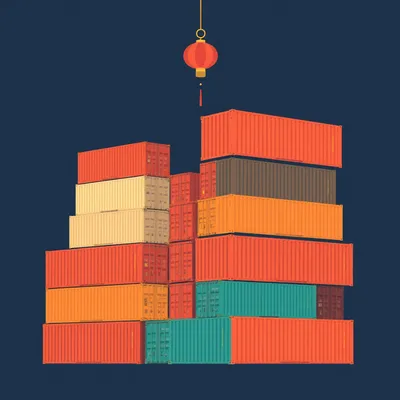
You've seen Shenzhen on every Alibaba listing. Today we finally ask why. Daniel sent us a long one, and it's worth reading in full.

It's a good one.
He writes: In our various episodes about logistics and supply chains, one place name keeps coming up — Shenzhen. If you spend any time on Alibaba or AliExpress, an enormous number of suppliers seem to be based there. Eventually you start wondering how one city can possibly account for so much of the world's export activity. We've talked about how industries in China cluster geographically, which is why sourcing trips focus on particular regions where related factories are concentrated. But Shenzhen feels different. It seems to come up less as a manufacturing center and more as a logistics hub.
That's already an interesting observation.
So what exactly is Shenzhen's role? Is it essentially one gigantic port and distribution center, or is there much more going on? How did it become such a dominant gateway, and what makes it so central to global trade? He's also curious about what happens after a shipment leaves the supplier. If you're placing a small order through Alibaba, the platform abstracts the logistics away — you don't know whether your goods are traveling by air, sea, rail, or some combination. You just care about the delivery window. But behind the scenes, what's actually happening?
Right, the black box.
Shenzhen has one of the world's busiest air cargo airports plus access to major seaports. When goods leave by air, are they flying directly to overseas hubs, or making a short regional hop first? And since Hong Kong is literally across the border, how often are exports trucked from Shenzhen into Hong Kong before being loaded onto an aircraft or container ship? Is it more common now for goods to leave directly from Shenzhen, or does Hong Kong still play a major role as the international gateway? He wants to understand not just the geography, but the practical decision-making — if he's buying from a supplier in Shenzhen, what determines sea versus air, direct versus Hong Kong? What does the invisible logistics network behind a typical Alibaba order actually look like?
That's the whole thing right there. The invisible network.
So let's start with the obvious question. What exactly is this city?
Shenzhen is not a port, and it's not a factory town. It's both, fused together in a way that doesn't really exist anywhere else. You have design, prototyping, manufacturing, and logistics all operating within a thirty-mile radius. That vertical integration is the thing. It's why Alibaba supplier lists are dominated by Shenzhen addresses — the factory and the freight forwarder are practically neighbors.
So it's not that Shenzhen is a logistics hub that happens to have factories nearby. The two functions feed each other.
A factory that can get a prototype turned around in three days and then hand it to a consolidator who can have it on a plane that night — that's not two separate advantages. That's one system. And the system is what makes Shenzhen the default choice for a huge swath of global sourcing. If you're a small electronics brand in Germany or a tool distributor in Texas, you're probably buying from Shenzhen whether you realize it or not.
The question Daniel's really asking, I think, is how you get from a fishing village to that. Because Shenzhen didn't exist as a city in any meaningful sense until...
Nineteen eighty. Deng Xiaoping designates it a Special Economic Zone. At that point it's a fishing village of about thirty thousand people. Thirty thousand. Today it's somewhere north of seventeen million. That's not growth — that's a controlled explosion.
A controlled explosion is about right. What did the Special Economic Zone designation actually do?
It turned Shenzhen into a laboratory. China was experimenting with market reforms, and the SEZ model meant foreign companies could set up joint ventures, repatriate profits, operate under different tax rules, and import materials duty-free for re-export. None of this was available in the rest of China at the time. So Shenzhen became the one door that was cracked open.
And Hong Kong was right there.
That's the whole story, really. In the 1980s and 1990s, Hong Kong manufacturers were facing rising labor costs and land prices. Shenzhen was cheap land and cheap labor with a friendly investment regime, and it was an hour's drive away. So you got this model they called "front shop, back factory." Hong Kong handled the finance, the sales, the logistics coordination — the front shop. Shenzhen did the manufacturing — the back factory. Goods would be trucked across the border, consolidated in Hong Kong, and shipped out through what was already one of the world's best ports and airports.
So the logistics infrastructure was originally Hong Kong's. Shenzhen was just the production floor.
Right, and that's the piece people miss. Shenzhen didn't build a port and then attract factories. The factories came first, and they relied entirely on Hong Kong's logistics network. But once you have thousands of factories producing for export, the volume creates its own gravity. Shipping lines want to call where the cargo is. Air cargo operators want to be near the source. So Shenzhen built its own ports — Yantian, Shekou, Chiwan — and its own airport, and over time the logistics infrastructure grew to match the manufacturing base.
And now it's a flywheel. More logistics attracts more manufacturers, which generates more volume, which justifies more logistics investment.
And the flywheel has been spinning for forty years. Today the Shenzhen port complex handles over thirty million TEUs annually. A TEU is a twenty-foot equivalent unit — one standard shipping container. Thirty million of them. That puts Shenzhen consistently in the top three container ports globally, trading places with Shanghai and Singapore depending on the year.
Thirty million containers is a number so large it stops meaning anything.
It's about eighty thousand containers a day. If you lined them up end to end they'd stretch from Shenzhen to... I don't know, somewhere absurd.
Berlin. Roughly.
See, this is why I keep you around. But the port volume is only half the picture. The manufacturing base isn't just cheap assembly anymore. Shenzhen is home to Huawei, DJI, BYD. The Pearl River Delta surrounding it produces everything from advanced electronics to textiles to medical devices. So the logistics hub is serving a massive, technologically sophisticated industrial hinterland. It's not just shipping plastic toys.
The "front shop, back factory" model — is that still the arrangement, or has Shenzhen absorbed the front shop function too?
It's absorbed a lot of it. Shenzhen now has its own financial sector, its own design firms, its own logistics companies. Hong Kong still handles a huge share of the air cargo — we'll get to that — but Shenzhen is no longer just the production floor. It's the whole building.
So that's how Shenzhen became the machine. Now let's look at how it actually runs day to day.
Let's start with air. Shenzhen Bao'an International Airport — that's the city's own airport — handles over one point six million tonnes of cargo annually. That makes it one of the busiest cargo airports in the world, top twenty or so globally.
One point six million tonnes. And for context, what does Hong Kong handle?
Hong Kong International Airport, HKG, handles over four million tonnes. It's been the world's busiest cargo airport for most of the last decade, trading the top spot with Memphis depending on the year. So HKG moves more than double what Shenzhen's airport does.
Which seems odd, given that Shenzhen is where the factories are.
It seems odd until you look at the route networks. HKG has far more long-haul freighter capacity. More flights to more destinations, more frequently. It's a legacy of Hong Kong's decades as the region's aviation hub — the infrastructure, the bilateral air service agreements, the established relationships with global freight forwarders. Shenzhen's airport has been growing fast, but it still doesn't have the same reach for intercontinental routes.
So the goods get made in Shenzhen, and then...
A huge share of them get on a truck. Cross the border into Hong Kong at checkpoints like Huanggang or Shenzhen Bay. Then they're loaded onto a long-haul freighter at HKG and flown to Dubai, or Memphis, or Frankfurt, or wherever they're going.
How huge a share?
It's hard to pin down a precise percentage because the data gets murky — shipments get consolidated and re-consolidated. But the general industry understanding is that a very significant portion of what you'd think of as Shenzhen air exports actually fly out of Hong Kong. The trucking leg adds maybe half a day to a day, but you make it up on the other end because HKG has more frequent flights and often faster customs processing.
So the border is basically a speed bump, not a wall.
It's a speed bump with paperwork. But it's a well-oiled speed bump — these crossings handle enormous volumes of cross-border trucking every day, and the processes are streamlined to keep goods moving. The trucks are often bonded carriers, meaning the cargo stays under customs seal from the factory to the airport, so you're not doing full import-export clearance at the border.
And what about sea freight? Same story?
Sea is different. For ocean shipments, Shenzhen's ports — Yantian is the big one, plus Shekou and Chiwan — are direct load ports for all the major shipping lines. Maersk, MSC, CMA CGM, COSCO — they all call at Yantian. So if your goods are going by sea, they almost certainly leave directly from Shenzhen. No Hong Kong detour needed. The container gets loaded at Yantian and the next stop might be Singapore, or it might be Rotterdam or Long Beach.
Why the difference? Why truck air cargo to Hong Kong but ship sea cargo directly?
A container ship is a floating warehouse that makes scheduled stops. Adding Yantian to the rotation costs the shipping line almost nothing — they're already sailing past. And the volumes are enormous, so it's worth their while. Air freight is different. A freighter has limited capacity and very high operating costs. Airlines concentrate their long-haul flights at hubs where they can aggregate cargo from multiple origins. Hong Kong is that hub for the region. Shenzhen's airport is growing into that role, but it's not there yet for long-haul.
So the decision tree for a buyer starts with air versus sea.
And that mostly comes down to weight-to-value ratio. High-value, low-weight goods fly. Think smartphones, semiconductor chips, high-end electronics, medical devices. Bulky, low-value goods go by sea. Furniture, textiles, injection-molded plastic parts, cheap consumer goods. There's a crossover point where the air freight cost eats too much of your margin, and you accept the four-to-six-week ocean transit instead of three to five days by air.
And then within air, there's the Hong Kong versus Shenzhen direct question.
Right. If you need absolute speed and you're willing to pay for it, you want your goods trucked to Hong Kong because HKG has more frequent long-haul departures. If cost is the priority and you can tolerate slightly longer transit, Shenzhen direct might work if there's a suitable flight. But for a lot of small and medium buyers, you're not making this decision at all.
Because the platform abstracts it.
This is where the invisible network comes in. Let's take Daniel's example — a small Alibaba order. Say you order a three-dollar phone case. That phone case is not getting its own shipping container. It's not even getting its own pallet. What happens is a consolidator in Shenzhen aggregates thousands of small parcels from hundreds of different suppliers. They're sorting, repacking, optimizing. The consolidator looks at the destination, the delivery window, the current spot rates for air and sea, and chooses the cheapest viable mode.
And the buyer just sees a tracking number.
The buyer sees a tracking number that might not even update for the first week, because the parcel is sitting in a consolidation warehouse waiting for enough volume to fill a container or a pallet. Then it moves. For a phone case, the most likely route is trucked to Hong Kong, flown to a regional hub — Dubai, Singapore, Memphis — then handed off to a last-mile carrier. The whole chain might involve four or five different middlemen, none of whom the buyer ever knows about.
The three-dollar phone case gets a private jet. Well, shared private jet.
A very crowded private jet. And the economics work because the consolidator is filling that jet with ten thousand other phone cases, plus USB cables, plus screen protectors, all sharing the cost. The per-unit shipping cost on a three-dollar phone case might be thirty cents.
That's the part that feels like magic. Thirty cents to move a physical object halfway around the world.
It's not magic, it's density. Air freight is charged by chargeable weight, which is the greater of actual weight or volumetric weight. Phone cases are light but they take up space, so you pay for the volume. But when you pack them tight enough, the cost per unit drops to almost nothing. The consolidator's entire business is solving that packing problem at scale.
What about a pallet of electronics? Something a small business might order — a few hundred units of a product.
That's a different calculus. If you're ordering, say, a pallet of Bluetooth speakers from a Shenzhen supplier — something with enough weight and value to justify sea freight but not so urgent that you need air — that pallet is probably going to Yantian. It gets loaded into a forty-foot container along with other exporters' goods, consolidated by a freight forwarder. The container goes onto a Maersk or COSCO vessel, and three to five weeks later it's at Long Beach or Rotterdam.
And if the same buyer needs part of that order faster?
Then you split the shipment. Air freight for a portion — probably via Hong Kong — and sea freight for the rest. It costs more, but if you're a business and you need inventory on shelves while the bulk is still on the water, the math can work. This is where knowing the actual port of departure matters.
Which brings us to the practical side. Daniel's asking what he should do with all this information as a buyer.
The first thing is ask your supplier for the Incoterms and the actual port or airport of departure. Incoterms are the international commercial terms that define who pays for what — FOB, CIF, EXW, all that. But the departure point tells you whether your goods are going via Hong Kong or direct. If it says Shenzhen Bao'an Airport, that's direct. If it says Hong Kong International Airport, there's a trucking leg involved, which adds a day or two and potentially some customs complexity.
For small orders, don't obsess over the route.
Don't. The consolidator's optimization is almost certainly better than anything you'd choose yourself. They're aggregating volume across thousands of shipments and they know the spot rates. You focus on the delivery window and the total landed cost — the product price plus shipping plus any duties or taxes. The route is their problem.
For larger orders though, you can get strategic.
If you're ordering enough volume to fill a significant portion of a container or to negotiate directly with a freight forwarder, then you can start making these decisions. Split air and sea — urgent high-value items fly via Hong Kong, bulk goes via Yantian. And here's a thing most buyers don't think about: choose your supplier location with logistics in mind. A factory near Yantian can have a container at the port in hours. A factory on the far side of the city might add a day of trucking just within Shenzhen. These lead time compressions add up.
Compress the lead time on the front end, and you might be able to switch from air to sea entirely, which saves a fortune.
That's the kind of thing that separates a professional importer from someone who just clicks "buy" on Alibaba. The physical proximity of factory to port is a genuine competitive advantage, and it's one of the reasons Shenzhen works so well as a system. You're not just near a port — you're near one of the world's biggest ports, with direct sailings to everywhere.
Let me ask you something. You mentioned Shenzhen's airport is growing. China's been pushing for more direct international routes. Does Hong Kong's role as the air gateway start to shrink?
That's the open question. Shenzhen Bao'an has been expanding aggressively — new runways, new cargo terminals, more international routes. And there's a political dimension. Beijing would prefer that Chinese exports fly out of Chinese airports rather than relying on Hong Kong, which operates under a separate customs and legal system.
Sure. Sovereignty and revenue.
But Hong Kong has deep structural advantages. Its customs regime is faster and more business-friendly for certain types of goods. Its air service agreements with other countries are more extensive — those are bilateral treaties negotiated over decades, and Shenzhen can't just inherit them. And the freight forwarding ecosystem in Hong Kong is incredibly mature — the expertise, the relationships, the financial infrastructure. You don't replicate that in five or ten years.
Hong Kong probably keeps the air cargo crown for a while.
For long-haul, yes. But the gap is narrowing. And there's another variable — cross-border rail. The China-Europe freight train network has been growing. Goods from Shenzhen can be railed up to inland hubs and then across Eurasia. It's faster than sea and cheaper than air. For certain products and destinations, it's becoming a real third option.
That's a whole other episode.
It is. But the point is the network keeps evolving. The Shenzhen of 1980 was a fishing village with a dream. The Shenzhen of today is a vertically integrated export machine. The Shenzhen of 2040 might look different again.
Through all of it, the buyer in Des Moines or Dublin clicks a button and a box shows up three weeks later, with no idea any of this happened.
That's the invisible network. It's not one route — it's a constantly recalculating optimization problem solved by consolidators, freight forwarders, and shipping lines, all competing to move your stuff cheaper and faster than the next guy.
Hilbert: If I'm ordering something from a Shenzhen supplier and the tracking shows it sitting in "Hong Kong processing center" for three days, is that normal or should I be worried?
Completely normal. That's the consolidation step. Your parcel is waiting for its flight buddies.
Yeah, three days is actually fast. If it sits for more than a week, then maybe ping the supplier. But a few days in a Hong Kong processing center means the system is working exactly as designed. Your phone case is making friends.
That's a strangely wholesome image for international logistics. Thanks, Hilbert.
The invisible network is going to keep evolving. E-commerce volumes are still growing, Shenzhen's airport is still expanding, and the China-Europe rail corridors are getting more efficient. The interesting question is whether Hong Kong remains the indispensable air gateway or whether Shenzhen eventually captures enough direct long-haul capacity to change the routing equation. My guess is Hong Kong stays dominant for air for at least another decade — the institutional advantages are too deep to unwind quickly. But the trend line is clear.
For anyone sourcing from Shenzhen, the practical takeaway is simple. Know your departure point, understand what it means for transit time, and for small orders, trust the consolidator. They're better at this than you are.
Thanks to Hilbert Flumingtop for producing. This has been My Weird Prompts.
If you've got a weird prompt about logistics — or anything else — email the show at show at my weird prompts dot com. We'll dig in.
We'll be back soon.