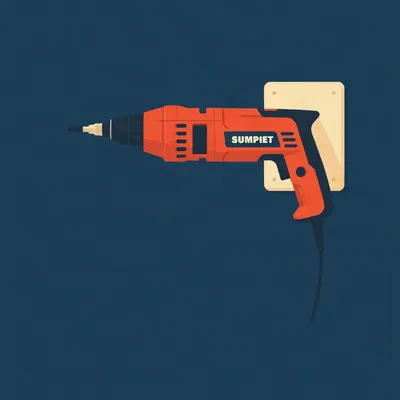
Daniel's Dremel 7760 keeps dying mid-project, and he wants to know why he can't just plug the thing into the wall and keep carving while it tops itself back up. His question, laid out properly, is threefold. What do you call that feature when you're scanning a spec sheet? How does the circuitry actually juggle running a motor and charging a battery at the same time? And if it's such an obvious bridge between corded and cordless, why is it so rare on tools like his?

And the answer to that last one is going to annoy him, because the feature has a name, it has a well-understood circuit topology, and it's still almost never put in budget cordless tools for reasons that are completely rational and completely unsatisfying.
So today we're digging into power path management, battery chemistry, and the economics of why a fifty dollar rotary tool doesn't do the thing that sounds obvious after two minutes of thought.
Let's start by putting a name to this thing. If you're looking at a spec sheet, you'll see it marketed as charge-while-running or pass-through charging. Those are the consumer-facing terms. Engineers call it power path management or load sharing. The circuit lets the wall adapter power the device and charge the battery at the same time, instead of forcing you to pick one or the other.
And Daniel's Dremel 7760 doesn't have any of that. It's a basic cordless rotary tool with a wall charger that only charges when the tool is off. The moment you pull the trigger, the charging circuit is out of the picture entirely.
Which is actually the simplest possible design. The battery connects to the motor through a switch. The charger connects to the battery through a separate path. They never operate at the same time. It's cheap, it's safe, and it's why the tool costs what it costs.
But the puzzle is real. Laptops do this. Phones do this. You can use a laptop while it's plugged in and the battery charges. So why doesn't a rotary tool do the same thing? The answer sits in battery chemistry, heat, and the brutal economics of a fifty dollar tool. We'll unpack each one.
Now let's get under the hood and see how the circuit actually juggles power. There are two main topologies for this, and they're worth distinguishing because they behave very differently in practice.
The first one is what's called a diode-OR power path, or an ideal diode power path if they've spent money on the fancy version. The idea is that when you plug in the adapter, the adapter takes over powering the device completely. The battery is disconnected from the load and charges separately. When you unplug, the battery takes over seamlessly.
Think of it like a two-lane merge on a highway. The adapter is one lane, the battery is the other, and the device only ever draws from one lane at a time. The diode-OR just makes sure there's no backflow, no moment where the battery tries to charge the adapter or the adapter fights the battery.
And the "ideal diode" version is worth a quick tangent, because it's a nice example of how engineering terms drift. A regular silicon diode drops about zero point seven volts across itself. If your adapter is supplying twelve volts and the diode eats zero point seven, that's nearly six percent of your power gone as heat before it reaches the motor. An ideal diode uses a MOSFET and a tiny controller to mimic a diode's one-way behavior with a voltage drop of millivolts instead. Same function, far less waste. But it costs more, and on a fifty dollar tool, every cent counts.
Right. And that's a recurring theme here. The engineering solution exists. It's been solved. The question is always whether the solution costs more than the problem it solves.
The second topology is battery-as-buffer. That's what most laptops and phones actually use. The battery stays in the circuit even when you're plugged in. The adapter supplies the average power, but the battery handles the surges. When your laptop's processor spikes from idle to full tilt, that sudden draw comes from the battery, and the adapter tops the battery back up in the lulls.
And that's a really elegant design for a device with a spiky load profile. A laptop doesn't draw a constant forty watts. It draws five, then sixty, then twelve, then ninety. The battery smooths all that out, and the adapter just has to supply the average. The battery is the shock absorber.
A rotary tool is the opposite of spiky. You pull the trigger, the motor draws a fairly constant current until you let go. There's no processor ramping up and down. So the battery-as-buffer topology solves a problem the Dremel doesn't really have.
Right. And it's worth pausing on that, because it's the first big fork in the road. The reason laptops and phones can do this isn't just that they're more expensive. It's that their power demands are fundamentally different. A laptop is a device that sips power most of the time and occasionally gulps it. A rotary tool is a device that drinks from a fire hose the entire time it's on.
It means the circuit that works beautifully for a laptop would be wasted silicon in a Dremel. You'd be adding a shock absorber to a vehicle that doesn't have any bumps in its road.
But let's talk about the actual circuit components, because this is where the cost and complexity hide. To charge a lithium-ion cell while powering a motor, you need at least two separate power conversion stages. The adapter might be delivering twelve volts, but the lithium cell wants four point two volts to charge. So you need a buck converter to step that twelve volts down to four point two, and that converter has to be controlled by a charge controller chip that monitors the cell voltage and current.
Meanwhile, the motor wants whatever voltage the tool is designed for, which might be seven point two volts or twelve volts depending on the pack configuration. So you need a separate regulator for the motor rail. And then you need the power path logic that decides where the adapter's current goes at any given moment.
And that logic isn't trivial. The charge controller has to sense the load. If the motor is pulling three amps and the adapter can only supply one amp, the charge controller has to back off the charge current to zero and let the battery supply the difference. That's called derating. And it leads to the first big misconception about this feature.
Which is that charge-while-running means the battery charges while you use the tool. In reality, if your motor pulls five amps and your adapter only supplies three, the battery is still discharging. It's just discharging slower than it would without the adapter. You're not charging, you're slowing the drain.
That's the thing that would make Daniel's fantasy less satisfying than he imagines. His Dremel 7760 comes with a charger rated at about one amp. The motor can pull several amps under load. Even if the tool had pass-through circuitry, plugging in that one-amp charger while carving would just make the battery die slightly less quickly. It wouldn't keep it alive.
To actually charge while running at full power, you'd need an adapter that can supply more than the motor's peak draw. For a Dremel, that might mean a five-amp or eight-amp brick. At that point you're carrying a power supply the size of the tool itself.
And that's before we get to heat. This is the part that makes battery engineers wince. Lithium-ion cells do not like being charged while hot. The motor in a rotary tool sits right next to the battery pack. After five minutes of carving, that pack is warm. After fifteen, it's properly hot. Charging a hot lithium cell accelerates the degradation reactions, the ones that grow the internal resistance and eventually cause the cell to lose capacity or, in the worst case, swell.
Swelling is the polite word for what happens when the electrolyte breaks down and produces gas inside a sealed pouch cell. You get a puffy pack, and a puffy pack in a tool you're gripping in your hand is not a great user experience.
And it's not just a comfort issue. A swollen cell has higher internal pressure, which means the separator between the electrodes can be compromised. Once that separator fails, you're looking at an internal short, and an internal short in a lithium cell is the prelude to thermal runaway. It's a cascade.
So a pass-through design on a tool like the Dremel would need thermal management. Either you throttle the charge rate when the pack is hot, which makes the feature nearly useless, or you add active cooling, which adds cost and bulk. The Dremel 7760 has no cooling fan. It's a sealed plastic shell. There's nowhere for the heat to go.
The tools that do offer pass-through tend to be bigger and more expensive precisely because they can afford the thermal headroom. Some of the higher-end cordless vacuums have pass-through on their docks, but they're charging a pack that's been sitting still, not one that's been running a motor for twenty minutes. And even then, the charge rate is often reduced.
Milwaukee has some chargers that can power tools through an AC outlet, but that's not the same thing. That's the charger acting as a power supply for the tool, bypassing the battery entirely. The battery isn't in the circuit. It's a corded tool with extra steps.
Which, when you think about it, is exactly what Daniel is asking for. He wants his cordless Dremel to become a corded Dremel when he's near an outlet. And the simplest way to do that is to buy a corded Dremel. They exist. They're cheaper than the cordless version. They never run out of battery.
But he already owns the cordless one, and he wants one tool that does both. That's the bridge fantasy. And it's a perfectly reasonable thing to want. It's just that the engineering to do it well is expensive, and the market for a fifty dollar tool that does both jobs is smaller than the market for a fifty dollar tool that does one job and a thirty dollar tool that does the other.
Let's talk about the economics, because that's where this feature goes to die. Adding power path management to a tool like the Dremel 7760 means adding a power path IC, a more sophisticated charge controller, a bigger adapter, and some kind of thermal management. That's ten to twenty dollars on the bill of materials.
And ten to twenty dollars on the bill of materials translates to somewhere between thirty and sixty dollars on the retail shelf, depending on the margin structure. So Daniel's fifty dollar tool becomes an eighty dollar tool, and now it's competing in a completely different bracket.
On a fifty dollar tool, ten to twenty dollars is the difference between a product that sells and a product that doesn't. The Dremel 7760 is built to hit a price point. Every component in it is the cheapest thing that does the job. Adding pass-through would push it into a different price bracket where it's competing against tools that are better in other ways.
And then there's the warranty problem. Charging lithium-ion while hot is a known way to shorten battery life. If Dremel added pass-through and people used it while the tool was hot, the batteries would fail sooner. That means warranty claims, bad reviews, and a damaged brand reputation. All to add a feature that most buyers won't use.
The market segmentation angle is real too. Cordless tools are sold on the promise of freedom from the wall. That's the whole pitch. You pay extra for the battery and the charger because you're buying mobility. If you add pass-through, you're admitting that the battery doesn't last long enough and the user might want to be tethered anyway. That undercuts the cordless pitch.
And it could cannibalize sales of corded tools. Dremel sells corded rotary tools. If the cordless version could also run corded, some buyers would skip the corded model entirely. From Dremel's perspective, selling two tools is better than selling one tool that does both.
There's also a real ergonomic issue. When you're using a rotary tool, you're moving it around. You're carving, grinding, polishing. A cord attached to the tool changes how it handles. The whole reason you bought the cordless version is that there's no cord to snag on the workpiece. If pass-through means plugging in a wall adapter, you've got a cord again, but now it's a cord attached to a tool that's heavier because it has a battery in it.
So the feature only makes sense for intermittent use. You use the tool cordless for a bit, then you set it down near an outlet and let it charge while you do something else, then you pick it up again. That's a niche within a niche. Most people either use the tool cordless and accept the battery life, or they buy the corded version.
Where pass-through does show up is in appliances that are stationary or docked. Robot vacuums charge on their docks and run off the battery when they're cleaning. Electric scooters charge when parked, not while riding. These are devices where the charging and the using happen at different times by design.
Some electric scooters do have regenerative braking, which charges the battery while the scooter is in use. But that's a different mechanism entirely. The motor acts as a generator when you brake, and the energy goes back into the battery. It's not the same as plugging in while riding, and it only recovers a small fraction of the energy.
The regen case is actually instructive, because it shows that even when you do charge a battery during use, the thermal constraints still apply. Regenerative braking on a scooter only captures energy in short bursts, and the battery management system carefully limits how much current goes back in. It's not a continuous charge while the motor is running.
The future outlook is interesting, though. Gallium nitride chargers are getting smaller and cheaper. Battery management chips are getting more sophisticated. The cost of adding power path management is coming down. It's possible that in five or ten years, pass-through trickles down to budget tools.
But I wouldn't hold my breath for the Dremel 7760 specifically. That tool is what it is. Daniel's going to have to live with the battery life or buy a second battery. The battery is removable, so he could charge one while using the other. That's the low-tech pass-through.
Which is actually the solution most professionals use. They buy two or three batteries and a charger, and they rotate them. It's not elegant, but it works, and it doesn't require any exotic circuitry.
It has the advantage of actually solving the problem. The tool is always ready because there's always a fresh battery on the charger. No thermal management needed, no power path logic, no ten dollar bill of materials increase. Just two batteries and a little discipline.
The engineering works, but the economics and the chemistry make it a bad fit for budget handheld tools. The feature exists, it has a name, and it's not going to show up in a fifty dollar Dremel anytime soon.
The other thing worth saying is that when pass-through does exist on a handheld tool, it's often not what the user expects. They plug in expecting the battery to charge while they work, and instead the battery just drains slower. That's a recipe for disappointment. The marketing term charge-while-running oversells what the circuit actually does.
Unless the adapter is beefy enough to supply the full load plus charge current, which is rare on a handheld tool because the adapter would be huge. So the feature gets a bad reputation even when it's implemented. Users try it, see the battery still going down, and conclude it doesn't work.
The honest version of the feature would be called slows-the-drain-while-plugged-in, which is less catchy and would never make it onto a spec sheet.
But before we wrap, Hilbert's been sitting on something, and it involves a battery fire.

I worked a summer at a battery recycling plant in the early nineties. We tested dead power tool batteries to see which ones could be refurbished and which ones went to the crusher. The test rig was a metal bench with a charger bolted to it and a fan blowing across whatever pack we were testing.
One day we had a pack come in from a rotary tool, one of the early nicad ones. The guy who brought it in said it had been charging while he used the tool. Not a factory feature, he'd wired it himself. The charge circuit kept pumping current into the pack while the motor was running, and the pack got hot enough that the plastic case started to soften.
We put it on the bench, hooked it up, and within maybe four minutes the thing vented. Flame shot out the side of the pack, burned a hole in the bench mat, and set off the smoke alarm. The whole plant had to evacuate. Fire department came. The foreman made us all sit through a safety briefing.
I've never trusted pass-through on a handheld tool since. The heat from the motor goes straight into the battery, and the charge circuit keeps pushing current into a pack that's already too hot. You get a swollen pack in your hand, or worse. It's not worth it for the convenience of not swapping a battery.
That's the heat problem in its most visceral form. The charge controller in a modern tool would throttle or shut off before it got to that point, but the physics hasn't changed. Hot battery plus charge current equals degradation, and degradation can end in a vent.
That's the thing Daniel's Dremel is designed to avoid. No pass-through means no possibility of charging a hot pack, which means no thermal runaway in the customer's hand. It's a safety decision dressed up as a cost decision.
The packs we tested in the nineties didn't have the protection circuits they have now. Modern cells have thermal fuses and the chargers have temperature sensors. But the sensors only work if they're wired in, and on a fifty dollar tool, the sensor is one more component that can be left out.
I've seen the inside of enough of these packs to know where the corners get cut. The wire gauge gets thinner, the solder joints get smaller, the thermal protection gets skipped. Adding pass-through on top of that is asking for trouble.
The cheap tools that would benefit most from the feature are the ones least likely to get it.
That's the market logic in one sentence. The feature costs money, so it goes on the tools where the buyer can afford it, and those are the tools where the buyer cares least about it.
I've got a corded rotary tool in the garage that I bought in nineteen ninety-four. Still works. The cord is annoying, but it never dies mid-job.
The one thing I'd take from this is that charge-while-running is a real feature with a real name, but it's not the bridge between corded and cordless that it sounds like. It's a compromise that mostly slows the drain, and it comes with heat and cost penalties that make it a bad fit for budget handheld tools.
The sharper version is that cordless tools are designed around the battery as the primary power source, and everything else in the tool is optimized for that. Pass-through fights the design rather than complementing it. Daniel's Dremel doesn't have the feature because the feature would make it a worse tool, not a better one.
The open question is whether gallium nitride chargers and smarter battery management chips will make pass-through cheap enough to become standard. If it does, the whole category of cordless tools might shift toward hybrid designs that are cordless when you need them and corded when you don't.
If that happens, the battery becomes less of a limitation and more of a convenience. You'd buy a tool with a small battery because you know you can plug it in when you're near an outlet. The battery would just be for the moments between outlets.
But that's a future where the economics have shifted. Right now, the fifty dollar Dremel is what it is, and Daniel's best option is a second battery and a charger. Not as elegant as pass-through, but it works, and it won't set his bench on fire.
Thanks to Hilbert Flumingtop for producing, and for the reminder that some features are missing for a reason.
This has been My Weird Prompts. Email us at show at my weird prompts dot com if you've got a tool that does charge while running and you want to tell us how it actually behaves.
We'll be back soon.