Daniel sent us this one — he wants a deep dive on solid paint markers, which he calls one of the industrial world's greatest and barely celebrated marking tools. He's asking about the chemistry, how a solidified paint stick actually works versus liquid paint markers and grease pencils, why these things adhere where Sharpies and liquid markers just give up, and which industries depend on them. Then he wants a brand comparison — Sakura Solid Marker, Markal Paintstik, La-Co, Dykem. There's a lot to unpack here.

There really is, and I love that this prompt exists because solid paint markers are one of those things where once you understand how they work, you realize how clever the engineering is. Most people have never even heard of them. They think a marker is a marker.
Which is like thinking a saw is a saw. Technically true, uselessly broad.
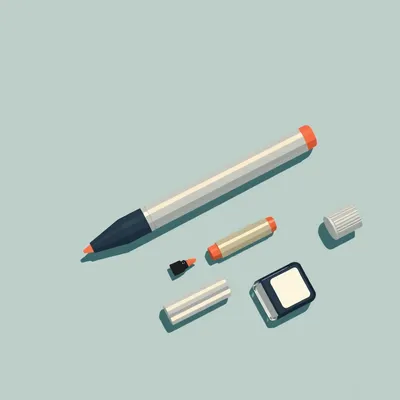
Let's start with what a solid paint marker actually is. You've got this stick that looks almost like a crayon or a tube of lipstick — it's solid at room temperature, you peel back a paper wrapper or push it up through a holder, and when you draw with it on steel or concrete, it leaves a bright, opaque, permanent mark. There's no liquid involved. No solvent evaporating. No drying time. That's the fundamental difference that makes everything else possible.
What's inside it? If there's no solvent carrier, what's holding the pigment together?
It's a mixture of pigment dispersed in a wax and resin binder system. The binder is solid at room temperature, which is why the stick holds its shape. When you draw it across a surface, friction and pressure cause a thin film of the binder to shear off and transfer to the substrate. The binder adheres mechanically and sometimes chemically, and the pigment is locked inside that film. No evaporation, no curing — what you see the moment you draw the line is what you get forever.
It's basically a crayon that means business.
A crayon that went to trade school and got its welding certification. The wax-resin binder is formulated for specific industrial conditions. Crayons use paraffin and are designed to be washable. Solid paint markers use harder waxes, synthetic resins, and sometimes drying oils that oxidize and crosslink after application to form a film that can survive outdoor exposure for years.
Crosslinking — so there is some chemistry happening after the mark is laid down?
In some formulations, yes. Markal, for instance, has lines where the binder includes alkyd resins or modified linseed oil components that undergo oxidative curing. The mark goes down like a soft solid, and over hours or days it hardens into something closer to a paint film. Other formulations are purely thermoplastic — they soften with heat and harden when cool, but don't chemically cure. The choice depends on the application. A mark that needs to survive a trip through a galvanizing bath is formulated differently from one that just needs to label steel beams sitting in a yard.
The "solid" part is doing double duty — it's the physical state at room temperature and it's also describing the fact that there's nothing volatile in there. No solvent means no evaporation, which means no shrinking, no cracking from solvent loss, and no flammable vapors.
That last point matters more than people realize. When you're marking steel in a fabrication shop where there's welding happening nearby, the last thing you want is a marker full of xylene or acetone. Solid paint markers eliminate that entirely. They're also not going to dry out if you leave the cap off, because there is no cap. The stick itself is the delivery system.
That's the kind of design elegance that comes from solving real problems rather than making something slightly cheaper.
It's old technology, fundamentally. The Markal company — originally Markal Company in Chicago — has been making these things since the nineteen thirties. The Paintstik was developed for marking hot steel in foundries and mills. The core formulation hasn't changed radically because it solved the problem so completely.
Let's contrast this with the other categories people confuse them with. Liquid paint markers — what's actually in those?
Liquid paint markers use pigment suspended in a solvent-based paint vehicle. You pump the tip or press it down to release the paint, which flows through a felt or fiber nib. The solvent evaporates, leaving a paint film. They give you the opacity and durability of paint, but they come with all the solvent problems — they dry out if uncapped, they can clog, they're flammable, and they don't work well on hot surfaces because the solvent flashes off before the paint can level properly. They also struggle on oily or greasy surfaces because the solvent can't displace the oil effectively enough to get adhesion.
Grease markers, wax pencils — those are the ones you peel a paper wrapper off, they feel waxy, they write on glass and smooth surfaces.
Those are primarily wax and pigment with maybe some fatty acids or oils to soften them. They're designed for temporary marking or for smooth non-porous surfaces like glass, porcelain, or polished metal. They don't cure, they don't form a durable film, and they'll wash off or rub off relatively easily. They're great for a china marker on a mirror or writing prices on a store window, but you wouldn't use one to mark a steel beam that's going to sit outside for six months before it gets erected.
The hierarchy from least to most durable is grease pencil, then liquid paint marker, then solid paint marker — but with the caveat that solid paint markers are a different category entirely, not just a better version of the same thing.
The difference shows up most dramatically in the adhesion story. This is what the prompt was really getting at — why do these things stick where Sharpies and liquid markers fail?
Walk me through that. What's actually happening at the surface level?
There are several things going on. First, the binder in a solid paint marker is designed to wet out on low-energy surfaces — oily steel, for instance. Most liquids bead up on oil because the surface energy of the oil film is lower than the surface tension of the liquid. But a solid stick, applied with pressure and friction, mechanically displaces the oil film. You're essentially scrubbing through the contamination as you apply the mark, and the softened binder grabs the substrate underneath.
It's a mechanical action, not just a chemical one.
Largely mechanical, though some formulations include surfactants or polar groups in the resin that help. The second factor is that there's no solvent to interfere. When you apply a liquid marker to a wet or oily surface, the solvent has to evaporate upward through the paint film, and if there's moisture or oil at the interface, the film never bonds properly. A solid marker has no solvent trying to escape — the film is laid down in its final form.
What about rough concrete? That seems like a completely different challenge.
Concrete is porous, dusty, and irregular. A liquid marker will wick into the pores and spread, giving you a blurry, feathered line, and the pigment gets diluted into the substrate. A solid paint marker sits on top of the surface. The binder is too viscous to wick, so the mark stays sharp. And because you're applying it with pressure, you're forcing the binder into the surface texture, creating a mechanical bond that's essentially a keying effect — the solidified paint fills the micro-crevices and locks in place.
"Keys into the surface" is one of those phrases that gets thrown around a lot, but here it's literally happening.
And on hot metal — this is where solid paint markers really earn their reputation. You can mark steel that's hundreds of degrees. Liquid markers will boil and spatter. Grease pencils will melt and flow. A solid paint marker, especially one formulated for high temperatures, will soften just enough to transfer, then set immediately as the surface cools slightly or as the mark itself reaches thermal equilibrium. Markal makes a line called Thermo-Safe that works on surfaces up to two thousand degrees Fahrenheit. The mark doesn't burn off — it's designed to leave a visible residue even at those extremes.
Two thousand degrees. At that point you're not marking steel, you're marking something that's glowing.
In a foundry or a steel mill, that's exactly the use case. You need to mark ingots, billets, castings while they're still hot, for tracking and quality control. If you wait for them to cool, you've lost hours of production time and your tracking system falls apart.
Let's talk about the industries, because the prompt listed several and I want to understand what each one is actually using these for day to day.
Welding and fabrication is probably the biggest market. In a fab shop, you're dealing with mill scale, surface rust, cutting oil, and you're often marking steel that's going to be welded, painted, or galvanized. A Sharpie mark will burn off during welding or get dissolved by the paint solvents. A solid paint marker mark survives through multiple downstream processes. Welders use them to mark cut lines, assembly match marks, and heat numbers for material traceability.
Match marks — those are the marks that tell you which piece goes where during assembly?
Yes, and losing a match mark because your marker couldn't handle the heat of tack welding is the kind of mistake that costs hours of rework. In shipbuilding, this gets even more critical. You've got steel plates being cut, shaped, and assembled outdoors, often in wet conditions, and the marks need to survive weeks or months of exposure before the piece gets welded into place. The maritime environment — salt spray, constant moisture, temperature swings — destroys most marking methods. Solid paint markers are one of the few things that hold up.
What about construction? I'm imagining marking structural steel, but also layout work on concrete.
Structural steel is marked at the mill or the fabrication shop with heat numbers, piece marks, and erection marks. Those marks need to be legible when the ironworker is up on the fifteenth floor trying to figure out which beam goes where. They also need to survive being stored outdoors at the job site. In concrete construction, solid paint markers are used for layout — marking anchor bolt locations, cut lines, elevation references. The mark stays visible even after rain, dust, and foot traffic.
Then there's mining and foundries, which feel like the extreme end of the spectrum.
Mining is brutal on marking tools. You're marking rock faces, drill cores, equipment in underground conditions with dust, moisture, and vibration. Drill core boxes need labels that won't rub off when the cores are stacked and transported. Foundries, as we touched on, need to mark hot castings. They also mark patterns, molds, and finished castings for quality control. The marks have to survive shot blasting, heat treatment, and sometimes machining coolant.
Foundry work seems like a good entry point for the brand comparison, because that's where Markal really built its reputation. What's the landscape look like?
Four major players, and each has its niche. Markal, which is now part of LA-CO Industries, is the grandfather. The Paintstik is their flagship product. It comes in a wide range of formulations — standard, high-temperature, low-chloride for nuclear applications, and specialty versions for specific metals. Markal markers are known for being soft enough to mark easily but hard enough to leave a durable film. Their color range is extensive — something like twenty-plus colors including metallics.
Low-chloride for nuclear — that's one of those specifications that tells you this is not a consumer product.
Halogen-free and low-chloride formulations exist because in nuclear power plants, stainless steel can suffer chloride stress corrosion cracking if you introduce halogens onto the surface. A regular marker or paint stick could literally damage the equipment it's marking. That level of application-specific engineering is what separates industrial marking from the stationery aisle.
Markal is the broad-line incumbent. What about Sakura?
Sakura is interesting because they're Japanese, and they approach the solid marker from a slightly different angle. Their Solid Marker — sometimes sold under the Pen-Touch brand — uses a drier, harder binder than Markal. The mark is more precise, less waxy-feeling. They're very popular in precision fabrication, aerospace, and anywhere you need a fine, clean mark. The Sakura markers are known for not smearing once applied, which is a common complaint with softer formulations.
Softer markers can leave a mark that's still tacky, and it picks up dust and grime.
Sakura's formulation sets harder and faster. They also make a marker with a mechanical holder that's more precise than the paper-wrapped sticks. Their color range is narrower than Markal's — you're getting your basic white, yellow, red, black, blue — but the consistency and precision are what people pay for.
They own Markal now, but they also have their own products?
LA-CO Industries acquired Markal in the nineteen nineties, and they've maintained the Markal brand as the premium industrial line while also selling under the LA-CO name for some products. LA-CO's own solid markers tend to be positioned for plumbing, HVAC, and general industrial maintenance. They're good, workhorse products but don't have the same depth of specialized formulations as the Markal line. LA-CO is also known for their pipe thread sealants and leak detection products — marking is one division of a larger industrial consumables company.
Dykem — that's a name I associate with layout fluid, the blue dye you paint on metal so you can scribe lines into it.
Dykem is owned by ITW, Illinois Tool Works, and they're the dominant name in layout fluids. Their solid paint markers are an extension of that — they're formulated to work alongside their layout fluids in machining and fabrication environments. Dykem solid markers are known for being compatible with cutting fluids and coolants. A mark that dissolves the moment it gets splashed with machining coolant is useless in a machine shop, and Dykem specifically tests for that.
If you're in a machine shop running flood coolant, Dykem is probably your brand. If you're in a foundry marking hot castings, Markal. If you're doing precision aerospace fabrication, Sakura.
That's a reasonable shorthand. Though there's a lot of overlap, and brand loyalty in these industries is intense. A welder who's been using Markal Paintstiks for twenty years is not going to switch because someone hands them a Sakura. The feel of the marker matters — how much pressure you need to apply, how the mark looks, whether it smears on your gloves.
The "feel" thing is real. I've used enough markers on enough surfaces to know that the difference between a marker that glides and one that drags is the difference between a line you trust and one you don't.
In industrial marking, trust is everything. If you're marking a cut line on a piece of steel that costs thousands of dollars, you need absolute confidence that the mark will still be there when you come back from lunch.
Let's get into application tips, because the prompt specifically asked for that, and I suspect most people use these wrong.
The number one mistake is not preparing the surface. Even though solid paint markers are more forgiving than liquid markers, you still get dramatically better results if you knock off loose rust, scale, and heavy oil. A quick wipe with a rag is often enough. For oily steel, some people use a solvent wipe first, but that defeats part of the advantage — the marker can handle some oil, and if you're going to solvent-clean anyway, you might as well use a liquid marker at that point.
The workflow is: rag, mark, done.
In most cases, yes. The second tip is about temperature. If the marker is cold, it'll be hard and won't transfer well. In cold weather, keep the marker in an inside pocket for a few minutes before use. Conversely, if the surface is extremely hot, you want a marker formulated for that temperature range — standard markers will just melt and flow.
What about sharpening or shaping the tip?
Most solid paint markers have a paper wrapper you peel down to expose more of the stick. The exposed tip naturally wears to a chisel or rounded shape with use. If you need a sharp point for fine lines, you can carve the tip with a knife — the material is soft enough to shape easily. Sakura's mechanical holders let you extend the stick in controlled increments, which is more precise than peeling paper.
These things don't dry out, but they can get damaged.
Keep them out of extreme heat, because the binder can soften and deform. Don't store them in direct sunlight for extended periods. The paper-wrapped ones can get crushed if you toss them in the bottom of a tool bag — the plastic holder versions are more robust for field use. And if the tip gets contaminated with dirt or metal shavings, just carve off the dirty layer. You've got plenty of material.
One thing I've noticed — and this connects back to a previous conversation about "permanent" markers — is that the word "permanent" on a Sharpie means something completely different from what these solid paint markers deliver. A Sharpie mark on steel might last a few weeks outdoors. A solid paint marker mark can last years.
The Sharpie uses a dye dissolved in alcohol. The alcohol evaporates, the dye sits on the surface, and UV light and moisture break it down. A solid paint marker uses pigment — actual solid particles — locked in a cured resin film. Pigments are orders of magnitude more UV-resistant than dyes. The binder shields them further. It's the difference between a stain and a coating.
A Sharpie stains the surface. A solid paint marker coats it.
Coating is what you need when the surface is going to see weather, abrasion, chemicals, or heat. The coating can be thick — solid paint markers lay down a film that's maybe ten to fifty microns thick, versus a dye-based mark that penetrates a few microns at most. That thickness provides opacity, which is why these markers show up bright and legible even on dark, rusty, or scaled surfaces.
Opacity is underrated. A yellow mark on dark steel from a dye-based marker is practically invisible. A yellow solid paint mark is bright and readable from twenty feet away.
That's why you see those bright colors in industrial settings. Yellow, white, and red are the most common — high contrast against steel, concrete, and wood. But the metallics are interesting too. Silver and gold solid paint markers exist for marking dark surfaces where you need the mark to be visible but not garish, or where you're marking finished products that will be seen by customers.
There's a whole aesthetic dimension to industrial marking that nobody talks about. The person marking architectural steel that will be exposed in a building cares about how the mark looks, even if it's temporary.
Some marks aren't temporary. There are applications where the solid paint mark is the final identification — serial numbers on equipment, inspection stamps, certification marks. In those cases, the mark needs to look professional and remain legible for the life of the equipment.
Let's talk about some specific use cases that illustrate why this technology matters. The prompt mentioned shipping and marine — what's happening on a container ship or a dock?
Shipping containers get marked with identification numbers, weight ratings, and certification plates. Those marks are exposed to salt spray, sun, and physical abrasion from handling equipment. They need to last the twenty-plus year service life of the container. Solid paint markers are used for stenciling and for freehand marking of repair information, inspection dates, and hazard warnings. In shipyards, hull steel is marked with piece identification that has to survive outdoors for months before assembly. The combination of salt, moisture, and UV is about as punishing as it gets for any coating.
The alternative would be what — stenciled spray paint?
Spray paint through a stencil works, but it's slow, you need stencils for every mark, and overspray is a problem in wind. A solid paint marker gives you the durability of paint with the speed and convenience of a marker. For one-off marks, it's dramatically faster.
What about on the maintenance side — equipment inspection, that kind of thing?
In mining and heavy equipment maintenance, solid paint markers are used for inspection markings. A mechanic doing a daily inspection on a haul truck will mark checked components with the date and their initials. Those marks need to survive until the next inspection, through mud, dust, and power washing. They also use them for torque stripe marking — after torquing a bolt, you draw a line across the bolt head and onto the adjacent surface. If the bolt loosens, the line breaks and you can see it immediately during the next walkaround.
Torque stripe — that's clever. A visual indicator that doesn't require any tools to check.
The mark has to stay put on a bolt that's vibrating, getting hot, getting covered in oil. A dab of paint from a brush would work, but the marker is faster and more precise. In aviation maintenance, torque stripe marking is standard practice, and they use specialized markers that won't introduce any contamination issues.
Which brings us back to the low-chloride, halogen-free formulations. In aerospace, even the marker you use is specified by the maintenance manual.
Everything is specified. The marker has to meet a standard — often something like MIL-SPEC or an OEM-specific specification — and using the wrong one can be a write-up. That's how seriously these industries take their marking tools. It's not just about making a mark. It's about making a mark that doesn't damage the substrate, doesn't introduce contamination, and doesn't fail prematurely.
The gap between "I need to label this Ziploc bag" and "this mark must survive re-entry heating" is vast, and it's filled with an entire industrial ecosystem most people never see.
That ecosystem is quietly enormous. The global industrial marking market is worth billions. Solid paint markers are a niche within that, but they're the niche that handles the hardest problems.
Let's circle back to the chemistry for a moment, because I want to understand the wax-resin binder system in more detail. What kinds of waxes are we talking about?
The exact formulations are proprietary, but in general you're looking at blends of microcrystalline wax, carnauba wax, polyethylene waxes, and various synthetic resins. Microcrystalline wax gives you flexibility and adhesion. Carnauba is hard and raises the melting point. Polyethylene waxes add toughness and chemical resistance. The resins — things like alkyds, hydrocarbon resins, or acrylics — provide film strength and, in curing formulations, the crosslinking chemistry.
It's a carefully balanced mixture where each component is doing a specific job. Change the ratio and you change the application temperature range, or the flexibility, or the weather resistance.
That's why Markal has so many different formulations. The standard Paintstik is a general-purpose balance. The Thermo-Safe line shifts the wax-resin blend toward higher melting points and adds components that leave a visible residue even after the organic binder burns off. The low-chloride version substitutes halogen-free ingredients throughout. Each one is a different recipe optimized for a different set of constraints.
The fact that you can get a version tested for nuclear applications tells you this is serious materials science, not just "melt some crayons and add pigment.
The nuclear qualification process alone — you have to prove that every ingredient, down to trace contaminants, won't cause corrosion or other damage to reactor components. That requires a supply chain where every batch is tested and certified. It's aerospace-grade quality control for a product that costs maybe fifteen dollars a stick.
Which is still an extraordinary bargain when you think about what it does. A fifteen-dollar marker that can label a fifty-thousand-dollar casting and survive its entire manufacturing journey.
The economics of industrial marking are all about avoiding downstream costs. A failed mark might mean a misplaced beam, a scrapped part, a misidentified alloy, or a safety incident. The marker is the cheapest thing in the entire workflow, but if it fails, the consequences cascade.
That's the argument for not cheaping out on markers, which I have made before and will make again. But with solid paint markers, even the premium stuff is still inexpensive in absolute terms.
A box of Markal Paintstiks costs maybe fifty or sixty dollars for a dozen. That's a year's supply for many users. The cost per mark is fractions of a cent.
Any final tips for someone who's never used one and picks one up for the first time?
Peel the paper carefully — you only need about a quarter inch of material exposed. Too much and it'll snap off. Apply firm, steady pressure and move at a consistent speed. Don't go back over the same line repeatedly — you'll build up too much material and it'll get messy. If you need to remove a mark, a solvent wipe with something like acetone or MEK will usually take it off, though on porous surfaces it's much harder. And don't expect it to feel like a pen. It feels more like drawing with a hard pastel or a lipstick. The feedback is different.
The lipstick comparison is going to stick with me. Industrial-grade lipstick for steel.
Honestly not the worst description. It transfers by friction, it's pigment-heavy, it's opaque, and it's designed to stay put.
Now: Hilbert's daily fun fact.
Hilbert: The name "Mongolia" may originate from the Mongolic word "mong," meaning "brave" or "unconquerable," first recorded in Chinese chronicles during the Tang dynasty around the eighth century — though some linguists argue it derives from a river name, the Mong-ghol, referenced in the Secret History of the Mongols as the ancestral waters of Genghis Khan's clan.
My ancestral homeland was named for either bravery or a river.
I'm going to choose to believe it's the river, just to keep you humble.
That ship sailed centuries ago. This has been My Weird Prompts. Our producer is Hilbert Flumingtop. You can find every episode at myweirdprompts dot com. If you enjoyed this, leave us a review wherever you listen — it genuinely helps. We'll be back next week.