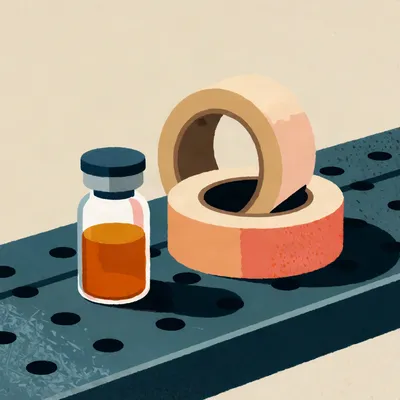
Daniel went hunting for 3M Primer 94, the little bottle that makes VHB tape grip surfaces it would otherwise slide off, and ended up buying it off AliExpress in vials so small they felt like a insult. He wants to know what's actually in it, what it does to a surface, and why something so documented is so hard to buy.

Herman Poppleberry, and I have been waiting for this one. Before we start, I'm going to say that the bottle is not mysterious. That is the first surprise.
The mystique is carrying a lot of weight for a clear yellow liquid.
It is. 3M publishes the full ingredient list in the safety data sheet. What they withhold is the exact percentages, which they call trade secret. So anyone can read what's in it, and almost nobody can buy it.
Documented but unobtainable. Like a library book that's been checked out since the eighties.
It comes from 3M's industrial adhesives and tapes division, it carries a Danger label, and a quart can runs about a hundred and ten dollars. Its real market isn't the garage. 3M's own New Zealand page says it's commonly used for film and vinyl graphics in automotive detailing. Car wraps. The DIY cult is an industrial product that leaked.
So how does a leak get a religion?
Let's open the can first.
Gently. It's flammable.
Very. The flash point is minus twenty Celsius, so it will light on a cold day. Now the ingredients. Cyclohexane is thirty to sixty percent. Xylene is fifteen to thirty-five. Ethylbenzene is under eleven, ethyl alcohol five to ten, and then a long tail of things like toluene, cumene, and benzene at under three hundredths of a percent.
Benzene is in the tail. That's a lovely detail.
Trace amounts, yes. Now the actives. Chlorinated polyolefin is under two percent. An acrylate polymer is one to five. A pinch of epoxy resin and maleic anhydride. The rest, roughly ninety-five percent, is solvent delivering that tiny payload.
So I paid for a bottle of mostly xylene with a rumour in it.
Solids content is about six percent by weight. It's thin, thirty to forty centipoise, density three quarters of a gram per millilitre. Water-thin, basically. Not a gel, not a paste.
Which is why the tiny vials worry me. Thin, volatile, and sitting in a plastic tube.
Hold that thought, because it comes back. First, the chemistry. Polypropylene and polyethylene are non-polar hydrocarbon chains, very low surface energy. Nothing wets them, so nothing sticks.
Water beads up. Tape skates off.
Right. Think of a freshly waxed car in the rain. The water sits in domes because it would rather cling to itself than spread across the wax. Adhesive does the same thing on polypropylene. It never makes real contact, so it never has the chance to bond.
So the problem isn't that the glue is weak. The glue never gets to touch anything.
Chlorinated polyolefin is essentially polypropylene with chlorine atoms hung along the backbone. The chlorine makes it polar enough that adhesives will wet it and bond. But the backbone underneath is the same polymer as the plastic you're sticking to.
So it's a double agent. Speaks plastic on one end, adhesive on the other.
The proposed mechanism is diffusion and entanglement. The solvent swells the surface a little, the CPO chains work in among the polypropylene chains, and you get a continuous bridge from plastic to adhesive.
Chains tangling. Like the cables behind a desk.
Pretty much. And it's been tested. A two thousand and one paper in the Journal of Adhesion Science and Technology used radiolabelled CPO. It found the CPO and the polypropylene blends were actually immiscible, they don't truly mix, and yet it still measured real diffusion into the substrate.
So it doesn't dissolve in, but it sneaks in.
Enough to anchor. Think of two decks of cards shuffled only at the edges. They stay separate decks, but the corners interleave enough that you can't slide one off the other easily.
Okay, but how do you even see that? You can't watch a molecule wander.
That's why the radiolabel matters. They tagged the CPO so they could detect where it ended up, and it showed up below the surface, in the substrate. Another conference paper measured a four to five-fold adhesion increase for a latex acrylic topcoat on polypropylene. And the surface analysis showed the failure happening at the topcoat and primer interface, not at the plastic. The primer's grip on the plastic became stronger than the coating above it.
Meaning the plastic stopped being the weak point.
Yes. Now paint is a different story. The solvents, xylene, ethylbenzene, cyclohexane, soften and swell the paint film slightly. The acrylate and epoxy bits key into it before everything flashes off. That's why it helps on painted metal where tape tends to give up.
So on plastic it's the chlorinated stuff, and on paint it's mostly the solvent being rude to the paint.
That's a fair split, though I'd say the acrylate does real work too. I'm not sure how much each part contributes, and 3M doesn't say.
Does more primer mean more grip? That's what I'd assume, and I'd be wrong.
You would. 3M is blunt about it. Quote, it's important to use the minimum amount of product necessary as over applying can cause sub-optimal results. A thick layer becomes its own weak layer. Typical CPO promoters go on at one to two tenths of a mil dry, and six percent solids sits right in that window.
A tenth of a mil. That's a coat you can't see.
Think of it like the film of soap left on a plate after you've rinsed it. Add more and you don't get a stronger bond, you get a slippery layer that shears apart under load.
So the instinct to slop it on is exactly backwards.
Wipe it on, let it dry. About five minutes at room temperature. Porous surfaces may need a second coat for even coverage.
So how would I know I've done it right, if I can't see it?
You mostly don't, which is the awkward part. A thin, even wipe that dries clear is the goal. If you can see puddles or a tacky residue, you've gone too far.
Which means a vial of a few millilitres is plenty. Maybe the tiny vials aren't miserly. Maybe they're the sensible amount.
Huh. That's a better defence of them than I had. Coverage is about fourteen point seven square metres per litre, so a tiny vial really does cover a surprising number of LED strips.
Now, the other half. Why can't I walk into a shop and ask for it?
Start with the hazard label. Flammable liquid category two. Skin sensitizer. Aspiration hazard, may be fatal if swallowed and enters airways. Reproductive toxicity category one B, may damage fertility or the unborn child. Suspected carcinogen. Damage to the nervous system on repeated exposure.
That's a short list of things you'd like in a glue.
Then the states. Uline's page says, quote, not available in California, Connecticut, Delaware, Massachusetts, Maryland, Maine, New Jersey, New York, Pennsylvania, Rhode Island, Utah, Virginia, Vermont and the District of Columbia.
Fourteen places that decided no.
Fourteen states plus DC, and that's a big slice of the population. 3M doesn't explain it, so the VOC link is inference. But its own data sheet says it contains more than two hundred and fifty grams per litre of volatile organic compounds.
Is that a lot? I have no feel for that number.
Regulators set limits on VOC content for consumer products, and those limits vary by product category and by state. I won't quote a specific threshold, because I don't have one for this category. But a figure above two fifty grams per litre puts it in territory where a strict state could plausibly say no.
So a state rule written for spray paint or cleaners could catch a primer nobody was thinking about.
Plausibly, yes, though I'd be guessing at which rule applies. That's why I keep calling it inference.
And then 3M recommends something else.
It does, which I love. The data sheet points to Scotch-Weld Plastic Adhesive 2262 thinned five or ten to one in acetone, or Plastic Adhesive 1099 unthinned. The manufacturer is steering you away from its own cult product.
Like a restaurant telling you the soup's better at the place across the road.
Add the packaging. A quart can, twelve to a case, a hundred and ten dollars each at Uline, ninety-six if you buy twelve. Shelf life is eighteen months from manufacture.
So for a hobbyist that's a quart of something that expires before you finish one percent of it.
And it's flammable, so shipping gets fiddly. Put that together and retailers just don't carry it. A two thousand thirteen forum thread asks if any hardware store has it, and the reply is that it's been phased out because it's only for 3M products and there's no demand. Someone in Perth said Bunnings had never heard of it.
Phased out is a very confident claim.
And wrong. 3M revised the technical data sheet in May of this year. It's alive industrially, just invisible to consumers. That gap is where the legend grows.
Nobody can find it, so it must be forbidden. That's how every cult starts.
And the grey market fills the hole. One reseller sells what it labels three M adhesion primer in half ounce to four ounce bottles from four ninety-nine, bundled with its LED strips. An eBay listing offers a point-oh-two ounce tube.
A fifth of an ounce. You could lose that in a sock.
Point-oh-two, actually, so a fiftieth of an ounce. Smaller than a fifth, and it's a real listing. And that's the important point. I couldn't find any consumer-sized package made by 3M. Every 3M item is a quart or bigger. So the small bottles are decants, somebody else's repackaging, and you can't verify what's in them.
Right, I misread my own note. Either way, which brings me to Daniel's vials. Thin solvent, tiny container, unknown provenance. It could be Primer 94, or it could be mostly xylene and optimism.
I can't say about his particular vials. The practice of decanting is well documented, though, and a leaky cap on a volatile liquid would mean it dries out before you get to it.
And if it dries out, what's left behind?
A film of those few percent of solids, which is the active part, stuck to the inside of the vial. The solvent goes first because it's the volatile part. So a vial that feels half empty might be holding most of its useful material on the walls, just unusable.
Could you thin it back down?
I wouldn't guess. Without knowing the exact solvent blend, you'd be improvising a formula, and the thin coat is the whole point.
There's a callback in here, isn't there. Skyscraper tape.
The tape is the famous part, and the primer is the thing that actually makes it hold on stubborn plastic.
And the trade has a view of it. What do the graphics people say?
There's a lovely line from a wrap installer on a sign forum. He uses it on the black plastic on vans and has good luck, quote, and now down the road whomever gets the pleasure of peeling off the stuff, may the force be with them.
So it works too well. A mount you can't remove.
That's the trade-off of moving the failure point. If the bond to the plastic is stronger than everything else, then removal means something else gives, usually the adhesive or the coating.
So nobody who uses it gets to be casual about placement.
Measure twice, because you won't be moving it. There's a cheaper sibling too, Tape Primer 83, which people describe as basically VHB adhesive improvers and cheaper in larger quantity. Same family.
Anyway, before we get further into the vials, Desmond has something for us, don't you, Desmond?

This is Desmond's Money Tip. Save the water you boil your potatoes in and do the washing up in it. Over a year that is roughly four pounds fifty in washing up liquid and hot water you did not have to buy.
Over a lifetime, if you start young, call it two hundred and eighty pounds. I keep a jug by the sink for it. My wife has stopped asking about the jug.
Money is mostly just the things you did not spend, sitting there quietly, going cold.
I might try the jug.
Corn, no. Starchy water. On the dishes.
Back to the primer.
So the regulatory map is the real scarcity. It's not secret. It's a flammable, reproductive-toxic, high-VOC solvent blend that a big bloc of states won't allow on a shelf.

The tin was gone by the Wednesday. Four pounds twenty at the car boot, a Hammerite lid on it, and I had my doubts about the contents. It was Primer 94. I knew by the smell the second I got it open. Sweet, a bit like pear drops left in a shed. I used it on the plastic trim of my wife's brother's Corolla, in two thousand and three, when he said the trim kept popping off. It did not pop off again. Herman, you explained the swelling very well, but I'll tell you, you can still smell it on the trim now. Nigel took the Corolla to Spain in two thousand and nine and it's still on it. He won't give me the trim back. I've asked. Nigel could hold his breath for two minutes and fourteen seconds, and he reminds me of it every Christmas. I find the chemistry fascinating, though. How a thing that thin can hold a car together. The work was good work, and the trim is still on.
Spain's a long way to go for a bit of plastic.
A good primer layer on polypropylene would behave exactly like that. The failure point moves up into the coating.
Though twenty-odd years later, still smelling it. Does that mean the solvent never fully leaves?
I wouldn't claim that from one man's nose. The solvents flash off in minutes by design. What he's smelling could be residue, or the car, or memory. I can't say which.
Two minutes fourteen. That's a lot of fumes he could have avoided.
Which is the point about ventilation, honestly. Xylene and cyclohexane vapours are heavier than air and collect low, and the data sheet flags nervous system damage on repeated exposure. A garage with the door shut is the wrong place to be wiping it on.
Outdoors, or a door open with a breeze, and gloves because it's a skin sensitizer.
Away from anything that sparks. With a flash point of minus twenty, a pilot light or a water heater in the corner is a real concern, not a theoretical one.
The smell Hilbert described, the pear drops. Is that a warning or a feature?
Warning. Sweet solvent smell means vapour is reaching your nose, which means you're breathing it. It's pleasant, and that's part of why it's easy to underestimate.
What are you paying for in a four ninety-nine half-ounce bottle? Under two percent of it is the active part, and you can't check whether it's there.
The product is alive industrially but fading from consumer reach, with a May data sheet on one side and fourteen states refusing to ship on the other. The cult may outlast the can. A thin coat of something real may be better than a thick coat of something unknown.
Thanks to Hilbert Flumingtop for producing.
If you want more of this, try episode five nineteen, When a Frustrated Renter Unlocks the Secrets of Skyscraper Tape; and episode four forty-nine, Why Your Tape Fails. This has been My Weird Prompts. If you enjoyed it, leave us a review wherever you listen.
See you tomorrow.


 chatterbox-regular