Daniel's back on the noise question. Same room, same sound, two brains, one of them lets it go and the other can't. Daniel is the one who can't. He has ADHD, the background noise only pushes in when he's trying to focus, and the part he wants this time isn't just the impairment. It's the distress. His words: when you're not in control of an external stimulus and it's causing you problems, that's distressing in itself — and he suspects the distress feeds back and makes the noise push in even harder.

And that suspicion is a real hypothesis, not just a feeling. There's a famous line of work on exactly that.
There is. But first, the ground rules. Last time we did this topic properly, we went deep.
We did go full neuroscience on him. Evoked potentials, gating ratios, the whole apparatus. He liked it, and he also said some of it went over his head.
So this is the friendly version. Everyday pictures, several of them, and we see which one actually fits. Then the distress loop, which is where his real question lives. Ready?
Start at the door. The sound goes in the ear.
The door. Two people sitting at the same table, someone's talking three seats away. Identical acoustic information arriving at two eardrums. The other person's brain files it under furniture within seconds. Daniel's brain keeps re-delivering it, like a courier who won't accept the package is unwanted.
Keeps knocking, keeps re-presenting the clipboard.
And to be clear about what we mean by "files it under furniture" — the other person isn't trying. They're not gritting their teeth and heroically ignoring the conversation three seats away. Ten minutes later they'd struggle to tell you it was happening.
Right, that's the part that stings for someone like Daniel. It's not that the other person is better at ignoring. It's that the ignoring already happened, automatically, and left no receipt. Daniel gets the receipt every time.
That's the puzzle in its cleanest form. The ear is doing the same job in both people. The cochlea isn't the difference. Everything interesting happens after the sound arrives — and the mistake almost everyone makes, including a lot of writing about this, is treating filtering as one gate. One door, either it closes or it doesn't.
And it's not one door.
How many is it?
It's a stack. There's an early automatic layer that suppresses repeated, irrelevant sound before you're even aware of it. There's a top-down layer where the front of the brain chooses what to attend to. There's the capacity of your working memory to hold the task and keep competitors out. And there's your arousal state, which sets whether the whole system is locked onto one thing or sampling everything. Four layers, each one can differ between two people, and they can all produce the same complaint.
Which is why Daniel's question "why is this so hard to treat" has an uncomfortable answer waiting at the end.
It does. I'll flag one thing up front so it doesn't ambush us later: the lab tests for the earliest layer are messy. There was a scoping review a couple of years ago that looked across the sensory gating studies and called the results inconsistent. Some ADHD studies find weaker gating, some don't. That's partly a measurement problem — measuring one layer of a four-layer stack in a lab is hard — and it is not evidence that the filtering is fine. Daniel's experience is the data point that matters here.
Agreed. His experience is given. We're here for the pictures.
Then let's build the stack. First layer: the bouncer at the door.
The bouncer.
Before anything reaches awareness, the brain does a first pass on incoming sound and drops what's repeated or irrelevant. The same click over and over — your brain's response to the second click is smaller than to the first. That shrinkage is the bouncer doing his job. In the lab they measure it two ways: the response to a repeated click, and whether a faint sound before a loud one dampens your startle. Some studies find that bouncer is sleepier in ADHD, some don't.
Can I test whether I have a working bouncer at home? Or is this strictly a lab thing?
You actually can get a flavor of it. Anyone who's moved near a train line or a flight path knows the version: the first week, every train is an event. You wake, you brace, you catalogue it. A month later you sleep through the midnight freight. That's the bouncer learning the pattern and stamping it through without bothering you. The reason the conversation three seats away doesn't get that treatment is that it never repeats identically — it's not a train schedule, it's people, and people are novel every second.
So the bouncer handles the train but not the table of six.
The bouncer handles what's regular. The table of six is irregular by nature — which means the problem moves up the stack, to the layers that handle novelty.
So the bouncer might be letting people in, or the problem might be further down the corridor.
And the inconsistency across studies is itself part of the story — when the complaint can come from four places, a test of one place will find it only in the people whose problem is at that place.
A mixed lineup of suspects, and one witness.
Which is a decent way to hold the whole literature, actually. The bouncer is one layer. Here's the next one up — the one that explains why this bites only when he's trying to focus. Before we get there, though, let's hear from Hilbert.

Hilbert's Anteater Trivia. The southern tamandua lives across much of South America east of the Andes. I have spent years east of things I could not control, and I am still here, mostly.
That's the spirit we're studying today.
The searchlight, then. Top-down selection. There's a thin shell of tissue wrapped around the brain's sensory relay station — everything you hear and see passes through the relay, and the shell sits on it like a customs post, turning each stream's volume up or down. In twenty fifteen, Wimmer and Halassa and colleagues showed in mice that the prefrontal cortex — the planning, task-holding part — is what drives that shell. The cortex picks which sense to attend, and the shell turns the other one down.
So it's not that the noise gets quieter. Someone is actively aiming a volume knob at it.
Aiming is the right word — Francis Crick sketched this same idea back in the eighties as a searchlight. The experiment that made it concrete: they silenced the prefrontal cortex in the mice, and the mice could no longer ignore the irrelevant sense. The searchlight stopped sweeping. Everything came in at equal priority.
And nobody's tested that circuit in humans with ADHD.
Not directly, no. It's mice. But it's the cleanest demonstration we have that ignoring is an active operation, not a passive one — and active operations can fail from the top, not just the bottom.
That reframes something, actually. People say "just ignore it" as if ignoring were the lazy option. It's the expensive option. Ignoring takes staff.
It takes a prefrontal cortex that's currently employed on your side. And it explains something about the classic cocktail party feat, too — following one voice in a wall of voices. Everyone frames that as an achievement of hearing the one voice. The mouse work says half the achievement is the active suppression of all the others. The spotlight and the dimmer fire together, or neither works.
There's a cousin of the searchlight you wanted to bring in — go on.
The dimmer switch. Your brain runs a rhythm called alpha, around ten cycles a second, and for a long time it was treated as an idle hum. It isn't idle. There's a study from twenty nineteen, thirty-odd people with EEG, where alpha activity shifted to track where a distractor was coming from — and the people whose alpha shifted toward the distractor were the ones who resisted it.
Wait. The alpha goes to the thing you're ignoring, not the thing you're listening to?
Toward the distractor's location, yes — the reading is that alpha acts like a volume knob pointed at a region, and pointing it at the noise turns that region down.
A dimmer you aim at the annoying table.
That's the picture. And it gives a shape to Daniel's phrase, that the noise "pushes in." One plausible reading, and it's a reading, not a tested ADHD finding, is that some brains point the dimmer reliably and some point it late or loosely. The person next to him may have the dimmer on the table the whole evening and never know they're doing it.
Next picture, the one with the best party trick in all of psychology.
The workbench. Working memory as the surface you hold the task on — and blocking a competing stream takes surface. Conway, Cowan and Bunting, two thousand one: people listen to a story in one ear and are told to ignore the other ear. In the ignored ear, at some point, someone says the listener's own name. About two thirds of people with low working-memory span hear their own name. About one in five with high span.
Same ears. Same volume. Same name.
Same everything. The difference was whether the ignored stream stayed blocked. The low-span workbench was too crowded to keep the lid on, so the name got through.
Two thirds versus one in five is a huge gap for "same sound, both healthy people."
It's one of those results I'd want every person who says "just tune it out" to sit with for a minute. Your ability to tune something out is capacity, and capacity is not distributed evenly.
And it's not about intelligence, right? That's the assumption people will make — that the high-span people are the smart ones.
Working memory correlates with some things, but that's not what the name study is showing. It's showing a specific resource being spent on a specific job — lid-holding — and that resource varies. You can be brilliant and have a crowded bench. The name still gets through.
Herman, honest question — which of these pictures do you actually think is Daniel's?
I don't think anyone can say, and that's not me hedging. It's the structural fact of the whole topic. The leaky bucket.
Go.
Load theory — Nilli Lavie's framework, and Forster and Lavie extended it. The idea: attention isn't just a spotlight, it's a fixed quantity of stuff. If your main task uses all of it, nothing leaks to the noise. If your task is dull and uses half of it, the other half leaks — straight to the background conversation. Forster and Lavie in twenty sixteen found distractibility runs as a continuous trait across the whole population, tracking ADHD symptoms, and — this is the part I love — when they raised the perceptual load of the main task, distraction dropped at every level of the trait.
Hold on. That says the noise problem shrinks when the work gets harder?
When the work gets richer. More to perceive, more to hold — the attention is spent on the task instead of leaking. And that maps directly onto Daniel's phrasing. He said the noise pushes in only when he's trying to focus. Notice it doesn't push in when he's relaxed on the sofa with the same room, same noise.
Because on the sofa there's nothing to protect. No task, no leak, no complaint.
And a dull task — half a task — is the worst case. Enough task to need focus, not enough task to absorb it. Spare attention pooling on the workbench, and the conversation across the room walks in and takes a seat. Anyone who's tried to read their email in a busy office knows the shape of this — the email is too thin to fill the bucket, so the room pours in.
That's the trap I don't think people name. It's not the hard work that gets interrupted. It's the boring work.
The dull work, yes. Hard-but-rich work can hold the room off. This is also the gentlest possible correction to the way Daniel usually frames the fight. He wants to fix himself so the noise stops mattering. Load theory says the noise matters less when the work matters more — and that's not fixing yourself, that's feeding the task.
That'll land well. Two more pictures and we're at the full stack?
Two. The idle engine. There's a brain network that runs when you're doing nothing — the daydreaming network — and in ADHD it doesn't shut off fully when a task starts. Sonuga-Barke and Castellanos laid this out around two thousand seven. Its slow rhythm breaks into the task, and every break-in is a gap where an external sound can grab you.
So the daydream isn't competing with the noise. It's holding the door open for it.
That's a better one-line version than the papers manage. And it means the internal and external distractions aren't two problems — they're one gap with two sources pouring through it. People always ask, "is it my mind wandering or the room?" and the honest answer is the question may not have two answers.
Last one.
Arousal. Down in the brainstem there's a small cluster called the locus coeruleus that sets your overall arousal level, and it has two operating modes. Locked-on: you're committed to one thing, everything else muted. Searching: you're scanning, sampling everything, nothing muted. Aston-Jones and Cohen described those modes in the early two thousands. Trying to focus while you're in searching mode is trying to read in a room you're also patrolling.
Every sound gets sampled on the way past.
Everything gets a tap. And there's a counterintuitive wrinkle worth giving Daniel, because it explains something he's probably noticed and never had explained: the Moderate Brain Arousal model says that in ADHD the internal setting is noisier — and a steady external noise, like white noise, can actually sharpen focus. It gives the system something predictable to chew on.
So the cure for noise can be noise.
Steady noise, yes. That distinction — steady versus not steady — might be the most practical sentence in the whole episode. Unpredictable sound, irregular sound, and speech are hard for anyone to habituate to. Speech worst of all, because the brain processes it for meaning automatically, whether you asked it to or not. Memory researchers have a name for it, the irrelevant speech effect — background speech reliably degrades what you're holding in mind, even for people with no attention issues at all.
That one I'll vouch for personally. Herman, you can be in the next room talking about a router with somebody, and I lose the thread of whatever I'm holding.
You do surface mid-thought when I'm on the phone.
I surface because the phone conversation contains half a plot. A ventilation hum contains no plot. My brain agrees to ignore things without characters.
That's the irrelevant speech effect in one household. And it's worth underlining for Daniel — background noise isn't equal-opportunity. If there's speech in it, he's not just filtering sound, he's filtering language, and language doesn't ask permission.
So the answer to Daniel's first question — same sound, different brains — is that there isn't one difference. There are at least four layers, each independently variable, and the complaint sounds identical whichever one is off.
Two people can be off at different layers and describe their week in the same sentence. Which is exactly why the treatment question is about to get difficult.
It's also why his hunch about the distress interests me more than any single layer. The stack explains the filtering. It doesn't yet explain the distress — and that's the part Daniel is really asking about.
Then let's go there properly, because the evidence behind his hunch is stronger than he probably expects. Nineteen seventy-two, David Glass and Jerome Singer, urban stress research. People exposed to loud noise that was unpredictable and uncontrollable — random bursts, no way to stop it — afterwards showed worse frustration tolerance and worse proofreading than people exposed to equally loud but predictable noise.
Same volume, both groups?
Loudness held constant. What differed was predictability and control. Then the detail that made the study famous: they gave another group a button. If the noise became unbearable, they could press it and stop it. The after-effects largely disappeared.
Did they press it?
Most never pressed it. Not once.
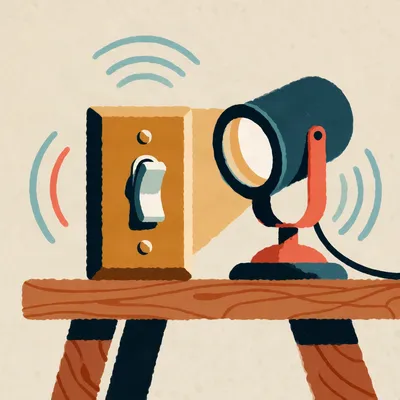
The button worked by existing.
By being there. The harm wasn't the decibels — it was the not being able to do anything about the decibels. Perceived control drove the damage, and removing the loss of control removed most of it, at the same volume. That is Daniel's suspicion, demonstrated in a lab fifty years before he typed it.
That's a strange result when you first hear it, and then it isn't at all. The noise wasn't just a sound. It was a standing reminder that someone else controlled the room.
And his version is worse than the lab's, because his noise comes with a task attached. He's not just sitting in someone else's sound — he's failing at something he cares about inside it. The lab subjects proofread badly afterwards. He's proofreading badly live, and watching himself do it.
Which brings in the second half of the loop. Walk me through what anxiety does to this.
Attentional control theory — Eysenck and colleagues, two thousand seven. Two effects that matter here. Anxiety impairs the inhibition function of attention, the specific ability to resist distractors. And it biases attention toward threat — things tagged as dangerous get priority sampling.
And the noise has been tagged. By now it's not neutral furniture — it's the thing that ruined Tuesday.
It's a threat cue with a rap sheet. So the loop closes on itself. The noise intrudes. The task stumbles. Frustration and lack of control raise stress. Stress weakens exactly the inhibition function that was holding the noise out, and raises vigilance on top of it. The noise comes back in harder. Daniel isn't imagining that acceleration — the machinery says it should happen.
The brain's alarm system keeps checking whether the thing it's afraid of is still there.
And every check is a sample of the noise. Vigilance is listening, by another name.
Something clicks for me here — remember the searching mode from the arousal layer? Stress pushes the system toward scanning. So the distress isn't just an unpleasant feeling riding on top of the filtering problem. It's driving one of the layers.
It's fuel for one of the layers. The same locus coeruleus that was maybe already tilted toward searching because of baseline dopamine tone is now getting pushed further into searching by the stress response. The loop and the stack aren't two systems. The loop runs on the stack.
Which is why his question "why does the distress make it worse" has a mechanical answer, not just a psychological one.
A mechanical one with a fifty-year-old experiment and a theory of attention behind it. Now — the treatment question, and this is where I want to be careful, because the honest structure of it is annoying.
Annoying how?
Several layers can produce the same complaint. There is no clinical test that tells you which layer dominates in a given person. And the distress loop amplifies whichever layer it is, so by the time someone walks into a clinic, the original difference and the amplification are braided together. A fix aimed at the wrong layer does nothing. Or, occasionally, makes it worse.
Give me the wrong-layer fixes. Concrete ones.
Noise-cancelling headphones for a working-memory-capacity problem. The headphones lower the sound at the ear, but the workbench was the issue — the sound that's left still takes the same surface. Or a stimulant for a loss-of-control problem. Stimulants and atomoxetine raise prefrontal dopamine and noradrenaline, which plausibly strengthens top-down control and the locked-on arousal mode — that's the layer they fit. But the man whose real wound is that he can't escape the room gets chemistry aimed at a gate.
And nobody's run the trial that would tell us. Filtering as an actual outcome measure for the medication.
Not to my knowledge — no trial has measured background-noise filtering directly as an outcome. The medications were trialed on attention scales, on classroom measures. Filtering is downstream in a way nobody itemized.
That's an odd gap. You'd think "can you work in a café" would be the first question.
It would be a better outcome measure than half of them. White noise, meanwhile — the thing Daniel already owns — has actual numbers now. There was a meta-analysis in twenty twenty-four, thirteen studies, three hundred and thirty-five participants, all lab tasks, children and young adults. Small benefit in ADHD. Slight harm in people without ADHD.
Slight harm.
The same sound, opposite sign depending on the brain. And there are no brown-noise studies at all, despite brown noise having a moment — every claim you hear about it is extrapolated from white and pink.
So the internet's favorite focus trick has thirteen small studies behind it, and the variant everyone switched to has zero.
Zero that I've seen. I want to be fair to it, though — the direction makes sense. White noise fits the arousal layer, and it works by substitution: it masks unpredictable sound with predictable sound. A bass pulse that cuts through a noise machine — a pulse is an event, events get sampled, the machine replaces events with weather. Weather you can ignore; events you can't.
Also worth saying plainly: small benefit means small. He shouldn't expect the machine to solve the room.
It won't solve the room, and the meta-analysis never claimed it would. What it does is move one input from unpredictable to predictable, which the habituation research says is the single most favorable trade you can make without leaving the room.
The other lever nobody expects: make the work richer. From load theory — the leak is spare attention, so give the attention somewhere to go.
That's the counterintuitive one and I keep coming back to it. The instinct under distress is always to cut the noise. Load theory says an equally valid move is to raise the task — richer input, more to perceive, more to hold — and the distraction drops at every level of the trait. The dull task is the trap. Half a task, and the noise gets the other half.
And the control lever — that's the Glass and Singer one. It's not even about less noise. It's about knowing you can stop it.
Headphones you can put on, a door you can close, knowing where the exit is. Knowing you can escape is most of escaping. And stress reduction — treating the anxiety itself — targets the inhibition hit, which is a different lever again, aimed at a different layer.
So the menu is: mask the sound, enrich the task, restore the control, treat the stress, or medicate the gate. Five levers, five different layers, and no test that tells you which one is yours.
That's the structural reason it's hard to treat, stated plainly. It's not that the science is weak — each layer has real findings behind it. It's that the complaint doesn't tell you the mechanism, and the amplifier is wired into the complaint.
One boundary worth drawing before we run out of room, because Daniel has wondered about it himself — misophonia. Where does that sit?
Different thing, as far as anyone's established. Misophonia is decreased tolerance to specific sounds — the consensus definition dates to twenty twenty-two — and there's work showing mouth sounds get motor-mirrored in the listener's own brain, which is a different mechanism from attention-dependent filtering. Whether it overlaps with what Daniel experiences is not established. He's considered it himself and come to the same conclusion. One sentence and I'll leave it there: it's a neighbor, not a twin.
A neighbor. Fine. So the picture for him — same sound, two brains, and the difference lives somewhere in a stack of four variable layers, then a loop tightens around whichever one it is.
And the loop is the bit that responds to being understood. Which is oddly hopeful — the thing Glass and Singer showed is that the harm moves when the control moves, and control includes knowing what's happening to you.
Knowing the bouncer is understaffed is a different evening than thinking the whole club is out to get you.
Nineteen seventy-two, and the button that worked by existing. The mechanism of it is...
A compressor. Loud things pulled down, quiet things left alone, the room made even. That's what the button did. It made the ceiling of the evening predictable.
It's not wrong.
It's not the standard account, either, but it holds. The button capped the worst case. Predictability was the whole active ingredient.
The other thing is the dog. The studio I work from now shares a courtyard with a terrier, little one, belongs to the woman at number four. She puts it out mornings and it gnaws a bone on the flagstones. Hours. The man at the next bench, Arik, proofreads patents — he could not filter that gnawing. Took me a week to notice anything was wrong and him another three days to say so. I'd have gone on forever. He doesn't complain, he rearranges. Moved the kettle onto the bench between us and the window, boils it all afternoon.
The kettle is between him and the dog?
Between his ears and the dog, yes. Steady noise, his choice, he controls the switch. I think the kettle is louder than the dog ever was. He says that's not the point, and he's right, though I don't like agreeing with a man who relocates my kettle without a word. I take the bone side of the courtyard for my loud work now — the owner and I agreed the dog comes in at noon, so I sharpen and drill before twelve. Corn got four metaphors out of a bouncer; the dog took me four seconds to place.
What did you place it as?
Weather. He turned the dog into weather. That's all the kettle does.
That's the masking point exactly — it was never about loudness, it was about swapping an event stream for a continuous one. His kettle is a bigger sound doing a smaller job, deliberately.
And he chose it himself, which is the button again. The whole therapy is that he's the one holding the switch.
Noon, every day, the dog goes in. Number four likes her mornings quiet too, apparently. We're three people and a terrier all managing the same courtyard.
The whole research literature in one courtyard, and none of them read it.
That's the thing I'd want Daniel to sit with, actually. Arik didn't fix his filtering. He fixed his control — a kettle, a switch, a bench he chose — and the gnawing became weather.
It tracks with everything we've covered. The complaint is the sound, but the wound is the control, and the wound is the piece that feeds back.
Which leaves the question we can't answer for him — if the complaint is identical and the layer differs, how would you ever know which layer is yours? The lab tests are inconsistent, the layers braid under the amplifier, and no trial has measured filtering as an outcome of anything.
And maybe that's the wrong question anyway. Maybe the layer doesn't need diagnosing before the levers get tried — the levers are cheap, mostly, and harmless in the trying. The diagnosing matters for the research. For the person in the room, the loop is the bit that yields.
Distress is treatable from the outside in, even when the filter isn't treatable at all.
You know, my instinct is always to reach for the mechanism first. Explain the gate, then fix the gate. This one pushes the other way — the gate is real, the layers are real, but the man at the bench next to Hilbert got his afternoon back with a kettle.
And Daniel already owns the noise machine. He might be one repositioned machine away from the next intrusion being weather.
He'll know within an evening. That's the good property of the control lever — it tells you immediately whether it's yours.
Our thanks, as always, to Hilbert Flumingtop at the desk, producing this thing and timing terriers.
He'd say the terrier times itself.
For more along these lines, there's episode twenty-five sixty-five, Why Background Conversation Hijacks Your Focus; episode twenty-nine oh five, How Your Brain Filters Noise (And Why It Fails); and episode twenty-six twenty-five, White Noise vs Pink vs Brown. This has been My Weird Prompts. If the show's been worth your afternoon, a review wherever you listen helps other people find it — and there's the whole archive at my weird prompts dot com.
We'll be back soon. Until then, keep the kettle where you can reach it.