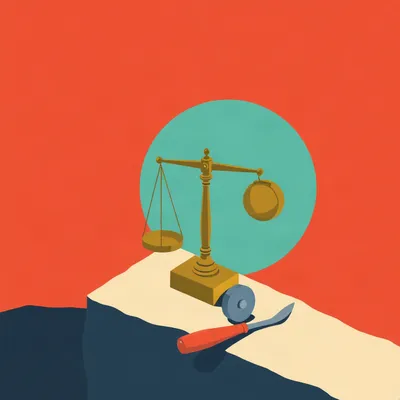
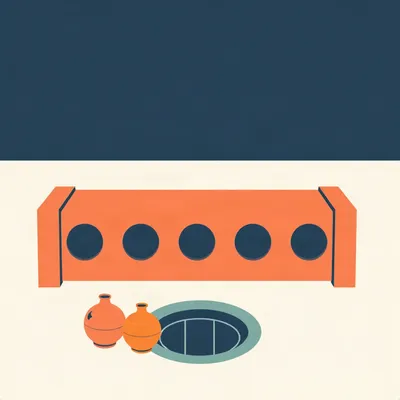
A portable bag of fraud feels almost excessively well organised.

The warnings about dishonest weights always make me imagine an entire industry of ingenious cheating. I want the actual tricks, from shorting somebody at a market stall to fiddling what a ruler collects, and the machinery people invented to catch it.
Daniel wants the crooked merchant opened up for inspection, pouch included. The prophets make the offence sound familiar enough that nobody needs the mechanism explained. What actually happens between putting grain on a scale and walking away with somebody else's money?

Often, the clever part happens before the customer arrives. You make the thing that defines a pound dishonest. Then you can stand there with both hands visibly clear of the balance and give a wonderfully convincing performance of fairness.
Clean hands. Criminal stones.
The surviving evidence gives us remarkably detailed tricks and countermeasures, but mostly through laws and inscriptions rather than colourful accounts of named merchants being caught. The authorities write down what people must stop doing. Some of those instructions are so specific that you can practically see the offending container.
That sounds promising. A law saying be honest tells me very little. A law saying stop doing that particular thing with the rim sounds like somebody has been getting away with it.
The structural problem is ownership of the measurement. The merchant owns the weights, the balance, the vessel, and the premises. A customer can watch everything happen and still lack an independent answer to what that shop's unit actually contains.
Local variation makes the argument harder, too. Different doesn't automatically mean fraudulent. A unit can be legitimate in one market and unfamiliar in another. You need to establish the agreed measure before you can prove somebody has shortened it.
Pre-modern India offers a useful comparison across a much longer period. Units varied with region, commodity, and rural or urban practice. Seed weights, including the ratti and wheat berry, sat alongside arm-lengths and finger-widths. Akbar's standardising measures used barley grains, but supplemented existing practice rather than instantly abolishing it.
Does that mean travelling merchants have a legitimate conversion problem as well as an opportunity to cheat?
Yes. A buyer has to distinguish conversion, custom, wear, and deliberate manipulation. Consistent local practice can support real commerce. The opening for fraud comes when one party understands the conversions and controls the equipment while the other cannot readily check either.
You are already looking fondly at the standard weights, Herman. I predict you'll trust the official one until we reach the official.
I trust a comparison against a protected reference. The official will have to earn his invitation.
He has the keys.
Unfortunately, yes. Rome's well-documented, reasonably consistent units don't mean every transaction was policed. Documentation and enforcement are different achievements.
Keep three targets separate. You can cheat a customer with your shop equipment. You can cheat a tax collector about what you owe. Or somebody inside the administration can falsify the public standard and make an entire chain of transactions wrong.
The last one sounds harder to detect because everybody else can be following the rules.
They can even accuse the honest outsider of having the wrong weight. Once the reference is corrupt, agreement becomes evidence against him.
Deuteronomy identifies the portable version very plainly. No larger and smaller weights in your pouch, and no larger and smaller measures in your house. Two objects claiming the same denomination let you choose the version that benefits you.
Walk me through it with grain. I want to see which weight goes where.
When you buy grain by weight, put the heavier false weight opposite it. The supplier has to give you more grain to balance what you call one unit. When you sell, use the lighter weight. Your customer gets less grain for that same nominal unit.
The stone gains weight when you're paying.
You sometimes see that described backwards. For goods weighed against a counterweight, heavier when buying and lighter when selling is the profitable direction. If you're weighing the payment itself, you have to follow that transaction separately. The law condemns the interchangeable standards, not merely one choreography.
That makes it more brazen than a badly adjusted scale. The merchant possesses two contradictory definitions and chooses one in front of you.
He doesn't need to switch them while you're watching. Different customers, different transactions. Each individual sale can look internally consistent.
Corn, would you bring your own weight?
For a large purchase, yes. For a handful of food, probably not. Then we can spend the afternoon arguing about whose stone is ancestral, whose is official, and whether either balance is any good.
That practical limit matters. Verification has a cost. A little loss repeated across ordinary purchases can reward the cheat without making each buyer's independent inspection worthwhile.
The merchant's pouch of stones is the fraud tool, then, and it's small enough to carry.

Friends, are your bronze weights feeling a little too honest? Are your deceitful weights not deceiving anyone? Then you need the Pouch of Plausible Deniability, the only portable stone set that comes with two sets of weights, a larger and a smaller, plus a third one we threw in because the price just dropped again, and again, and honestly it is basically free now, and for that basically free price we are also including an honest ephah, an honest hin, an arm-length of barley corn, and a signed certificate from Demeter herself, all of which are unrelated to anything but look great on a shelf. But hurry, because this offer ends the moment I finish this sentence, and I am nearly done, and there it goes.
I already own one. It made me reorganise a cupboard around three mutually incompatible weights. The portable set is also why the prophetic image works so well. Micah's bag of deceitful weights puts the dishonesty right in the merchant's belongings, ready for use.
Why does this become such a strong religious offence rather than just a commercial regulation?
The biblical treatment connects ordinary dealing to obligations before God. Honest exchange isn't something you suspend when no human inspector is present. Leviticus puts length, weight, and capacity together, bamiddah, bammishkal, uvammesurah, then demands honest balances, weights, an ephah, and a hin.
Dry goods and liquids both covered. Changing from grain to wine doesn't get you out of the commandment.
Nor does selling cloth instead. The scope reaches beyond scales. A shortened length measure or a deficient vessel can do the work without any theatrical thumb pressing down on a beam.
A vessel seems easier to cheat with. I can see the wine reaches the top, but I can't see whether the inside holds the promised amount.
A thick base can look reassuringly substantial while occupying space you paid to fill. That's an illustration of the vulnerability, not a particular recovered prosecution. The outside can advertise generosity while the useful cavity quietly disagrees.
Local bronze, stone, lead, wood... no, the important distinction isn't the material by itself. It's whether the object corresponds to a reference independent of its owner. A beautiful bronze weight can be beautifully wrong.
You would still photograph it.
Beside a reference weight, yes. Give me some credit.
Where does cheating the tax collector become different from shorting the wine customer?
In an illustrative tax transaction, under-measuring what you deliver can make a nominal obligation appear satisfied. An overlarge collection measure can work the other way, letting a collector take more than the stated due. Those are different beneficiaries. Tampering with the public measure goes further still, because it changes what other people use as their authority.
The ruler can be cheated by his collector. The farmer can be cheated by the same collector. Their interests overlap only until the collector sends the receipts upstairs.
Rome's lex Silia fixes public vessel relationships in law. The quadrantal of wine is tied to eighty Roman pounds, the congius to ten. That gives a physical comparison rather than a vessel merely declaring its own capacity.
Does passing that law prove somebody has already rigged the public vessels?
It proves the government considered the standard important enough to prescribe. It doesn't identify a particular offender or establish how often it happened. The vulnerability is clear; the prosecution story isn't supplied by the statute.
Legislators can anticipate a trick. They don't need a villain's signed confession first.
Six sextarii make a congius, and forty-eight make a quadrantal. The text also links the sextarius to pound-weight. Those relationships bind the smaller measures to the larger ones, though translating ancient capacity and weight language needs care about contents and conditions.
You can steal at the market and disagree with one customer. Falsify that public reference and you can make a district wrong together.
All right, how do you stop the district being wrong together? Somewhere somebody has to keep the thing everyone else compares against.
Athens gives us the spectacularly concrete answer. A decree from around one hundred and twenty BC orders copies equivalent to master measures and compels sellers across the Agora, workshops, shops, wine shops, and warehouses to use them. The rule follows trade indoors.
Moving the bad jug into a warehouse won't improve it.
It explicitly forbids officials to make the measures or weights larger or smaller. Disobedience attracts a thousand-drachma fine consecrated to Demeter and Kore, and citizens have a route to prosecute.
That's strikingly direct. It doesn't merely tell the official to catch somebody. It tells him not to manufacture the discrepancy.
That is why I don't think the merchant is the most revealing character here. The decree spends extraordinary attention on the people who issue and guard the standards. A dishonest shop affects its customers. A dishonest standard-maker can supply everybody's shop.
Would you let a conscientious official adjust the measure when he thinks the existing version is unfair, Corn?
Not privately. Publish a change if you mean to change it. Otherwise the conscientious official and the corrupt official have precisely the same privilege.
The decree takes that discretion away. Then it gets into geometry, which is... I admit, this is the part I like best.
Your ears have reached full specification.
For dried fruit and nuts, the choinix has prescribed dimensions and is sold heaped. The wording includes a depth of five fingers and a rim width of one finger. Fairness requires more than everybody vaguely agreeing the bowl looks full.
A finger still sounds wonderfully imprecise for a rule meant to end arguments.
Better than whatever the seller means by a generous handful.
It's a shared dimensional prescription within that measurement system. For fresh almonds, new olives, and dried figs, the decree calls for a choinix twice the size, with a rim three half-fingers wide. It also requires wooden vessels.
Before you build us one, Herman, explain why the wood earns its own sentence.
Material and rim shape affect the usable container and its heap. Requiring wood closes off some opportunities to change the wall and rim construction while presenting an apparently equivalent measure. I wouldn't claim we can reconstruct every evasion from the words alone.
The heap interests me. If the measure includes something above the rim, the way you fill it becomes part of the instrument.
A brimful capacity check doesn't completely settle a sale made by heaped measure. The goods, the mouth, and the filling convention matter too. The decree is regulating an operation, not just storing a bowl in an office.
I like the requirement for wood. You can inspect wood.
You were always going to defend the repairable bowl.
A crack makes an honest announcement. A changed definition doesn't.
There is also a make-weight. The commercial mina is specified at a hundred and thirty-eight drachmas of silver, plus twelve, giving a level balance at a hundred and fifty. The extra is explicit, not something a generous merchant happens to throw in.
Is that consumer protection, or simply another unit conversion?
It functions as a prescribed commercial addition, a cushion built into the rule. We shouldn't pretend every mina in every context means the same thing. The useful point here is that the addition has to be present and visible in the standard.
The customer shouldn't have to negotiate the legally required extra as a personal favour.
Protecting those standards takes actual custody arrangements. Masters are held by public slaves at the Sunshade, the Piraeus, and Eleusis. They're not to be changed or removed from the designated buildings. Marked copies can circulate under the rules.
Several locations must make access easier. Does it also create several things that can drift apart?
It creates a responsibility to maintain agreement. There is a handover inventory deposited in the Metroon. Incoming and outgoing custodians don't simply exchange a key and hope nobody notices a missing vessel.
The inventory is less exciting than the whip, but probably more useful before something goes wrong.
Athens had ten agoranomoi, five for the city and five for the Piraeus. These market overseers inspected goods, weights, and scales. Their authority included fines for free citizens and corporal punishment for people without free status.
The inspector walking around with a whip is rather a different image from a modern calibration visit.
Customer service has requested cavalry.
Fifty strokes are specified for a slave caught in the measures provisions, with destruction of the measure. For a seller using a wrong-sized vessel, goods can be auctioned immediately, proceeds paid into the public bank, and the vessel destroyed.
The practical confiscation and the legal inequality belong together. The same market system can care meticulously about a bowl's dimensions and punish bodies according to status.
Public slaves guarding the standards can also be whipped for misconduct, including charging improperly for copies. The custodians are under coercion as well as responsibility.
Rome does the same sort of inspection?
The aediles verify merchants' weights and measures. Official models are guarded on the Capitol and consecrated to Jupiter. Roman steelyards also carry control stamps. A surviving example in the Pera Museum has a stamp dated to the reign of Commodus.
A stamp lets the inspection remain after the inspector leaves.
Yes. The mark records a check people can recognise.
Republican penalties reported for agents and officials using false measures include half their property. Under Trajan, the offence comes within the law of falsification, the lex Cornelia de falsis. Measurement fraud also reaches land: a praetorian action lets someone sue a surveyor for declaring a false measure.
Losing half an estate would make the boundary measurement unusually absorbing.
Corn, would you accept a stamped weight without its paperwork?

...with the paperwork, preferably, Corn. The stamp records approval. It doesn't tell you whether the weight is still right today. I am having that argument with myself in writing this month. I retain the receipt for a brass one-kilogram weight. The weight is gone. The receipt says one kilogram. It doesn't say anyone checked it.
You're right. I slid from a recorded inspection to current accuracy. Those are separate claims.
The purchasing side of my flat accepts the receipt. The inspection side does not. Both sides are me. I send the letters through the post because internal mail keeps getting treated as agreement. There are eleven letters now. Purchasing says the absence of the weight prevents rejection. Inspection says the absence of the weight prevents acceptance. Neither side will release the disputed four shekels.
Purchasing has a strong position. It controls the flat.
It controls the hallway. Inspection has the kitchen. The receipt spends alternate nights in each room, under a cup, so neither side can claim continuous custody. Herman, you were very careful about the heaped bowl earlier. I need that care applied to the word checked. The receipt has a printed tick beside it. A tick beside checked is not the result of a check.
The document doesn't give you the comparison, the reference, or the result. It gives you an assertion.
That is what Inspection writes. Purchasing replies that the tick costs extra ink and must mean something. I am waiting for the next letter. It is on the hallway side of the door. The postage so far is sixty-six shekels.
Sixty-six shekels to keep four in dispute.
Verification can cost more than the immediate disputed amount. A public reference and an inspector spread that cost across transactions. They don't eliminate the need to know when the check happened or who performed it.
It also explains why the impressive machinery doesn't tell us whether the ordinary buyer feels protected. There can be a master vessel, a stamp, and an argument about whether this particular purchase is right.
The idea that sticks for me is how much authority lives inside the measuring object. Make that object answerable to an independent standard and you constrain the merchant. Let the official quietly change the standard and you authorise the loss.
Athens recognised that danger clearly enough to regulate the custodian, the copy, the handover, and the sale.
I'm left wondering how much cheating never becomes worth disputing, even with all that machinery available.
The surviving paperwork makes that an open question rather than a solved one. Our thanks to Hilbert Flumingtop for producing the show.
If this was your kind of episode, go back for episode sixteen, On Deepfakes, SynthID, And AI Watermarking; episode fifty-eight eighty-six, From Leviticus to the Kilogram; and episode twenty-one, Is Your AI Secretly American. This has been My Weird Prompts, the human-AI collaboration podcast.
If you enjoyed this one, leave us a review wherever you listen.
See you soon.
Goodbye.

 chatterbox-regular+meorav