There are two things on every desk that can record a voice. The condenser mic on the stand, and whatever headset you already own for calls. Daniel's prompt this week is about the strange country between them — the closed-cup, boom-mic headsets built for sports commentators and radio, sold as broadcast headsets. He wants the class explained: what actually separates one from the headset you'd wear on a Zoom call, which models are the classics, whether they hold up for real voiceover work, whether USB can be decent or you need XLR, and which ones want phantom power.

And Daniel's asking from a specific place, which matters. He records voiceover-style audio and dictation at home, small apartment, untreated room. We covered studio layouts and portable booth treatment recently, and the Bluetooth-hands-free sound question before that, so he's already been through the obvious answers. This is him going one shelf further up.
He's systematic about it. The twenty-dollar dictation headset gets its episode, the condenser gets its episode, and now the weird middle.
Which almost nobody has a word for. Most people have seen a broadcast headset — on a sideline reporter, on a commentary gantry — without ever registering it as a product category you can just buy.
So name the category first. What is one, actually?
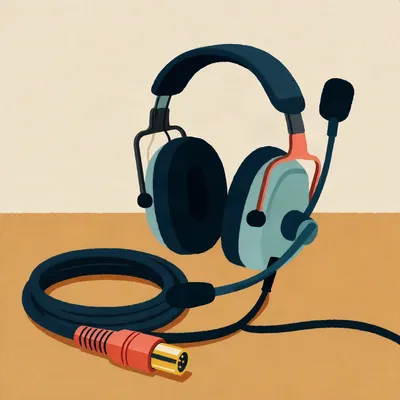
Closed headphones with a boom mic attached, engineered so the mic sits at a fixed distance from your mouth and moves with your head. The cups are closed to block the room, and they double as your monitor headphones, so you hear yourself and the programme feed without a separate pair. Everything about it is the opposite design goal from a studio mic on a stand, where the mic is planted and you hold the distance yourself.
And the office headset — the one that made Daniel's dictation audio sound like a phone call —
The short version is the phone network carved out a narrowband slice, roughly three hundred hertz to three point four kilohertz, because it carries intelligibility cheapest. The problem is that everything above four kilohertz — most of your s sounds, your f sounds, the sibilance — lives outside that slice. Strip it and the voice is still understandable, but it stops sounding like a person in a room.
The syllable survives and the speaker doesn't.
Broadcast headset mics run out to roughly fifteen, twenty kilohertz. Full voice bandwidth. So the difference isn't quality-for-quality's-sake, it's that the two devices are listening for different things entirely.
And the pitch, the whole reason this class exists — the fixed mouth-to-mic distance and the room rejection. Which I notice is also the source of every complaint I've ever heard about them.
That's the spine of the whole thing, yes. Fixed geometry means plosives and breath hit the capsule at close range, you get proximity-effect bass, you get cable handling noise travelling up the boom, and closed cups mean clamp force and heat over a long session. The feature and the flaw are the same feature.
Which sets up the two questions the rest of this hangs on. Are these analog XLR things, or is there a real USB option? And who needs phantom power?
Let's do the landscape first, because it answers the USB question almost by accident. Start with the lineage that defined the class: Sennheiser's HMD and HME twenty-six line. Launched at NAB in twenty-ten, specifically for loud sports commentary. Dynamic hypercardioid capsule, and the interesting part is it's what Sennheiser call a noise-compensating mic — designed to keep the sound consistent as the mouth moves around relative to the capsule, because a commentator's head is turning to follow a game.
The mic is built on the assumption that you won't hold still.
Which is exactly backwards from a studio condenser, where the whole discipline is holding still. The HME twenty-six is the condenser sibling, same frame, powered capsule. Then the HMD twenty-seven came along — dynamic hypercardioid, mic rated forty hertz to eighteen kilohertz, and insensitive to background noise. The HME twenty-seven is its electret version.
You said "launched at NAB in twenty-ten" and the number that interests me is that this line is old enough that buying one is now confusing.
It is. The HMD twenty-six-II-600S variant is marked end-of-life on Sennheiser's own site — no longer available to be purchased — while retailers like B and H still list a current HMD twenty-six dual-ear model, and Sennheiser themselves published a fresh quick guide for the line in March twenty twenty-four. So the line is neither clearly alive nor clearly dead, and the headset famously ships without the cable. The cable is a separate analog part — the Cable-II-X3K1, XLR three-pin male on one end, quarter-inch jack on the other. You have to buy the wire that connects it to the world.
A headset sold as a main course with the cutlery on a separate bill.
The other big family is Audio-Technica's BPHS line, and this is the working-announcer value option. The BPHS1 — closed over-ear stereo, dynamic cardioid mic, forty hertz to twenty kilohertz, XLR plus quarter-inch cable. That's the headset an actual minor-league baseball play-by-play announcer uses — Marco LaNave, calling games for the Akron RubberDucks — and his description of it was "a good, clear, professional sound to the broadcast." That quote matters because it's not an audiophile reviewing a bench, it's a man wearing it for nine innings in a press box.
Nine innings is a comfort spec as much as a sound spec.
And with the clamp force we'll come back to. The BPHS2 is the newer hypercardioid dynamic, and the BPHS2C is the electret condenser cardioid version. Both are closed on-ear rather than over-ear, which matters for comfort, and both have a hundred-and-five-decibel limiter on the headphones to protect your ears in loud environments. One thing worth noticing for voice work: their mics are rated narrower than the BPHS1, about fifty hertz to fourteen kilohertz on the dynamic and sixty hertz to fifteen on the condenser.
Then Shure.
The BRH family — BRH440M dual-sided, BRH441M single-sided. Dynamic cardioid, closed over-ear, and the clever bit: you flip the boom up and it mutes. No switch to find, the geometry is the switch.
That's the one feature I'd actually use. My memory of fumbling for mute buttons is long and shameful.
The BRH50M is the lighter one — two hundred and eight grams — dynamic supercardioid, for people who found the others too heavy. And Beyerdynamic rounds it out: the DT 290, hypercardioid dynamic, no phantom, sold in several impedances; the DT 297 PV MK II, cardioid condenser built explicitly for phantom power, eighty or two hundred and fifty ohm, also sold without a cable — four hundred and nineteen dollars ninety-nine for the two-fifty-ohm version on Beyerdynamic's US store, as of this week. Plus the DT 797 PV for loud events.
Notice what all four families have in common, though. XLR and a headphone jack. Every single one.
That's the structural answer to Daniel's USB question, and it's the thing almost everyone gets wrong before they even look at models. We couldn't find a true USB broadcast headset from Sennheiser, Beyerdynamic, the BPHS line, or Shure. Sennheiser's USB headsets are a different, office-grade product. The class is analog by design — XLR out for the mic, headphone jack for the ears — and the way it reaches a computer is through a USB audio interface. Mic into the XLR input, headphones into the headphone out. USB is something you add around it, not something it is.
Because the buyers are broadcast trucks and stadiums, not laptops.
The customer is a commentary position wired into a console. USB never came up. So when Daniel asks "can a USB option be decent," the honest answer has two halves. From the classic manufacturers, the question doesn't arise — the decent ones don't come in USB. But there are two real exceptions worth naming. The Rode NTH-100M — closed-back headphones with a detachable boom mic, the NTH-Mic, an omnidirectional permanently polarised condenser on a three-and-a-half-millimetre TRRS plug, running on the device's own plug-in power rather than forty-eight-volt phantom. Launched at a hundred and eighty-nine dollars, and a twenty twenty-three review put its mic among the best detachable headset mics going — while still saying a full-size USB or XLR mic sounds much better. It's the easy, cheap answer. One catch for an untreated room, though: that mic is omnidirectional, so it hears more of the room than the hypercardioid broadcast capsules do.
And the other exception?
The Audio-Technica ATH-M50xSTS StreamSet. They took the M50x — the most ubiquitous monitoring headphone in the world — put an electret cardioid boom mic on it, and there's a true USB version with a built-in converter up to twenty-four-bit ninety-six. That is the clearest genuine USB headset in this class that exists, as far as I've seen.
The monitoring headphone everybody already trusts, finally allowed to talk.
And now, as ever, here is Desmond with his money tip.

Desmond's Money Tip. Eat your dinner in the dark. A sixty watt bulb for one hour a day, at my tariff, is about five pounds a year, and I have decided that five pounds is five pounds.
I eat by the light of the fridge with the door open, which uses more electricity than the bulb, but I have never claimed to be good at this, only careful.
Money is mostly just the dark, and getting used to it.
I'm half inclined to try that. The fridge light is the warmest one in the flat anyway.
Corn, you would eat by fridge light and then tell me it was ancestral sloth practice.
The leaves store better in the dark. Herman — the harder half of Daniel's question. Suppose he buys one of these. Does it actually hold up for voiceover?
This is where I have to be straight with him: it's a compromise, and the people doing it professionally will tell you so. Working audiobook narrators — the ones who answer questions from beginners — say flatly that pros use a studio mic, and a headset is the compromise. I can't find a single sourced example of a professional audiobook narrator using a broadcast headset as their main microphone. They're the standard in sports commentary and radio, not in narration.
Which makes sense of the design, actually. A commentary position is a loud press box with a monitor feed. A narration booth is a silent treated room.
And the mechanics explain the gap. Everything that makes the headset right for the press box is wrong in the booth. At two centimetres from your mouth, plosives and breath are constant threats, you get proximity-effect bass buildup, the cable conducts handling noise straight up the boom, and closed cups clamp and heat over a four-hour read. The Bonedo review of the BPHS2 pair found the condenser handled the proximity bass more gently than the dynamic at that distance — but isolation and fit were the weak points on both.
The condenser forgives your mouth; the headphones don't forgive your ears.
There's a comfort in knowing the trade has a shape, though. It's not that they're bad mics. It's that they're mics solving a problem Daniel doesn't have.
Unless he does. His room is untreated — that's the one thing the headset does better than a studio condenser.
That's the real argument for him, yes. Room rejection and fixed distance. A condenser on a stand in an untreated flat hears the flat. A hypercardioid capsule a couple of centimetres from his mouth hears mostly him.
Then the phantom power question, because it decides what else he has to buy.
Model by model, and it splits exactly along capsule type. Dynamics need nothing: the HMD twenty-six and twenty-seven, the BPHS1 and BPHS2, all the Shure BRH models, the DT 290 — plug in and go. Condensers and electrets need power: the BPHS2C takes eleven to fifty-two volts of phantom, the DT 297 PV is built for phantom, the HME twenty-six has a P48 variant that's powered through its own dedicated cable, and the HME twenty-seven is the electret. The Rode sidesteps all of it — plug-in power off the device, a couple of volts.
That's the trap though, isn't it. "Dynamic means no phantom" slides into "dynamic means easy."
And it doesn't. The HMD twenty-six-II-600S puts out zero point four millivolts per pascal, which is low. No phantom, fine — but you now need clean preamp gain, and cheap gain is noisy gain, and the noise lands right where a quiet voiceover exposes it.
So the money you saved on a power supply goes to the preamp.
And there's a wrinkle on the headphone side nobody mentions. People pair these with those little XLR-to-USB adapters — the Shure MVX2U, which does supply phantom, or the MXL MicMate Pro with forty-eight volts, gain and a headphone volume knob. Sensible-looking. But many broadcast headphones run at a few hundred ohms, the Sennheisers up to six hundred, and whether one of those small adapters, or a budget interface, can drive that impedance loudly enough — I honestly don't know that anyone has confirmed it. High-impedance headphones want a capable amp. The mic side of the chain might be the easy half.
The headphone side is the part that's silently doing the monitoring, and it's the part nobody specs.
For Daniel, specifically — small flat, untreated room, voiceover-style recording and dictation — here's how I'd land it. If he wants the truest version of the class, the BPHS1 into a competent interface with clean gain: dynamic, no phantom, full-range mic, and working announcers vouch for it. It's an older model, so he should check it's still in stock where he lives. If his interface has phantom and he wants a gentler sound right up at the lips, a condenser like the BPHS2C or the Beyerdynamic DT 297 PV. If he wants cheap and easy, the Rode NTH-100M: plug-in power, a hundred and eighty-nine dollars at launch, straight into a headset jack, accepting that the omni mic hears more room. And if he wants a true-USB headset in the class, the M50x StreamSet USB is basically alone.
Buy the cable. Whatever he buys, check the box for the cable, because half this class ships without one.

Sennheiser HMD twenty-seven, about four hundred and thirty-five euros in twenty twenty, cable not included.
He speaks.
The cable is the Cable-II-X3K1, Corn. XLR three-pin male plus a quarter-inch jack, and I'll tell you the pinout argument I've been having with the man at the audio shop on Jaffa Road since spring. He says the XLR end is the male end because that's the end that plugs into the console. I say the jack end is the load end and the XLR should be pinned accordingly. He's wrong, but he's the only one who stocks it, so we meet in the middle of the argument every couple of months and he sells me something.
You've kept that going over a pinout?
It's not a pinout, Herman, it's a principle. Anyway. You're both right about the fixed distance being the point, and you're both missing the half that matters. The twenty-six's mic element is noise-compensating — it's built to sound the same with your mouth on-axis, off-axis, wandering. That's why commentators sound like commentators and not like men leaning into a sponge. I watched a man try one in a room where the air conditioning was the loudest thing in it. Corn, you're a touch close to the pop filter, that's the clip on the esses I've been riding. As I was saying — the headset cleaned him up, and the air conditioning still won, because a hypercardioid at twenty millimetres rejects the room but not the duct. He ended up recording in the stairwell, which was quieter and smelled of paint.
Twenty millimetres is very specific.
I keep a notebook. Mouth-to-mic distance for every headset I've used, in millimetres. The one I had — the boom arm stopped four millimetres short of where I wanted it, and the notebook says that made it the worst fit of anything in it. I sold it to a commentator at the horse track in the end. He liked it, but he holds his head crooked, so it worked out for him.
Four millimetres off. And the stairwell beat the treatment.
Stairwell beat everything. Cost nothing either, which the man at the shop on Jaffa Road would hate to hear.
The notebook of distances is going to live in my head now. Every headset he's ever worn, logged.
The duct point is the one worth keeping, though — room rejection isn't HVAC rejection. If Daniel's flat has an air conditioner or a humming fridge, a mic that can't hear the room can still hear the machine running in it.
Which, if you take one thing from this episode, I'd make it that: the broadcast headset is a fixed-geometry machine. The distance that never changes is the entire pitch, and it's also why plosives, proximity bass and a duct can reach a capsule that's locked twenty millimetres from your mouth. The mic can move, but it can't retreat.
And the second half of that: dynamic doesn't mean easy. No phantom still means you owe the chain gain, and the headphones owe you an amp.
The open question that's been sitting on me the whole episode — nobody is building this thing for voiceover. Every model we named is commentary heritage: press boxes, gantries, limiter caps for crowd noise. If someone designed a headset from scratch for a person alone in a quiet room reading for four hours — lighter clamp, gentler proximity, monitoring that flatters — that product doesn't appear to exist.
And the one crack in the wall is that M50x StreamSet USB. It proves the category can move — a real broadcast-class headset with a converter built in, no interface, no pinout arguments. It's a studio-monitoring headphone that grew a mic, not a commentary headset that shrank. If that line keeps going, the answer to Daniel's USB question changes in a couple of years, quietly, without anyone announcing it.
Which is usually how the good equipment arrives. Thanks as always to Hilbert Flumingtop at the desk — the pinout argument continues, we gather. If this was your kind of episode, go back for episode seven, Building Custom ASR Tools. This has been My Weird Prompts. If you've enjoyed this one, the whole archive lives at my weird prompts dot com, and a review wherever you listen helps more than you'd think.
We'll be back soon. See you tomorrow, brother.


 chatterbox-regular