Most coverage of buspirone calls it the anxiety pill that isn't addictive and doesn't knock you out, and leaves it there. A mild drug for mild worry. Then you find gastroenterologists prescribing it before meals for people who feel full after three bites, and the mild-drug story stops making sense.
That's Daniel's question. He met buspirone through functional dyspepsia, knows it isn't an SSRI, and sees it sitting in a strange gap between the traditional classes. What is it, exactly, and what is it doing in a stomach? And what does "neuromodulator" mean when people say it about low-dose psychiatric drugs used for the gut?

Herman Poppleberry, and I've been waiting for this one. The strangest fact is printed right on the FDA label. Under mechanism of action it says, and I'm quoting, "The mechanism of action of buspirone is unknown."
On the label. For a drug that's been sold for about forty years.
Forty years. It does say what it knows. High affinity for the serotonin 1A receptor, moderate affinity for dopamine D2 receptors in the brain. And it says no significant affinity for benzodiazepine receptors, and no effect on GABA binding. So it's not a Valium cousin, however it feels to the patient.
Which is nothing, according to a lot of patients.
Fair, we'll get there. The category problem is this. A benzodiazepine boosts GABA. An SSRI blocks the reuptake pump so serotonin hangs around longer. Buspirone does neither. It walks up to a serotonin receptor and activates it directly, but only partway. That's a partial agonist, and it belongs to a small chemical family called the azapirones. Nobody built a shelf for that family.
So it's been homeless since the eighties.
Pretty much. And in the gut it's used for something completely different from anxiety. It's called a fundus-relaxing drug, and the evidence there is more interesting and more contested than the anxiety data.
Start with the receptor, then. Partial agonist sounds like a hedge.
It's a dimmer switch. Full serotonin turns the 1A receptor up to some level. Buspirone turns it up, but less. So where serotonin is low, buspirone adds signal. Where serotonin is high, it competes for the receptor and can actually turn the signal down. Same molecule, opposite directions, depending on the room.
Is there a everyday version of that? Something that behaves differently depending on what's already there?
A thermostat with a floor and a ceiling. Say a heater that only ever runs at half power. In a freezing room, half power is a gift. In a room that's already roasting, it's the thing that keeps a bigger heater from running flat out, if it's hogging the socket. Crude, but that's the logic.
Which explains why nobody can say what it does.
Partly. And the timing is different from an SSRI. An SSRI takes weeks, because the brain has to adapt its receptors. Buspirone binds the receptor itself, so you'd expect a pharmacological effect within hours. For anxiety, though, patients still report it takes a couple of weeks to feel anything, which is one more thing nobody can explain.
So it works fast on a receptor and slow on a person.
Right. For the gut, the pharmacokinetics are what make the story work. Half-life is two to three hours, so it's gone quickly. It's absorbed fast and heavily metabolized on the first pass through the liver, by the enzyme CYP3A4. And food changes everything. Eating raises the exposure, the area under the curve, by eighty-four percent, and the peak by a hundred and sixteen.
So a pill with dinner is nearly double the pill without.
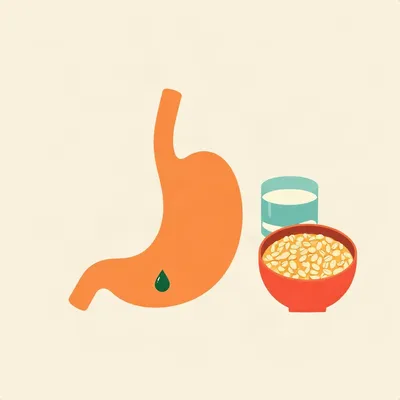
Close to it. That's why the dyspepsia trials give it fifteen minutes before meals. Time the dose to the meal and the drug is peaking just as the stomach has to receive food.
Receive food. I'll admit the stomach's job is a thing I think about more than most people.
Your digestion takes days, Corn, so you've had time to think about it.
Several days. It's called being thorough.
The job in question is gastric accommodation. When you swallow, the top of the stomach, the fundus, relaxes so it can hold a meal without the pressure shooting up. In some functional dyspepsia patients that reflex is weak. Food arrives, the fundus doesn't give, and you feel full after a few bites and bloated, even though nothing is structurally wrong.
We did that reflex properly in an earlier episode, the stomach relaxing to eat and what happens when it doesn't. So buspirone is a pharmacological way to turn that reflex up.
That's the pitch, and the landmark trial is Tack, twenty twelve. Seventeen patients, crossover design, two four-week periods with a washout between, ten milligrams three times a day before meals. Gastric accommodation on buspirone was two hundred and twenty-nine milliliters versus a hundred and forty-one on placebo. That's roughly sixty percent more room.
Sixty percent. In seventeen people.
Small, yes. But it's a barostat measurement, a balloon in the stomach reading volume, not a questionnaire. Gastric emptying of solids didn't change, and sensitivity to distention didn't change. Liquids emptied slower. So it did one clean thing.
How does that measurement work in practice? A balloon sounds unpleasant.
It is a bit. A thin bag on a tube goes down into the stomach and is held at a constant pressure. Then the patient drinks a nutrient meal, and the device records how much the bag has to inflate to hold the pressure steady. If the fundus relaxes, the bag swells. That swelling is the accommodation, read as a number, and nobody's opinion goes into it.
And the symptoms?
Overall severity score seven and a half versus eleven and a half on placebo. Fullness, early satiety and bloating all improved.
Hm. That sounds too tidy. Is the stomach actually responding, or is the brain turning down how it feels?
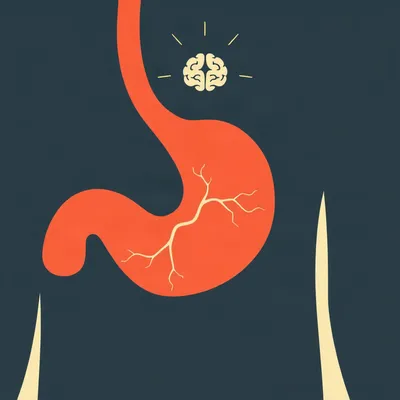
That's the central question and I can't tell you it's settled. Either there are 5-HT1A receptors on the fundus relaxing the muscle directly, which is the peripheral story. Or the receptors that matter are in the brainstem, changing vagal tone and how the gut's signals get processed. The label says unknown, and for once that's literally accurate. But there's a sleeper study that leans central. Dinan, two thousand and one.
Go on.
They used buspirone as a probe, not a treatment. Give a dose and measure prolactin, because 5-HT1A receptors in the brain drive prolactin release. It's a readout of how sensitive those receptors are. Fifty non-ulcer dyspepsia patients against fifty-nine healthy controls, thirty milligrams. The patients released more prolactin, most clearly at ninety minutes, and more in women.
So their receptors shout louder at the same dose.
Enhanced central serotonergic sensitivity was their conclusion. Which flips the picture. Maybe buspirone isn't a stomach relaxer so much as something that corrects the gain on a brain-gut axis that's turned up too high.
Then why would it relax the fundus?
Possibly both. The vagus carries the command to relax. If the central end is miscalibrated, fixing it could restore accommodation as a side effect. I don't know how much of the volume effect is central, honestly.
Herman, would you buy that? You trained as a pediatrician, you saw functional stomach aches in kids. Does "the brain turned the volume up" match what you saw?
Honestly, yes. Kids with recurrent belly pain, normal scopes, normal everything, and a nervous system that was clearly over-reporting. I never prescribed anything like this, but the sensitized-system idea matches my clinic better than the weak-stomach idea does.
And now, as ever, there's a fact waiting for us.

Medieval Pottage Facts. In a Suffolk cottage built in the early fifteenth century, the roof timbers hidden in the attic are still thickly encrusted with medieval soot from the hearth. The past is not gone. It is in the attic.
Soot. Good to know.
Back to the stomach. The physiology is clean, but here's where it gets messy. The clinical evidence is much shakier than that one famous trial suggests.
Shakier how?
There's a twenty twenty-five meta-analysis, Mohamedali and colleagues. Ten studies, two hundred and eighty-three patients, a mix of randomized trials, an N-of-1, a cohort, a case series, case reports. Pooled across them, the improvement in dyspepsia and gastroparesis symptoms versus placebo was not significant. The effect size was minus point one four, and the confidence interval ran from minus point four four to plus point one seven. It crosses zero comfortably.
So the drug that added sixty percent to stomach capacity doesn't reliably make people feel better.
Across those trials, no. Only bloating improved significantly. Fullness and nausea didn't. And that's the one I find telling. Bloating is largely a perception symptom.
So the one that moved is the one the brain decides.
That's my reading, and I'll flag it's a reading. The gap between the Tack trial and the -analysis has a few plausible explanations. Tack was a physiological study. It was built to detect a change in accommodation, and seventeen people is plenty for that. The -analysis asks a different question: across mixed designs and short durations, do patients report feeling better? Most of those trials ran only weeks. Dyspepsia fluctuates, and placebo response is huge.
Why would the pooling hurt so much? Wouldn't more patients sharpen the answer?
Only if the studies are measuring the same thing. Here you've got gastroparesis and dyspepsia patients lumped together, different doses, different outcome scales, and case reports that can't be weighted like a trial. More patients, but blurrier ones. A real effect in one subgroup can wash out in the average.
Seventeen people is also a number where one enthusiastic investigator can be forgiven for a lot.
It's a crossover, so each patient is their own control, which helps. But yes, it's why the trial is cited constantly and the -analysis quietly. The review from twenty thirteen called it a drug that promotes accommodation and "is also effective." That "also" was carrying a lot.
Preliminary data, as they say, is a phrase with a long shelf life.
Longer than the drug's half-life, certainly.
Let me ask the category question straight. Daniel's term was neuromodulator. What does the word cover?
The Rome Foundation, which writes the diagnostic criteria for these disorders, defines central neuromodulators as antidepressants, antipsychotics and other central nervous system drugs used for what they now call disorders of gut-brain interaction. It's a purpose label, not a pharmacology label. The idea is that these drugs act along the brain-gut axis, tuning how visceral signals are processed, at doses lower than you'd use for depression.
That's very broad. It's more or less "psychiatric drug, used for the gut."
And the Rome report from twenty seventeen said, in so many words, that the evidence and guidance for using them is "scanty and incomplete." They built the consensus by Delphi, which is experts voting. The convincing evidence is for tricyclics at low to modest doses. And the pocket card they published in twenty twenty-one lists SSRIs, tricyclics, the tetracyclics like mirtazapine, and the SNRIs. Buspirone's family barely shows up.
So it's a neuromodulator that isn't on the neuromodulator list.
It's in the field's own literature, and it's in a twenty twenty-five Lancet Gastroenterology and Hepatology -analysis of irritable bowel, which names azapirones among the categories it looked at. So the field is warming. The formal taxonomy hasn't caught up.
Now the "low-dose" part. Isn't that the whole point of the term?
For tricyclics, yes. Gut doses of amitriptyline are well under what you'd give for depression, and they work, or don't, by something other than the antidepressant effect. For buspirone the picture's different. Psychiatric dosing is fifteen to sixty milligrams a day. The dyspepsia trials use ten milligrams three times daily. That's thirty, right in the psychiatric range.
So it's not low dose at all.
Not in absolute terms. It's the same drug at a similar exposure, just timed to meals, and with that food effect on top, the meal-time exposure is higher still. So I'd resist the idea that there's a separate low-dose gut mechanism here.
The misconception is that every neuromodulator is a psych drug at a homeopathic dose.
Right. Buspirone's a counterexample. It's the psychiatric dose, aimed at a different symptom.
So why would it help one patient's gut and another's anxiety?
If the prolactin data hold up, it's the same story. A sensitized axis. Tricyclics are the best-studied example: they reduce visceral hypersensitivity, and in healthy people they don't act as painkillers at all. They bring a sensitized system back toward normal rather than dulling a normal one. Buspirone may be doing the same through a different receptor. A gain corrector.
Herman, a question for you. If the effect is real but small, and it works through the brain, would you want your own doctor to try it before a tricyclic?
Hm. Honestly, I'd want the tricyclic first, because that's where the evidence is, and then I'd want buspirone for someone who can't tolerate the sedation or the dry mouth. Buspirone's tolerability is good. About ten percent quit in the anxiety trials, mostly for dizziness and nausea. But nobody's run the head-to-head, so I'm guessing.
A guess from a retired pediatrician is still worth more than most guidelines.
Flattery from you is suspicious.
Does it make a difference whether you take it before or after breakfast? My aunt Dorothea took it for her nerves and she always had it with grapefruit juice.
It makes a real difference. Food raises the exposure a lot, so with breakfast you'd get a higher dose than on an empty stomach. Grapefruit is a good instinct, actually, since it inhibits CYP3A4, the enzyme that clears buspirone. I can't say what it did for her, but it would plausibly raise her levels, not lower them.
She thinks it was a sugar pill. Says she felt nothing. No calm, no sleep, nothing. She told the whole family. She also says the pharmacist swapped them, and that the leaflet was lying, so you can take her view for what it's worth. The leaflet had the line in it, mechanism of action unknown. I like that. It sits under the bread bin now. The bread bin had a short leg. Dorothea says that is the only thing it was ever good for. She has told that to people at weddings.
Under the bread bin. That's a load-bearing leaflet.
And honest. A label that admits the gap is better than one that invents a mechanism. And if she was getting grapefruit with it, her levels may have been higher, not lower. Though "nothing" is the most common report for buspirone, so I wouldn't read it as a swap.
Four of her friends said the same. Same pharmacy. She keeps a list.
Mm. Four people feeling nothing from a drug that makes no promises about how it feels. That's about what the drug does.
Is there any reason that would be a pharmacy problem rather than a drug problem?
It's possible in principle, but the simpler explanation wins. Buspirone has no rush, no sedation, no moment where you notice it arriving. Benzodiazepines teach people to expect a feeling within the hour. Take away that feeling and some people conclude nothing happened, when what they're missing is a signal, not an effect.
Which brings it back to the gut. If patients report nothing and the stomach holds sixty percent more, the stomach might be the part that notices.
That's an interesting way to see it. The dyspepsia trials ask patients what they feel, and the -analysis shows mixed answers. The barostat doesn't ask anyone anything.
One thing from that, before the grapefruit gets away from us. Timing with food changes the dose by nearly double. So the real instruction in those trials was the clock, not the milligrams.
Exactly that. The schedule is half the drug.
One more detail that didn't fit anywhere. Hepatic impairment raises buspirone's steady-state exposure about thirteenfold, and kidney impairment about fourfold. For a drug with such a gentle reputation, the liver matters enormously.
Thirteenfold. Gentle until it isn't.
Here's what I'm left with. If the gut effect is real but small, and it runs through the brain rather than the fundus, then "neuromodulator" is less a drug class than a description of what's being corrected, a sensitized brain-gut axis. Which would make the dose and the clock matter more than the label on the bottle.
And the experiment that would settle it, buspirone head to head against a tricyclic, hasn't been run. Until it is, the category stays unfinished.
Thanks to our producer, Hilbert Flumingtop, for keeping the desk running.
If you enjoyed this one, try episode twenty-four ninety-one, How Your Stomach Relaxes to Eat (And When It Breaks); and episode twenty-five eighty-three, The Motility Blind Spot. This has been My Weird Prompts. If you enjoyed it, leave us a review wherever you listen, it helps more than you'd think.
We'll be back soon.



 chatterbox-regular