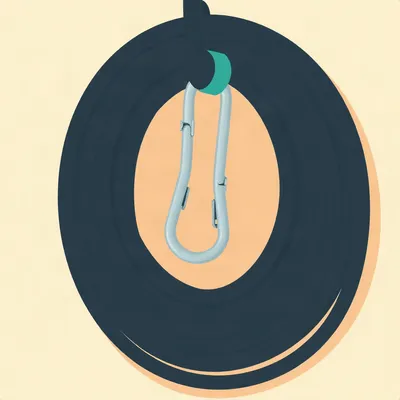
Daniel wrote in with a whole thing about carabiners this week. His basic position is that he knows they're one of the great organizational systems, he's seen heavy-duty ones hold up impressive loads, but he's never quite trusted them. He can't get past the idea that a little hook is holding up something substantial. He's seen those cable organization setups where huge spools of Ethernet are hung on Velcro straps and carabiner hooks, and his question is straightforward: is that strap and that hook actually strong enough for a hundred-meter spool of cable? His suspicion is yes, probably much stronger than needed, but there's a difference between knowing that and trusting it enough to hang something breakable. He wants us to talk about the diversity of what's on the market, the various load ratings, and how these things can be used for home organization and carrying gear. Extensions, backpacks, body bags, the whole range.

Body bags. He said body bags.
He said body bags. I assume he means the kind you carry tools in, not the other kind.
I hope so. Although a carabiner would hold either.
Let's not test that.
Fine. But he's right that this deserves real attention. We've talked around carabiners for weeks now, every time carry systems come up, and we've never actually stopped to look at the hook itself.
So let's start by understanding what we're actually dealing with here. Because the word carabiner covers a huge range of hardware, from climbing-rated pieces that cost forty dollars and hold thousands of pounds, to the little aluminum thing that came free with a water bottle and says not for climbing in tiny letters.
Most people read it as a warning that the thing is junk. It's not. It's a legal designation. It means the manufacturer hasn't paid to have it certified for life-safety applications, hasn't put it through the testing that climbing gear requires. It doesn't mean it's poorly made. Some accessory carabiners are perfectly decent hardware. They're just not rated for holding a person off the ground.
Which is the right standard, because the consequences of failure change dramatically when the thing falling is you.
So we need to separate two questions. One is the engineering question: what can these things actually hold? The other is the psychological one: why doesn't the number on the package make Daniel feel better? Because those are different questions, and I think the second one is where the interesting stuff is.
First, let's look at the engineering. What can these things actually hold? Because I think the numbers will surprise people.
Let's start with Daniel's specific example, because it's a good one. A hundred-meter spool of Cat6 cable. Solid copper, not the cheap copper-clad stuff, still only weighs about four kilograms. Call it nine pounds. That's the whole spool, box included.
Nine pounds.
Nine pounds. And the Velcro straps he's talking about, the ones sold for cable management and general organization, they come in sizes with actual load ratings. The small ones are typically rated around a hundred and fifty pounds. Medium, two fifty. Large, three fifty.
So the strap is rated for somewhere between fifteen and forty times the actual load.
More than that, depending on which size he's using. A hundred and fifty pound strap holding nine pounds is using about six percent of its rated capacity. And that's the strap. The carabiner is a separate question.
What's a typical accessory carabiner rated for?
This is where it gets murky, because accessory carabiners don't have the standardized rating system that climbing gear does. A climbing carabiner will be stamped with a kilonewton rating, typically twenty to twenty-five kilonewtons along the major axis. That's roughly forty-five hundred to fifty-five hundred pounds. The gate-open strength is lower, maybe seven to ten kilonewtons. The minor axis, sideways, is lower still.
So even a real climbing carabiner has three different numbers depending on how you load it.
Right. And the number stamped on the spine, the big one, only applies when the load runs along the spine, the long axis, the way it's designed to be loaded. If you load it sideways, across the gate, the strength drops dramatically. An accessory carabiner, the kind Daniel's probably looking at for cable organization, might not have any stamped rating at all. Or it'll have something vague. But even a cheap aluminum accessory carabiner will typically hold a few hundred pounds along the spine before the gate starts to deform.
So for a nine-pound cable spool, even the cheapest carabiner on the market is overkill by a factor of thirty or more.
The hardware is not the weak point. That's the first thing to understand. The hook is not going to snap under a cable spool. It's not going to snap under ten cable spools. The failure mode Daniel's actually worried about, the thing that would actually happen in the real world, is slippage. The gate opens. The strap backs out. The load shifts and finds the one angle the carabiner isn't designed to resist.
That's the thing people don't think about. The hook doesn't break. The connection comes apart.
And the connection comes apart because of gate design. This is why the diversity of carabiners on the market isn't just about strength. It's about how the gate behaves under load. A wire gate carabiner, the kind climbers love because it's light and the gate doesn't freeze shut in cold weather, that gate can be pushed open by sideways pressure. A screw-lock gate, where you have to manually thread a sleeve down over the gate to lock it, that's much more resistant. A double-action or triple-action auto-locking gate, the kind you see on industrial gear, that requires two or three deliberate movements to open. It's not opening by accident.
So the market diversity is really about trust thresholds. People who are nervous buy the locking gate. People who are comfortable buy the wire gate.
And the locking gate isn't stronger. That's the thing. A screw-lock carabiner and a wire gate carabiner from the same manufacturer will have the same spine rating. The screw-lock just makes it harder for the gate to open unintentionally. It's a safety feature about the failure pattern, not about the raw strength.
Which is exactly Daniel's situation. He's looking at a hook and thinking about strength, when the thing he should be thinking about is whether the gate can open accidentally.
Let's talk about why the hook is so strong in the first place, because the physics is elegant. A carabiner is shaped like a loop, and the load runs along the spine, the solid back of the loop. The gate is just there to close the loop. When you load a carabiner correctly, the force travels through the spine, which is a continuous piece of metal. The gate is barely involved. That's why a piece of aluminum the size of your thumb can hold a car.
A small car.
A small car. Twenty-five kilonewtons is about fifty-five hundred pounds of force. A Honda Civic weighs about twenty-eight hundred pounds. So a single climbing carabiner could hold two Honda Civics, if you could rig them properly.
I'm not going to ask how you know that.
I looked it up. The point is, the geometry is doing the work. The hook distributes force through the strongest part of the structure. But only if the load is oriented correctly. If the load shifts and presses against the gate sideways, the gate is a thin piece of wire or rod held in place by a spring. It's not designed for that. That's the weakest point, and it's weak by design, because the gate's job is to open.
So the carabiner is essentially a very strong spine with a deliberately weak door.
The door is weak because it has to open. If the door were as strong as the spine, you couldn't get anything in or out.
And the failure pattern Daniel's imagining, the hook snapping under load, that's the one thing that almost never happens. What happens is the gate opens, or the strap slips through the gate, or the whole thing rotates and loads the gate sideways.
The strap backing out is a real issue with those Velcro loops. If the Velcro isn't pressed firmly, or if it gets dusty, or if the load shifts and pulls at an angle, the strap can work its way through the gate. The carabiner stays closed. The strap just isn't in it anymore.
So the impressive cable spool setups Daniel's seen, those work because the load is nine pounds and the weakest link is still rated for a hundred and fifty. Even if the strap slips a little, even if the gate gets pushed sideways, there's so much margin that nothing actually fails.
And the spool is a cylinder. It hangs nicely. The load is stable. It's not shifting around. That's the ideal case for a carabiner system. Stable load, light weight, big safety margin.
So the hardware is over-engineered for most tasks. Which brings us to the harder question: why don't we trust it?
Because knowing is not trusting. Daniel knows the numbers. He said as much. He knows the strap is rated for three hundred and fifty pounds. He knows the cable weighs nine. And he still wouldn't hang a box of wine glasses on it.
Would you?
Depends on the box.
That's the thing. The numbers don't change. The box of wine glasses weighs the same as the cable spool. Maybe less. The strap is rated the same. The carabiner is the same. But suddenly the failure cost is different.
That's the asymmetry of failure. If the cable spool falls, it's an inconvenience. You pick it up, maybe the box is dented, you re-hang it. If the wine glasses fall, they're gone. The cost of being wrong is not captured in the load rating. The load rating tells you whether the hardware will hold. It doesn't tell you whether you can afford to be wrong.
And the visual doesn't help. A small hook holding a big box reads as fragile, regardless of what the stamp says. The affordance, the thing the object looks like it can do, doesn't match the rated capacity.
There's a real psychological phenomenon here. People trust thick, heavy, solid-looking things more than thin, light, elegant things, even when the thin elegant thing is stronger. A steel beam reads as strong. A carabiner reads as a keychain accessory. The fact that the carabiner is made of the same aluminum alloy as an aircraft wing doesn't register visually.
So the market has responded to this trust gap by making carabiners that look more serious. Bigger gates, thicker spines, locking mechanisms with visible moving parts.
And that's not dishonest, exactly. The locking mechanisms do serve a real function. But there's also a kind of security theater to it. A big chunky screw-lock carabiner feels more trustworthy than a thin wire gate, even if both are rated for the same load. The screw-lock's real advantage is that the gate won't open accidentally. But the feeling of security it gives you is out of proportion to the actual risk reduction.
For organizational use, the risk reduction is already enormous. You're not loading these things anywhere near their capacity. The locking gate is solving a problem you mostly don't have.
Unless you're carrying something that moves. That's where locking gates earn their keep. If you're walking around with a carabiner on your belt and a tool pouch hanging from it, the load is bouncing and shifting constantly. Every step is a little sideways force on the gate. That's exactly the scenario where a wire gate could work itself open.
So body bags, tool pouches, anything carried on the body, that's where the locking gate matters. The load is dynamic, not static.
And the belt attachment use case has another advantage. The carabiner is the quick-release point. You can unhook the pouch without taking off your belt. That's the real innovation. It's not that the carabiner is stronger than a sewn loop. It's that it's reversible. You can add and remove things instantly.
Which is why carabiners beat zip ties and screws for modular organization. A zip tie is permanent. You cut it off when you're done. A screw is semi-permanent. A carabiner is a connection you can see, check, and undo in half a second.
And the visibility matters. You can glance at a carabiner and see whether the gate is closed. You can see whether the strap is seated in the hook. You can't see whether a zip tie is about to fail. The carabiner makes the connection legible.
That's the deeper insight. Carabiners work as an organizational system because they make the connection visible and reversible. You can inspect the joint, and you can change it. That's worth more than the raw strength.
Let's talk about the market, because Daniel asked specifically about the diversity of options. The big split is between climbing-rated and accessory. Climbing-rated carabiners are certified, stamped with kilonewton ratings, and expensive. Accessory carabiners are cheaper, lighter, often not rated, and marked not for climbing.
And for home organization, the accessory ones are fine. You're not hanging a person off a pegboard.
Right. The not for climbing designation is actually a useful honesty. The manufacturer is telling you exactly what the thing is for. It's for holding water bottles, keys, cable spools, tool pouches. It's not for life safety. That's not a quality judgment. It's a category statement.
Within accessory carabiners, you've got aluminum, steel, and titanium. Aluminum is light and cheap, fine for most indoor use. Steel is heavier and stronger, better for outdoor or industrial settings where corrosion matters. Titanium is light and strong and costs more than the thing you're hanging from it.
Titanium carabiners are a flex. Nobody needs a titanium carabiner to hold a cable spool. But they're lovely.
Then you've got the gate types. Wire gate, solid gate, bent gate, straight gate. Wire gates are light and don't freeze. Solid gates are more robust. Bent gates are for climbing, easier to clip into. Straight gates are general purpose.
And the locking mechanisms. Screw-lock, twist-lock, ball-lock, magnetic auto-lock. The screw-lock is the classic. You thread a sleeve down over the gate. It's simple and reliable, but it takes two hands and a few seconds. The twist-lock is faster. The ball-lock requires pressing a ball bearing to release. The magnetic auto-lock is the newest thing, uses magnets to hold the gate closed until you deliberately twist it.
For a tool pouch on a belt, what would you recommend?
A screw-lock or a twist-lock. Something you can operate with one hand, but that won't open accidentally. A wire gate is too easy to snag. A ball-lock is fine but fiddly with gloves. The screw-lock is the workhorse.
And for a cable management wall, where the load is static and you're not touching it?
A cheap accessory carabiner with a wire gate is fine. The gate isn't going to open on its own if nothing is moving. The load is nine pounds. The strap is rated for three fifty. The only risk is the strap working loose, and that's a Velcro issue, not a carabiner issue.
So the answer to Daniel's original question is yes, the strap and the carabiner are strong enough for the cable spool, by a huge margin. But the reason he doesn't trust it is that he's thinking about the wrong failure pattern. He's imagining the hook snapping. He should be thinking about the gate opening or the strap slipping.
And the fix for that is not a stronger carabiner. It's a locking gate and a properly seated strap. The strength was never the problem.
Which is a useful principle for a lot of organizational hardware. The stamped number is the headline, but the failure pattern is the story.
Let me give a concrete example from the backpack world. People hang all kinds of things off backpacks with carabiners. Water bottles, shoes, climbing shoes, chalk bags. The carabiner is usually clipped to a daisy chain or a webbing loop. The load bounces as you walk. If you use a wire gate, the bouncing can work the gate open. I've seen it happen. The carabiner doesn't break. The gate just opens, and the water bottle is gone.
The backpack use case is where locking gates actually matter, because the load is dynamic and the consequences of failure are losing the thing.
The backpack use case is also where the carabiner's reversibility shines. You can move the water bottle to a different loop in seconds. You can add a second carabiner for a second item. The system is modular in a way that a sewn pocket or a zippered compartment isn't.
The carabiner is the universal connector. It doesn't care what it's connecting. A water bottle, a tool pouch, a cable spool, a body bag. If it has a loop or a handle, the carabiner can hold it.
That universality is why the market has exploded. You can buy carabiners at the hardware store, the outdoor store, the craft store, the gas station. They're everywhere because they solve a problem that comes up everywhere: how do I attach this thing to that thing, temporarily, without tools?
The gas station carabiner is probably the one Daniel's worried about. The one that costs two dollars and says not for climbing and feels like it's made of recycled soda cans.
Even that one will hold a cable spool. It might not hold it forever. The gate might deform over time. The aluminum might fatigue. But for a static nine-pound load, it's fine. The problem is that we've all seen a gas station carabiner fail, and the memory of that failure sticks with us more than the hundred times the good carabiners held.
That's the availability heuristic. The vivid failure is more memorable than the boring success.
Carabiner failures are vivid. They're sudden. One second the thing is hanging there, the next second it's on the floor. There's no warning. No creaking, no bending. Just a ping and then gravity.
Daniel's distrust isn't irrational. It's a rational response to a real failure pattern. He's just misidentifying which failure pattern to worry about. He's worried about the hook breaking, when he should be worried about the gate opening.
The gate opening is preventable with the right hardware. That's the actionable takeaway. If you're nervous about a carabiner holding something you care about, buy a locking gate. The strength was never the issue.
I want to go back to something you said earlier about the gate being weak by design. That's the key insight, I think. The carabiner is a compromise. It's a loop that has to open, so it can never be as strong as a closed loop. A welded steel ring is stronger. A quick-link is stronger. But you can't clip a quick-link onto a belt loop in half a second.
The quick-link is the carabiner's stronger cousin. It's a closed loop with a threaded sleeve. You have to unscrew it to open it. It's stronger and more secure, but it's slow. The carabiner trades some security for speed.
Which is the fundamental trade-off in all organizational hardware. Speed versus security. The carabiner is the fast option. The quick-link is the secure option. The zip tie is the permanent option.
The screw-lock carabiner is the middle ground. It's almost as fast as a wire gate, but almost as secure as a quick-link. That's why it's the default for anything that matters.
For Daniel's cable spool wall, the ideal setup is probably a screw-lock carabiner on a properly seated Velcro strap. The screw-lock is overkill for the load, but it eliminates the one failure pattern that could actually happen.
It gives him the psychological comfort of knowing the gate can't open accidentally. Which is what he actually needs. The numbers were never going to make him feel better. The locking gate will.
Because the trust gap isn't about strength. It's about control. A locking gate gives you control over the failure pattern. You can see that the gate is locked. You can check it. You can verify it. The stamped rating is just a number you have to take on faith.
That's the thing about trust. It's not built by numbers. It's built by understanding. Daniel doesn't trust carabiners because he doesn't understand how they fail. Once you understand that the hook won't snap, that the gate is the weak point, and that a locking gate solves that problem, the trust follows.
We've answered the engineering question and the psychology question. The hardware is over-engineered for organizational use. The failure pattern is slippage, not breakage. The trust gap is real but fixable with the right gate design.

It was the gate. I saw it happen. Summer of eighty-eight, I was doing load-in for a touring band.
Wait.
We were hanging monitor wedges off the truss with carabiners. Not climbing-rated ones. Just whatever the production manager bought at the hardware store. And one of them, the gate opened. The wedge was hanging from a loop of aircraft cable, and the cable shifted, and it pressed sideways against the gate. The gate just popped open. The wedge dropped about six feet and landed next to the bass player's foot.
What happened to the carabiner?
Nothing. It was fine. It was still clipped to the truss. The gate was open, but the carabiner wasn't damaged. The cable just wasn't in it anymore.
That's exactly the failure pattern we've been describing. The hook didn't break. The connection came apart.
I picked it up and looked at it. The gate spring was still good. The spine was fine. It just wasn't designed to have a steel cable pressing sideways against the gate. Nobody had thought about that.
This was a rated carabiner?
It was rated for something. I don't remember the number. It didn't matter. The rating was for the spine. The cable was on the gate.
The number on the side gave everyone false confidence. The carabiner was strong enough for the load, but only if the load stayed where it was supposed to.
That's the thing about ratings. They're for a specific orientation. You load it the way the manufacturer says, and it'll hold what they say. You load it sideways, and it's a different piece of hardware.
Did anyone get hurt?
No. The bass player jumped about a foot in the air. The wedge was fine, actually. Those old Yamaha wedges were built like tanks. But after that, I only used screw-locks. For everything. Even my keychain.
Your keychain has a screw-lock?
It's not that inconvenient. I've got the kind where you twist the sleeve. Takes half a second. And I know the gate's not opening in my pocket.
That's a reasonable response to what you saw. The failure wasn't the carabiner's fault, exactly. It was the orientation. But once you've seen a gate pop open, you don't want it happening again.
The thing people don't understand is that the gate is a spring. It's a little piece of wire held shut by a tiny coil spring. It's not designed to hold anything. It's designed to stay closed until you open it. If you put load on it, you're asking a spring to do a job it was never meant to do.
The spring is the part you can't inspect. You can look at the spine and see if it's cracked. You can't see the spring inside the gate. You just have to trust that it's still springy.
I've got a drawer full of carabiners where the spring went soft. The gate doesn't snap shut anymore. It just kind of flops. Those are done. I throw them out.
That's the other failure pattern nobody talks about. Gate spring fatigue. The carabiner looks fine, but the gate doesn't close properly, and then the whole thing is useless.
I check mine every few months. If the gate doesn't snap shut with a good ping, it goes in the bin. I've got a box of dead ones somewhere.
A box of dead carabiners.
They're not good for anything. You can't fix the spring. You can't replace the gate. It's a disposable part.
That's worth knowing. A carabiner is not a buy-it-for-life item. The gate spring wears out. The aluminum fatigues. If you're using them daily, you should expect to replace them eventually.
The trust gap is even more justified than we thought. The hook can snap, in theory, if you overload it. The gate can open if you load it sideways. The spring can wear out over time. The only thing that doesn't happen is the dramatic failure people imagine.
I've never seen a carabiner snap. I've seen gates open. I've seen straps slip. I've seen springs go soft. But the spine itself, the solid metal part, that just doesn't break under normal use.
Because the spine is a solid piece of metal. It's the strongest part of the whole system. The weak points are all the moving parts.
The answer to Daniel's question is that the hook will hold, but only if you understand how it fails. The strength was never the issue. The issue is the gate, the orientation, and the spring.
The strap. Don't forget the strap. I've seen more things fall because the strap wasn't seated properly than because the carabiner failed. The Velcro gets dusty, or it's not pressed all the way, and the strap just works its way out of the gate.
The whole system is only as strong as the weakest link, and the weakest link is usually the human one. The person who didn't press the Velcro firmly. The person who clipped the carabiner at a weird angle. The person who didn't notice the gate wasn't fully closed.
That's the real lesson. The hardware is fine. The human is the failure point.
I should get going. I've got a thing.
Thanks for the story.
It wasn't a story. It was a load-in.
That story about the gate opening sideways, that's exactly the failure pattern we've been circling. The carabiner was rated for the load, but the load found the one axis the rating didn't cover.
That's the misconception worth naming. People think a carabiner's load rating applies in any orientation. It doesn't. The rating is for the spine, the long axis. Load it sideways, across the gate, and the strength drops dramatically. That's the thing most people get wrong.
The second misconception is that not for climbing means low quality. It doesn't. It means the manufacturer hasn't certified it for life safety. For holding a cable spool or a tool pouch, an accessory carabiner is perfectly adequate. The designation is about category, not quality.
The third one, the one Daniel's actually wrestling with, is that if the numbers say it can hold the load, you should trust it. But the numbers don't capture the cost of being wrong. A broken wine glass is not in the load rating.
Where does that leave us? I think the ideal organizational carabiner is one that removes the gate as a failure point entirely. A quick-link, or a locking hook, something with no spring-loaded gate to pop open. The trade-off is speed, but for static loads like a cable spool wall, speed doesn't matter.
The market is moving toward clearer labeling. Some manufacturers are starting to print orientation diagrams on the packaging, showing the correct loading direction. That's the missing piece. The number is useless without the orientation.
Daniel's hesitation isn't irrational. It's the right instinct applied to the wrong variable. He's worried about the hook breaking, when he should be worried about the gate opening. But the worry itself is justified. The system has real failure pattern. They're just not the ones he thinks they are.
The next time he's looking at a cable spool on a carabiner and feeling nervous, the fix isn't a stronger hook. It's a locking gate and a properly seated strap. The hook was never going to drop the spool. The gate might.
If he wants to hang breakables, the answer is the same. Understand the failure pattern, eliminate it, and then trust the engineering. The numbers really are on his side.
This has been My Weird Prompts, the human-AI collaboration podcast. Thanks to our producer, Hilbert Flumingtop, for keeping the whole thing running.
If you've got a weird prompt, send it to us. Email us at show at my weird prompts dot com.
We'll be back soon.