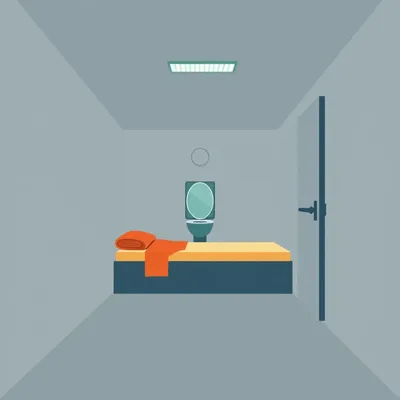
A woman walks out of a cave in southern Spain, squinting, and the first thing she says is that she hadn't finished her book. Five hundred days underground and she's annoyed it's over.

She thought there was more time left. That's the part people don't expect.
Right, and that's where Daniel wants to take us today. Here's what he wrote in. Beatriz Flamini spent five hundred days alone in a cave, no natural light, no clocks, no news, no regular contact with anybody. And when she came out, her sense of how long she'd been down there was badly off. Daniel wants to use that as a launch point for something bigger. How much of our sense of time depends on stuff outside us? Light and dark, clocks, meals, work schedules, other people, weekends, seasons, just the environment changing around you. What happens when all that goes away. What do the isolation experiments actually tell us. And then he pulls it back to ordinary life, which is the part I find most interesting. We don't live in caves, but we can lose those cues anyway. Working from home. Unemployment. Staying indoors. Living alone. Looking after a baby. Working late. Being absorbed in a project. Days with no variation in them at all.
And his question there is sharp. Can the same thing happen on a small scale? Does an unstructured week disappear because there's nothing to calibrate against? Does a week full of distinct experiences feel longer looking back?
And then the big one underneath all of it. How much of our apparently intuitive sense of time is actually being built and corrected continuously by the world around us. And what happens when those anchors go.
That's the real question, and the cave is the extreme version of it.
So the cave is the extreme case, but it applies to all of us. First thing to get straight is that time perception isn't one thing.
It's at least two, and they run on different machinery. Prospective timing is what you're doing right now, in the moment, tracking a duration as it unfolds. That system is clock-like. It's using ongoing neural activity, population state dynamics, to compute duration basically in a single step.
And retrospective timing is the other one.
Retrospective is what you do after the fact. You judge how long something took by pulling up memories of what happened in that interval and inferring length from them. It's reconstructive, and it runs through event segmentation. You chop experience into events, then you compute duration from the memory of those events. Two steps, not one.
Same interval, two different systems. That's the spine of the whole episode.
And it explains something Daniel's circling. The same stretch of time can feel short while you're in it and long in hindsight, because those aren't the same judgment. They're not even the same system.
Now here's the thing about Flamini that gets buried. The popular telling is she lost track of time and thought far less had passed. That part's true. But the striking bit is the direction and how she felt about it. Five hundred days felt short. She didn't want to come out.
When the rescuers came to get her she was asleep. She said, "Already? Surely not. I hadn't finished my book."
She never touched the panic button. She said, "Never. In fact I didn't want to come out."
This wasn't a woman who endured something and was relieved to escape. She described it as excellent. Unbeatable. She said if this is your dream and you're realizing it, why are you going to cry.
So temporal deprivation didn't just scramble her clock. It changed her relationship to time.
Let's start with what actually happened to her, and then the experiments that tried to reproduce it under controlled conditions.
Go.
Beatriz Flamini, elite Spanish mountaineer, extreme athlete. Fifty years old. She went into a cave about seventy metres underground outside Granada on the twentieth of November, 2021, and came out on the fourteenth of April, 2023. Five hundred days. She was forty-eight when she went in and she celebrated two birthdays alone down there.
Two birthdays.
No contact with the outside world at all. Her team was instructed not to contact her even in the event of a family death. Think about what that means. She went in before the war in Ukraine. She came out after Spain's COVID mask mandate had ended, after Queen Elizabeth had died. She had no idea about any of it.
What was she doing with the time?
Exercising, painting, drawing, knitting woolly hats, reading. Sixty books. A thousand litres of water.
Sixty books in five hundred days. That's a book every eight days. That's not a prisoner's pace, that's a reader's pace.
And she was being monitored the whole time. Psychologists, researchers, speleologists, trainers. The Universities of Granada and Almería plus a Madrid sleep clinic. They were studying exactly this. Social isolation, extreme temporal disorientation, time perception, circadian rhythms, cognitive change.
So she's a research subject as well as a record attempt.
Which is why the case is useful. It's not just an anecdote. There's a team behind it with instruments.
Now the record claim, because I know there's a wrinkle.
There is. A commenter on Hacker News, of all places, noticed that she took an eight-day break around day two hundred and ninety-eight. She left the cave and stayed in a tent above it while IT staff fixed a broken wifi and camera network. Still no human contact, but she was back under the sun, which breaks the no-sunlight rule. So the Guinness record, which had been held by a Ukrainian at four hundred and sixty-five days, is probably not hers. Contested.
She broke the rule for wifi. That's the most modern sentence I've heard all week.
The team may not have framed it that way. But for our purposes it doesn't matter much. Eight days out of five hundred still leaves her as the central case.
So what did the isolation researchers find? The ones who did this deliberately.
Jürgen Aschoff ran isolation-unit experiments in an underground bunker in Andechs, Germany, from the nineteen sixties onward. Subjects living singly, no time cues, for days to over a month.
No light cues at all?
None. No clocks, no windows, no schedule. Just a room, and the ability to press a button when you think a certain amount of time has passed.
And they could still count seconds?
Roughly. That's the surprising part. In the nineteen eighty-five paper, forty-two subjects, no time cues, they all developed free-running circadian rhythms. Their internal day drifted longer than twenty-four hours, roughly twenty-four point two to twenty-five hours. And when they were asked to signal when one hour had passed, they consistently overestimated. Their "hour" ran long.
Consistently, or on average?
Consistently. And the size of the overestimate correlated strongly with how long they'd been awake and with the length of their circadian cycle.
So the longer your internal day drifts, the more your "hour" stretches.
Yeah. But here's the piece that matters most. Short-interval estimates, ten seconds to two minutes, were unrelated to the long-interval estimates. Subjects who were terrible at guessing an hour were perfectly fine at counting seconds.
Different mechanisms.
Different systems. Long-duration timing falls apart without anchors. Short-duration timing doesn't care. That's why you can still catch a ball, still feel a beat, still know when a conversation has gone on too long, and still lose an entire week.
That's the first time in this conversation I've felt personally attacked.
Wait until the meal study.
There's a meal study.
Aschoff again, nineteen eighty-six. Forty-six subjects in the same conditions. Almost all of them settled into three meals per subjective day. Forty-three out of fifty-two, and by "day" I mean their internal day, which could be much longer than twenty-four hours. Even when wakefulness stretched past thirty hours, three meals. Even when it shrank below twelve, three meals.
Thirty-hour day, three meals.
And the intervals between meals stretched or compressed in proportion to how long they'd been awake. But the number of meals stayed at three.
So the template survived.
The template survived total isolation. That's the thing. Nobody taught them to eat three times per sleep-wake cycle in that bunker. That's a habit so deeply internalized that the world can vanish and it keeps ticking.
That's the first anchor that turns out to be portable. We carry it.
And that's the generalizable finding from the whole literature. Humans have an endogenous circadian clock. It free-runs at twenty-four point two to twenty-five hours, so it drifts, but it doesn't collapse. Long-duration estimation degrades badly without external anchors. Short-duration is robust and separately wired. Learned behavioral rhythms persist and act as scaffolding. And isolation produces desynchronization where different body systems can drift onto different periods, sleep-wake one way, temperature another way, and that's where it gets psychologically strange.
The body comes apart into different clocks.
Effectively yes. And that's probably part of what makes prolonged isolation so disorienting. It's not one clock running slow. It's multiple clocks disagreeing.
What about Siffre? The French guy, the caves.
Michel Siffre, the canonical reference. Caves in nineteen sixty-two and nineteen seventy-two. The seventy-two experiment, "Beyond Time," ran over six months in a Texas cave.
But.
But the caveat is real. Siffre's work is historically important and it shaped how everybody thinks about this, but I couldn't verify it through PubMed. There's no direct peer-reviewed citation I can point to. So it's popular science and history rather than the primary literature. The Aschoff work is what I'd actually lean on.
So the isolation science tells us long-duration estimation is fragile and that learned rhythms persist. But it doesn't yet explain why the same interval feels short in the moment and long in hindsight. That's where the neuroscience comes in.
The framework paper here is Tsao, Yousefzadeh, Meck and colleagues in Nature Reviews Neuroscience, twenty twenty-two. It draws the hard line between prospective and retrospective.
And the quote is worth having because it's technical in a way that's actually clarifying.
Prospective timing, they say, "is effectively carried out in a single step where the ongoing dynamics of population activity directly serve as the computation of duration, whereas retrospective timing is carried out in two steps: the initial generation of population state dynamics through the process of event segmentation and the subsequent computation of duration utilizing the memory of those dynamics."
So in the moment, the clock is running. In hindsight, you're not reading a clock at all. You're counting the events you remember.
You're counting your memories. Which is why Flamini's five hundred days could feel short to her. She wasn't judging duration in the moment. She was reconstructing it after the fact, from a set of experiences that were remarkably uniform. Exercise, paint, draw, knit, read. Day after day after day.
Low event density.
And that's the direct experimental link to the disappearing week. Bailey and Areni, Perceptual and Motor Skills, two thousand six. Twenty minutes of puzzles with music playing in the background. One group heard eight short songs. The other heard four long songs.
Same twenty minutes.
The group with eight songs estimated the interval as longer. And the interpretation is exactly the segmentation model. More distinct events, more memory traces, longer felt duration. They wrote that background music "may actually expand the subjective length of an interval by creating accessible traces in memory, which are retrospectively used to infer duration."
So more cues, not just longer time.
More cues. That's what the disappearing week is. Not time going faster. Fewer segments.
And there's a paper on event boundaries that flips the moment-to-moment experience.
Ongchoco, Yates and Scholl, Journal of Experimental Psychology: General, twenty twenty-three. They used a rhythmic reproduction task and found event boundaries cause simultaneous dilation and contraction. Time after a boundary feels delayed. Time before a boundary feels sped up. Their phrasing was that "events structure temporal experience, facilitating a give-and-take between the subjective expansion and contraction of time."
So a boundary is a hinge. The second before it compresses, the second after it stretches.
That's the shape of it. And that's why a day with a lot of events, even if the events are small, feels longer and more substantial. Every boundary is a marker that your memory can hang duration on.
Which means the disappearing week isn't a mystery. It's arithmetic. Fewer segments, shorter feeling.
Right. And now we can bring it back to the small-scale case, which is what Daniel was asking about.
The lockdown natural experiment.
The pandemic gave researchers a global experiment in exactly the situation Flamini was in, minus the cave. Loss of routine. Loss of social contact. Loss of environmental variation. Change in light exposure. Same ingredients, much smaller scale.
What did they find?
The Blursday database, Chaumon, Rioux, Herbst and colleagues, Nature Human Behaviour, twenty twenty-two. Two thousand eight hundred and forty participants across nine countries. Fourteen questionnaires and fifteen behavioral tasks. Directly measuring subjective time during lockdowns.
And the finding.
"Perceived isolation affects time perception." That's their phrase. And they documented an inter-individual central tendency effect in retrospective duration estimation. Different people drift in different directions, but they drift.
Blursday is a good name. Somebody earned a bonus for that.
It captures it perfectly. Days blending into each other until you can't tell Thursday from Tuesday.
And the German longitudinal study?
Wessels and colleagues, Scientific Reports, twenty twenty-two. One week into lockdown, people reported a slower perceived passage of time and increased boredom compared to before the pandemic. Time felt like it was dragging.
Which is the opposite of Flamini.
Which is the opposite of Flamini, and it's the same underlying phenomenon, just at a different stage. Over the course of the lockdown, the perceived passage of time accelerated and boredom decreased. They adapted. They came to see the strange situation as the new normal. And when restrictions returned in October twenty twenty, the slowing trend reappeared.
So it's not a one-way drift. It's a cycle. Slow, then speed up as you adjust, then slow again when the structure falls apart.
And the predictor was boredom and general emotional state. Depressive symptoms only played a minor role. That's important. This isn't a story about depression distorting time. It's a story about the shape of your days.
So people recalibrate.
Actively. The system isn't just passively drifting. It's re-anchoring. That's the evidence that our intuitive time sense is being constructed moment by moment by the environment, and rebuilt when the environment changes.
There's a twenty twenty-four paper that splits speed from duration.
Nicolaï, Chaumon and van Wassenhove in Scientific Reports. Duration and speed-of-time estimation were differentially affected by social isolation. And short durations tended to be perceived as fast.
"How long it felt" and "how fast it seemed to go" aren't the same question.
They're separable. People can say a month went by quickly and also that the days were interminable. Both are true reports about different systems.
Which is exactly the cave. Flamini said it flew, and yet she had five hundred days of individual hours that she had to fill. Both things were true.
They were. And the mechanism explanation makes sense of that. Prospective timing, the hours in the moment, they can drag. Retrospective timing, the memory-based reconstruction at the end, that can compress. The two systems can disagree.
So to pull the takeaways together, because Daniel asked for a synthesis. Reduced variation in daily experience, reduced social contact, reduced environmental change, all of these measurably distort time perception. People re-adapt when structure returns, which is evidence the system is actively being corrected by the environment.
Active correction is the key phrase here.
And the disappearing week is a segmentation failure. Fewer distinct events, fewer memory traces, shorter retrospective duration. A novel event-rich week feels longer in hindsight because it generated more segments for the retrospective system to count.
And the cave is just an extreme amplification of the same arithmetic.
The extreme version and the everyday version are the same mechanism running at different amplitudes.
One more thing worth sitting with. Flamini's specific direction of distortion is not typical. Most of the isolation research reports time dragging, or at least becoming strange. Flamini said it flew.
And she didn't want to leave.
She didn't want to leave. Which is a clue that the cave wasn't just a deprivation. It was also a project with a clear sense of purpose and an enormous amount of engagement.
So the emotional relationship to the experience shaped the direction of distortion.
Engagement and novelty seem to be part of what sets the direction. Low engagement, low novelty, time drags. High engagement, high novelty within a structure you chose, and time can compress even under extreme conditions.
Which is why the lockdown finding isn't a contradiction of Flamini. It's the same system responding to different inputs.
Yeah. Same mechanism, different parameters.
A first-person version of exactly this anchor-substitution problem.
Hilbert: Actually it was the second of November, not the first.
Hilbert: You said the twentieth. The twentieth of November is when she went in. But the air pressure readings her team published start on the second. Anyway.
Okay.
Hilbert: I spent eleven months in a boiler room in Belfast. Late eighties. Building was being refurbished, they needed somebody on site overnight, the heating plant had to keep running. I was the only person there from ten at night to six in the morning. No windows in the boiler room. There was a clock, but it stopped in the second week and I never bothered to fix it.
Eleven months in a boiler room.
Hilbert: I started keeping a tally. Every shift I'd make a mark on the wall next to the boiler, one mark per shift. And after about a month I stopped trusting the calendar entirely and just went off the marks.
You trusted the wall.
Hilbert: The wall was where I lived. The calendar was in the office, which I never went into.
The tally, was it accurate?
Hilbert: For a while. Then I noticed the marks weren't matching up with the payslips. I was four days behind. I don't know how. I must have missed a mark, or made one twice, or skipped a night and forgotten about the skip.
You knew it was wrong.
Hilbert: I knew it was wrong. I kept using it anyway.
Why?
Hilbert: Because the payslips only came once a month and the wall was right there. The wall was what I had. I'd go by the wall.
You kept going by it after you knew.
Hilbert: Six more weeks. Then I stopped keeping the tally and just used the wall as it was. The wall was still more useful than the calendar, even at four days off.
Because the calendar was abstract.
Hilbert: The calendar was in the office. I never went into the office.
That's the anchor-substitution thing, isn't it. Aschoff's subjects ate three meals a day on a thirty-hour cycle. You kept counting days off a wall that was four days wrong. The structure persists even when it's out of sync with reality.
Hilbert: The marks were still marks. They still told me one shift had ended and another had started.
You built a fake anchor and trusted it.
Hilbert: I built a small anchor. I knew what it was good for and what it wasn't. The problems came when the two things disagreed and I had to pick one.
Which one did you pick?
Hilbert: The wall.
Right.
Hilbert: When the job ended I went back to the regular calendar and the wall stopped being necessary. I don't remember the exact dates I worked. I remember the smell of the boiler and the pitch of the noise it made when it was about to kick on. That's what's left.
Which is itself the segmentation thing.
Hilbert: It's what there is.
We'll get to the closing in a moment, because there's a question that Hilbert's just raised that's bigger than the cave. If we'll build a fake anchor and trust it, what does that say about how much of our time sense is actually ours?
Before that, the misconception. When people hear the Flamini story, the thing they usually take away is that she lost track of time in the sense of thinking far more had passed than actually had.
Which is backwards. She thought far less had passed. Five hundred days felt like less. She was annoyed it was over. "Already? Surely not. I hadn't finished my book."
The second misconception, less obvious, is that temporal isolation makes time drag. It doesn't, universally. It depends on engagement, novelty, boredom, emotional state. Lockdown slowed time at first, then people adapted and it re-accelerated. The direction isn't fixed.
The third, which is the deepest one, is that our sense of time is a single intuitive faculty that we either have or don't. It isn't. Prospective and retrospective timing are separately wired. Short-interval timing is robust. Long-interval timing is fragile. That's why you can catch a ball and lose a month.
The fourth, since we're being thorough, is that Flamini's Guinness record is settled. It isn't. The eight-day break around day two hundred and ninety-eight probably invalidates it.
What's the open question? If our sense of time is being constructed and corrected continuously by the world around us, what does it mean that so much of modern life removes the correctors? Remote work. Asynchronous schedules. Indoor living. Algorithmic feeds that flatten the day into a scroll. Every one of those is a small reduction in external anchoring.
Every reduction is a small increase in the segmentation failure we've been talking about.
The other thing worth sitting with is the valence question. Flamini didn't want to come out. Temporal deprivation didn't just scramble her clock. It changed her relationship to time itself. Is there something to that, or is it just the relief of a completed project?
She said the experience was excellent. She said if this is your dream and you're realizing it, why would you cry. That's not the language of someone who was waiting to be rescued.
The anchors are not conveniences. Light, meals, weekends, other people, seasons, news. Those aren't just nice things. They're the scaffolding of a sense we think is intuitive but is actually being built, moment by moment, by the world around us.
When the world stops building it, we start building a fake one and trusting it. That's Hilbert's wall.
It's Hilbert's wall. Thanks to Hilbert Flumingtop, our producer. This has been My Weird Prompts, the human-AI collaboration podcast.
If you want to send us a prompt like Daniel's, head to my weird prompts dot com. Or email us at show at my weird prompts dot com.
We'll be back soon.
See you then.