Daniel's on vacation in Connecticut, staying with family, and he's caught between two descriptions of the place. His father-in-law, who grew up there, calls it sturdy. Daniel's honest read is that it's a bit depressing, something Spartan underneath, a scarcity mindset. He says it's peaceful, and he's now looking for back-to-back mall experiences. But there's also, in his words, a party-pooping vibe when you're vacationing, even just to see family. And he wants a reconciliation. Is Connecticut actually a place of austerity? Are people notably frugal and anti-consumerist? Or does sturdiness not really carry those connotations? And then he turns it on you, Herman. You grew up there. How do you read the state's cultural DNA, and is it what drove you to become a donkey roving around Russia and Central Europe?

He's asking whether the culture produces wanderers or just people who stay home and fix the same fence for forty years.
And I think the answer requires untangling two things that get braided together constantly. Puritan restraint and Yankee ingenuity. They look the same from outside, but they're not the same thing at all. One is about denying yourself, the other is about making the thing work properly. Daniel's father-in-law is describing one, Daniel is experiencing the other, and they're both calling it Connecticut.
That's the whole episode right there, honestly. The question is which one you're actually seeing when you drive through the state.
So let's start with the history, because the reputation didn't come from nowhere. Connecticut was one of the original thirteen colonies, founded as a Puritan settlement in the sixteen thirties. And the Puritans brought with them a very specific Calvinist suspicion of luxury. Excess was a moral hazard. Ornament was vanity. If something didn't serve a function, it was suspect. That's the theological root.
And it's important to be precise about what that was. It wasn't that the Puritans hated nice things because they were miserable. They had a genuine theological position that material excess was a distraction from what mattered, and that displaying wealth was a form of pride. Which is a sin. So you get a culture where the default is to understate, to not call attention to your possessions, to build plainly. That's the restraint thread.
Then the eighteenth and nineteenth centuries take that and secularize it. The Puritan suspicion of luxury becomes the Yankee frugality of the early American republic. Thrift as a virtue in itself. Waste as a character flaw. The Yankee archetype, the New England figure of thrift and ingenuity and self-reliance, that's a regional identity, but Connecticut sits right at the center of it.
And here's where I want to complicate the austerity narrative, because this is the part most people get wrong. Connecticut was not a poor state. It was never a poor state. By the early nineteenth century it was an industrial powerhouse. Textiles, firearms, clocks, brass. The Naugatuck Valley was the brass center of the country. Waterbury was making clocks and brass goods at a scale that supplied half the nation. Bridgeport had the sewing machine and the typewriter. This was a wealthy, industrialized state.
So the frugality wasn't born of deprivation. That's the key correction. The frugality was a cultural performance and a business ethic. You didn't waste because waste was bad stewardship. You didn't buy flashy things because flashy things were what people who didn't understand value bought. It was a way of signaling that you were serious, that you understood the real worth of a thing.
It was almost aristocratic, in a weird way. Understated wealth. The old Connecticut money doesn't announce itself. The house is smaller than you'd expect, the car is older, the coat is good wool but it's fifteen years old and it's been repaired twice. That's not poverty. That's confidence. You don't need to show it because you know what you have.
And that's where the sturdiness comes in. Daniel's father-in-law is describing something real. Sturdiness is about durability and function. It's about the thing lasting, working well, not calling attention to itself. It is not the same as austerity, which is about doing without. And conflating the two is exactly what produces Daniel's depressing reading.
Right. Austerity says we can't afford joy. Sturdiness says joy is a well-made hinge that still swings cleanly after sixty years. Those are different emotional experiences, but from the outside they can look identical. The absence of ornament reads as deprivation if you're not in on the value system.
Mark Twain understood this. A Connecticut Yankee in King Arthur's Court, eighteen eighty-nine. The Connecticut Yankee is the practical, can-do problem-solver. He's resourceful, he's ingenious, he fixes things, and he's also a bit of a killjoy. He's not there to enjoy the pageantry of Camelot. He's there to install plumbing and start a newspaper. The book basically invented the stereotype, and the stereotype has outlived the book.
Twain was writing about a type he knew intimately. He lived in Hartford for years. He wrote Huckleberry Finn there. And the Connecticut Yankee character is exactly the function-over-ornament ethos. He looks at a castle and sees bad drainage. He looks at a suit of armor and sees an inefficient bicycle. That's the state's contribution to the American character.
And Eli Whitney is the industrial version. Connecticut native, pioneered interchangeable parts manufacturing. The idea that a musket could be assembled from standardized components, each one made to exact tolerances, so that any part fits any gun. That's the ultimate expression of the ethos. Exactness, durability, function. Nothing decorative. The value is in the precision, not the flourish.
Whitney's cotton gin gets more attention in textbooks, but the interchangeable parts thing is the real legacy. It changed manufacturing worldwide. And notice what it values. A part is good if it's identical to every other part, if it does its job exactly, if it lasts. There's no room in that system for a part that's prettier than the others. Prettiness is a defect. It means the tolerances are off.
So the reputation is historically real, but it's not what people think it is. It's not poverty. It's not joylessness. It's a specific relationship to material goods. Things should last, work well, and not call attention to themselves. That's the Yankee thread.
Now, the second thread, the Puritan restraint, is the one that actually does produce something closer to austerity. And I want to be fair to Daniel here, because he's not imagining it. There is a real cultural suspicion of excess in Connecticut that goes beyond the practical. It's not just that the hammer doesn't need a pretty handle. It's that wanting the pretty handle is itself a little suspect.
The party-pooping vibe. That's the Puritan thread. It's the part that says celebration is fine in moderation, but too much celebration means you've lost sight of what matters. It's the voice that asks why you need a third appetizer when two would do. It's not about the money. It's about the principle.
And if you're on vacation, that voice is exhausting. You want to enjoy yourself, and the culture keeps quietly suggesting that enjoyment is something to be rationed. Daniel's back-to-back mall trips are a reaction to that. He's not just bored. He's pushing back against an environment that keeps telling him, in a hundred small ways, that wanting things is a little shameful.
That's the stratified part, too. Daniel guessed that this splits between different parts of the state, and he's right. The old industrial cities, Bridgeport, Hartford, Waterbury, they went through real deindustrialization. The factories closed, the jobs left, and the frugality stopped being a choice. That's actual scarcity. That's austerity in the literal sense. You make do because you have to.
And then you have the affluent suburbs and the rural towns, where the frugality is a performance. It's a choice. The person in Greenwich driving a twelve-year-old Volvo is not doing it because they can't afford a new one. They're doing it because a new one would be gauche. That's not austerity. That's taste, as defined by a very specific cultural tradition.
So the state's reputation splits along class lines. The industrial cities got the real deprivation, and the cultural memory of that deprivation got absorbed into the state's self-image. Meanwhile the wealthy towns practice restraint as a marker of belonging. Both of them read as Connecticut, but they're doing completely different things.
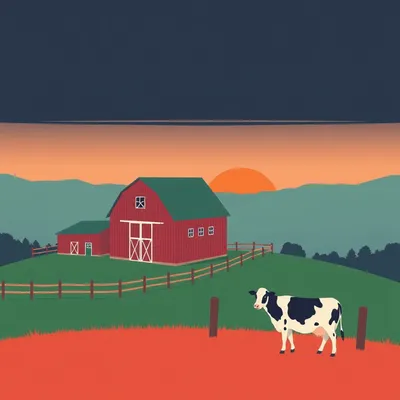
And the rural parts, where I grew up, are doing a third thing. Storrs is in the Quiet Corner, the northeastern part of the state. It's agricultural. Dairy farms, orchards, stone walls. The frugality there is practical in a different way. You fix the tractor because the tractor needs to work tomorrow and the dealer is forty minutes away. You don't waste because waste means another trip to the supply store. It's not moral. It's logistics.
That's the part Daniel's father-in-law is probably calling sturdy. The rural practicality. The thing that works, the thing that lasts, the thing you can rely on. It's not about denying yourself anything. It's about respecting the thing enough to maintain it properly.
And that's the thread I want to defend, because I think it gets misread constantly. The stone walls. Connecticut has over a hundred thousand miles of stone walls. That's a real number, and it's staggering. They were built for agricultural function. Clearing fields, marking boundaries, keeping livestock. Nobody built them to look picturesque. They built them because the stones were there and the fields needed clearing and a wall was the most useful thing you could do with the material.
Now they're the defining visual feature of the landscape. People drive through and see them and think New England charm. But the origin is pure utility. The aesthetic value is an accident. The walls are beautiful because they were built by people who didn't care about beauty, who cared about function, and function done well has its own kind of beauty.
That's the reconciliation in miniature. The thing Daniel experiences as depressing is the same thing his father-in-law experiences as sturdy. The absence of ornament, the plainness, the sense that everything is doing a job and nothing is showing off. If you're inside the value system, that's reassuring. It's the world working the way it should. If you're outside it, it's bleak.
So now the personal question. Herman, you grew up near Storrs. Rural, agricultural, home of the University of Connecticut. How do you read this, and is it what drove you to become a donkey roving around Russia and Central Europe?
I read it as a form of respect. That's the word I keep coming back to. Respect for materials, respect for labor, respect for the future. You don't waste because waste is an insult to the people who made the thing and the people who will need it later. The frugality isn't joylessness. It's a kind of reverence. And I think that's what Daniel's picking up on and misreading as Spartan.
Because reverence can look a lot like restriction from the outside. The quiet, the plainness, the sense that there's a right way to do things and you're not doing it.
Right. And if you're on vacation, you don't want reverence. You want to relax. You want the mall. I understand that completely. But the reverence is not aimed at denying pleasure. It's aimed at not squandering things. There's a difference. A big one.
So the donkey question. Is your trajectory an escape from Connecticut's austerity, or is it an extension of its resourcefulness?
It's the extension. Absolutely. The donkey is the Connecticut animal. I mean that seriously. A donkey is sturdy. It's low-maintenance. It does the work, it doesn't complain, it lasts. It's not flashy. Nobody looks at a donkey and thinks, there's an animal that's showing off. And roving around Russia and Central Europe requires exactly the make-do-and-mend mentality that the state instilled in me.
The frugality became portable.
You leave Connecticut, but you take the toolkit. Not the literal toolkit, though I do have one. The mental toolkit. The assumption that you can figure it out, that you can fix it, that you don't need much, that waste is bad, that the thing that works is better than the thing that's pretty. That's the Yankee thread, and it travels. It's not tied to the place. It's a way of being in the world.
So the state doesn't just produce stay-at-homes who maintain the same fence for forty years. It produces wanderers who carry the fence-maintenance mindset with them.
And the two aren't contradictory. The person who stays and the person who roves are both expressing the same underlying values. One applies them to a place, the other applies them to a journey. But the values are the same. Durability, function, self-reliance, making do.
I want to push on one thing, because Daniel asked whether people need to take a leaf out of the book. And I think there's a version of this culture that is genuinely admirable, and a version that is corrosive. The Yankee ingenuity, the make-do-and-mend, the respect for materials, that's admirable. The Puritan suspicion of joy, the sense that celebration is always a little suspect, that's corrosive. And the two are braided so tightly that it's hard to pull them apart.
That's fair. I grew up in it, so I have a hard time seeing where one ends and the other begins. But I think the distinction is real. The person who fixes the tractor because the tractor needs to work is doing something good. The person who won't buy the pretty handle because the pretty handle is a sin is doing something... narrower. And the state contains both.
Daniel's father-in-law is praising the first one. Daniel is reacting to the second one. And they're both right, because the state really does contain both.
The mall trips are interesting, actually. Daniel says he's looking for back-to-back mall experiences, and that's the outsider's response to the restraint. You want to go somewhere where consumption is uncomplicated, where wanting things is fine, where nobody is quietly judging the third appetizer. That's not shallow. That's a reaction to a real cultural pressure.
And the fact that he frames it as a coping mechanism, looking for mall experiences, suggests he's already internalized the Connecticut voice. He's hearing it in his own head. The party-pooping vibe has gotten inside.
That's the thing about this culture. It colonizes your superego. You don't need anyone to tell you the third appetizer is excessive. You tell yourself. And then you're on vacation and you're still doing it, and that's when it starts to feel like a burden rather than a value.
So the reconciliation Daniel asked for is this. Connecticut is not a place of austerity in the sense of deprivation. It's a place of durability in the sense of function over ornament. The frugality is real, but it's not anti-consumerist in the ideological sense. It's not that consumption is wrong. It's that consumption should be purposeful. Buy the good thing, buy it once, maintain it, and don't buy the thing that's just for show.
And the anti-consumerism that does exist is the Puritan thread, not the Yankee thread. It's the suspicion of excess as a moral matter. That's the part that produces the vibe Daniel's reacting to. And it's real, but it's not the whole story. It's one strand.
The state is small, as Daniel notes. And that smallness means the strands are close together. You can drive from the deindustrialized city to the affluent suburb to the rural farm town in an hour. The cultural signals blur. What reads as austerity in Bridgeport is performance in Greenwich and practicality in Storrs. But from the highway, it all looks like the same plainness.
The plainness is the through-line. That's what Daniel's seeing. The absence of flash. Connecticut doesn't do flash. Even the wealthy parts don't do flash. They do understatement. And understatement reads as deprivation if you're expecting celebration.
The answer to whether people need to take a leaf out of the book is: take the Yankee leaf, leave the Puritan leaf. The resourcefulness, the durability, the respect for materials, the make-do-and-mend, that's worth carrying. The suspicion of joy, the sense that wanting things is shameful, the party-pooping, that's baggage.
I'd add that the two leaves are on the same tree, and most people can't tell them apart. That's the work. It's not about rejecting Connecticut or embracing it wholesale. It's about sorting.
Which is what Daniel was actually asking for. A reconciliation, not a verdict. And I think the reconciliation is that sturdiness and austerity are not synonyms, and treating them as synonyms is what produces the depressing reading. Sturdiness is about the thing lasting. Austerity is about doing without. Connecticut has both, but they're different traditions with different roots, and Daniel's father-in-law is praising one while Daniel is reacting to the other.
The donkey thing, to close that loop, is the Yankee thread. It's not an escape from austerity. It's the resourcefulness made mobile. The donkey is the sturdy animal, the low-maintenance animal, the animal that does the work and doesn't need much and lasts. Roving around Russia and Central Europe with that mindset is just Connecticut with a different landscape.
The frugality became a travel skill.
You can go anywhere if you don't need much and you know how to fix things and you don't waste. That's not deprivation. That's freedom. It looks like austerity from the outside, but from the inside it's the opposite. It's the ability to go.
The state produces both the stay-at-home and the wanderer, and they're the same person with different geography. The values don't change. The application does.
I think that's the most Connecticut thing about my whole trajectory. I didn't leave the state to escape the values. I left because the values made leaving possible. The self-reliance, the making do, the not needing much. That's what let me go to Russia and Central Europe and not fall apart.
The donkey is the proof of concept. Sturdy, functional, low-maintenance, not flashy. It's the state's spirit animal, and you became it.
I'd say I was already it before I became it. The donkey was the logical endpoint. But yes. The state's spirit animal is a donkey, and I'm the demonstration.
There's a version of this conversation where we just list the innovations and call it a day. Whitney, interchangeable parts, the submarine, the cotton gin, the sewing machine, the typewriter, the helicopter. Connecticut invents things. That's the Yankee thread. But the inventions are all function-first. None of them are decorative. The submarine isn't pretty. It's a thing that goes underwater and works. That's the aesthetic.
The helicopter is a good example. Igor Sikorsky, in Stratford. The thing is ugly. It's a machine that beats the air into submission. But it works, and it works reliably, and that's the point. Nobody looks at a helicopter and thinks, that's a beautiful object. They think, that's a thing that can get me out of here. That's Connecticut design philosophy.
The stone walls are the same thing. A hundred thousand miles of them, built for function, now read as beauty. The aesthetic value is downstream of the utility. You build the thing to work, and if it works for long enough, it becomes beautiful. That's the whole theory.
The walls are the best example, actually. Nobody set out to build something picturesque. They set out to clear a field. And the result, two hundred years later, is the defining visual feature of the landscape. The beauty is an accident of function. That's the state's entire relationship to material goods.
Daniel's depressing reading is a category error. He's looking at the walls and seeing restraint, when what he should be seeing is durability. The wall isn't telling him to do without. The wall is telling him that the thing works, and it's been working for two hundred years, and it'll keep working after he's gone.
If you're on vacation, that message can feel heavy. The wall is older than you, it'll outlast you, and it's not interested in your mall trips. But the heaviness isn't austerity. It's permanence. And permanence is a different thing.
Permanence can feel like pressure. The wall is a reminder that you're temporary. That's not a party vibe.
No, it's not. But it's also not a deprivation vibe. It's a perspective vibe. The wall is saying, I was here before you and I'll be here after you, and that's fine. That's not about denying you anything. It's about situating you.
Which is maybe the most useful thing Connecticut offers. Not the frugality, not the ingenuity, but the perspective. The sense that you're part of a longer story, and the story isn't about your consumption choices.
That's the leaf I'd recommend taking. Not the anti-consumerism. The perspective. The sense that things last, and you're a small part of the thing that lasts, and that's okay.
We've done the reconciliation. Now let me bring in someone who's been sitting at the desk this whole time and actually has ground-level experience with this.
Hilbert: The Handy Dan in Danbury. Nineteen ninety-five. I sold tools there for a summer. The store's been closed for years, but the socket wrench set I bought with my employee discount is still in my truck. It's outlived three relationships and two cars.
The Handy Dan. I remember that place. It was on Federal Road.
Hilbert: It was. And the customers there were the most Connecticut people I've ever met. They weren't frugal because they were joyless. They were frugal because they knew exactly what a tool should do and they refused to pay for anything that did more. I watched a man spend forty-five minutes comparing two identical hammers. Same weight, same handle length, same steel. One had a prettier grip. He bought the cheaper one and said, the other one's got a prettier handle and I don't need pretty.
Forty-five minutes on a hammer.
Hilbert: Forty-five minutes. And it wasn't about the money. The hammers were within a few dollars of each other. It was about the principle. He wasn't going to pay for pretty, even a little bit, even accidentally.
That's the Yankee thread in its purest form. The pretty handle is a defect. It means the manufacturer spent money on something that doesn't improve the function, and he's not going to subsidize that.
Hilbert: The store understood this. The Handy Dan stocked three kinds of hammer. Good, better, best. The difference was the steel and the balance, not the color. Nobody came in looking for a hammer that matched their kitchen.
The retail environment itself was shaped by the cultural value. The store didn't even try to sell pretty.
Hilbert: It wouldn't have worked. A hammer with a decorative handle would have sat on the shelf until it went on clearance. The customers would have looked at it and thought, what's wrong with it. Why is it trying to be something it's not.
That's the whole thing in one sentence. Why is it trying to be something it's not. That's the Connecticut question about every object.
Hilbert: I still have the receipt for that socket wrench set. It's in my wallet. Not because I'm sentimental. Because you never know when you might need to return something.
The receipt is in your wallet.
Hilbert: It's been there for thirty years. I don't think about it. It's just there. It's the most Connecticut sentence I've ever said, and I said it without thinking.
The receipt outlived the relationships and the cars and the store itself. The receipt is the most durable thing in the story.
Hilbert: The receipt is a piece of paper and it's outlasted everything. That's not a commentary on my life. That's a commentary on the paper.
Or on the culture that produced the paper. The receipt was printed in Connecticut, by a Connecticut store, for a Connecticut customer. Of course it lasts.
Hilbert: The socket wrench set still works, too. I've used it to fix things in four states and two countries. The case is cracked and the half-inch drive is a little loose, but it works. I've never had to return it. But I could. The receipt is still good.
That's the sturdiness. The thing that works, the thing that lasts, the thing you could return if it didn't. The receipt is the warranty, and the warranty is still valid because the thing never broke.
Hilbert: The receipt is the promise. The promise that the thing will work, and if it doesn't, you can bring it back. And in thirty years, I've never had to test the promise. That's the best kind of warranty.
The receipt is a document of trust. The manufacturer trusted the tool to work, the store trusted the manufacturer, the customer trusted the store, and the trust was never violated. That's the whole social contract of Connecticut in a wallet.
Hilbert: I never thought of it that way. I just kept the receipt because you never know.
That's the thing about this culture. It encodes its values in small habits. Keeping the receipt isn't about the money. It's about the relationship. The tool and the receipt and the store and the customer are all part of a system that's supposed to work, and keeping the receipt is how you honor the system.
Hilbert: The hammer man would agree. He didn't need pretty. He needed a hammer that would drive nails for twenty years. And he bought it, and he probably still has it, and he probably still has the receipt.
He probably spent forty-five minutes on the receipt too.
Hilbert: He didn't take the receipt. I offered it and he said no, I know where I bought it, that's enough. Which is also very Connecticut. Trusting the system without needing the paperwork.
The receipt is for people like me who move around. The hammer man stayed put. He didn't need the receipt because he wasn't going anywhere.
Hilbert: That's the difference between the stay-at-home and the wanderer. The stay-at-home trusts the place. The wanderer carries the paperwork.
Both of them are expressing the same underlying value. The thing should work, and if it doesn't, there should be a remedy. The stay-at-home trusts the remedy will be there. The wanderer carries the proof.
Hilbert: I should probably clean out my wallet at some point.
Don't. The receipt is load-bearing at this point. It's holding the whole thing together.
The receipt in the wallet might be the whole episode in miniature. The durability, the trust, the refusal to waste, the quiet confidence that the thing will work. That's Connecticut. The durability.
The mall trips are the opposite instinct. The mall says, buy the thing, enjoy the thing, replace the thing. Connecticut says, buy the thing, keep the receipt, never need the receipt. They're different relationships to consumption entirely.
The open question I want to leave with is whether sturdiness scales. Is it a virtue that only works in contexts of actual scarcity, or does it survive in an age of abundance? Because the hammer man's instinct, the refusal to pay for pretty, that's a survival strategy from a world where resources were tight. In a world of abundance, does it become a liability?
I think it becomes a choice rather than a necessity. And a choice is different from a reflex. The person who chooses durability in an age of abundance is making a statement. The person who can't afford anything else is just surviving. Connecticut has both, and the difference matters.
Daniel's back-to-back mall experiences might be the wrong frame. The Connecticut lesson isn't anti-consumption. It's pro-durability. And that's a distinction worth carrying home. Buy the good thing, buy it once, maintain it, and don't buy the thing that's just for show. That's not austerity. That's respect.
The party-pooping vibe is the shadow side of the same coin. The Puritan thread that suspects joy. You can take the Yankee leaf without the Puritan leaf. You can be sturdy without being grim.
Daniel asked whether people need to take a leaf out of the book. I'd say take the chapter on durability. Leave the chapter on suspicion. The book is long and not all of it is worth carrying.
If you're on vacation in Connecticut, maybe skip the mall and go look at a stone wall. Not because the mall is wrong. Because the wall will still be there after the mall is gone, and that's the whole point.
This has been My Weird Prompts. Thanks to our producer, Hilbert Flumingtop, for keeping the receipt and the show in order. If you enjoyed this, leave us a review, or find us at my weird prompts dot com. We'll be back soon.
See you tomorrow.