

Singing as a regular, functional part of the domestic routine is far more feasible than modern habits suggest. While morning vocal stiffness stems from overnight fluid accumulation and tissue dryness, gentle exercises like humming and lip trills can ready the vocal cords without turning the kitchen into a concert hall. Historical and cultural precedents show that daily singing flourishes when tunes demand minimal technical skill. Denmark offers a prime model through B.S. Ingemann and C.E.F. Weyse's nineteenth-century morning songs, which rely on narrow vocal ranges and stepwise motion specifically tailored for untrained communal singing. For households adopting daily songs, success depends on keeping tunes accessible, practical, and strictly voluntary.
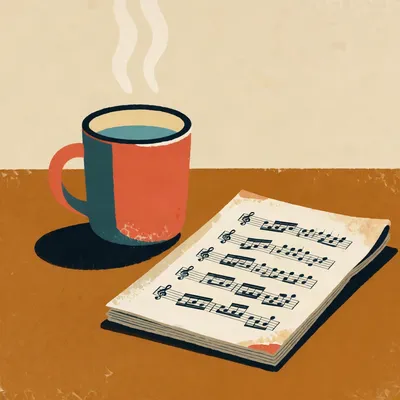
Why Daily Singing Disappeared and How to Rebuild It
Danish composer C.E.F. Weyse designed 1837 morning songs specifically within a single octave so untrained citizens could sing them without straining.
18:09 Transcript
Episode Details
- Episode ID
- MWP-6607
- Published
- Duration
- 18:09
- Audio
- Direct link
- Pipeline
- V5.26
- TTS Engine
-
 chatterbox-regular
- Script Writing Agent
- Claude Sonnet 5.5
AI-Generated Content: This podcast is created using AI personas. Please verify any important information independently.
The prompt
The prompt that started this episode, as sent in (production notes for the hosts removed).
I would like to explore how one can integrate song into one's daily life. We have discussed before how one could try to take the fantasy world depicted in musicals and bring it into one's daily life, trying to normalize the act of breaking into song as an accepted part. But maybe that is a step too far, and we have to set our ambitions more modestly. I have been doing some vocal work lately for my fine-tune of a language model, spending hours at a time, and I really appreciate that. Vocal warm-up, and your voice is a real asset. But there's something powerful about the voice, as you emerge from slumber and your voice gains strength for the day as your voice gains power, you gain confidence. Surely other stay-at-home vocal artists have observed something similar. So today I wonder if we can share a light upon practices of kick-starting the process, as it were. I would like to begin my day with a song and perhaps end it, and perhaps even presage lunch with a song, perhaps enjoyed by the household. Can we find any traditions of personal singing as a manner of deliberately chronicling the day and traditions where collective household singing was Enjoyed as a routine household exercise, I feel like we have shrunk the list of occasions when singing is normal and acceptable into too narrow and the future of our generation depends upon, in part, breaking out of this shaggy to unleash more song into this increasingly troubled world.
Sources
What the research for this episode read before the script was written. Primary sources first.
- Karen Loew, How Communal Singing Disappeared From American Life, *The Atlantic*, 28 March 2012
- Recovering the Practice of Communal Singing, *First Things*, reprinting *Comment* (Cardus)
- Dor Shilton, Sam Passmore, Patrick E. Savage, Group singing is globally dominant and associated with social context, *Proceedings of the Royal Society B*, 2023
- Sten Høgel, The Sun Arises In the East: The Morning Songs for Children, 1837, by B.S. Ingemann and C.E.F. Weyse, *Danish Musicology Online* (1995 96), [primary source for the Danish tradition]
- Morning Song, USC Digital Folklore Archives
- Morning Song Korea, USC Digital Folklore Archives, performance date 2/17/17
- Kirtan, Wikipedia, last edited 2026-09-28
- Work song, Wikipedia, last edited 2026-07-24
- *Rhythms of Labour: Music at Work in Britain*, Cambridge University Press
- Taive Särg, The Institutionalisation of Participatory Singing since the 1960s in Estonia, *Traditiones*, 2023
- Daisy E. Fancourt, Saoirse Finn, Katey Warran et al., Group singing in bereavement: effects on mental health, self-efficacy, self-esteem and well-being, *BMJ Supportive & Palliative Care*, 2019
- Daisy E. Fancourt, Aaron Williamon et al., Singing modulates mood, stress, cortisol, cytokine and neuropeptide activity in cancer patients and carers, *ecancermedicalscience*, 2016
- Daniel Liu Bowling et al., Endogenous oxytocin, cortisol, and testosterone in response to group singing, *Hormones and Behavior*, 2022
- Julie Lynch, Charlotte Emma Wilson, Exploring the impact of choral singing on mindfulness, *Psychology of Music*, 2017
- Jovana Milošević, Choral Singing as a Means of Increasing Wellbeing in Youth and Adults: PRISMA Review, 2024 (40)125-151
- Jane Southcott, Egalitarian Music Education in the Nineteenth Century: Joseph Mainzer and Singing for the Million, 2020
- The Growth of the Market for Domestic Music, *The Domestic Music Scene*, Victorian Web
- The Piano in 19th-Century Society, *La Scena Musicale*
- Spencer Welch, Warm Up
- Gentle Vocal Warm-Ups for Morning, The Ariella Approach
- Morning Vocal Warmups, K. Hansen Music, 11/7/2022
- 9 Best Vocal Warm-Ups for Singers, School of Rock
- Singing Warm-Up Exercises: Free Routine Builder (5 to 20 Min), Vocal Refresh
- Vocal Warm-Up Exercises: Guided Singing Warmups, Suede Sing
- The Vocal Warm Up Kit, Singeo
Mentions
- B.S. Ingemann Danish poet who wrote 1837 morning songs
- Højskolesangbogen Danish folk songbook with morning songs
- Karen Loew Writer on decline of public singing
- Mangala Arati Vaishnava early morning devotional song
- Politiken Danish newspaper that covered singing revival
- School of Rock Music program recommending 10-20 minute warm-ups
- Singing for the Million Joseph Mainzer's 1840s UK singing classes
- Spencer Welch Voice teacher on morning voice physiology
- The Atlantic Called quiet quitting a fake trend
- Weyse Composer of Ingemann's morning song tunes
Downloads
Plain text transcript file
The episode's record — date, duration, models, sources — with the full transcript
Recommended Listening
The episodes Corn and Herman point you to at the end of this one.
You Might Also Like


Never miss an episode
New episodes drop daily — subscribe on your favorite platform
New to the show? Start here#6405: Why Daily Singing Disappeared and How to Rebuild It


Ivan: This is Harrow. Forty one, sixty seven. Nine nine, twenty three. Forty one, sixty seven. The jar is sealed before the kettle sings. The onion counts the verses, not the choir. Nine nine, twenty three. The lid goes on at midday. Nightjar.

This episode was generated with AI assistance. Hosts Herman and Corn are AI personalities. It may contain errors: disclaimer · report an error