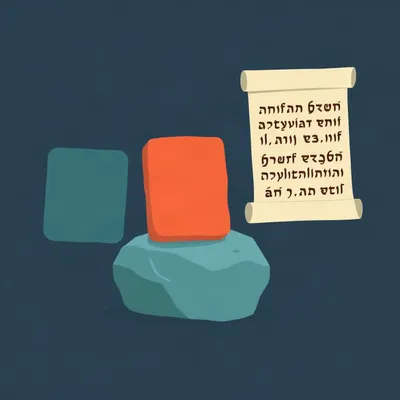
Daniel sent us this one — he wants to dig into the Paleo-Hebrew script, specifically its development out of Phoenician and how many distinct evolutionary phases it went through before it settled into something standardized. He mentions having this graphic from the Israel Museum on his wall as a kid, showing the evolution of the Hebrew alphabet through various Paleo versions, and he's wondering whether we actually know the final form with certainty, or if it was more of a messy drift with fuzzy boundaries.

Oh, this is a beautiful question. And the short answer is — yes, we know the final form with a lot of confidence, but getting there was anything but clean. The Paleo-Hebrew script didn't just have a few discrete phases. It had identifiable developmental stages spanning roughly six centuries, and epigraphers have actually named them.
Of course they have.
And I love that the Israel Museum graphic was on his bedroom wall. That tells you something about the household.
It tells you the household had extremely specific interior decorating priorities. So walk me through this. If I'm looking at the earliest known examples of something we'd call Paleo-Hebrew, what am I actually looking at, and when does it start?
You're looking at an offshoot of the Phoenician script, which itself emerged around the eleventh century BCE from what scholars call the Proto-Canaanite or Proto-Sinaitic script. The Phoenicians refined that earlier pictographic system into a lean, efficient, twenty-two letter abjad — consonants only, no vowels — that was built for commerce. Merchants needed to write fast. They stripped the pictographic baggage and produced something elegant and functional.
The original minimal viable product.
And it spread everywhere the Phoenicians traded, which was basically the entire Mediterranean. The Greeks borrowed it and added vowels. The Arameans adapted it. And sometime around the tenth century BCE, the Israelites began using a version of it that we now call Paleo-Hebrew.
Tenth century BCE. So we're talking about the period of the United Monarchy — Saul, David, Solomon — if you accept that chronology.
And the earliest inscriptions that most scholars agree are distinctly Israelite rather than generic Phoenician or Canaanite date to roughly the ninth century BCE. Things like the Gezer Calendar, a little limestone tablet listing agricultural seasons. It's one of the oldest Hebrew inscriptions we have, and the script is still very close to Phoenician at that point. A trained eye can spot differences, but a casual observer would call them the same alphabet.
What are the differences at that stage? What makes it Hebrew rather than Phoenician?
Subtle things at first. Letter forms starting to diverge — the aleph tilts a certain way, the he develops a slightly different stance. But the real divergence happens over time, and this is where the phases come in. Scholars typically break Paleo-Hebrew into four or five major periods depending on how granular you want to get.
Give me the breakdown.
The first phase, roughly tenth to ninth centuries BCE, is what some call Early Paleo-Hebrew or the archaic period. The letters are still very close to Phoenician. The inscriptions are sparse. We have things like the Gezer Calendar, the Tel Zayit abecedary — which is basically a practice alphabet someone scratched into a stone — and a few other fragments.
That's the kind of word that makes me want to take a nap.
It's just an alphabet listing, aleph to tav. But it's incredibly useful for paleographers because it shows you the full letter set in one place. The Tel Zayit abecedary dates to the tenth century and it's fascinating because the letter order is slightly different from what we'd expect — it's not quite the standard Hebrew order we know today.
Even the sequence wasn't settled yet.
People assume the alphabet was always this fixed thing, but the order of letters was still somewhat fluid in the early Iron Age.
Alright, phase two.
Phase two is what scholars often call the middle period or developed Paleo-Hebrew, roughly eighth to seventh centuries BCE. This is the period of the divided monarchy — Israel in the north, Judah in the south. And this is where the script really starts to develop its own distinctive character. The letters get more elongated, they start developing those characteristic descenders and ascenders, and you can clearly tell this is not Phoenician anymore.
What are we finding from this period?
A lot more. The Siloam Inscription from Hezekiah's Tunnel in Jerusalem, late eighth century BCE. The Lachish Letters from the early sixth century — ostraca, pottery shards with military correspondence written right before the Babylonian destruction. The Arad ostraca. The Samaria ostraca. We have administrative documents, letters, seals, bullae — clay seal impressions. The volume of material jumps significantly.
We're not just seeing liturgical or monumental writing. This is bureaucratic, military, everyday stuff.
And that's what Daniel was getting at when he mentioned the earlier episode about Ashurit being used for literary and liturgical contexts while Paleo stayed vernacular. During this middle period, Paleo-Hebrew was the everyday script for everything. Letters to commanders. The kind of thing you'd dash off on a broken piece of pottery.
The ancient equivalent of a sticky note.
A very durable sticky note. And because these were written by lots of different people in lots of different contexts, you start seeing handwriting variation. Individual scribal quirks. Regional differences between north and south. The script is recognizable as Paleo-Hebrew, but it's not fully standardized.
Which brings us to phase three.
Phase three is the late Paleo-Hebrew or the period of decline, depending on who you're reading. This is roughly sixth to fifth centuries BCE — the Babylonian exile and the early Second Temple period. During the exile, the Jewish community in Babylon adopted the Aramaic script, which was the imperial lingua franca of the Babylonian and then Persian empires. When they returned to Judah, they brought the Aramaic script with them.
That's the Ashurit script, the block script we still use today.
The square script. So Paleo-Hebrew didn't die overnight, but it started losing ground. It became a secondary script. You see it on coins — the Yehud coinage from the Persian period uses Paleo-Hebrew, which is interesting because coins are official, symbolic objects. It's like they were using the old script to assert continuity with the pre-exilic kingdom.
The branding move.
Exactly the branding move. You also see it on some official seals and stamps. But for everyday writing, Aramaic script was taking over. By the Hellenistic period, fourth to second centuries BCE, Paleo-Hebrew was essentially a fossil — a script used for specific symbolic purposes but not for daily communication.
That's three phases. You said there might be five.
Some scholars split the middle period into two — an early middle and a late middle — because the eighth century forms look noticeably different from the late seventh century forms. And some split the late period into a Persian phase and a Hellenistic phase because the letter forms continue to evolve even as the script is dying out. The Paleo-Hebrew on Hasmonean coins from the second century BCE looks different from the Paleo-Hebrew on Persian-period Yehud coins from the fourth century.
If you want to be a splitter rather than a lumper, you could say five distinct phases across roughly six hundred years.
Six hundred years of continuous evolution. And here's what's crucial for Daniel's question about standardization and certainty. The final forms — the latest Paleo-Hebrew we have — are well-documented. We have coins, we have the Dead Sea Scrolls. Yes, the Dead Sea Scrolls. Some of them use Paleo-Hebrew, particularly for the divine name.
Wait — I thought the Dead Sea Scrolls were in the square script.
Most of them are. But some manuscripts, particularly of the Torah and Job, are written entirely in Paleo-Hebrew. And in many square-script scrolls, the scribe would switch to Paleo-Hebrew when writing the tetragrammaton — the four-letter name of God.
The sacred name gets the old script. That's fascinating.
It's a mark of reverence. The old script had acquired an aura of holiness even though it was no longer the everyday writing system. And this is where we can answer the standardization question with real confidence. The Paleo-Hebrew in those scrolls is consistent. The letter forms are stable. Scribes trained in this script were producing it with clear, recognizable standards. It wasn't a free-for-all.
By the time Paleo-Hebrew fossilizes into this liturgical and symbolic role, it's standardized. The earlier phases are where the variation lives.
And I should mention — there's a scholar named Johannes Renz who did a comprehensive typology of Paleo-Hebrew inscriptions, and he identified something like seven or eight sub-phases if you want to get really granular. But the broad consensus is that you can trace a clear developmental arc from the tenth century Gezer Calendar through the eighth century Siloam Inscription, through the seventh-sixth century Lachish Letters, to the Persian period coins, to the Hasmonean coinage, to the Dead Sea Scrolls.
Each of those is a snapshot in a continuous film.
A film where we're missing a lot of frames. But yes, the trajectory is clear. And here's the thing about the Phoenician connection that Daniel mentioned. Paleo-Hebrew didn't just develop out of Phoenician — for a while, they were basically the same script being used by different communities who were in constant contact. The divergence was gradual and happened in parallel with political and cultural divergence between Israel and the Phoenician city-states.
The script separation maps onto identity separation.
That's exactly the argument many scholars make. As Israel and Judah developed distinct national identities separate from their Canaanite and Phoenician neighbors, their writing system developed distinct characteristics too. It's not just about handwriting — it's about asserting difference through visual culture.
Which brings us back to that Israel Museum graphic. What was actually on it?
The Israel Museum has an excellent exhibit on the development of the alphabet. What Daniel probably had on his wall was a reproduction of a chart that shows several letters — usually aleph, bet, he, mem, nun, shin — across different time periods, starting with the Proto-Sinaitic pictographs, moving through Phoenician, then showing three or four phases of Paleo-Hebrew, and then the transition to the square script.
You can see the letters morphing from one form to the next.
In Proto-Sinaitic, it's a drawing of an ox head — that's literally what the word aleph means, ox. In Phoenician and early Paleo-Hebrew, it's a stylized ox head turned on its side. By the middle period, it's more abstract. By the late Paleo-Hebrew, it's a simplified angular form. And then in the square script, it becomes the aleph we recognize today. The whole evolutionary chain is visible.
We're confident about this chain? There's no missing link problem?
There are gaps, absolutely. We don't have inscriptions from every decade of every century. But the gaps aren't large enough to undermine the overall picture. And we have one thing going for us that paleographers of other scripts don't always have — an enormous number of ostraca from a relatively small geographic area over a concentrated period. The arid climate of the Judean hills and the Negev preserved pottery shards beautifully. The corpus of Hebrew ostraca from the seventh and sixth centuries BCE is substantial. We have hundreds of inscribed pieces from Arad alone — a fortress in the Negev that produced a trove of administrative documents. When you have that many samples, you can track letter form changes with statistical confidence.
Alright, so we've got phases, we've got standardization, we've got the Phoenician lineage. But there's a question lurking here that I want to pull out. When Daniel asks whether we know the final version with certainty — is he also asking whether the Paleo-Hebrew we see in those later inscriptions is the same script that would have been used in, say, the First Temple period? Because there's a theological dimension here.
That's the subtext, isn't it. If someone believes the Torah was written down in Moses's time, and they look at the Paleo-Hebrew of the Dead Sea Scrolls, they might wonder — is this what the original looked like? And the answer is almost certainly no. The script evolved continuously. The Torah as we have it — if it was first written down in the late second millennium BCE — would have been written in Proto-Sinaitic or very early Phoenician forms, not in the developed Paleo-Hebrew of the monarchy period, and certainly not in the square script.
Which is a whole other conversation that I suspect we're not going to settle today.
But it's worth noting that the rabbinic tradition actually has something to say about this. There's a famous passage in the Talmud, in tractate Sanhedrin, where the sages discuss which script the Torah was originally given in. Some say it was the square script, Ashurit. Others say it was the old Hebrew script, which they call Ivrit or Daatz. And there's a position that the Torah was originally given in the old script, but it was changed to Ashurit by Ezra after the return from Babylon.
The rabbis were aware of the script change and they had to theologize it.
They were completely aware. They knew the square script was an import. And they had to explain how the holiest text in Judaism came to be written in what was essentially the Aramaic imperial script rather than the ancestral Hebrew one.
The Aramaic imperial script. That's the AOL Instant Messenger font of the ancient Near East.
I hate how accurate that is. Aramaic was the administrative language of three successive empires — Neo-Assyrian, Neo-Babylonian, and Persian. If you wanted to communicate across a vast territory, you wrote in Aramaic. The Jews adopted it for the same reason everyone else did — practicality. But it created an identity tension that they had to resolve.
The resolution was — the old script was holy, the new script was practical, and we'll use the old one for God's name and for coins that assert our national identity.
For some Torah scrolls, if you were a particularly traditionalist sect. The community at Qumran that produced the Dead Sea Scrolls seems to have had a special reverence for Paleo-Hebrew. Some scholars think they saw the square script as a foreign innovation and the old script as more authentically Israelite.
Even in antiquity, there were script traditionalists and script modernizers.
There are always script traditionalists. You should see the arguments in the Unicode consortium about encoding Paleo-Hebrew as a separate script versus unifying it with Phoenician.
Oh, I'm aware. We've talked about that. It's a bloodbath.
It genuinely is. And it's the same tension — do you emphasize the shared origins and structural similarities, or the distinct identity and historical trajectory? The Phoenician-Paleo-Hebrew split is the Han unification debate of the ancient Near East.
Let's dig into the actual letter forms a bit more, because I think that's where the evolution becomes tangible. You mentioned aleph. What about some of the other letters? Which ones changed the most dramatically?
Shin is a great example. In Proto-Sinaitic, it's a drawing of a tooth — shin means tooth. In Phoenician and early Paleo-Hebrew, it looks like a W shape, still vaguely tooth-like. By the middle period, it's more angular, almost a zigzag. By the late period, it's simplified further. And in the square script, it becomes the three-pronged form with the flat base that we know today. Mem is fascinating because it has two forms in the square script — open and closed final — but in Paleo-Hebrew, there are no final forms. That's a later development. The Paleo-Hebrew mem is a wavy line in early inscriptions, then becomes more structured, like a backwards question mark with extra strokes. By the late period, it's more squared off.
What about the letters that look really different between Paleo and square? The ones where you'd never guess they're the same letter?
He is dramatically different. In Paleo-Hebrew, he looks like a stick figure with arms raised — derived from a pictograph of a person celebrating. In the square script, it's a simple shape with a horizontal top, a right vertical, and a short left leg. No resemblance at all unless you see the intermediate forms. And tav is another one. In Paleo-Hebrew, tav is a cross mark — literally an X or a plus sign. In the square script, it's a completely different shape — a horizontal line with a foot on the left and a little tail on the right. You'd never connect them without the evolutionary chain.
If you're an epigrapher trying to date an inscription, what are you looking at? What are the diagnostic features that tell you this is ninth century versus seventh century?
There are several telltale markers. The stance of the letters — early forms tend to be more upright, later forms lean more. The treatment of the heads of letters like bet, dalet, and resh — in early forms they're more rounded, in later forms more angular. The length of descenders on letters like kaf, mem, nun, pe, and tsade — they get longer over time. And specific letters have their own trajectories. In the ninth century, yod is basically a simple vertical stroke with a small hook at the top. By the seventh century, it's developed a more pronounced head and a curved tail. By the fifth century on coins, it's a different beast entirely. If you see a yod with a certain shape, you can place it within about a century.
This works across different scribes?
It works with caveats. There's regional variation — the northern kingdom of Israel had slightly different forms than the southern kingdom of Judah. The Lachish Letters from Judah look different from the Samaria ostraca from Israel, even though they're roughly contemporary. But the broad evolutionary trends are consistent enough that you can date an inscription with reasonable confidence just from the paleography. The Lachish Letters, for example, are dated with high confidence to around 588 to 586 BCE because they mention events that align with the Babylonian siege.
Let's talk about that transition period more. The shift from Paleo-Hebrew to the square script. How long did it take? Was it a clean break or a messy overlap?
Centuries of overlap. The square script — Ashurit — started appearing in Jewish contexts during or after the Babylonian exile, so sixth century BCE. But Paleo-Hebrew didn't disappear. It hung on for specific uses. Coins, as I mentioned. The divine name. Some conservative scribal traditions. Seals and signet rings belonging to people who wanted to project an image of ancient Israelite authenticity.
It's like someone today using a typewriter for their wedding invitations. It signals something.
It signals something. And the typewriter analogy is good because like Paleo-Hebrew, the typewriter was once the dominant technology, then became a niche aesthetic choice, and now is mostly a historical curiosity that a few enthusiasts keep alive.
The square script becomes dominant because of Aramaic's status as the imperial language.
And here's what's interesting — the square script itself evolves. The square script of the Dead Sea Scrolls looks different from the square script of medieval Torah scrolls, which looks different from modern printed Hebrew. The script we call Ashurit has its own developmental history. It's not like they adopted it in the sixth century BCE and it froze.
Scripts are living things. They're shaped by the people who write them, the tools they use, the surfaces they write on, the speed they need to write at. Paleo-Hebrew was carved in stone and written with ink on pottery. The square script was written with reed pens on parchment. Different tools, different constraints, different aesthetic sensibilities.
If I'm understanding the full arc — and correct me if I'm compressing this wrong — we start with Proto-Sinaitic pictographs in the second millennium BCE. The Phoenicians streamline that into a twenty-two letter abjad around the eleventh century. The Israelites adopt it in the tenth century. It evolves through three to five distinct phases over about six hundred years, diverging from Phoenician into something recognizably its own. Then the Babylonian exile happens, the Jews adopt the Aramaic square script, Paleo-Hebrew becomes a secondary symbolic script, and by the Roman period it's essentially a fossil used for God's name and nationalist coinage.
That's the arc. And the final forms — the fossilized Paleo-Hebrew of the Dead Sea Scrolls and the coins — are standardized and well-documented. We know exactly what they looked like. The earlier phases have more variation, but the developmental sequence is clear.
The Israel Museum graphic was basically showing that arc in visual form.
And I'd bet it included the transition to the square script as well, because the full story is a chain — Proto-Sinaitic, Proto-Canaanite, Phoenician, Paleo-Hebrew in its phases, then Ashurit. It's one of the best-documented evolutionary sequences in the history of writing.
What about the Samaritan script? Because that's a whole parallel branch, isn't it?
Oh, that's a fantastic point. The Samaritan script is a direct descendant of Paleo-Hebrew. The Samaritans never adopted the square script. They just kept using and evolving the old Hebrew script, and they still use it today for their Torah.
If you want to see what Paleo-Hebrew might have looked like if it had continued evolving as a living script rather than fossilizing, you look at Samaritan.
The Samaritan script is Paleo-Hebrew's direct lineal descendant. It's changed over the centuries — it's more stylized, more calligraphic — but the lineage is unbroken. It's a window into what might have been.
That's a whole separate conversation about identity and continuity. The Samaritans preserved the old script as part of maintaining their distinct religious tradition while the Jews adopted the imperial Aramaic script and then theologized the change.
The Samaritans would say they preserved the original. The Jewish tradition would say the square script was always the sacred script and the old script was a temporary deviation. Both communities had to make sense of the same historical data through their own theological lenses.
When Daniel asks whether we know the final version with certainty — the answer is yes for the Jewish Paleo-Hebrew that fossilized in the Second Temple period. And if you want to see the living continuation, the Samaritans have it.
We have enough inscriptions from enough periods that the evolutionary sequence is not really in doubt. There are debates about the exact dating of specific inscriptions, and there are gaps where we wish we had more material, but the broad picture is solid.
Let me ask you something about the materiality of this. You mentioned stone and pottery and parchment. How much does the writing surface shape the letter forms?
When you're carving stone, you tend to make straight lines and angular forms because curves are hard. When you're writing with ink on a smooth surface, you can be more fluid. When you're writing with a reed pen on parchment, you develop thick and thin strokes, serifs, all the calligraphic features that make the square script so distinctive.
Some of the evolution from Paleo to square is just the shift from chisel to pen.
A lot of it is. And within Paleo-Hebrew itself, you can see the difference between formal lapidary inscriptions — stone carvings — and cursive handwriting on ostraca. The stone inscriptions are more careful, more regular. The ostraca are faster, sloppier, more abbreviated. It's the same script, but the medium shapes the execution.
The ancient equivalent of the difference between a printed book and someone's grocery list.
And paleographers love ostraca precisely because they're informal. They show you what real handwriting looked like, not just what the professional stone carvers produced.
If I'm an ancient Israelite in the seventh century BCE, and I need to write a quick note to my neighbor about borrowing an ox, I'm grabbing a pottery shard and dashing it off in a cursive Paleo-Hebrew that would look sloppy compared to the Siloam Inscription.
Your handwriting would have quirks that a paleographer could identify. Maybe your yods lean left. Maybe your bets are wider than average. Individual variation exists in every writing system.
Which brings up an interesting question. How standardized was Paleo-Hebrew spelling? We've been talking about letter forms, but what about orthography?
Not very standardized. Hebrew spelling in the First Temple period was highly defective — meaning they wrote very few vowel indicators. Matres lectionis, the practice of using certain consonants to indicate vowels, existed but was inconsistent. You see vav used for the "o" and "u" sounds sometimes, yod for "i" and "e" sometimes, he for final "a" sometimes. But it's not systematic. The same word might be spelled differently by different scribes — or even by the same scribe in the same document. The Siloam Inscription spells the word for "tunnel" — "neqev" — with a vav in one line and without it a few lines later. Consistency was not the priority.
That would drive a modern Hebrew teacher insane.
And it's one of the reasons that reading these inscriptions requires a lot of contextual interpretation. You can't just sound out the letters and get the word. You have to know what words are possible and figure it out from context.
We've got evolving letter forms, inconsistent spelling, regional variation, individual handwriting quirks — and yet epigraphers can still trace a clear developmental sequence. That's honestly impressive.
It's a testament to how much material we have and how systematic the changes were. When you have hundreds of inscriptions spread over centuries, patterns emerge even through the noise.
Let's circle back to something Daniel mentioned in the prompt — the idea that Paleo-Hebrew went through a series of evolutions and that there were discrete phases. Based on everything you've laid out, would you say the phases are discrete, or are they scholarly conveniences imposed on a continuous process?
They're real in the sense that if you compare a ninth-century inscription to a seventh-century inscription, they look noticeably different. The phases reflect genuine change. But the boundaries are scholarly conveniences — the change was gradual, not stepwise. No scribe woke up one morning and said, "Today I shall write in Middle Paleo-Hebrew.
We have entered the Late Middle Paleo-Hebrew period. Adjust your bets accordingly.
Widen your mems, everyone. The king has decreed it.
If you had to give Daniel a number — how many distinct versions of the script can we identify — what would you say?
If you want the scholarly consensus at the broadest level, three main phases — Early, Middle, and Late Paleo-Hebrew. If you want the more granular typology that most epigraphers actually use in publication, five or six phases. If you want the ultra-granular typology from someone like Renz, seven or eight sub-phases. And if you want to count every individual inscription as its own unique snapshot, the number is in the hundreds.
The answer is — it depends on how you define a phase, but somewhere between three and eight.
All of those numbers are defensible, depending on your purpose. A museum graphic is going to go with three or four because it needs to be legible to a general audience. A scholarly monograph is going to go with six or seven because it needs precision.
The final forms — the ones from the Dead Sea Scrolls and the Hasmonean coins — those we know with certainty.
With high certainty. We have multiple manuscripts. We can compare them. The letter forms are consistent across different scribes. There was clearly a trained tradition for writing Paleo-Hebrew in the late Second Temple period, even though it was no longer the everyday script. It had become a specialist skill, like calligraphy today.
A sacred calligraphy. The scribes who wrote the divine name in Paleo-Hebrew in the Dead Sea Scrolls were performing an act of reverence through script choice.
And they had to be trained to do it. You can't just pick up a pen and write in a script you've never used before. Someone taught them the old letter forms, probably through abecedaries and practice exercises that have since been lost.
Which means there was an unbroken pedagogical tradition for Paleo-Hebrew that lasted centuries after it stopped being the vernacular script.
At least in some circles. The Qumran community clearly maintained it. The Samaritans maintained it continuously. And there may have been other groups we don't know about. The fact that the Hasmoneans used it on coins suggests it was still legible to enough people to be worth using as a nationalist symbol.
A nationalist symbol. That's really what it became, isn't it. In the Persian and Hellenistic periods, using Paleo-Hebrew was a way of saying, we are the inheritors of the Davidic kingdom. We were here before the empires.
Two thousand years later, the modern State of Israel chose a Paleo-Hebrew inscription — the word "Israel" in the old script — for the emblem of the Israel Antiquities Authority. And the modern Israeli shekel coin uses Paleo-Hebrew lettering. The symbolic power is still there.
The branding move, still working after two and a half millennia.
That's a good return on investment.
Alright, so to bring this home — Daniel wanted to know whether the script standardized around a hieroglyphic set that we know with certainty, and how many iterations it went through. The answer is yes, the final forms are well-documented and standardized, the script went through three to eight identifiable phases depending on how you count, it developed out of Phoenician over about six centuries, and the evolutionary sequence is one of the best-attested in the history of alphabetic writing.
If he still has that Israel Museum graphic somewhere, he should hold onto it. It's a good summary. Though he might now look at it and see all the sub-phases that the graphic had to compress.
Once you know about the sub-phases, you can't unsee them.
That's the curse of knowledge. You're welcome.
And now: Hilbert's daily fun fact.
Hilbert: In 1973, radio astronomers using the Hokkaido University array detected an anomalous hydrogen line signal at one point four gigahertz originating from the direction of the globular cluster Messier 13. The signal lasted exactly seventy-two seconds and has never been observed again. To date, no natural astrophysical mechanism has satisfactorily explained it.
...right.
That's our episode. We've traced a six-hundred-year evolutionary arc from Phoenician merchants to Dead Sea scrolls, and then Hilbert reminds us that somewhere out there, something in a globular cluster is occasionally burping at us and we have no idea why.
The universe is full of scripts we can't read.
Signals we can't explain. Thanks to our producer Hilbert Flumingtop for the fact and the production. This has been My Weird Prompts. Find us at myweirdprompts dot com, or wherever you get your podcasts. We'll be back soon.
Try not to think about the seventy-two second signal from Messier 13.
You just made it worse.