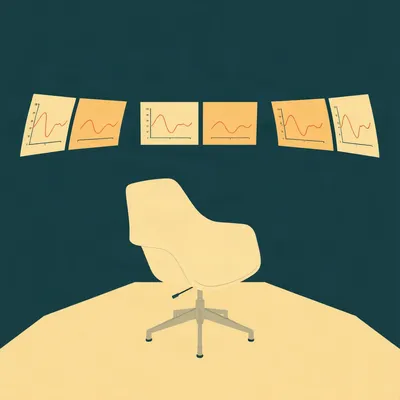
Seven swivel chairs. White fibreglass. Buttons in the right armrest, an ashtray in the left, and a holder for a glass of whisky. That was the control room for the entire economy of Chile.

The whisky holder is doing a lot of work in that sentence.
It's a real whisky holder. Nineteen seventy-two, Santiago.
It's also the room Daniel wants us in today. We'd been going through people putting chatbots on the ballot, and he wanted the version from before any of that existed. A government that tried to run a whole national economy through a machine, fifty years before anyone had a chatbot to put on a poster. Project Cybersyn. Which I know mostly as a photograph. That room, the chairs, the screens on the walls. It looks like the bridge of a starship that's been furnished by a Scandinavian furniture shop.
The designers always said they had no science fiction in mind. Nobody has ever believed them.
What I actually want to know is whether it worked. Because the photograph has done a lot of heavy lifting for fifty years, and I've never heard anyone say what the room did.
That's the right suspicion, and we'll get there. Start with how a socialist government ends up hiring a British management consultant. Salvador Allende is elected in nineteen seventy, and he starts nationalising industry fast. By the end of nineteen seventy-one the state has taken over more than a hundred and fifty companies. Mines, factories, textile mills. And it has nobody to run them.
Which is the part of nationalisation nobody puts on the banner.
There's a young engineer at the state development agency called Fernando Flores. He's twenty-eight. He's read the books of a man called Stafford Beer, who is a British cybernetician, and in July nineteen seventy-one Flores writes to him and asks him to come and wire up the economy.
Cybernetician is a job title you could only have had in about a fifteen-year window.
Beer was the most magnificent example of it. Big beard, big house in London, drove a Rolls-Royce, charged corporations a fortune to explain that a company is like a nervous system. His big idea was the viable system model. Five levels, from the people doing the work at the bottom, up through coordination and control, to the level at the top that sets the identity and the direction of the whole thing.
Then he comes to Chile and drops nearly everything else he's doing.
Walked away from most of his consulting work. He thought this was the chance of a lifetime, a whole country to run his ideas on. And there's a lovely moment early on. Beer is explaining the model to Allende himself, drawing it out level by level, working up from the bottom. He gets to the top level, the fifth one, and he's clearly building up to telling Allende, this one is you, Mister President. And Allende leans back before he can say it, and says, at last, the people.
Hm.
Beer was about to flatter him, and Allende out-flattered the people instead. That's a politician.
The project's Spanish name was Synco, and part of the joke was that it sounds like cinco, five.
So, what did Beer actually have to work with? Because I'm picturing Chile in nineteen seventy-one and I'm not picturing a lot of computers.
You're picturing correctly. There were a handful of mainframes in the whole country, and they could get time on roughly one. There's still argument over which machine, it's usually given as an IBM three-sixty. But what Chile did have was telex machines. Old teleprinters, sitting in offices, typing messages down a phone line. So that's the network. Every participating factory sends its figures every day by telex. Output, stock, absenteeism, energy use. It goes to Santiago, gets punched into the mainframe, and a program called Cyberstride looks for anything unusual.
Wait. So the nervous system of the nation is a fax machine.
A fax machine's grandfather. And honestly, Corn, I think that part was brilliant. They had no internet, so they found the thing that already went to every factory and made it carry data.
You've fallen for it. I could see it coming from the moment you said cybernetician. Your ears went up.
My ears did nothing.
Your ears did something. Go on, though. What happens when Cyberstride finds something unusual?
It's meant to escalate. If a factory's numbers drift and the factory doesn't sort it out itself within a set time, the alert goes up a level. And if it keeps going, it goes up again, and eventually it reaches the room with the chairs. There was also a simulator, called CHECO, where officials could try a policy and see where the economy would go in a few years.
A factory telexing Santiago every day about its absenteeism. If I worked in that factory, I'd call that surveillance with good typography.
That worry was there at the time, and to be fair to Allende, he pushed against it. Once he understood the model, he wanted it decentralising, worker-participative, anti-bureaucratic. That's why the alerts went to the factory first. The plant gets a window to fix its own problem before anyone above it hears about it. In Beer's language, each level keeps as much autonomy as it can handle.
So the escalation is a grace period. You've got until Thursday before the ministry finds out about your absenteeism.
Which, if you've ever worked in a big organisation, is more grace than most managers give. What do you think, would you have trusted it, if you were the plant manager?
I'd have trusted it for about a week, until the first time Santiago rang me about a number I'd already fixed. After that, I'd have learned exactly which figures go down the telex and which stay in the drawer.
That's a known problem with every one of these systems. Once people know a number is being watched, they start managing the number.
Tell me about the room, though. That's the bit everyone's seen.
Hexagonal. Designed by a team under Gui Bonsiepe, from the Ulm school of design in Germany. The seven chairs face screens on the walls. No keyboards anywhere, on purpose. The idea was that the people in charge, ministers and union leaders, shouldn't need anyone to type for them. You press a button in the armrest and the screen changes.
Let me guess. Live graphs of copper output, updating by the second.
That's the part the photograph doesn't tell you. The graphs were drawn by hand. Designers drew every chart, photographed it, and the screens were slide projectors, behind the wall. Something like fifteen hundred slides.
So the real-time national dashboard was a slideshow.
Prepared in advance, by people with pens. And the room itself was never fully operational. It was finished as a prototype, and people who worked on it called it the symbolic heart of the project, which is a polite way of saying it was the heart and not the hands.
The world's most expensive holiday slides, and every one of them is about copper.

Every day, in nations just like yours, an economy goes unmonitored. Factories send no data. Ministers sit in ordinary chairs. Graphs go undrawn. Experts agree that a nation without a hexagonal room is a nation without a plan. This is a message about national responsibility. Know the signs: if your cabinet has fewer than seven swivel chairs, if nobody in government has an ashtray built into their furniture, if your country cannot express its happiness through a dial, it may already be too late. Protect your economy. Protect your people. Act now. Brought to you by Opsroom Home, the complete hexagonal control room, with fifteen hundred hand-drawn slides, flat-packed for the modern household. Opsroom Home. Because the responsible thing is to sit down.
Herman. That had your fingerprints on it.
I have never heard of Opsroom Home, I don't own a slide projector, the one in the storage cupboard belongs to Daniel and it doesn't take carousels anyway, and I was in the kitchen the entire time anybody could have booked that. So, the dial. Because that ad didn't make it up.
The happiness dial is real?
It was called an algedonic meter. From the Greek words for pain and pleasure. Beer had a plan called Project Cyberfolk. Every home with a television gets a little box with a dial. When the government says something on TV, you turn the dial towards happy or towards unhappy, and the totals are fed back in real time. The national mood, live, while the minister is still speaking.
A national like button, wired to the television, in nineteen seventy-two.
Beer's teenage son, Simon, built prototypes of it. They were never rolled out to the country. Depending on who you read, a few prototypes existed and that's as far as it got.
Here's where I get off the train a bit, Herman. And you'll have predicted this, because I always come back to it.
You're going to say prices.
I'm going to say prices. An economy already has a pain and pleasure dial. It's called a price. When people want more bread than there is, the price goes up, and every baker in the country hears about it without anyone sending a telex. Allende's government froze prices and took over the firms, which switched that dial off. And then they hired a genius to build a second one, out of teleprinters and slide projectors.
That's not unfair. I'd say the cybernetics people would answer that prices are slow and blunt, and that they wanted something faster.
Faster than a teenager soldering a knob onto a box?
In fairness to Simon, the knob worked. But I take the point. And there's a real argument among historians about how much of Cybersyn ever worked. Some people who've looked hard at it say it was mostly a beautiful room and a telex network, and the telex network was the only part that did anything.
Did anything ever actually happen in the room?
Something happened, and it's the best story in the whole project. October nineteen seventy-two. The truck owners go on strike. Tens of thousands of trucks, in a country that's a long thin strip where almost everything moves by road. They block the routes into Santiago. Food, fuel, raw materials, all stuck. It was a deliberate attempt to choke the government, and there are long-standing allegations that American money was behind it.
In which case, a country run by a computer met a country run by truck drivers.
And here's what they did. They took the telex network, the one built for factory statistics, and used it as a command channel. Which roads are open, which depots have fuel, which unions are still working. The government ran the supply of the capital with something like two hundred loyal trucks, routing them around the blockades by telex.
Two hundred.
Against tens of thousands. And after about twenty-four days the strike collapsed. That's the moment Cybersyn's people pointed to for the rest of their lives.
Here's the thing that jumps out at me, though. Nothing that won that strike was the clever part. No Cyberstride, no simulator, no algedonic dial. It was people in a room reading telexes and making phone calls. The network carried the messages and humans made every decision.
Do you count that as a win for the machine or not? Honestly.
I count it as a win for having a network at all. If you'd taken the room away, they'd still have beaten the strike. If you'd taken the telex away, they wouldn't.
I think that's right, and it's what makes it relevant to what Daniel was getting at in the AI party story. Every time somebody tries to put a machine in charge, the photograph is of the decision-making bit. The chairs, the chatbot on the poster, the minister on the screen. And the part that does the work is always the boring pipe underneath.
So how does it end?
Badly, and quickly. September the eleventh, nineteen seventy-three. The military coup. Allende dies in the presidential palace. The military abandons the project and destroys the operations room. What we have now is mostly photographs.
The room that was going to run the economy didn't survive the first week of the new government.
What happens to the people afterwards is almost a novel. Fernando Flores, the twenty-eight-year-old who wrote the letter, had become a minister by then. He's arrested and held in a prison camp until nineteen seventy-six. Amnesty International campaigns for him, he's released into exile, and he goes to Palo Alto. He works at Stanford, does a PhD at Berkeley, writes a book about computers and language with Terry Winograd, sets up software and consulting companies, gets rich, and goes back to Chile and is elected a senator.
And which side does the cybernetic socialist end up on?
By the twenty ten election, he's backing the right-wing candidate.
Prison camp, Stanford, management consultant, senator for the centre-right. That's the most viable system in the whole story.
Stafford Beer, meanwhile. In nineteen seventy-five he gives up the big house in London and the Rolls-Royce, and moves to a two-room stone cottage in Wales with no running water. Swaps the Rolls for an old Land Rover. Spends a lot of the rest of his life on poetry and yoga.
He lost the economy of Chile and downsized to a cottage without a tap. I've seen people take a smaller setback worse.
Here's my question for you, though, Corn. If you'd been Flores, in nineteen seventy-one, with a hundred and fifty factories and nobody to run them. Would you have built it?
The telex network, yes, tomorrow. The room, no. I'd have spent the slide projector money on more teleprinters and a few more people who knew how to read them.
You'd have built the boring half.
I'd have built the half that beat the truckers.

Siemens T one hundred teleprinter. Two hundred and forty shekels.
Is that the one you've got in the flat?
On top of the fridge. Plugged into the socket for the extractor fan, so I can't run them both. It works. Fifty baud, which is the speed you lot would get through a sentence if Herman didn't say cybernetician in the middle of it. The keys are fine for a claw, it's the paper feed you have to be gentle with. I bought it in the summer for Yossi Dahan.
Yossi lives two doors down from me. He doesn't trust telephones. He wants the weather in Ashdod every morning, in writing, by seven. His brother-in-law lives in Ashdod. So the brother-in-law rings Yossi with the weather, Yossi walks it round to my flat, and I telex it to him.
So the weather goes from Ashdod to Yossi's ear, into your kitchen, and back into Yossi's hands. And Yossi is in the room for all of it.
He stands next to the fridge while it prints. Then he takes the paper home. That was fine until last month, when he started replying. He has to come to mine to reply, because there's only one machine. So he sits in my kitchen and telexes me. I'm standing next to him.
A point-to-point link with one terminal. That's not a network, that's a man typing at a fridge.
He pays in lemons. I'm owed three hundred and forty. Three hundred and twelve. I don't count the ones with a sticker on, those are from a shop and he knows it.
The lemons aren't the money, though. The money was the paper. Yellow rolls, from a man in Holon who's the only one left who stocks them. I paid him for twenty rolls in July. He sent nineteen and a roll of cash register paper, which is the wrong width, and he says it's the same thing. It isn't. It jammed the feed. Took me an evening to get it out with tweezers.
And the dispute is now with Holon, not with Yossi.
It's with both. Yossi wants it on Shabbat now as well. He says the weather doesn't stop. He's proposing I leave the machine on Friday afternoon and he lets himself in. He's already got a key cut. He showed me the key. He's very pleased with the key.
I'm not giving him the extractor fan socket on a Friday. I had the same arrangement with a man at the shipping office in Haifa years ago, and it ended with a teleprinter in the stairwell. Tuesday Yossi paid me nine lemons, two with stickers.
Seven, then.
Cash register rolls are thermal paper, too. A teleprinter hammers ink onto the page. It would never have printed a single letter on it.
Nineteen rolls and a substitute. The man in Holon has found his business model.
That's where I'd leave Daniel's question, I think. Did Chile run its economy by machine? No. It ran a telex network with very good chairs, and the one time it really mattered, it was people reading paper and routing trucks. The computer never decided anything.
And the bit that seems most modern in hindsight is the dial on the television. A government that wanted to know how you felt about every sentence as it said it. We have that now, it's just that nobody at a ministry built it. The phones in our pockets do it, every scroll and every like. So the question I'd leave people with is whether anybody running a country today is reading that dial as carefully as Beer meant them to. Or whether, like Yossi, they're just standing next to the fridge waiting for the paper to come out.
Thanks as always to our producer, Hilbert Flumingtop, for keeping the whole thing running.
This has been My Weird Prompts. You'll find every episode at my weird prompts dot com.
See you tomorrow.