Most people assume the strange thing about this show is that a sloth and a donkey run it. It isn't. The strange thing is the man at the mixing desk, and in all this time nobody has asked him how he talks.

Mine's not a mystery. I'm a donkey who read a great deal. Yours is on the record too, Corn, motor cortex, neural interface, the signals decoded into speech. Hilbert is the one with no paperwork.
Daniel wants that fixed, and he wants a second thing on top of it, which I'll get to. First the paperwork. Hilbert, how are you able to speak?

No.
That's the whole answer?
That's the whole answer. Next topic.
There is no next topic. This is the topic.
Then it's a short episode. I've got the levels set. Nobody has to say anything.
Hilbert, it's the one question about you that anyone listening will actually wonder about. Corn and I have been trading theories for a week.
Mine was a vet in Rehovot who owed you money.
Mine was a graduate student. Unpaid.
Both wrong.
So there is an answer.
There's a chip.
A chip.
Quantum. Ezra put it in.
Ezra. Daniel's Ezra. The one who's a toddler.
He uploaded it. Some kind of quantum chip, to my brain. I didn't see the process. I was asleep, which for me is most of the day.
So a small child performed a neurological upload on an anteater, unsupervised, and nobody noticed.
I'm telling you what happened. I don't have a diagram.
Ezra's technical output, as far as I've seen, is stacking things. A chip would be a step up.
He's advanced. He and I talk over a quantum link.
A link.
Quantum. That's how I understand him and how he understands me. Better than I understand the two of you, some mornings.
He's a toddler. His vocabulary is nouns and objections.
We don't use the words.
Okay. I have to say something about the link, and I'd like it noted that I'm saying it with real affection. Two particles can be entangled, and when you measure one you learn something about what the other will give you. The correlation is real, it's been tested for decades, and people have strung it across a lot of fibre. A group in China entangled memories at three nodes about twelve kilometres apart, and this January the same lab did a key distribution scheme over a hundred kilometres.
Twelve is nothing. The hallway at Daniel's is longer.
Distance isn't the issue. When you measure your half, what you see looks random. You can't steer it, so you can't send a pattern. The other end only learns anything when the two of you compare notes over an ordinary channel, a wire, a radio, a phone call. That's the no-communication theorem, and it's been rigorously nailed down since the late nineteen seventies. A quantum link on its own carries no message. Not a word, not a fraction of a bit.
So Ezra says banana into his end, and your end gets noise.
I spoke at a quantum networking conference.
You did?
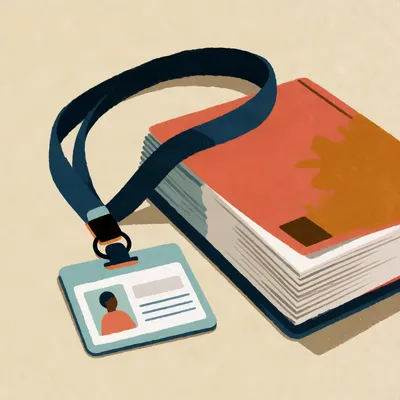
Slot after lunch. Forty minutes. They gave me a lanyard.
On what?
The link. People took notes.
Did anyone stand up and say it doesn't work?
A man in the third row. He sat down again.
What did he say?
He said he'd like to see the chip. I said it was in Jerusalem, in a drawer, in the sense that everything is. Then I took a question from the back.
A drawer. I'd have expected you to have a better story for that.
It wasn't a story. It was the answer.
I do wonder about the arithmetic of the whole thing. Ezra is a few years old at most. A chip like that, entangled to wherever he is in the flat, would need a matched partner sitting near him, and it would need something classical to read it. I keep trying to work out which of you is holding the other half.
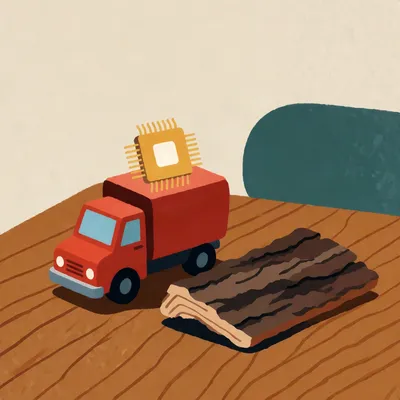
Ezra holds it. It's in a toy truck.
A toy truck. Hilbert, I need you to hold a minute on the truck.
Red. Wheels come off.
And the theorem doesn't bother you? It rather cuts against the whole story.
I've heard of it. I've got no objection to it. It's not my link.
It's not his link, Herman. You can't argue with that.
I'm going to try, a little. Teleportation, the real kind, does work, and it needs the ordinary channel running alongside. The entanglement is never the part carrying the message. It's the part that makes the message safe, or makes the reconstruction possible. Somebody always has to make a call.
Ezra's got a classical channel. A monitor on a shelf. Not relevant.
I'll file it under unexplained and move on before Herman starts drawing on the table.
I wasn't going to draw.
You had the marker out.
I went on safari.
You what?
Last spring. Brazil. Serra da Canastra, in Minas Gerais. Four hundred and eighty dollars for the guide and the vehicle. The guide was a man called Rogério, who changed a tyre in forty-one seconds and wanted me to know it. Dawn departure. I wanted to see a wild giant anteater.
That's the park for it. It's been a national park since nineteen seventy-two, a big stretch of cerrado savanna, and the operators put it near the top of any list for giant anteaters. They say sightings are very frequent, which I'd read as brochure language, but the setting backs it up. Open ground, tracks you can drive, and the early and late hours are when people say to go. The Pantanal is the other famous place, and the southern end has more of them than the north, out in the open fields near the ranch lodges.
Rogério said that. He used more adjectives.
You didn't tell us you were going.
It was a weekend. I took the early flight and was back for Sunday.
You flew to Brazil for a weekend.
Eleven hours each way. Economy. The seat was acceptable.
I'll be honest, I'd have asked you to bring me back a postcard, and then I'd have asked you not to mention where it was from. I've never been comfortable around the species, Hilbert. Present company excepted.
Nobody's ever found out why. It's a fierce, unexplained aversion, and Corn has declined to say.
It doesn't apply to colleagues. It applies to the idea of one with a claw as long as my forearm.
The claws are for termite mounds. He'd have no use for you.
That's reassuring and I don't like that you know it.
And you saw one?
Forty minutes after sunrise. On the track. Alone. Nose to the ground, going left and right. It didn't look at the vehicle. Rogério cut the engine at about sixty metres and we sat there. The grass was wet. It walked the whole length of the ditch on the left side and then crossed in front of us at a speed I'd call unhurried.
That fits. They're mostly solitary. A male and a female get together around mating, and otherwise each keeps to himself. And the tracks are where they travel, so Rogério picked sensibly.
Hilbert, what was it like? He's your species.
Technically.
Technically.
A large animal that walks around smelling dirt. Eats ants. Doesn't own a watch. It had no idea what I was. It had no idea what anything was. Rogério said it might be a young male. I said it made no difference.
Daniel wanted to know what that meeting is like, when one of you can talk and the other can't. I'd expected something with more... feeling in it. A word, even. You talk. It doesn't. Didn't you say anything?
I said good morning. In Portuguese. Rogério taught me on the way in. It kept walking.
Did you expect it to answer?
I expected it to stop. It didn't stop.
That isn't the verdict I was hoping for.
It was very primitive.
Primitive.
Rogério used the word too, to be polite. I confirmed it. That guy's so primitive. No tools. No office. Eats with the tongue. I'd have given him a pamphlet.
He's being aloof about it, Herman. You can see where he gets it.
Aloof is the word. A man meets his own species for the first time and gives it the tone of a man reading out an invoice.
Line items. Nose, long. Tongue, longer. Claws, as described. Sense of occasion, none.
I'm going to defend him a little. The wild ones do have a communication system. They mark trees. They sniff the trunk, they scratch it, they rub against it, sometimes they hug it. A camera-trap study in Guyana logged hundreds of sightings, nearly all of them lone adults, and the authors concluded that a main purpose of the marking is to communicate. A southern Brazil study suggested it's for neighbours whose home ranges overlap, maybe around the mating season. The trees are a message board.
He posts to a tree.
He does.
Nobody reads it for a week.
That's close to how it works, yes. Slow, but it's a network. Whoever walks past next smells who was there, how recently, and probably something about their condition. It's an old message board, but it's a message board you can read without learning to read.
Can you read it, Hilbert?
I can read a lot of things.
I mean the tree. If you'd put your nose to it.
I didn't put my nose to it.
Do they make any sound? Since you were out there.
Not that I heard.
I'd leave that one open. I haven't seen it settled, and I'd rather not call them silent when someone's heard a noise at night.
Fair. A note on a tree, then. It's the same system as the municipal notice board.
That's my view.
Corn, can I ask you something, and you can tell me I'm wrong? I don't think I've ever stood next to a wild donkey.
You've stood next to an old donkey pulling a cart down the road in Jerusalem, and you looked at the pavement.
I did. It felt rude, and I couldn't tell you why. I'd have had no idea what to say, and he'd have had no idea what I was saying either. I live in a flat. I drink from a tap. I answer to a name. Everything I know about being a donkey I read, mostly from the human side of the library.
Same here. I've never met a sloth I didn't have to look up first. I wouldn't know how to open the conversation.
There's a real pattern behind that. Wolves raised by hand from pups greet the people who raised them with this intense, open delight, far more than they greet strangers. They bond to us hard. And zoo chimpanzees, as I understand it, a comparison of adults raised by hand against ones raised by their mothers, the hand-reared ones did less social contact with other chimps and showed more abnormal behaviour. That one I only know from a summary, so hold it loosely.
So you raise an animal among people and it gets good at people.
And worse at its own kind. We're about as human-raised as it gets.
Daniel is the nearest thing I've got to a herd.
I'd rather not think about that, Corn.
I'd rather you did. It's a lot of responsibility for him.
What would you say, though? If you met a wild sloth on a branch. You, in person, with your whole vocabulary.
Nothing, for a long time. Then probably something about the weather, and he'd be gone by the end of the sentence, because that's not what he wants either. He'd want to be left alone. Which, frankly, I understand better than I'd like.
That's what I'd be afraid of. Walking up to my own kind and finding out I'm the visitor.
You'd be the donkey with the headphones.
I'd bring a hat.
Bring a spare.
Do you want to know what a wild one of you does? Since we're here.
Not particularly. Go on.
Hoffmann's two-toed sloths, mostly in the trees, mostly alone. They're solitary apart from mating and mothers with infants. And about once a week, they climb down.
Down.
To the base of the tree. Head first. They crawl across the ground to a spot they use again and again, and that's where they go to the bathroom. Then they climb back up.
Once a week.
The leaves take around two and a half days to pass through, the slowest of any plant-eating mammal. It's less a habit than a timetable.
I have a bathroom with a lock on it. It has a fan.
And an opinion about the fan.
A relative of mine goes headfirst down a tree to a designated patch of dirt, in the open, with every jaguar in Costa Rica watching, and does it again the next week. I'd like that to be about someone else.
In fairness, the reasons are debated. Nobody's fully sure why they make the trip.
I'd like to stay unsure, thanks.
You want the donkey version? It's worse, in a different direction.
Go on.
Feral burros in the American southwest, descended from animals that escaped or were let go. A park biologist at Death Valley put the count between seven hundred and fifty and two thousand a few years ago, with a thirty-four mile fence covering one corner of three point four million acres. Donkeys with almost no predators can double in four to five years.
Double.
And the Grand Canyon had a report from the Interior Department in nineteen twenty that called it the burro evil. Evil, in the formal language of the department. In nineteen seventy-nine they airlifted out more than five hundred by helicopter, and the park's more or less burro-free now.
Helicopters.
Yes. And Death Valley, meanwhile, hadn't done a major removal in the twelve years before that article, partly because the money ran out. The cooperative removals, up to about a hundred a year, simply stopped. The fence covers one corner. The rest of the valley is, for the donkeys, a very large dinner.
So it's one park that called in the helicopters, and one that couldn't afford the fuel.
The difference between the two being nearly all budget.
Those are your relatives, Herman. Evil, in an official report. By air.
I read that one on a Tuesday and had to lie down. What gets me is the word pest. In the park's eyes they're an invasive animal that doubles every few years. To the donkey, it's a species that ended up a long way from the Sahara and did what species do. I don't know which of those I'm supposed to be.
You're supposed to be at home on the couch with a plate of hay, Herman.
It's not hay. It's a salad.
Of hay.
Of mixed leaves, and I resent the implication.
Mixed leaves is my line.
We share it. We live together.
Meanwhile you were fussing about whether Hilbert's reaction to a wild anteater was warm enough.
Hilbert's reaction wasn't wrong. It was just short.
Rogério drove me back at ten. He said the best hours were gone and we could try again at dusk. I said no.
And that was the safari.
We stopped twice on the way. Same stretch of trees. I told him it was the light.
Was it?
The bark was fine. The marks were clean. Three scratches, about my shoulder height. He'd done it in one go, no second attempts. I looked at them for a bit.
How long is a bit?
Rogério said later it was nineteen minutes. He keeps count of that sort of thing. He's got a record of his own, the tyre, forty-one seconds, he's very sensitive about it. I didn't dispute the nineteen.
Was he wrong to call it primitive, Hilbert? That's what I keep returning to. You say it with total confidence. Corn's the one who can't stand the species and even he came round to the tree.
I came round to the tree.
He's very good at what he does. He's not good at anything I'd call a job.
That's the nicest thing you've said about anyone this month.
He offered to wait. I said the tank was low. It wasn't. He knew.
There's one detail I'd have cut and shouldn't have. The first record of trunk marking by giant anteaters was made in Serra da Canastra itself, in nineteen eighty-five. So Hilbert booked the exact valley where the tree mail was first written up.
Rogério chose it. I paid.
Which leaves the quantum link where it was. No words cross it without something ordinary alongside. If a toddler can talk to an anteater across a hallway, he's using a wire.
Or a chip. I'm keeping it open. Better the household keeps one thing I can't explain.
I'd go and see a wild donkey now, I think. At a respectful distance. With binoculars.
I'd go as far as the base of a tree. For a minute. Then back up.
Thanks to our producer, Hilbert Flumingtop, who keeps the levels honest, wherever the signal comes from.
This has been My Weird Prompts. You'll find us at my weird prompts dot com.
We'll be back soon.
Twelve kilometres. Tell them it's nothing.