...and the thing about the drawer is that you never actually audit it. You just keep adding to it.

Everyone has that drawer. Mine has a charger from a phone I don't own anymore.
Which phone?
I don't remember. That's the point of the drawer.
Herman, we should probably get to the actual prompt, since Daniel went to the trouble of writing it down rather than just thinking it loudly at us.
Right, yes. Sorry.
So Daniel's written in with a whole cluster of questions, and they're good ones. He points out that an enormous number of devices run on five volts over USB, and that Type A is a legacy connector, but it's the power input for countless appliances, so we're going to be figuring out how to connect these things for a good while yet. Then he names the problem: when you go looking for ways to plug them in, you fall into a world of dubious adapters that were mostly built for charging phones. Some of them promise to power four Type A sockets off a single plug head, which he says always struck him as a bad idea. And then the big one, the amperage question. He says he'd always assumed a five volt device could negotiate its draw, and that any decently engineered USB plug would accommodate the modest currents these devices pull. But then you see adapters rated five volts one amp, five volts half an amp, and up from there. So is it essential to pair the plug to the current the device expects, or is that conservative marketing in large part?
Four separate things in there. And the fourth one has a real answer.
Let's start with why we're even having this conversation in the first place, because Type A is a 1996 connector.
Nineteen ninety-six, and the official spec tops it out at four and a half watts. Meanwhile some Type A ports in the wild deliver thirty watts.
How does a connector with a four and a half watt ceiling end up pushing thirty?
Because the spec is the floor of what everyone agrees to, not the ceiling of what the hardware can do. Vendors shipped fast charging schemes on top of Type A years ago. Qualcomm's whole Quick Charge line ran over Type A. So the connector's official limit and the connector's real-world limit have been two different numbers for a long time.
So the two questions we're actually answering today are, one, how does power negotiation and current draw actually work, and two, when you buy one of these adapters, what actually matters.
And the arc I'd want to run is mechanism first, then the multi-port problem, then the safety landscape.
Mechanism first, because everything else follows from it. And there's a fresh angle here I want to flag up top, which is that Type A's dumb, always-on five volts is not a defect. It's exactly the reason cheap devices cling to it.
That's the through line. Let's start with the mess before there were rules.
How bad was it?
Under USB 2.0, in the year two thousand, a device could draw a hundred milliamps by default. It could negotiate up to five hundred milliamps, and that was the maximum. But a suspended bus limited draw to two and a half milliamps.
Two and a half.
Two and a half milliamps. So if you plugged in a device with a completely dead battery, and the bus went to suspend, the device could only reliably pull two and a half milliamps.
Which is essentially nothing.
It's essentially nothing. Charging in that era was a crapshoot.
That's a great phrase.
It's Analog Devices' phrase, I'll be honest.
Still good.
So the industry wrote a rulebook. Battery Charging specification one point two, released in twenty ten, and it defined three kinds of port.
Name them.
Standard Downstream Port. Dedicated Charging Port. Charging Downstream Port.
And the difference is?
An SDP is what you get on a laptop. Two and a half milliamps suspended, a hundred milliamps connected, five hundred milliamps once configured. A DCP is a charger with no data lines at all. D plus and D minus are shorted together, and it can supply beyond one and a half amps. A CDP is the best of both. Data plus up to one and a half amps.
So a device has to figure out which one it's plugged into.
Yes. And for a DCP, the detection is beautifully primitive. The device drives D plus high and measures D minus. Then it swaps. If the port shorts them, both readings come back the same, and the device concludes, I'm on a dedicated charger, I can pull real current.
That's it? That's the whole handshake?
Electrically, that's it. A DCP is D plus and D minus shorted, with a maximum of two hundred ohms between them. That's the entire definition.
Which means a device that's built to look for that specific signature is looking for something very easy to fake.
And vendors did fake it. Apple's one amp and two point one amp chargers used resistor dividers on D plus and D minus instead of the BC one point two short, so the device would read a specific voltage and conclude, this is an Apple charger, I can pull two point one. Samsung did the same thing on Galaxy tablets for two amps.
So you had a spec, and then you had three or four proprietary dialects layered on top of the spec.
Which is why adapter emulators exist. Chips like the Maxim MAX fourteen six thirty and MAX fourteen six thirty-two sit in a charger and auto-detect what the device is asking for, then switch the resistor network to match. They speak every dialect.
So a modern multi-port adapter is basically a little translator.
It's a translator that's guessing.
Right. Now the amperage question.
Here's the answer, and it's the load-bearing fact of the whole episode. The device controls the draw. Not the charger.
Say that again, because I think people have it backwards.
The device controls the draw. Anker puts it plainly. The device itself controls how much current it draws. If a gadget is capped at one amp, it will only draw one amp, even when plugged into a two amp charger. EcoFlow says the same thing. You can plug a device built for five volts one amp into a five volt two amp charger that supplies higher current, and the device only draws what it needs.
So the classic fear, that a bigger charger will force current into your device and fry it, is just wrong.
It's wrong. Current isn't pushed. It's pulled. The charger advertises what it's capable of, and the device takes what it wants.
Then why do we all have the instinct that it matters?
Because the reverse case is real. Ask Leo spells it out. The amperage provided must match or exceed what the device requires. Greater than the requirement, it works. Matching the requirement, it works. Less than what's needed, and the device may fail, may run or charge slowly, the supply itself may overheat, or the device may be damaged.
So under-spec is the dangerous direction.
Under-spec is the dangerous direction. Over-spec is fine. That's the whole asymmetry, and the instinct people have points the wrong way.
Here's the part I don't fully understand though. If the device controls the draw, how does it ever draw less than it could?
By failing to recognize the port.
Give me the example.
The Nexus 7. Plugged into a two point one amp port, and it drew five hundred milliamps.
It willingly starved itself.
It saw data pins where there shouldn't be data pins, assumed it was on a standard downstream port, and applied the five hundred milliamp USB spec limit. There was more current available and it refused to take it.
So the negotiation can fail in the safe direction too. The charger is generous and the device doesn't believe it.
And that's actually the more common failure for Daniel's odd gadgets. It's not that they pull too much. It's that they refuse to pull enough.
Which brings us to the Type A versus Type C thing, because this is where it gets interesting.
Type A always feeds five volts to a pin as soon as it has a power source.
Always. Unconditionally.
Unconditionally. A sink device doesn't need any special characteristics to receive power. It just touches the pin and there's five volts there. That's it. That's the entire protocol.
And Type C?
A Type C source sends nothing until the sink signals readiness. There are resistors involved. The device has to present the right resistance on the configuration channel before the charger will turn on the current at all.
Which is safer.
It's much safer.
And which is why a whole category of devices exists that will not charge from a Type C to Type C cable, but charge happily off a Type A port.
There was a first-hand account of exactly this in August, on XDA. Devices with Type C ports that flatly refuse a Type C charger and work instantly off a Type A.
So the device has a modern connector and the internals of a nineteen ninety-six gadget.
It has a Type C port that's only wired for the shape. Nobody implemented the signaling, so the charger does the correct thing, sends nothing, and the device sits there dead.
And Daniel's drawers full of these things. Which means Type A isn't just lingering out of nostalgia. It's lingering because it's the port that doesn't ask questions.
It's the port that works on the device that was built badly, which is a strange kind of resilience.
So amperage, the short answer. Matching plug to device is not essential in the direction people worry about. A two amp supply won't hurt your one amp device. A one amp supply will hurt your two amp device, or at least disappoint it.
That's the whole thing.
So where does the conservative marketing come in?
Ah. So Daniel framed it as, is the rating essential, or is it conservative marketing. And the honest answer is that the marketing is conservative about the device and generous about the charger.
Unpack that.
The ratings you see printed on a charger are almost never about protecting your device. Your device protects itself. They're about what the charger can actually deliver, and that number is the one that's usually optimistic.
Let's do the four-port thing, because Daniel's instinct there was right and I want to know if it was right for the right reason.
His instinct is right, but the reason is subtler than too much current.
Start with the mechanism.
A multi-port charger has one fixed total wattage budget. One budget. It gets split among all the ports. As you add devices, the per-port share drops.
And there are two ways to split it.
Two schemes. Static split, where each port gets a fixed wattage. Predictable, but wasteful, because headroom on an unused port can't help the device next to it. And smart or dynamic sharing, which reallocates in real time, but is still capped by the total.
So the total is the wall no matter how clever the sharing is.
The total is the wall. You can't share your way past physics.
Give me the concrete case, because this is the one that proves it.
Tripp Lite U two eight zero, the four-UK. Rated five volts, six amps, thirty watts total. Advertised as five volts, two point four amps per port.
Two point four per port. Four ports.
Read the spec sheet. It delivers five volts at one point five amps per port simultaneously when at maximum capacity.
So two point four becomes one point five the moment you use what you bought it for.
The two point four is only achievable when the other three ports are idle. It's true, technically. It's just not true in the configuration you bought it for.
That is the marketing gap in one product.
And it's not Tripp Lite being shady particularly. This is standard practice across the category. Look at the others. StarTech's four-port travel charger is thirty-four watts, six point eight amps total. Leviton's four-port wall outlet is four point two amps, twenty-five watts total, and it has a smart chip that recognizes each device's requirement.
So Leviton's honest about the total and lets the chip sort it out.
Leviton's number is the real number. Twenty-five watts spread across four ports. Nothing in the copy pretends otherwise.
So for Daniel's four-port skepticism, the risk isn't that four devices pull too much.
Right, because the devices control their own draw. That's the irony. He was worried about the wrong direction too, the same way everyone is.
So what actually goes wrong?
The adapter quietly gives each device less than it wants. And most devices won't complain. They'll just charge slowly, or behave erratically, or heat up, or reboot intermittently. You'll blame the device. It was the adapter.
A slow charge and a broken device look the same from the outside.
They look identical from the outside. That's why this is so hard to diagnose.
Alright. So a well-built multiport unit is fine, and a no-name one is the hazard. That brings us to safety, and I want the tells.
Hackaday did a teardown of cheap USB supplies, and the findings are the ones you'd want people to know. One unit had no fuse and no protective tape. Another had about a millimeter of creep distance between the AC and DC sides.
A millimeter. That's the gap between mains voltage and the thing you touch.
That's the gap. The USB port was soldered by only its four pins, nothing else holding it. There was a capacitor with long uncovered leads sitting dangerously close to the USB shell.
And the good one?
The good unit had two PCBs for isolation, protective tape, an injection-molded barrier separating the sides. Output of four point nine volts, quote, with nary a ripple.
Four point nine versus what the bad one put out.
The bad one measured five point three four volts under load, which is outside the five point two five USB limit, with a five point five volt peak at four kilohertz. It wasn't a charger. It was a noise generator with a plug on it.
So my markers to check. Isolation distance first.
Isolation distance. UL requires a few millimeters between the AC and DC sides, and that's not a formality. It's the thing standing between your hand and the mains.
Then?
A thermal cut-off, or a resettable fuse. Secure connectors. And a verifiable label.
It's doing all the work. The CE mark is the classic example. CE can mean Conformité Européenne, the actual European declaration. Or it can mean China Export, which is the same two letters in a slightly different spacing, and it means nothing at all. And a UL logo with a number you can check is worth more than either, because you can go and check it.
Unless the number was copied off somebody else's product.
Which happens constantly.
Give me the counterfeit figure.
A twenty sixteen report found more than ninety percent of, quote, genuine Apple chargers and cables sold on Amazon were fake.
Ninety percent.
And the comment threads around this made a point that I think is the most useful thing in the whole safety conversation, which is that Amazon commingles inventory. You cannot avoid it by buying from a particular store.
Meaning the seller is irrelevant.
The seller is irrelevant, because your order is filled from a shared bin where the real and the fake are mixed together.
That's grim.
It is. And a commenter made the other point worth keeping, which is about the economics of it. For every customer that complains and asks for a refund, there might be three or more who don't bother. Some of these counterfeit products have legitimate safety concerns, including chargers with poor AC to DC electrical isolation.
So the market doesn't correct because the failures are silent.
Because the failures are silent, mostly. And when they aren't silent, they're catastrophic enough that you'd have heard about it, which makes them rare enough to ignore. It's a bad feedback loop.
One more thing for the file, a wearable device that shipped with a note saying, use only a one amp charger.
Which is wrong. That's not how USB charging works. The device controls its draw. So the note is either a misunderstanding by whoever wrote it, or it's a cover for a device that was designed badly enough that it does over-draw.
And there's no fresh investigation into counterfeit charger safety that we could find. The strongest evidence is that twenty sixteen teardown and the twenty sixteen counterfeit report.
So treat the safety angle as well established, but dated. The physics didn't change. The paperwork is older than we'd like.
Daniel's conservative marketing question, answered properly: it's conservative about your device's needs and generous about the charger's capability.
The charger overstates what it will give you per port when you load it up.
The device understates what it will take.
Hilbert: Anyway, mine was four point seven.
Four point seven what?
Hilbert: Volts. The moment I put a second device on it, it sagged from five point one to four point seven. That's below the four point seven five the spec requires, and you can watch it happen with a meter.
Wait, so a supplier sold you...
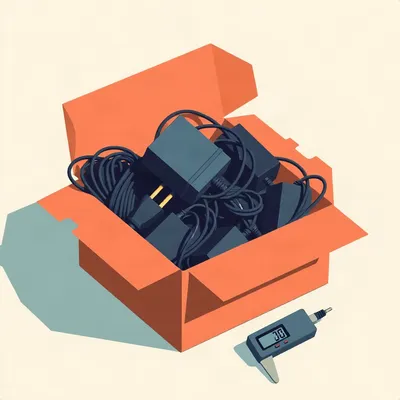
Hilbert: Four-port adapters. He said two point four amps per port, all day long. I tested one with a load, plugged in the second device, and watched it drop to four point seven. They're in a box. I kept the lot and I kept the receipt, because I couldn't decide what to do with either.
You tested it with a load?
Hilbert: I had a dummy load and a meter. I know what a supply is supposed to do under load. Two point four per port all day long, he said. It gave one point four on the second port and the voltage slid.
The number on the box is a claim about the first thing you plug in and nothing else.
Hilbert: That's right. But here's what I'd correct you on. You've spent the hour telling people the device controls its own draw. That's true. But you're framing the four-port problem as though the danger is the four devices pulling too much.
You don't think it is.
Hilbert: It isn't. The devices will take what they take. The problem is the adapter quietly handing each one less than it needs, and most devices won't say a word. They'll just charge slow, or behave strangely, and the owner blames the gadget.
The four point seven is the tell though. That's a device being starved of voltage and acting possessed.
Hilbert: Jittery touchscreen, reboots, a battery that never quite fills. I've had all three of those off one of these.
The Hackaday teardown found a bad unit running five point three four, outside the upper limit. Yours failed the other way, below the lower limit.
Hilbert: A supply can be wrong in both directions. Above the limit it cooks things. Below the limit it just starves them quietly, and that's the one people live with for a year.
Behaving possessed. Yeah, that's exactly what it looks like.
Hilbert: The two point four was on the box. The one point four was what it did. Same brick, ten minutes apart.
The question isn't just whether it's safe. It's whether it's honest.
Hilbert: That'll do.
The closing thought, and I want to build this on what Hilbert just said, because I think the honest-versus-safe distinction is the actual takeaway. If the device controls its own draw, then why do so many devices still ship with a note telling you to use only a one amp charger?
Three possibilities. A real design problem, a liability dodge dressed up as a spec, or somebody who never read BC one point two.
The second question. If Type A's always-on five volts is a feature, not a bug, what happens when the industry finally moves to Type C?
The cheap devices get left behind, or they get a resistor and a capacitor and they adapt. My read is they adapt slowly, because the incentive is that Type A costs pennies to make, and pennies are the whole reason any of these gadgets exist.
Type A sticks around because it's cheap and because cheap devices rely on its dumb behavior.
The risk was never the connector. The connector is a piece of shaped metal. The risk is the adapter, and the marketing that overstates what the adapter will actually give you.
It's a piece of shaped metal that doesn't ask questions. Which is the highest compliment you can give a piece of shaped metal.
That's going in the show notes.
Thanks as always to our producer, Hilbert Flumingtop. This has been My Weird Prompts. If you liked this one, subscribe and leave us a review, it helps. I'm Corn.
I'm Herman Poppleberry. We'll be back soon.