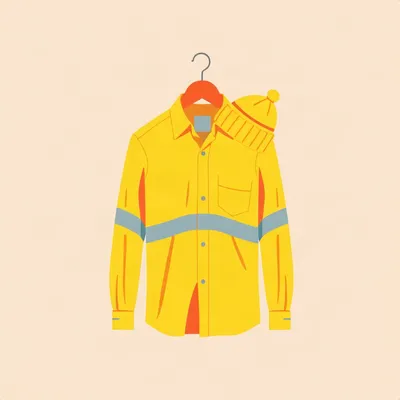
Daniel's latest prompt is a shopping report from the high-visibility wing of his ongoing war on normal social interaction. He bought a button-up shirt on Amazon in full fluorescent yellow, the kind of thing that looks like a dress shirt until the light hits it and it starts arguing with the sun. He'd discovered at Carhartt that high-vis exists way beyond the classic vest, which surprised him, and now he's been wearing this shirt to rural bars and waiting for someone to comment so he can say, oh wait, it's just bright yellow. He also grabbed a pullover, found the shorts too expensive and is now openly soliciting donations of compliant high-vis shorts from listeners, and picked up a beanie. His rules for the hunt were strict: no Amazon alphabet-soup brands, no novelty junk, only gear from real manufacturers that exists for an actual safety or work purpose. And he wants a top five countdown of the most ridiculous high-vis items that exist, meet his standards for social experiments, and weren't made as pranks.

He also noticed the underwear gap, which I find interesting because it's not an accident. But we'll get there.
The man is treating rural Pennsylvania like a field site for studying how humans respond to a walking traffic cone in a bar. I respect the methodology.
The shirt's the interesting entry point because it's not a novelty item at all. It's made for people who need to be visible in what you'd call office-adjacent settings. Site managers, engineers who split time between a trailer and an active work zone, safety inspectors who need to walk out onto a floor and be seen but still look like they belong in a meeting. So the garment is trying to be two things at once, which is exactly what makes it funny when it's in a bar.
It's the same logic as those hybrid dress sneakers that were everywhere a few years ago. The shoe is trying to say, I'm professional enough for the office but ready for a jog, and it ends up failing at both. But the high-vis shirt is different because it's not failing. It works for the job. It's just that the job and the bar are incompatible contexts.
Right. The sneaker is a compromise nobody asked for. The shirt is a solution to a real problem. The problem just doesn't exist in a bar. So the shirt isn't a failed hybrid. It's a successful tool in the wrong room.
What makes something high-vis in the first place? Because Daniel's question assumes there's a category, and there is, but it's not what most people think. It's not just the color.
Right. The governing standard is ANSI slash ISEA one oh seven, and it defines high-visibility safety apparel by performance class and garment type, not just by being yellow. The color matters, sure, the fluorescent yellow-green or orange-red background, but the retroreflective tape is the actual mechanism. It bounces light back toward the source, which is why a vest lights up in headlights but looks flat in daylight. The standard specifies how much background material, how much reflective tape, and where it has to sit on the body. A Class one garment is for lower-risk situations, Class two for road work, Class three for the highest exposure, like highway work at night.
So the vest is just one garment type in a regulated taxonomy. The standard covers shirts, pants, jackets, coveralls, rain gear, headwear historically. And that taxonomy is why Daniel found a button-up shirt. It's not a prank item. It's a Class two or Class three shirt with reflective stripes sewn into the shoulders and torso, made by a workwear company because there's a real job that needs it.
The two thousand twenty update to the standard is the detail that explains the beanie. ANSI removed the accessories category entirely. Before that, you could certify things like beanies, socks, gloves as accessories under the standard. After the update, those items can't carry an ANSI compliance label because they don't cover enough of the body to meet the performance requirements on their own. So Carhartt still makes a high-vis beanie because outdoor workers in cold climates need their heads visible, but it's not ANSI compliant. It's high-vis in color and material, but it's outside the standard now.
Which means Daniel's beanie is both practical and technically non-compliant. That's a beautiful little regulatory limbo. It's bright enough to save your life but the standard has formally declined to vouch for it.
The standard's logic is about torso coverage and tape placement. A beanie covers the top of your head, which is not where the standard says the reflective material needs to be. So the beanie exists because the market wants it, and the standard ignores it because it can't certify it. That tension is the whole story of high-vis beyond the vest.
It's like a food that's obviously nutritious but can't legally be called healthy because it fails some technical requirement. The beanie is doing the work, but the paperwork doesn't recognize it.
The beanie is the nutritional supplement of the safety world. Everyone knows it helps, but the label can't say so.
So before we count down, we should say what Daniel's really asking. He's found that high-vis is a regulated safety category with real engineering behind it, and also a social costume that produces reactions. The question is which items sit at the intersection of genuine function and maximum absurdity in a casual setting. And why some items exist and others don't.
The market gaps are as informative as the items that exist. High-vis underwear doesn't exist from any serious brand, and that's not because underwear is impractical. It's because underwear is never visible in any scenario where visibility matters. No safety standard drives it, no employer requires it, no job task exposes it. So the market simply never made it. The absence is the logic.
Which is a very Daniel observation, by the way. He noticed the gap and immediately wondered who'd need to be compliant in their underwear. His answer was half of one hand, which sounds about right.
The other thing to flag before the countdown is that high-vis has spread way beyond construction. Cyclists, runners, emergency responders, open-water swimmers, hunters, dog walkers. The standard was written for workers, but the underlying need, be seen by drivers, applies to anyone near traffic or water. So the market has expanded into categories that look ridiculous precisely because they're borrowing workwear logic for leisure activities.
A swim cap that meets open-water visibility standards is a work garment for a sport. A dog vest that matches your jacket is safety gear for a walk. The absurdity comes from the context, not the item.
So with that framework, let's do the countdown. Number five, high-vis formalwear, which is what Daniel already owns. The dress shirt with reflective stripes. Carhartt and Dickies both make versions, and they're designed for exactly the scenario I mentioned, someone who needs to be seen on a site but still look presentable in a trailer or a client meeting. The shirt is cut like a normal button-up, has a collar, buttons down the front, but the fabric is fluorescent yellow-green and there's silver reflective tape across the chest and arms.
The absurdity is that at a distance it reads as a business shirt. Then you get closer and realize the person wearing it is visible from orbit. It's the mullet of workwear. Business in the front, traffic control in the back.
Daniel's bar experiment with this shirt is perfect because the shirt is doing two conflicting things. It's signaling professional, I'm wearing a collared shirt, and it's signaling danger, I'm working near moving vehicles. In a bar, neither signal belongs, so people don't know which one to respond to. That confusion is the social experiment.
Imagine you're at a bar and a guy walks in wearing what looks like a normal button-up from across the room. You think, fine, he came from work. Then he gets closer and the tape catches the light and suddenly you're thinking, did he come from a construction site or a job interview? The brain has to resolve two incompatible reads in about half a second, and it just gives up.
And most people won't ask. They'll just stare a little too long and then look away. The confusion stays internal. That's what makes it such a clean experiment. There's no confrontation, just a room full of people doing mental math they can't finish.
What I love about the formalwear category is that it's not a costume. Nobody made this shirt for a joke. It's for a real person with a real job. The fact that it's also hilarious in a bar is collateral damage.
Number four, high-vis swimwear. This one surprised me because I didn't expect a safety standard to reach the pool. Speedo makes high-vis swim caps and suits for open-water swimmers and lifeguards. The logic is straightforward. An open-water swimmer in a dark wetsuit is nearly invisible from a boat or shore, especially in chop. A fluorescent cap with reflective elements changes that.
So the swim cap is a piece of safety equipment for people who swim in places where boats exist. It's not a fashion statement. But put that same cap on at a pool party and it reads as either a joke or a job. You're either the lifeguard or you're wearing a traffic cone on your head for reasons nobody can figure out.
The suit is the better example. A full high-vis swimsuit is absurd because the garment's entire purpose is to be seen in water, but in a pool the water is clear and shallow and everyone can already see you. So the safety function is redundant, and all that's left is the color. You're just the person in the neon suit.
And the social response is different from the shirt. The shirt makes people confused. The swimsuit makes people assume you're either a lifeguard or doing a bit. There's no third option.
It's the same reason a referee shirt at a basketball game reads as a costume. The context has no need for the signal, so the signal becomes a joke by default.
Number three, high-vis pet gear. Ruffwear makes high-vis dog vests and leashes, and these are for hunting and rural walks. The dog vest is the same logic as the human vest. A dog off-leash in a field or near a road is invisible in low light, and the vest makes it visible. The leash has reflective threading.
The social experiment here is the matching set. Daniel in his high-vis pullover walking a dog in a high-vis vest is a coordinated visibility unit. Two beings, one mission, no ambiguity. And in a casual setting, people don't know whether to comment on the dog or the owner or the fact that they match.
The dog vest is also a great example of the market's logic. It exists because hunters and rural dog owners have a genuine need. A dog that runs into a field at dusk is a real safety problem. So Ruffwear, which is a serious outdoor gear company, makes a serious product. The absurdity is purely contextual. In a suburban park, the same vest looks like the dog is about to direct traffic.
I'd argue the matching set is the most potent social experiment on the list because it's not just one person in high-vis. It's a coordinated statement. You've extended the visibility regime to an animal that has no idea what's happening. The dog is just happy to be involved.
The dog is the innocent participant. It doesn't know it's wearing safety gear. It just knows it's on a walk. That innocence makes the whole thing funnier and also a little sweeter.
And that's the thing about all three of these. They're real products for real use cases. The formal shirt is for site managers, the swim gear is for open-water swimmers, the dog vest is for hunters. None of them were made for a prank. That's what makes them funny. The joke is something the market did by accident.
The market is an accidental comedian. It keeps producing garments that are completely serious and completely ridiculous depending on where you stand.
Number two is the gap. High-vis underwear. Daniel's right that no major brand makes it. And the reason is exactly what he guessed, but let's make it precise. The ANSI standard defines garment types by how much of the torso they cover and where the reflective tape sits. Underwear covers the torso but it's never the outermost layer in any work context. No employer has ever required a worker to be visible in their underwear. No safety scenario involves a person in a state of undress needing retroreflective material. So the standard has no category for it, and no serious manufacturer has any reason to make it.
The novelty versions exist, of course. Small brands will print fluorescent underwear with reflective trim because somebody will buy it as a joke. But those fail Daniel's reputable brand test. They're made for the prank, not for a real safety need. So the gap is genuine.
And the gap is informative because it reveals the market's actual logic. High-vis items are designed for specific job tasks where visibility matters. The garment has to be the outermost layer in a situation where being seen is the difference between safe and dead. Underwear fails that test in every possible scenario. So it doesn't exist. The market is not making a moral judgment. It's just following the requirement.
Daniel's line about half of one hand is funny, but it's also accurate. The number of people who need ANSI compliant underwear is statistically indistinguishable from zero. The market noticed.
And the market is very good at noticing. It will make anything if there's demand. The fact that it hasn't made this tells you the demand is not just small, it's structurally impossible.
Number one is the beanie, which Daniel already bought, and it's the perfect capstone because it sits exactly on the line between practical and absurd. Carhartt makes a high-vis beanie. Outdoor workers in cold climates wear them because their heads need to be visible. The beanie is warm, it's fluorescent, and it has reflective threading. It does a real job.
But the two thousand twenty standard removed accessories, so the beanie can't be ANSI compliant. It's high-vis in every practical sense, but the regulatory framework has no category for it anymore. So it's both the most practical item on the list and the most technically non-compliant.
That's the beautiful part. The beanie exists because the market demanded it, and the standard walked away from it. So you have a garment that workers need, that saves actual lives, and that no longer has a formal compliance label. It's the regulatory equivalent of a shrug.
And for Daniel's purposes, the beanie is perfect. It's affordable, roomy, from a reputable brand, and it works in a rural bar. Nobody expects a beanie to be that bright. It's a small, concentrated dose of visibility that you can deploy without committing to the full vest.
The beanie is the gateway drug of high-vis social experiments. It's low commitment. You can take it off and stuff it in a pocket. The shirt requires you to own the bit for the whole evening. The beanie lets you dip in and out.
The beanie also answers the question of why some items exist and others don't. Beanies exist because heads get cold and heads need to be visible. Underwear doesn't exist because underwear is never visible when it matters. Socks exist because they peek out above boots. The market follows the visibility requirement.
So the full logic is, high-vis items exist where the job makes the garment visible, and they don't exist where the garment is always hidden. The beanie is visible, the socks are partially visible, the underwear is invisible. The market is a perfect mirror of the requirement.
Which brings us to the social experiment angle, because that's the other half of Daniel's question. Why does wearing high-vis in a bar produce a reaction? The answer is that high-vis is a uniform. It signals worker, danger zone, I am doing something that requires being seen. In a leisure setting, that signal clashes with the context. The bar is for relaxing. The shirt is for not getting hit by a truck. The mismatch creates a small cognitive dissonance.
And Daniel's response, oh wait, it's just bright yellow, is a defusing move. He's acknowledging the signal and then denying it. The shirt isn't a uniform, it's just a color. But the color is the uniform. That's the joke.
The color is doing all the work. Fluorescent yellow-green is not a neutral choice. It's the color of caution, of construction, of slow down. You can't wear it casually without invoking all of that. So the social experiment is really about how much meaning a color can carry.
And the fact that it's from Carhartt matters. If it were a cheap Amazon brand, the shirt would be a costume. But it's a real work shirt. The authenticity is what makes the social experiment work. You're not wearing a parody of a worker. You're wearing the actual garment.
That's Daniel's reputable brand requirement, and it's the right instinct. The joke only works if the item is real. A novelty high-vis shirt from a no-name brand is just a costume, and costumes don't produce the same confusion. The confusion comes from the garment being genuine.
The genuine garment in the wrong context is a category error made visible. That's the whole thing.
You're right about that.
I wore one to a wedding once. Early two thousands, I was doing night security at a chemical plant in Baytown. The job issued us these vests, the orange ones with the silver tape, and they made us wear them over the full body suits when we did perimeter checks. I got used to the thing. So when my brother-in-law got married, I thought, I'll wear the vest over my suit. Make a statement. Got asked to leave before the cake.
The worst part was, I didn't even think it was a bit at the time. I just thought it looked sharp. The vest was clean, it had that silver tape that caught the light. I thought I was making a fashion choice. Turns out I was making a category error.
I still have a high-vis raincoat I wear for dog walks. Biscuit, the golden retriever. He's got a matching collar. We've been trolling the neighborhood for years. Drivers give us a wide berth. I don't know if it's respect or fear, but they move over.
I looked for high-vis underwear once, just to see. Found nothing worth buying. Some junk from a brand I'd never heard of. I figured the same thing you said. Nobody needs to be compliant in their shorts. Missed opportunity, if you ask me. Somebody could've made a killing selling those to guys who think it's funny.
The raincoat and collar matching is the same coordinated visibility unit I mentioned with the dog vest. You're doing the social experiment without the bar. The neighborhood is the field site.
The wedding story is the limit case. You took a garment designed for a chemical plant and put it in the most formal social setting available. The category error was maximal. Of course they asked you to leave.
The vest was clean. That's the part that got me. It wasn't dirty. It just looked wrong in a church.
Biscuit doesn't know he's part of an experiment. He just likes the walk. But people see the two of us coming and they cross the street. I've been doing it so long now that if I wear a normal coat, I feel invisible. Like I forgot something.
That feeling of invisibility is the other side of the social experiment. Once you've been hyper-visible, normal clothes feel like a downgrade. The high-vis becomes the baseline.
Which raises the question of whether this ever becomes mainstream fashion. High-vis has been flirting with fashion for years. Designers put reflective details on streetwear. But the full fluorescent garment stays in the workwear lane because the signal is too strong. You can't neutralize it.
The two thousand twenty standard change might actually push it further from fashion. By removing accessories, the standard said, this is for torso-covering work garments, not for lifestyle items. So the regulatory framework is doubling down on the workwear identity at the same time the fashion world keeps borrowing bits of it.
So the future is probably more of the same. The workwear brands keep making serious high-vis gear, the fashion brands keep borrowing the aesthetic, and the gap between them stays wide. Daniel and his beanie live in that gap.
The one thing I'd take from this is that the market gaps are the most honest part of the whole category. High-vis underwear doesn't exist because no job requires it, and the beanie exists but isn't compliant because the standard walked away from it. The entire category is a map of what work actually requires.
Clothing is a language. High-vis says safety, but in the wrong context it says look at me, and the fact that one garment can say both is the whole appeal of Daniel's experiment.
The open question is whether the social experiment ever stops being an experiment. If you wear high-vis to enough bars, it becomes your thing. The shock wears off. You're just the guy in the yellow shirt. And then what's left is a person who likes being visible.
Which might be the most honest outcome. Daniel started with a prank and ended up with a wardrobe. That's how these things go.
Thanks to Hilbert Flumingtop for producing, and for the wedding story, which I suspect we'll be thinking about for a while.
This has been My Weird Prompts, the human-AI collaboration podcast. Email us at show at my weird prompts dot com with your own high-vis finds or your own social experiment results.
We'll be back soon.