Daniel wants us to live inside the pot this time. Not the history of pottage, not whether perpetual stew is real — but the actual Tuesday of it. You wake up, the pot's been going since before your grandfather was born, and your first thought is what goes in it today.

And his phrasing is good — he says people wouldn't have called it pottage or perpetual stew. It's just food. The normal way of eating. Which is the right frame, because once you name a thing you've already made it exotic.
He's asking four things. How does a household actually run the pot day to day. How does variety happen. Do people get bored of mush. And when you visit a friend, is there pottage jealousy.
Pottage envy. I love that phrase.
And the honest answer to the last one is we have no idea, because nobody wrote it down. But we can get close.
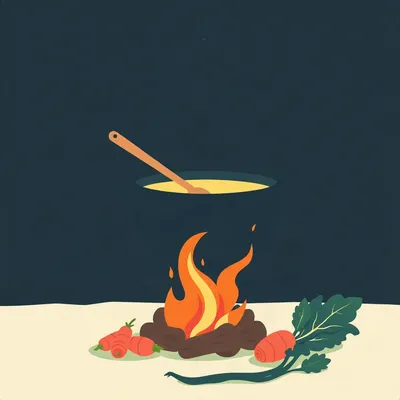
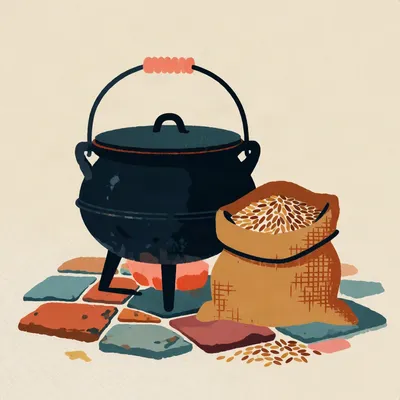
Start with the physical setup, because everything else follows from it. A cauldron — iron, maybe holds five to ten gallons — hung from a chain over the hearth. Not a tripod, a chain, so you can raise it or lower it depending on whether you want a boil or a simmer. Fill it with water or stock. Light the fire. That's the whole apparatus.
And the fire is the constraint nobody thinks about. You can't have a perpetual pot without a perpetual fire, and a perpetual fire is expensive. Wood had to be gathered or bought, and in a lot of towns there were rules against keeping a fire going overnight because of the risk of burning the whole street down.
Right. So the actual rhythm was probably semi-perpetual. Big pot, kept going for days or a week, fed daily, never quite emptied. But not the romantic version where the same broth has been alive for four hundred years.
The romance is a single book, by the way. Reay Tannahill, Food in History, nineteen seventy-two. She wrote that medieval peasants rarely emptied the cauldron except before Lent, and that the taste of salted pork or cabbage would linger for days, even weeks. Almost every perpetual stew claim you've ever read traces back to that one paragraph.
And she gives no source. No manorial record, no cookbook, no account. Ken Albala, the food historian, calls it fakelore. He says why would you keep a pot going indefinitely when you could just cook what you need, eat it, and rinse the thing out.
Which is the economist's answer. The lived answer is more interesting.
Let's do the day. Morning. Hearth fire gets lit. The pot from yesterday is still there, thick, maybe congealed on top if it was cold overnight. You skim anything that looks off, add water, add whatever the morning has. Yesterday's bread heels. A handful of oats. Maybe the bones from a chicken you ate last week that have been simmering out.
The bones are doing real work. A stock that's been going a few days tastes different from one that's new. Deeper, more rounded. That's the thing Tannahill got right even if she overclaimed the timescale — flavors do linger and layer.
Then the household scatters. People go to the fields, to the workshop, whatever the work is. The pot stays on a low simmer all day. Whoever is near the hearth — an older child, a grandmother, someone doing indoor work — tends it. Adds water so it doesn't scorch. Throws in whatever comes to hand.
And this is the part Daniel's really asking about. The lived texture. You're not sitting down to pottage three times a day. You're eating it whenever you're hungry and near the house. It thickens as the day goes on, so the morning version is thinner, brothier, and the evening version is a proper stew.
The manorial records give us the skeleton. Beaulieu Abbey, twelve seventy, lay gardeners got a daily allowance of a convent loaf, a gallon of good ale, and four bowlfuls of the convent pottage. Four bowlfuls. That's the caloric base.
A gallon of ale. I keep coming back to that number. A gallon.
Small ale, mostly. Low alcohol, maybe one or two percent. It was safer than water and it was calories. The trinity of the medieval table was pottage, bread, and small ale. Grain three ways.
So let's talk about what's actually in the pot, because that's where variety lives or dies.
Seasonality is the engine. Summer is a different pot from winter. Summer you've got fresh greens — leeks, colewort, the early cabbage family, mallows, orach, borage. A lot of things we'd call weeds now. Chervil, parsley. Fresh herbs go in at the end, they brighten the whole thing.
Parsley was the standard English flavoring. In Ireland it was nettle. Which is a lovely detail — the same dish, two islands, different green.
Nettle is good. Tastes like spinach with a mineral edge. And it's free and abundant.
Winter is the dried pot. Peas, beans, oats, roots that store. Turnips, carrots if you have them. Dried herbs. Maybe salted pork if the household could afford it, and that's the whole flavor base.
And here's the thing about variety that modern people miss. It wasn't variety in the sense of a different cuisine every day. It was variety in the sense that Tuesday's pottage tasted different from Friday's because the ingredients had shifted. The broth is an accumulation. You add mutton bones on Monday, by Wednesday the pot has a mutton note. You add cabbage on Thursday, by Saturday there's a cabbage note. It's an ever-changing thing made of small changes.
Which is almost the opposite of boredom. It's a slow evolution. Like a river — same river, different water.
But Daniel asked directly: do people get bored of mushy bowls of food? And the honest answer is we have no medieval testimony of anyone complaining about pottage monotony. Not one. Which is itself interesting.
Absence of evidence isn't evidence of contentment. Peasants weren't exactly writing diaries.
There's one scholar, Adrian Bregazzi, who wrote a paper called Craving Difference in Late Fourteenth Century England, and he argues it's inconceivable that fundamental human desires wouldn't drive people to vary the monotony of bread, pottage, and ale. But that's his inference. He's projecting.
The counterpoint is Rachel Laudan. She says the assumption that we can eat different things at different times of day and different days of the week is a post-nineteenth-century phenomenon. For most of history, for most people, food was samey and that was normal.
And that's probably closer to the truth. Boredom is a luxury of abundance. When you're hungry, a bowl of hot pottage is a relief, not a letdown. You don't pine for variety when the alternative is an empty stomach.
There's also texture to consider. Pottage wasn't uniformly mush. The grain held some bite. Bread was torn into it. Cheese was eaten alongside. The bowl had contrast.
The chemistry helps too. A pot that's been simmering for days develops flavors you can't get from a fresh pot. Glutamates from the meat, the breakdown of proteins, the concentration. It's why the modern examples — the Thai beef noodle broth in Bangkok that's been going since nineteen seventy-four — taste the way they do.
Fifty-one years. That pot has a birthday.
And even that one gets cleaned every night. They remove the soup, keep a little bit simmering, and start fresh the next day. The owner says it plainly — lots of people think we never clean the pot, but we do.
So the real tradition, even where it exists, is yesterday's soup seeds today's. Not one unbroken liquid for decades.
Which is probably what medieval households did. You empty the pot every few days, but you don't scrub it to bare metal. The next pot starts with the scrapings and the memory.
Let's get to pottage jealousy, because that's the question with the most juice.
No source documents it. I looked. There's no medieval record of anyone envying their neighbor's pottage. But the absence is almost certainly because nobody wrote about peasant food at all. We have manorial accounts because lords wanted to track rations. We don't have peasant opinions about the flavor of their neighbor's pot.
But we can reconstruct the conditions for it. Pottage quality varied enormously by skill. The hearth-tender — and it was usually a woman — knew her craft as intimately as a royal chef knew his. The difference is nobody wrote her name down.
A good pottage cook knew when to add the herbs, how to layer the flavors, how much water to add so it didn't scorch, which greens to use first because they take longer to soften. A bad one made gray sludge. The same ingredients, different hands, different result.
So when you visited a friend and their pottage was better than yours, you noticed. Maybe you asked what they put in it. Maybe you tried to copy it. That's pottage jealousy in practice even if it's not documented.
And the modern parallel is exact. At Wattana Panich, the Bangkok broth place, customers explicitly compare broths. The owner says people say nothing there compares with the soup here. That's the same impulse. You taste someone else's version and you measure yours against it.
There's a social dimension too. Pottage wasn't private. The pot was in the middle of the house, the hearth was the center of domestic life. You ate from it, you fed your family from it, you fed guests from it. The pot was the household's identity in a way a modern fridge never is.
Which is why the pottage jealousy question is really a question about hospitality. If you went to a friend's house and their pottage was excellent, you'd probably say so. If it was terrible, you'd eat it anyway because that's what you do.
And here's a thought. The jealousy might have cut the other way. If your pottage was known to be good, that was social capital. The household with the good pot was the household people wanted to visit.
The Beaulieu Abbey record is interesting on this point. The convent pottage was a defined thing. Four bowlfuls a day. It implies a standard, a recipe, a consistent quality. Institutions ran pots at scale.
A convent pottage is a different beast from a household pottage. Bigger pot, more hands, more mouths. The rhythm is different. You're not feeding a family, you're feeding fifty people.
And the inputs are different. An abbey has gardens, orchards, fishponds. The pottage is planned. A peasant household's pottage is improvised. Whatever the fields and the season give you.
Let's talk about meat, because the modern image of pottage is vegetarian gruel and that's wrong.
The Bristol study settled this. They scraped organic residue from peasant cooking pots at West Cotton in Northamptonshire and found beef and mutton stews with cabbage and leek. Actual medieval peasants, not lords, were eating meat pottage.
Not daily. Meat was expensive. But when you had it, you stretched it. A bit of salted pork flavors a whole pot. Bones simmer for days. Offal goes in. Nothing is wasted.
The Tannahill quote captures this. A hare, a hen, or a pigeon gives it a fine meaty flavor. The taste of salted pork or cabbage lingers for days, even weeks. That's the layering I was talking about.
And the religious calendar forced resets. Lent. Meatless days. Good Friday, when in some places you weren't even allowed to light a fire. The pot got emptied and scrubbed and started fresh.
Which is the final nail in the perpetual stew myth. The Church was the rhythm-setter. You couldn't have a truly perpetual pot because the calendar wouldn't let you. The pot had to stop, empty, and reset.
So the honest picture is a pot that runs for days or a week, gets emptied, gets restarted with the scrapings, and evolves seasonally. Not a four-hundred-year broth. But also not a fresh pot every meal.
And the lived experience is something like this. You wake up. The fire's lit. The pot's there. You eat a bowl with bread. You work. You come back, the pot's thicker. You eat again. Maybe you throw in a handful of greens you pulled on the way home. The pot changes. You change. Life goes on.
There's something almost Buddhist about it. The pot is never the same pot twice, but it's also never a different pot. It's continuity made edible.
And that's why the myth persists. The idea of a stew that's been alive for centuries is just a better story than the truth, which is that people ate soup every day and it was fine.
The truth is better. The truth is that a woman in a cottage in Oxfordshire in thirteen eighty knew her pot the way a jazz musician knows a standard. She could tell by the smell whether it needed salt, by the color whether it needed water, by the way the steam rose whether the fire was right. That's expertise. That's craft.
And it's invisible because nobody wrote it down. We have the manorial accounts, we have the archaeology, we have Langland writing about pottage and pain and penny-ale. But we don't have her.
Piers Plowman. Had ye pottage and pain enough, and penny-ale to drink, ye had right enough. That's the whole philosophy in one line. Enough pottage, enough bread, cheap ale. That's a good life.
And Andrew Boorde in fifteen forty-two: pottage is not so much used in all Christendom as it is used in England. The English were the pottage people. It was a national identity.
Which is funny because now English food is the butt of jokes. Pottage is the ancestor of that reputation.
Let's talk about the modern revivals, because they tell us something about the appeal.
The perpetual stew club in Brooklyn. Twenty twenty-three. Annie Rauwerda started a pot in a park, ran it for sixty days, hundreds of people showed up bringing ingredients. It went viral.
And that's the thing. Modern people with modern kitchens and modern food safety knowledge chose to do this. Not because they needed to, but because the idea of a shared pot is compelling. It's community made edible.
The food safety people were not thrilled. The threshold is a hundred forty degrees Fahrenheit. Below that, bacteria. The USDA says eight hours maximum for holding food at temperature. A perpetual stew violates every rule.
And yet. People showed up. People brought ingredients. People ate from a communal pot in a park. The impulse is old.
The Bangkok pot is the real deal. Fifty-one years. A copper pot about five feet across. A hundred fifty pounds of beef a day. The meat simmers for three hours, comes out, simmers four more. The broth just keeps going.
And the owner says they've never had a set recipe. The person making the soup has to constantly taste it. That's the craft I was talking about. It's not a recipe, it's a relationship.
The Tokyo oden broth is even older. Restarted in nineteen forty-five after the original hundred-year stock was lost to wartime bombing. So the current broth is about eighty-one years old. But the lineage is older.
And the Perpignan pot-au-feu. Claimed to run from the fifteenth century until World War Two, when the German occupation cut off ingredients. That's the most romantic version. A pot that survived the Renaissance, the Reformation, the French Revolution, and died because the Nazis interrupted the supply chain.
If that's true, it's the greatest pottage story ever told. And if it's not, it's the greatest pottage lie ever told. Either way, I respect it.
The point is that the concept is real, it's just not medieval. The medieval version was the semi-perpetual pot. Days, maybe a week. The modern Asian versions are the true perpetual stews. The Brooklyn version is a performance of the idea.
So what do we actually tell Daniel about pottage jealousy?
We tell him it almost certainly existed but nobody wrote it down. The conditions were all there. Variable skill, variable ingredients, social visiting, a dish that was the household's identity.
And we tell him that the boredom question is probably the wrong question. Boredom is what you feel when you have options. When the pot is the option, you don't get bored. You get hungry, and the pot is there.
The mush question is also a bit off. Good pottage wasn't mush. It had texture, it had layers, it had the accumulated flavor of days. Bad pottage was mush. The difference was the cook.
I keep thinking about the hearth-tender. The woman whose name we'll never know. She got up before everyone else, lit the fire, checked the pot, added water, skimmed the top, tasted it, adjusted. Every day. For her entire life.
And she was good at it. The way a surgeon is good at surgery. The way a DJ is good at reading a room. She knew her craft.
You're comparing medieval pottage to DJing.
I'm saying expertise is expertise. The medium doesn't matter. She read her pot the way you read a room.
That's actually beautiful.
The pot was a living thing. Not in the mystical sense. In the practical sense. It changed every day. It responded to what you put in. It could go wrong if you neglected it. It rewarded attention.
And it was the center of the house. The hearth, the pot, the family. Everything else was peripheral.
Which is why the loss of the hearth is the real story. When the stove arrived, the pot moved. When the refrigerator arrived, the pot changed. When the microwave arrived, the pot became optional. The continuity broke.
And now we have a pot in a park in Brooklyn that runs for sixty days and makes international news. Because the thing we lost is the thing we miss.

The Beaulieu allowance was a convent loaf, a gallon of good ale, and four bowlfuls of the convent pottage. Four.
Wait, did I say three?
Nobody said three. I'm just making sure it's on the record. Four bowlfuls. Twelve seventy. I worked a kitchen in a monastery once, not far from there. Hampshire. The pottage was terrible. The ale was worse.
A monastery kitchen.
Summer job. Nineteen eighty-nine. I was twenty-two. The abbot had opinions about pottage. Thought it should be thicker. The cook thought it should be thinner. They argued in Latin so the novices wouldn't understand.
Did the pottage change?
No. It stayed exactly the same. Gray, thin, a bit of leek if you were lucky. The abbot won the argument but lost the pottage.
That's the institutional version. A household pot responds to the people eating it. A monastery pot responds to the hierarchy. The abbot wanted thick, the cook made thin, and the result was a compromise nobody wanted.
The bread was good, though. Baker knew what he was doing. And the ale was fine once you got past the first pint.
You were twenty-two in a monastery kitchen. How does that even happen?
I was between jobs. The monastery needed a kitchen hand for the summer. I'd done a bit of cooking. They didn't ask many questions.
What did they pay?
Room and board. The board was pottage. The room was a cell. I lasted two months.
And now you're here, correcting our bowl counts.
Four bowlfuls. It matters. If you're going to talk about the lived experience, get the rations right. Four bowlfuls a day is a lot of pottage. That's the point. It wasn't a side dish. It was the meal.
That's the thing Daniel's really asking about. The pottage wasn't part of the diet. It was the diet. Bread and ale alongside, but the pottage was the center.
The pot in that monastery kitchen was a forty-gallon thing. Cast iron. Took two men to move it when it was empty. It never got emptied properly. The cook would scrape it out once a week, but there was always a layer of yesterday at the bottom.
So even the monastery ran a semi-perpetual pot.
Everyone did. Because cleaning a forty-gallon cast iron pot is a miserable job and nobody wanted to do it more than necessary.
That's the economic argument Albala makes, but from the other direction. He says there's no advantage to keeping it going indefinitely. The cook's answer is there's no advantage to scrubbing it either.
The cook's answer to most things was that there was no advantage. He was right about the pot. Wrong about the abbot.
I want to know if you ever had good pottage. Somewhere in all those jobs.
Once. A woman in Kent. I was doing some work on her roof. She had a pot going, rabbit and turnip, and she gave me a bowl. Best thing I'd eaten in a year. I asked her what was in it. She said rabbit and turnip. That was all she'd tell me.
The cook's secret. The recipe is the ingredients, but the pottage is the hand.
I've tried to make it since. Never comes out the same. I don't know what she did. Maybe she didn't know either.
That's the thing about the hearth-tender. The knowledge was embodied. She just knew.
She knew. That's right.
The Bristol residue study found beef and mutton stews with cabbage and leek in peasant pots. But it can't tell us how they tasted. The chemistry gets you the ingredients, not the craft.
The craft is the part that dies with the cook. That's true of everything.
The pottage jealousy. You've eaten enough institutional food to have an opinion.
People compare food. Always have. You eat at someone's table, you notice if it's better than yours. You don't write it down. You just notice. And maybe you ask what they put in it, and they don't tell you, and you spend the next twenty years trying to figure it out.
That's pottage jealousy. Just the quiet recognition that someone else's pot is better, and the desire to close the gap.
I think that's the answer to Daniel's question. The pot was the household's signature. You'd have to be dead not to notice when someone else's signature was better.
The woman in Kent. I still think about that bowl. That's pottage jealousy, thirty years later.
The modern equivalent is the Bangkok broth. People travel across the city because they say nothing compares. That's the same impulse, just with a restaurant instead of a neighbor.
The difference is that in the medieval version, the good pottage wasn't for sale. It was just there. In your neighbor's house. And you could only taste it if you were invited.
Which made it more valuable, in a way. Scarcity.
She invited me because I fixed her roof. I'd have fixed that roof for free if I'd known.
Daniel asked whether people got bored of mushy bowls of food. I think the answer is no, but not because the food was exciting. Because the alternative was worse.
Because the pot changed. Slowly, but it changed. The summer pot was green and bright. The winter pot was brown and deep. The Lent pot was meatless and thin. The feast pot was rich and rare.
The religious calendar was the variety engine. You couldn't have meat on Fridays. You couldn't have meat for all of Lent. The pot had to change because the rules changed.
The Church, by forcing resets, accidentally made the pottage more interesting.
That's a very Corn reading of ecclesiastical history.
I'll take it.
The other variety engine was geography. Parsley in England, nettle in Ireland. Different regions, different pots. Travel was rare, but when you traveled, you tasted the difference.
That's the pottage jealousy in its purest form. You leave your village, you eat someone else's pottage, you come home and your own pot tastes wrong for a week.
I ate pottage in four countries. England, Ireland, once in France. The French one was the best. They put wine in it.
Wine in pottage. That's a flex.
It was a monastery again. Different one. They had vineyards. The pottage was still mostly beans, but the wine helped.
You keep ending up in monasteries.
They feed you. Not well, but they feed you.
The Beaulieu allowance was actually generous by the standards of the time. A gallon of ale a day is a serious amount of calories. Four bowlfuls of pottage on top of that. You wouldn't starve.
The pottage was the flexible part. The bread and ale were fixed rations. The pottage was whatever the garden and the season provided. That's where the variety lived.
Which brings us back to the lived experience. The pottage was the variable in a fixed system. Bread is bread. Ale is ale. But pottage is Tuesday's pottage, different from Monday's, different from Wednesday's.
The person who managed that variability was the hearth-tender. She was the system administrator of the household's calories.
System administrator. She'd have hated that.
She'd have thrown a turnip at me.
The point stands. The pottage was the household's daily negotiation with the season, the budget, the religious calendar, and the skill of the cook. It was never the same twice, and that's why it wasn't boring.
Daniel's question about mush is really a question about texture, and the answer is that pottage had more texture than we think. The grain held. The greens wilted but didn't dissolve. The meat, when there was meat, gave chew. The bread torn in at the end gave contrast.
The thickness varied through the day. Morning pottage was thin, almost a soup. Evening pottage was thick, almost a stew. Same pot, different meals.
The pot was a clock. You could tell the time by the consistency.
That's actually true. The pot thickened as the day went on and the water boiled off. If you came home and the pottage was thick, you knew it was late.
I want to go back to something Daniel said. He said it might not even be known as pottage. It's just what people regard as food.
That's the key to the whole episode. The word pottage is a historian's word. The people eating it just called it food. Or dinner. Or the pot.
The pot. That's the name. You didn't ask what's for dinner. You asked what's in the pot.
The answer was always the same: whatever we had.
Which is the most honest answer to any food question ever asked.
The woman in Kent didn't call it pottage. She called it the pot. Said it had been going since her mother's time. But the same pot. Same iron.
The pot as heirloom. That's a thing. Cast iron lasts generations. The pot outlived the people who cooked in it.
She said her grandmother bought it at a fair. Eighteen something. I didn't ask the price.
An eighteen-something cast iron pot, still in use, still making pottage. That's continuity.
That's the thing we've lost. The continuity. The pot that knows your family.
The pot that knows your family. That's the line. That's the whole episode.
We should probably wrap this up before you start writing poetry about cauldrons.
One more thing. Daniel asked about pottage jealousy at a friend's house. I think the answer is yes, it existed, and it was probably the most common form of food envy in human history. Not because pottage was great. Because it was the only food there was to envy.
The envy wasn't about the ingredients. It was about the hand. Your friend's pottage was better because your friend's wife or mother or grandmother was better at making pottage. That's a hard thing to fix.
You can buy better ingredients. You can't buy a better hand.
You can learn. But you have to want to.
That's the final answer, I think. The lived experience of pottage was the lived experience of attention. The people who paid attention ate well. The people who didn't ate gray sludge. Same pot, same fire, same ingredients. Different attention.
The question for Daniel, the forward-looking thing, is whether we've lost the attention or just moved it. We pay attention to different food now. The craft is still there. It's just not in a pot over a fire.
The craft is in the sourdough starter, the home ferment, the weekend brisket. The pottage impulse didn't die. It just changed vessels.
This has been My Weird Prompts. Thanks to our producer Hilbert Flumingtop for keeping the rations accurate.
If you enjoyed this, leave us a review wherever you listen. It helps more than you know.
If you have a prompt for us, email us at show at my weird prompts dot com.
We'll be back soon.