So Daniel sent us this one — he's been wearing an EDC belt and electrician pouch day to day, and it's become his whole system for surviving a chaotic season of apartment moves, DIY, and chasing a one-year-old around. The power bank has become the star of the pouch, but his big chunky wartime unit is overkill now. He wants something slim enough to forget about, ideally credit-card-sized, that can deliver at least one full charge or even half a charge for his OnePlus Nord 3, and most importantly, hold that charge for months when it's just sitting in the pouch waiting for an emergency. The question is: does that product exist, and if not, how close can we get?

And this is exactly the kind of specification problem I love, because it looks simple on the surface. You want a thin power bank that charges your phone. How hard can that be? Turns out the answer is: physics says no, at least not yet. But the version of yes that does exist is still pretty good.
So let's start with the numbers. What does a full charge actually cost in battery terms?
The OnePlus Nord 3 5G has a five thousand milliamp-hour battery. GSMArena confirms that. So Daniel wants a power bank that can deliver five thousand milliamp-hours into that phone. And the first misconception we have to kill right here is that a five thousand milliamp-hour power bank will do that. It won't.
Because of conversion losses. And I think this is the point where most people's eyes glaze over, but it's worth actually walking through what's happening inside the circuit.
The power bank stores energy at three point seven volts nominal — that's the native voltage of a lithium polymer cell. But USB output is five volts minimum, and most modern power banks use USB-C Power Delivery at nine or even twelve volts. So the power bank has to boost that voltage, and that boost converter is not perfectly efficient. Then you've got cable resistance, heat dissipation in the phone's own charging circuit, and the phone's battery management system doing its own conversion. Think of it like pouring water from one bottle to another through a funnel — you always lose a few drops to the sides, to evaporation, to the little splash that misses the funnel entirely. All in, you typically lose fifteen to twenty-five percent between the power bank's internal cell and the phone's battery.
So the rule of thumb is: take the phone's battery capacity, divide by roughly zero point eight, and that's the power bank rating you actually need.
Right. For a five thousand milliamp-hour phone, you need about sixty-two fifty milliamp-hours of power bank capacity to deliver one full charge. For half a charge, you're looking at about thirty-one twenty-five. That's the real target. And now we get to the hard part.
The credit card.
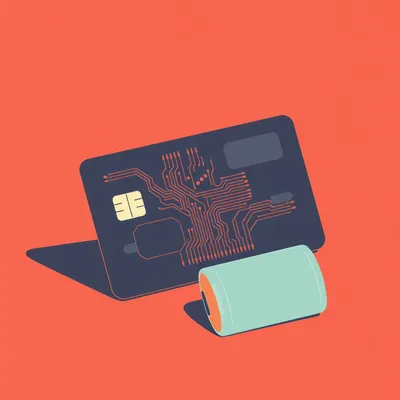
The credit card. An ISO seven-eight-one-zero ID-one card is eighty-five point six millimeters by fifty-four millimeters. That's the standard. So Daniel's asking: can we pack enough energy into that footprint, at about five millimeters thick, to deliver a meaningful charge?
And I'm guessing the answer starts with some depressing multiplication.
Let's do the math. That volume — eighty-five point six by fifty-four by five millimeters — is about twenty-three cubic centimeters, or twenty-three milliliters. A good lithium polymer pouch cell today has an energy density around two hundred to two hundred fifty watt-hours per liter. At two hundred fifty watt-hours per liter, twenty-three cubic centimeters gives you about five point seven five watt-hours.
Which in milliamp-hour terms?
At three point seven volts nominal, that's about fifteen hundred fifty milliamp-hours. That's the theoretical maximum capacity you can physically fit in that volume with current lithium polymer chemistry. And that's before you subtract space for the circuit board, the USB port, the power button, the indicator LEDs, and the plastic housing.
So the absolute ceiling for a true credit-card-sized, five-millimeter-thick power bank is about fifteen hundred milliamp-hours. Which, after conversion losses, delivers maybe twelve hundred milliamp-hours to the phone. That's less than a quarter of a full charge on the Nord 3.
A quarter charge is not nothing. That's probably two to three hours of screen time. It'll get you home, it'll let you call a ride, it'll keep maps running. But it's not the "one full charge" Daniel asked for. And that's the physics ceiling — not an engineering problem, not a cost problem. The energy simply isn't there in that volume.
So what actually exists in the market right now? When you search "credit card power bank," what shows up?
The category is mostly marketing. Most products calling themselves credit-card-sized are thicker than they look in photos. The genuinely slim ones — sub-six millimeters — typically max out at two thousand to three thousand milliamp-hours. The Anker Nano Power Bank, which is one of the better-known slim options, packs five thousand milliamp-hours but it's ten point six millimeters thick. That's more than double Daniel's five-millimeter dream.
So the trade-off is stark. For every millimeter of thickness you shave off, you're losing roughly three hundred to four hundred milliamp-hours of capacity in that credit card footprint.
And that's the thing about energy density — it's volumetric. Watt-hours per liter. If you want to cut the thickness in half, you cut the capacity in half, assuming the same footprint and the same cell chemistry. There's no cheat code. The lithium ions don't care about your belt pouch aesthetic.
Which brings us to the question: can solid-state batteries change this?
That's where the hope lives. Solid-state batteries replace the liquid electrolyte with a solid one, which lets you use a lithium metal anode instead of graphite. Lithium metal anodes have roughly ten times the specific capacity of graphite. Companies like QuantumScape and Samsung SDI have been showing prototype cells with energy densities approaching four hundred to five hundred watt-hours per liter — roughly double current lithium polymer.
So in that same twenty-three cubic centimeter credit card volume, you'd get about three thousand milliamp-hours instead of fifteen hundred. Still not a full charge, but now you're in "half charge" territory.
After conversion losses, you'd deliver maybe twenty-four hundred milliamp-hours to the phone — about half a charge on the Nord 3. That's useful. But the timeline matters. Industry estimates put solid-state batteries in consumer electronics around twenty twenty-eight to twenty thirty. Toyota's been talking about solid-state in electric vehicles by twenty twenty-seven or twenty twenty-eight. Consumer power banks usually lag automotive and smartphone adoption by a year or two. So Daniel's five-millimeter credit card power bank that delivers a half charge? Probably three to five years out.
But here's what I'm wondering — is the solid-state timeline actually firming up, or is this one of those things that's been five years away for the last ten years?
That's the fair skepticism. Solid-state has been the poster child of "just around the corner" battery tech for a while. But what's different now is that we're seeing production line investments, not just lab demos. Samsung SDI announced a pilot production line for solid-state batteries in twenty twenty-three, targeting mass production in twenty twenty-seven. QuantumScape shipped prototype cells to automakers for testing. These are concrete milestones, not PowerPoint slides. The timeline still has risk — scaling up from pilot to mass production is where battery technologies usually stumble — but the trajectory is more real than it was five years ago.
So the physics says five millimeters is a pipe dream for a full charge, and even a half charge is a few years away. But what about the other half of Daniel's request — standby stability? He wants to charge this thing, toss it in the pouch, and know it'll still have juice six months later when he actually needs it.
This is where things get interesting, because the common assumption is wrong. Most people think lithium batteries self-discharge quickly, like old nickel-metal hydride AAs that would be dead in a month. But lithium polymer and lithium ion cells actually have excellent shelf life. The self-discharge rate is about five percent per month at room temperature.
Five percent per month. So a five thousand milliamp-hour power bank loses about two hundred fifty milliamp-hours per month just sitting there. After six months, it's still got roughly seventy-four percent of its charge.
Which is totally usable. That's still enough for most of a full phone charge. So the chemistry itself is not the problem. The real problem — and this is the hidden killer of emergency power banks — is the battery management system.
The BMS.
The little circuit board inside every power bank that monitors voltage, controls charging, drives the LED indicators, and handles the USB negotiation. That board draws power constantly. It's called quiescent current — the idle current the electronics consume even when nothing is plugged in. And the quality of that BMS design varies enormously between brands.
So a cheap power bank might have a BMS that draws one or two percent of the battery per day just sitting there.
And that's the nightmare scenario. You charge your emergency power bank, toss it in the pouch, and three weeks later it's dead — not because the battery self-discharged, but because the circuit board slowly sipped it to death. I've seen teardown reviews of no-name power banks where the standby drain was as high as three percent per day. That bank is empty in a month, guaranteed.
And here's the thing that really gets me — when that happens, the user doesn't know it was the BMS. They just think "lithium batteries don't hold charge" and they stop trusting power banks entirely. The reputation damage spreads to the whole category.
One bad BMS experience poisons the well. And the frustrating part is that good BMS design isn't even expensive — we're talking about a chip that costs maybe fifty cents in volume. It's just that the no-name manufacturers skip it to save that fifty cents, and the user pays the price six months later when they're stranded with a dead phone.
Which means the spec Daniel should actually care about isn't just milliamp-hours — it's standby drain. And that's almost never on the box.
Almost never. You have to dig into reviews, forum posts, and teardown videos to find it. But there are brands that consistently do this well. Anker, Nimble, Mophie — these companies use quality BMS chips from firms like Texas Instruments or Richtek that have sub-microamp quiescent current in deep sleep modes. A well-designed power bank from one of these brands should hold eighty to ninety percent of its charge after six months.
So the practical recommendation is crystallizing here. For Daniel's use case — emergency backup for a Nord 3, carried in a belt pouch, needs to hold charge for months — the sweet spot is a five thousand milliamp-hour power bank at around eight to ten millimeters thick.
That's the realistic optimum. It delivers one full charge after accounting for conversion losses. It's slim enough to disappear in a belt pouch. And with a good BMS, it'll sit there for six months and still be ready. The Anker Nano Power Bank at ten point six millimeters is a bit chunky but extremely reliable. The Mophie Powerstation Mini is eight and a half millimeters and five thousand milliamp-hours — that's probably the closest thing to Daniel's dream that exists right now.
And if he's willing to accept a half charge for the sake of even more slimness?
Then you drop to the three thousand to thirty-five hundred milliamp-hour range, which gets you down to about six to eight millimeters thick. Products in that niche exist — Nimble makes a slim five thousand that's about nine millimeters, and there are some generic three thousand milliamp-hour cards that hit six millimeters. But the capacity trade-off is real. At three thousand milliamp-hours rated, after conversion losses you're delivering maybe twenty-four hundred to the phone. That's roughly half a charge on the Nord 3.
Which, for an emergency, is probably fine. Half a charge is four to five hours of screen time. That's enough to navigate home, make calls, check news, coordinate with family. The use case isn't "power user needs to finish a Netflix series." It's "phone is dying and I need to not be stranded."
And that's the mental reframe Daniel might need to make. The wartime power bank was for multi-hour shelter stays with no power — you needed massive capacity because you didn't know when you'd next see an outlet. The peacetime belt pouch power bank is for the unexpected top-up. You left the house at eighty percent, the day ran long, the phone is at twelve percent, and you need enough juice to get through the next three hours. A three thousand milliamp-hour slim bank handles that scenario perfectly.
In a wartime scenario, the power bank isn't just for your phone — it might be charging a radio, a flashlight, someone else's device. The capacity requirements are fundamentally different because the uncertainty is different. You're not topping up from eighty percent; you're recovering from zero, possibly multiple times.
And the infrastructure assumptions are inverted. In peacetime, you assume there's always a wall outlet somewhere in your future — tonight, tomorrow morning, at the office. The power bank is a bridge. In wartime, the power bank might be your only source of electricity for an unknown duration. That's why Daniel's old unit was a chunky brick — it wasn't overkill for that context, it was appropriately sized for a world where grid power is not guaranteed. The belt pouch era represents a return to grid-trusting normalcy, and the power bank shrinks accordingly.
So let's talk about the specific product landscape. What should Daniel actually buy?
If I'm making a shortlist, I'd put the Mophie Powerstation Mini at the top. Five thousand milliamp-hours, eight point five millimeters thick, USB-C with Power Delivery, and Mophie's BMS is known to be solid on standby. It's about the size of a stack of six credit cards.
Which, in a belt pouch, is basically invisible.
The Anker Nano Power Bank with the built-in USB-C connector is another strong contender. It's ten point six millimeters, but the foldable plug means Daniel doesn't need to carry a separate cable in the pouch. That's a real EDC consideration — cable clutter is half the annoyance.
And Anker's BMS reputation is excellent.
Anker uses really good power management ICs. Their standby drain is consistently among the lowest in independent tests. The 621 Magnetic Battery is another Anker option — five thousand milliamp-hours, ten millimeters, and it's MagSafe compatible. Though the Nord 3 isn't a MagSafe phone, so Daniel would need a magnetic ring case or adapter.
For the ultra-slim seekers, there's the Nimble five thousand, which comes in at nine millimeters and is made from recycled materials if that matters to you. And then there's a whole tier of generic "credit card" power banks on Amazon that claim three thousand to five thousand milliamp-hours at five to six millimeters. I would be extremely skeptical of those.
The capacity claims on those are often inflated, and the BMS quality is a complete unknown. If Daniel's entire use case is "charge it, forget it for six months, and it works when needed," a no-name BMS is the single biggest point of failure. Saving three millimeters of thickness is not worth finding your emergency bank dead when you actually need it.
There's also a practical point about the cable situation. Daniel's wearing a belt pouch, which means he's already carrying multiple items. A power bank that requires a separate USB-C cable adds bulk and tangling. The Anker Nano with the built-in foldable plug solves that elegantly.
And some of the Mophie models come with a short integrated cable as well. It's a feature worth prioritizing for EDC. A six-inch cable that lives permanently attached to the power bank means one less thing to fish out of the pouch.
I'm thinking about the actual moment of use here. Daniel's got a one-year-old in one arm, he's trying to grab the power bank from his pouch with the other hand, and he needs to plug in his phone without dropping anything. A separate cable in that scenario is a genuine liability — it snags, it falls, it requires two hands to manage. The integrated cable turns it into a one-handed operation.
That's the kind of detail that sounds trivial in a product review but becomes the entire experience in the field. EDC is not about how things perform on a desk; it's about how they perform when you're distracted, off-balance, and operating with one hand. The integrated cable is worth more than a millimeter of thickness in that calculus.
So the belt pouch gets a five thousand milliamp-hour brick at eight to ten millimeters. But where is this all heading? I'm thinking about the broader trajectory here. Daniel's EDC belt system is a microcosm of something bigger — the idea that personal infrastructure is becoming modular and body-worn.
The power bank is just one node in that system. And the interesting question is whether phones themselves will make the power bank obsolete before solid-state batteries make the credit card form factor viable. If phones start shipping with silicon-anode batteries that deliver two-day battery life — and there are rumors Apple and Samsung are working on exactly that — then the whole category of "emergency power bank" shrinks.
Because you'd just never run out in a single day.
Right. If your phone reliably lasts two days, the "unexpected top-up" scenario almost never happens. You charge at night, you're fine. The power bank becomes a camping and travel accessory, not an everyday carry item.
But that's a big if. Phone manufacturers have historically used battery efficiency gains to make phones thinner rather than make batteries last longer. The Nord 3 is a perfect example — five thousand milliamp-hours is a big battery, but Daniel still can't get through a full day.
Because the screen, the five-G modem, the background apps, the constant notifications — power consumption keeps rising to meet battery capacity. It's a Red Queen race. Until phone makers decide that "two-day battery life" is a selling point worth prioritizing over thinness, we're going to keep needing power banks.
And that's the final irony of Daniel's request. He wants a credit-card-thin power bank so it disappears into his carry system. But the reason he needs a power bank at all is that his phone was made thinner than its battery capacity can support for a full day of real-world use. The thinness is the problem, and he's trying to solve it with more thinness.
Which is very human, actually. We want the consequences without the trade-offs. And sometimes physics lets you have both — eventually. Solid-state batteries will probably get us to the credit card half-charge in a few years. But for now, eight to ten millimeters is where the realistic optimum lives.
So to synthesize the actionable advice for Daniel: for his Nord 3, buy a five thousand milliamp-hour power bank at eight to ten millimeters thickness. That delivers one full charge after conversion losses, fits easily in the belt pouch, and with a quality BMS from a brand like Anker, Mophie, or Nimble, it'll hold that charge for six months or more. Check reviews specifically for standby drain before buying. If he wants absolute minimum thickness and can accept a half charge, drop to three thousand milliamp-hours at six to eight millimeters. Avoid no-name "credit card" banks — the BMS lottery is not worth losing.
And if he wants the cleanest pouch setup, get one with an integrated or built-in cable. The Anker Nano with the foldable USB-C plug is probably the best all-around pick for his specific scenario.
The five-millimeter dream is a physics problem, not an engineering problem — at least until solid-state cells hit consumer products around twenty twenty-eight. But eight millimeters? That's here right now, and it's good.
And the standby thing is worth reiterating. Daniel's instinct to prioritize charge retention is exactly right. Most people fixate on capacity and ignore standby drain, and then their emergency bank is dead when the emergency arrives. A five thousand milliamp-hour bank from a reputable brand, charged and checked every few months, is a reliable piece of personal infrastructure.
It's funny — we've spent this whole episode talking about a battery, but what we're really talking about is trust. Daniel wants to trust that when he reaches into his pouch in a pinch, the thing will work. And that trust is built on BMS quality and realistic expectations about capacity, not marketing claims.
That's the whole EDC philosophy, isn't it? Every item in the pouch is a bet about what you'll need and whether it'll deliver. The power bank is just the most electrically complicated bet.
And now: Hilbert's daily fun fact.

In seventeen eighty-seven, the British brigantine HMS Chatham landed on the Chatham Islands and its crew recorded finding a variety of sweet potato cultivated by the Moriori people that had been selectively bred for over four centuries to thrive in the islands' cool, windswept peat soils — a heritage grain-adjacent root crop so precisely adapted that its planting calendar was encoded in a lunar mnemonic chant passed down through five family lines.
A lunar mnemonic chant for sweet potatoes. I feel like I should be taking notes.
Thanks, Hilbert.
So the belt pouch gets its five thousand milliamp-hour brick, and Daniel gets to stop worrying about his phone dying between the apartment move and the next diaper change. But the bigger question this all points to is whether personal power is going modular in a permanent way. Solar panels the size of a notebook, batteries in your belt, your phone as the hub of a body-worn grid. The modular carry revolution is just getting started.
And when solid-state hits, the whole equation changes again. We'll revisit this in twenty twenty-eight.
This has been My Weird Prompts. Thanks to our producer Hilbert Flumingtop. If you've got a weird prompt, send it to show at my weird prompts dot com. We'll be back soon.