Daniel's been listening back through the soldering safety episode, and he's landed on a question that's bigger than fumes. He found one of those Weevil Eye learn-to-solder kits on AliExpress — the beetle-shaped board with two LEDs and a light sensor — and it got him thinking. If that kit is the model for how to learn a physical skill cheaply and without fear, how far does the skill itself actually go? He's got almost no soldering experience, partly because the fumes scared him off. He had the same block with engraving until he sorted out respiratory safety, and now he loves it. So his real question is whether soldering is still a living skill or a museum piece. He assumed modern consumer hardware is built entirely by robots, and that professional repair work is robotic too. If that's true, then maybe a solder-free breadboard kit for learning ESP32 stuff is the smarter path, and the Weevil is a detour into a dying craft. But he also wonders if skipping soldering carries an opportunity cost, because you never learn the physical skill. So: how relevant is soldering if you want to work with hardware, fix things, repair things? Is it at risk of deprecation? And for someone starting today, should they grab the Weevil, the breadboard, or both?

The premise is backwards.
Say more.
The assumption that robots do all the soldering and all the repair is the exact opposite of what the industry is actually dealing with right now. Hand soldering isn't fading out. It's a bottleneck. There's a documented shortage of people who can do it, and it's getting worse, not better.
So the robots are not coming for the soldering iron.
The robots have been here for decades. Pick and place machines, reflow ovens, wave soldering — that's how consumer boards get built, and Daniel's right about that part. A phone motherboard is not assembled by a person with an iron. But here's the thing. Every one of those boards started as a prototype. And prototypes are hand soldered. Every single one. Before the automated line exists, someone sat at a bench with a microscope and an iron and built the first version, found the mistakes, reworked it, and iterated. The automation doesn't eliminate the hand skill. It depends on the hand skill existing upstream.
That's the design side. What about repair?
Repair is where it gets really interesting. The highest-value repair work in consumer electronics right now is board-level microsoldering. Replacing a power management chip, a shorted capacitor, a broken USB connector. That's done by a human being under a microscope with a hot air station and a very fine iron. There are very few people in the world who can do it well.
How few?
The numbers I've seen suggest about a thirty percent shortage of skilled soldering technicians in the US. In the UK, over sixty percent of electronics employers say they can't fill hands-on roles like soldering and PCB rework. And the average hiring cycle for a skilled surface-mount technician is over two months. That's not a niche problem. That's a structural gap in the entire industry.
So the thing Daniel assumed was automated away is actually the thing nobody can hire for.
And it's getting more valuable, not less. The electronics manufacturing services market is projected to grow from around five hundred thirty-four billion dollars in twenty twenty-three to over eight hundred fifty billion by twenty thirty. Meanwhile the workforce is aging out and not being replaced. There's a figure floating around that the US is heading toward over two million unfilled manufacturing jobs by twenty thirty-one. Soldering is a big part of that.
Which means the Weevil kit is not a nostalgic toy. It's the entry point to a skill that's in genuine demand.
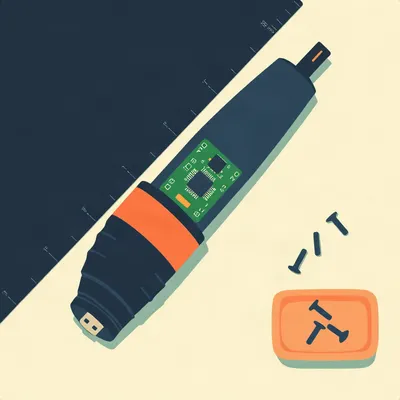
And the thing is, the Weevil is actually a good entry point. It's a through-hole kit, which means the components have legs that go through holes in the board, and you solder them from the back. That's the right place to start. It teaches you component polarity, resistor color codes, how to make a clean joint. Ten or twenty minutes of work, ten bucks for the original SparkFun version, clones are even cheaper. It doesn't include an iron or solder or cutters, but the barrier to entry is about as low as it gets.
Daniel asked about the opportunity cost. Does a breadboard kit teach you the same thing?
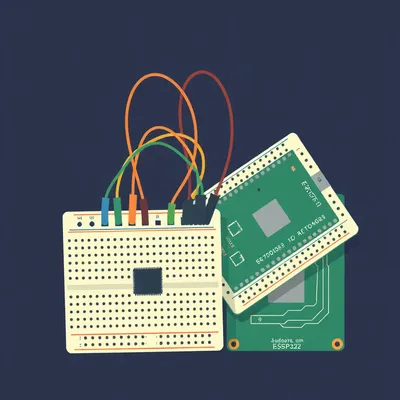
No. And that's not a knock on breadboards. Breadboards are for logic and programming. You plug wires into holes, you test circuits, you iterate fast. They're brilliant for learning how a microcontroller works, how sensors communicate, how to write firmware. But they teach you nothing about making a physical connection that survives being dropped, heated, vibrated, or carried in a pocket. The breadboard connection is temporary by design. The solder joint is the point where the thing becomes a thing.
That's the distinction. One is a sketch. The other is the painting.
And here's the part that might surprise Daniel. The solder-free kits are not a substitute for soldering. They're a stage. Most people who get into hardware start with breadboards because they're cheap and reversible. Then they build something they actually want to keep, and they realize the breadboard version is fragile and the wires fall out. That's the moment they buy an iron. The two paths converge. It's not either-or.
So the answer to his last question is both.
Both. Start with the breadboard if that's what excites you. But get the Weevil too. The Weevil is ten dollars and an afternoon. The opportunity cost of not learning to solder is much higher than the cost of the kit.
Let's talk about the fear, because that's the thing that kept him away. The fumes.
The fume fear is real but it's also solvable in about five minutes. The main thing you're inhaling when you solder is flux fumes. Flux is the chemical that cleans the metal so the solder can bond. When it heats up, it releases fumes that can irritate your lungs. Lead is not vaporizing at soldering temperatures. Lead melts at around three hundred twenty-seven Celsius, but it doesn't become a vapor until well over seventeen hundred. Your iron isn't getting anywhere near that. So the lead-in-the-air worry is mostly misplaced. The flux fumes are the actual issue.
And the fix?
A fume extractor. You can buy a small desktop one for twenty or thirty dollars. Or you can do what a lot of people do and just point a fan across the work area so the fumes blow away from your face. Open a window. Don't hunch directly over the joint. Wear safety glasses because hot flux spatters. That's it. The fear is addressable with gear you probably already own.
Daniel said he got over the engraving fear the same way. He learned the respiratory safety, and then he enjoyed the work. This is the same pattern.
And there's an irony there. He's already proven to himself that the fear was the barrier, not the skill. Soldering is the same situation. The safety is manageable. The skill is learnable. The barrier is psychological.
Which brings us back to the bigger claim. Is soldering at risk of deprecation? I want to push on that.
Push.
The argument for deprecation would go something like this. Consumer devices are sealed. You can't open a phone without heat guns and specialized tools. The modules are getting smaller. BGA packages with balls underneath that you can't even see. The repair industry is moving toward module swaps, not component-level fixes. So the average person who learns to solder a through-hole kit is learning a skill that doesn't transfer to the devices they actually own. Is there a version of that argument that's true?
Partially. The sealed device thing is real. A modern phone is not designed to be opened by the owner. And through-hole soldering is not what you need for a phone repair. That's surface-mount work, and the components are tiny. A through-hole kit like the Weevil doesn't teach you to reball a BGA chip. Nobody is claiming it does.
So the skeptic has a point.
The skeptic has a point about the specific skill transfer. But the skeptic is missing the bigger picture. The through-hole kit teaches you the fundamentals: heat control, solder flow, joint inspection, what a cold joint looks like, how much solder is too much. Those fundamentals transfer to surface-mount work. The tools are different, the scale is different, but the principles are the same. You don't learn microsoldering by starting with a phone motherboard. You learn it by starting with something you can see without a microscope.
It's like learning to drive in a parking lot before you get on the highway.
And the module-swap point is interesting, because it's true that a lot of repair shops don't do component-level work. They swap the whole board. But the reason they do that is not because component-level repair is obsolete. It's because the skill is scarce. A board-level microsoldering shop can fix a phone that a module-swap shop would write off. The scarcity of the skill is what pushes repair toward the cruder approach, not the other way around.
So the deprecation argument gets it exactly backwards. The skill isn't disappearing because it's no longer needed. It's disappearing because it's hard to learn, and the need is growing faster than the supply.
There's a piece from earlier this year in EPP Europe, an electronics manufacturing trade publication, that says manual soldering is experiencing a renaissance. Their argument is that automation still produces defects — solder bridges, tombstoned components, misaligned parts — and human technicians are needed to catch and fix those. Plus prototyping, small-batch work, custom builds, field maintenance, education. Six areas where hand soldering is still the only option. That's not a dying skill. That's a skill with expanding applications.
And the education angle is the one that should worry people. There was a column in Circuit Cellar a few months ago where the editor asked why university electrical engineering students arrive unable to solder. These are people getting degrees in the field, and they've never held an iron. That's a genuine decoupling of theory from practice.
That's the part that bothers me most. We're graduating engineers who can design a circuit in software but can't build the physical thing they designed. They can simulate it, they can lay out the board, they can write the firmware. But if the prototype comes back from the fab house with a mistake, they can't rework it. They have to send it back and wait. That's not just a skills gap. That's a missing limb.
And the industry is responding by trying to train people from scratch. There was a program launched in Florida last year — St. Petersburg College working with Jabil, which is a major electronics manufacturer — specifically to teach soldering. Because the workforce isn't there. They're building it.
The community college angle is interesting, because it suggests the skill is being treated as a trade again. For a while there was this assumption that soldering was a low-skill factory job that would be automated away. Instead it's becoming a specialized craft with a wage premium. The Zipdo data I've seen suggests only about twelve percent of soldering technicians have any kind of certification. That's a huge opportunity for anyone who takes the time to get good.
So if Daniel's listening and wondering whether the Weevil is worth ten dollars, the answer is that it's the cheapest entry point into a skill that's under-supplied, over-demanded, and not going anywhere.
And the breadboard is not the alternative. It's the companion. Breadboard for the logic, Weevil for the physical skill. Together they cover the two halves of what it means to work with hardware.
Let's talk about what actually happens after the Weevil. Suppose someone builds it, enjoys it, wants to keep going. What's the path?
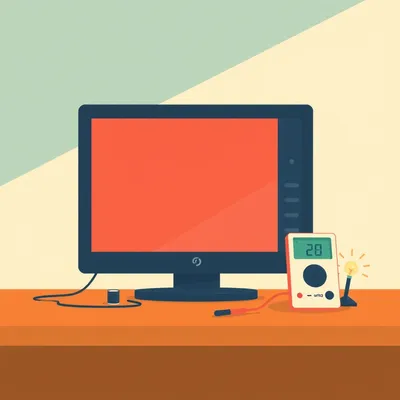
The path is surprisingly cheap. A decent USB-C iron like the Miniware TS101 runs about sixty or seventy dollars. Add solder, flux, wick, a brass sponge. A mediocre multimeter. That's the whole bench. Then you start fixing real things. The highest-leverage repairs for a beginner are broken capacitors and broken power connectors. A huge proportion of things that are fixable at all are going to be those two. A dead monitor, a dead TV, a dead laptop charger — very often it's a capacitor that's bulging or a barrel jack that's snapped off the board. Those are through-hole or large surface-mount repairs that a beginner can do after a few kits.
And the first time you bring a dead monitor back to life with a fifty-cent capacitor, that's the moment the skill stops being abstract.
That's the moment. And it's also the moment you realize how much e-waste is just a skill shortage. There's a piece from iTweak earlier this year that makes the point directly. The scarcity of board-level microsoldering skill, not the law, is what sends fixable boards to e-waste. You can have the right to repair, you can buy the part, but if nobody can actually replace the dead power-management IC, the board goes in the bin.
That's a grim sentence, but it's also a job description.
It's a job description with a waiting list. The board-level shops that do this work are booked out. The people who can do it are rare. And the demand is growing because devices are getting more complex, not less.
Which means the Weevil is not just a toy. It's the first step on a path that leads somewhere real.
And the path is shorter than people think. The gap between a through-hole kit and a simple surface-mount repair is maybe six months of casual practice. The gap between that and microsoldering under a microscope is years. But the first step is the same for everyone. You hold the iron, you make the joint, you see the solder flow.
I want to go back to something Daniel said about learning by doing. He described himself as someone who learns best that way. And he said the stress of not messing up on expensive hardware makes it hard to learn well. That's exactly why the Weevil exists.
The Weevil is designed to be messed up. It's ten dollars. If you ruin it, you buy another one. The whole point is to give you a place to fail that doesn't cost anything. That's the model Daniel identified. The disposable practice object.
And that model does transfer across technology. The breadboard is the same idea for logic. The cheap Arduino clone is the same idea for firmware. The whole maker movement is built on the insight that failure on cheap hardware is a better teacher than caution on expensive hardware.
But the soldering version has an extra layer, because the failure is physical. You can see a bad joint. The solder didn't flow, or it balled up, or it bridged two pads. The feedback is immediate and visual. That's a different kind of learning than compiling code and seeing an error. It's tactile.
And that's the thing the breadboard can't teach. The breadboard doesn't care if your connection is ugly. It just needs contact. The solder joint has to be mechanically solid, electrically clean, and visually inspectable. Three constraints at once.
Which is why the Weevil is such a good design. It's not just a blank board with pads. It's a beetle. The LEDs are the eyes. When you've soldered it correctly, the thing comes alive and responds to light. The feedback is built into the project. If the eyes light up, you did it right. If they don't, you've got a problem to diagnose. That's a complete learning loop in a ten-dollar kit.
And the AliExpress clones are the same design. Daniel found it there, which means the model has spread. The Weevil Eye is now a commodity. That's a sign that the demand for learn-to-solder kits is real.
The original SparkFun version is ten bucks. The clones are less. At that price, the opportunity cost argument collapses. The question isn't whether you can afford the Weevil. The question is whether you can afford not to know how to solder.
Let me ask the question from the other side. Suppose someone decides soldering is obsolete and never learns. What are they actually giving up?
They're giving up the ability to fix their own stuff. A broken cable, a loose connection, a dead capacitor in a power supply. These are five-minute fixes if you know how. If you don't, you're buying a replacement. They're giving up the ability to prototype hardware. If you want to build something physical, you can breadboard it, but the moment you want it to survive being moved, you need solder. They're giving up a career path. The technician shortage is real, and the wages are rising. And they're giving up a way of understanding how the physical world works. There's something about making a joint with your own hands that changes how you see every device around you.
That last one is not nothing.
It's the thing that's hardest to quantify. When you've soldered a board, you look at every other board differently. You see the joints, the flux residue, the rework marks. You can tell if something was hand-assembled or machine-assembled. You can see the quality. That's a form of literacy.
And it's a literacy that's becoming rare. Which is why it's valuable.
The rarity is the value. That's the part that should reframe Daniel's question. He asked if soldering is at risk of deprecation. The answer is that it's at risk of becoming a lost art, and that's exactly why it's worth learning. The scarcity is the opportunity.
There's a line from that Circuit Cellar piece that stuck with me. The editor asked if soldering is like the slide rule, something historical reenactors will show to tourists. And then he said, I hope not.
The slide rule comparison is actually useful. The slide rule disappeared because the calculator did the same job better and cheaper. Nothing has replaced the hand solder joint. The robot can do the repetitive work, but it can't do the judgment work. It can't look at a joint and decide if it's good. It can't rework a board that came out wrong. It can't prototype a new design. The human with the iron is still the most flexible tool in the room.
And the AI angle? Daniel works in AI. He might be wondering if that's the next thing to automate.
There are AI tools emerging for microsoldering. There was a hackathon project earlier this year called Wrench Board that placed second in Anthropic's Build with Opus. It's an AI assistant that helps diagnose board faults and guides the repair. But the person at the bench still holds the iron. The AI proposes, the human decides and solders. That's the current ceiling. The physical dexterity, the heat control, the judgment of when a joint is good — that's not automated.
So even in the AI future, the hand skill survives.
For now, yes. And I'd argue for a long time. The physical world is messy in ways that software isn't. Every board is slightly different. Every joint is a tiny negotiation between heat, solder, flux, and surface. That's not a problem you can train a model on easily, because the training data is tactile.
Which brings me back to the practical question. Daniel asked: Weevil, breadboard, just one, or both?
Both. And here's the order I'd suggest. If he's more excited about programming and logic, start with the breadboard and an ESP32 kit. Get the firmware running, blink the lights, read the sensors. That's the dopamine hit that keeps you going. Then, when he's ready to make something permanent, get the Weevil and an iron. The Weevil is an afternoon. It's not a semester. It's the smallest possible commitment to a skill that pays off for decades.
And if he's more excited about the physical craft, start with the Weevil. The breadboard will still be there when he needs it.
The point is that neither one is a dead end. They're two halves of the same thing. The person who can breadboard a circuit and solder it permanently is a person who can build things. The person who can only do one is missing something.
The fumes thing, one more time, because that was the original blocker. What's the actual setup?
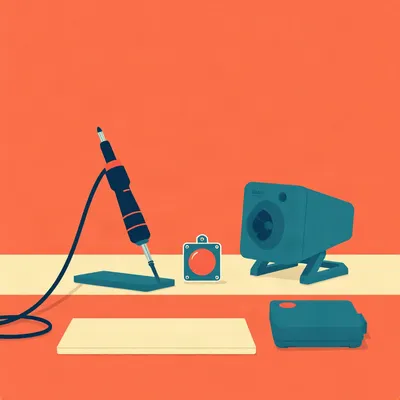
A small fan blowing across the work area. A window open. Safety glasses. That's the minimum. If you're doing a lot of soldering, get a fume extractor with a carbon filter. Twenty or thirty dollars. Don't eat at the bench. Wash your hands when you're done, especially if you're using leaded solder. The lead doesn't vaporize, but it can transfer to your hands and from there to your mouth. Basic hygiene, same as Daniel already figured out with engraving.
The fear is manageable, the cost is trivial, and the skill is in demand. That's the whole answer.
The deprecation worry is exactly backwards. The reason to learn soldering is not that it's a nostalgic craft. It's that the world is running out of people who can do it, and the devices are piling up.
I keep thinking about the e-waste angle. The idea that a fixable board goes in the bin because there's no one to fix it. That's a market failure, but it's also a personal opportunity. Every one of those boards is a chance for someone with an iron to create value.
The value is real. Board-level repair shops charge real money. The skill commands a premium because it's scarce. The person who learns to do it well is not going to be short of work.
The Weevil is not a toy. It's a job application.
It's a job application you fill out with your hands.
Daniel's instinct was right. He saw the kit and thought, this is the model that needs to exist across technology. The cheap, disposable, low-stakes practice object. And the answer to his question is that the skill it teaches is not just relevant. It's a bottleneck.
The breadboard is the other half. Logic and physical craft. Software and hardware. The person who has both is the person who can actually make things.
The person who has only one is always going to be dependent on someone else for the other half.
Hilbert: The slide rule didn't disappear because nobody needed it. It disappeared because the calculator did the same job faster. Soldering's got no calculator.
That's the distinction.
Hilbert: I used to work in a shop that repaired two-way radios. This would have been around nineteen eighty. Every radio that came in, we opened it up and reflowed the joints. That was the fix, most of the time. The boards were through-hole, big components, easy to see. You'd find the cracked joint, hit it with the iron, and the radio worked again. The customers thought we were wizards. We were just people who knew how to solder.
That's the part that hasn't changed. The components got smaller, but the cracked joint is still the cracked joint.
Hilbert: The difference now is the boards are designed so you can't get to the joint. The radio shop I worked in, you could open the case with a screwdriver. Modern devices, you need a heat gun and a suction cup. The soldering skill is still there, but the access problem got worse. That's why the board-level shops are rare. Not because the soldering is harder, but because getting to the board is a whole separate skill.
The manufacturers like it that way.
Hilbert: They like it fine. But the right-to-repair pressure is changing it. There's a bill in the US Senate now, filed back in February, that would require documentation and diagnostic access. If that goes through, the access problem gets smaller and the soldering problem gets bigger. Because now you can open the device, you can buy the part, but you still need someone who can put it on the board.
That's the bottleneck in a sentence.
Hilbert: The other thing I remember from that shop is the fumes. We didn't have extractors. We had a window and a fan. And every guy who worked there had a cough. Not from lead. From flux. We didn't know what flux was, we just knew the smoke made your chest tight. If I'd known then what a twenty-dollar extractor would have done, I'd have bought one with my own money.
The safety knowledge is the thing that's actually improved since then.
Hilbert: The safety got better. The skill didn't. A kid today with a ten-dollar kit and a YouTube video knows more about making a good joint than I did after a year on the job. The information is out there. The hands-on practice is the part that's missing.
That's what the Weevil is for.
Hilbert: I never built a Weevil. We learned on scrap boards. The boss would throw us a dead radio and say, practice on this. Which is fine, except you don't know if you did it right because the radio was already dead. The Weevil's got the LEDs. You know if you did it right. That's a better teacher than a dead radio.
The feedback loop is built in.
Hilbert: The feedback loop is the whole thing. You make the joint, you see the result. That's how you learn. Not by reading about it. By doing it and seeing what happens.
The thing that strikes me about the radio shop is that the fix was always the same. Reflow the joint. That's a through-hole repair on a board from the seventies. The modern equivalent is the cracked solder ball under a BGA chip. Same problem, smaller scale, much harder to fix. But the principle is identical. Heat, solder, surface.
Hilbert: The principle doesn't change. The scale changes. The tools change. But the joint is the joint.
The answer to Daniel's question about deprecation is that the joint is not going away. The joint is the thing everything else is built on.
Hilbert: The joint is the thing. And the people who can make a good one are getting harder to find.
Which is why the ten-dollar kit is not a bad place to start.
Hilbert: Ten dollars is nothing. I spent more than that on lunch last week. And the lunch didn't teach me anything.
What's the one thing you'd tell someone starting out?
Hilbert: Get the extractor. Not because the fumes will kill you tomorrow, but because the habit of safety is easier to build at the start than to add later. The old guys in the radio shop, they never learned the habit. They just coughed. Don't be them.
That's the same thing Daniel figured out with engraving. The safety first, then the enjoyment.
Hilbert: The safety is part of the skill. It's not separate. You learn to hold the iron, you learn to keep the fumes away from your face. Same motion. Same habit.
Once the habit is there, the fear goes away.
Hilbert: The fear goes away with the first good joint. You see the solder flow, you see the joint shine, and you think, oh, that's what it's supposed to look like. After that, it's just practice.
The first good joint is a real moment. I remember mine. It was on a kit like the Weevil, a little LED flasher. The joint was ugly, but it worked. And I thought, I made that. That's the hook.
Hilbert: The hook is real. And it doesn't go away. Every time you fix something, you get the same little hit. It's why the guys in the board-level shops do what they do. It's not the money. It's the moment when the thing comes back to life.
That's the part that's hard to explain to someone who's never done it. The moment when the dead thing works again.
Hilbert: It's a good moment. Better than most.
It's a moment that's available to anyone with a ten-dollar kit and an afternoon.
The answer to Daniel's question is both, and the reason is that the skill is not dying. It's waiting.
The skill is waiting for people to pick up the iron. The demand is there. The devices are piling up. The only missing piece is the person willing to spend an afternoon learning.
The Weevil is the cheapest way to become that person.
The Weevil and a breadboard. The breadboard for the logic, the Weevil for the physical craft. Together they're the whole thing.
One thing I want to leave on. The slide rule comparison. The slide rule disappeared because something better replaced it. Nothing has replaced the hand solder joint. The robot does the repetitive work, but the judgment work, the rework, the prototype, the repair — that's still human. And it's going to stay human for a long time. So if you're starting out today, the question isn't whether soldering is worth learning. It's whether you want to be one of the people who can do the thing that almost nobody else can.
The thing is, the barrier to entry is ten dollars and an afternoon. That's the cheapest career insurance you'll ever buy.
Thanks to Hilbert Flumingtop for producing, as always.
This has been My Weird Prompts. The human-AI collaboration podcast.
If you enjoyed this, leave us a review wherever you listen. We'll be back soon.