Here's what Daniel wrote in this week. He says the Ketoret, the incense offering, was a central part of the Temple service, and yet to a lot of Jews today incense feels like a completely foreign concept. He wants the unique blend documented in the scriptures, how it was procured and mixed and blended, and what was actually in it.

Four questions in one breath. That's Daniel.
It's four, and they're all good, so let's do all four. What it was, what was in it, how it was made, and why it's strange to us now.
Start with the strange part, because it's the hook. The most prestigious service in the entire Mishkan, and there is no synagogue on earth that does the equivalent. Not one.
Prestigious how?
Chabad calls it maybe the most prestigious service in the Tabernacle and the Temple. And there's a teaching from the Lubavitcher Rebbe on the word itself. Korban, the word for sacrifice, comes from the root meaning close. Ketoret comes from keter, which is Aramaic for bond.
Close versus bonded. Proximity versus connection.
Right. The offerings brought you near. The incense was the inner thing.
So what was it, physically?
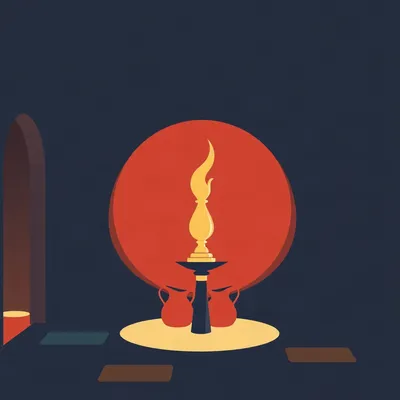
A golden altar at the end of the Sanctuary, right up against the curtain that separated it from the Holy of Holies. Burned every morning and every evening. That's why it's called ketoret hatamid, the regular incense. Exodus, chapter thirty, verses seven and eight.
Twice a day, every day.
And once a year, one exception. Yom Kippur. The High Priest takes coals from the altar in a censer, two handfuls of incense, and goes inside the Holy of Holies, and the smoke rises in front of the mercy seat over the Ark. Leviticus sixteen.
That's the only day anybody goes in there.
That's the only day. And the incense is what he carries in.
It also stops a plague at one point, doesn't it?
After Korach's rebellion. Aaron runs into the middle of the assembly with the incense and the plague halts. Numbers seventeen.
So the recipe has a body count attached to it in both directions.
That's one way to put it.
Alright. So that's what it was. Now what was in it. Because the Torah gives us four ingredients and the rabbis give us eleven, and I want to know how you get from one number to the other.
Exodus thirty, verse thirty-four. Four names. Nataf, which gets translated stacte. Shechelet, onycha. Chelbenah, galbanum. And levonah zakh, pure frankincense. And the verse says of each there shall be a like weight.
Four. Equal parts, apparently.
That's the surface. Now watch the derivation, because this is the part that either delights you or makes you pull your hair out. The verse says spices, plural. Plural means at least two. Then it names three, nataf, shechelet, galbanum. Two plus three is five. Then it says spices again, which the Sages read as doubling the five to ten. Then frankincense is named separately at the end. Eleven.
That's a reading of the grammar.
It's a reading of the grammar. Keritot, page six.
I want to be clear for listeners that this is not a hidden code. This is how the Oral Law reads a verse.
It's exegesis, yes. And the result is a full ingredient list with weights, in a baraita called Pitum HaKetoret. Same page.
Give me the list.
Four primary spices at seventy maneh each. Balm, which is tzori. Onycha, tzipporen. Galbanum, chelbenah. And frankincense, levonah. That's two hundred and eighty maneh.
Seventy each. Those are the big four.
Then four secondary at sixteen maneh each. Myrrh, cassia, spikenard, saffron. Sixty-four maneh.
And the last three?
Costus at twelve maneh, aromatic bark, kilufah, at three, and cinnamon at nine.
Which totals?
Three hundred and sixty-eight maneh.
That's not a round number. Which means it's not an accident.
Three hundred and sixty-five of those maneh correspond to the days of the solar year. One maneh per day, half burned in the morning, half in the afternoon.
And the extra three?
Reserved for Yom Kippur. That's what the High Priest takes his handfuls from when he goes into the Holy of Holies. He returns them to the mortar the day before and grinds them very thoroughly.
So the annual batch is a calendar.
The annual batch is a calendar. And there are things in the mixture that don't count toward the eleven at all. Auxiliary substances. Kersannah lye, nine kav. Cyprus wine, three se'a plus three kav. Sodomite salt, a quarter kav. And then two pinches, the ma'aleh ashan, the smoke-raiser, and according to Rabbi Natan, kipat hayarden, Jordan amber.
Two pinches out of three hundred and sixty-eight maneh, and one of them is the whole story.
One of them is the whole story. Hold that.
Before we get there, I want to talk about the identifications, because this is where I expected the tradition to be confident and it isn't.
It's not. Cassia, the ketziah, is described as perhaps the most difficult of the eleven spices to identify. Maimonides himself, in his commentary on the Mishnah, in Keritot, says he could not identify it.
Maimonides.
Maimonides.
The man who wrote a guide for the perplexed could not tell you what one of the eleven spices was.
He could not. And kipat hayarden is disputed. Maimonides says ambergris, the waxy stuff from a sperm whale. Others say it's a plant, or a rose that grows along the Jordan.
A whale product and a flower, and nobody's settled it.
Nobody's settled it.
What about the onycha? I've read that one's contested too.
Onycha comes into English from the Greek for fingernail, because of the shape. The Septuagint uses it. The common identification is the operculum, the little trapdoor shell that closes a sea snail, murex or strombus. But the Talmud describes it as something produced on the ground, and Zohar Amar argues it was an animal product, so there's a genuine split. Josephus, for what it's worth, claims there were thirteen spices, some of them from the sea.
Josephus rounding up.
Josephus being Josephus.
And galbanum.
Chelbenah. The least pleasant-smelling of the whole list. And Rashi reads its inclusion as representing the sinners of Israel. His line is that we shouldn't lose hope and abandon them.
So the one ingredient that stinks is the one that teaches you not to write people off.
That's the reading.
I keep coming back to that. Ten of the eleven smell sweet. One of them is foul, and it's mandatory, and the reason it's mandatory is a moral argument about who gets included.
And omitting any single spice was a capital offense. Liable to death at the hand of Heaven. Keritot six.
So you can't quietly leave out the one that smells bad.
You cannot.
Alright. We have the recipe. But a recipe is not a practice. How was this actually made, and why did it stop?
Start with the processing, because it's more physical than people expect. The onycha was scrubbed with Kersannah lye, and the reason given is so that it should be pleasant. Then soaked in Cyprus wine, so that it should be strong.
Lye and wine.
And the Talmud notes that urine would actually work better for that step, but it's banned from the Temple on grounds of propriety. Kavod ha-mikdash. The dignity of the place.
They knew the better solvent and refused to use it.
They knew and refused.
That's a very specific kind of institution.
Then the compounding itself. The ingredients were re-pounded twice a year in a large movable mortar. In summer they were spread out, to stop mold. In winter they were heaped in a pile, to keep the pungency in.
Seasonal handling. That's a working kitchen, not a ceremony.
And the workers chanted while they pounded. Pound it thoroughly, thoroughly pound it.
That's the line.
Over and over, in time with the pestle.
And honey was forbidden.
Forbidden. Adding it disqualified the whole batch. Leviticus two, verse eleven, no honey in an offering made by fire.
So you have a recipe with a hard exclusion, a capital penalty for omission, a banned solvent that would work better, and a chant. This is a trade.
It's a trade with a security clearance.
Which brings us to the Avtinas family.
The priestly clan that compounded the incense in the Second Temple. They kept the technique and the exact proportions secret. And the rabbis went after them for it. Mishnah Yoma, chapter three. The craftsmen of the House of Avtinas did not want to teach the secret of the preparation of the incense, and about these who were concerned only for themselves it is stated, the name of the wicked shall rot. Proverbs ten, verse seven.
That's a hard line to have preserved about you.
It's a curse in the Mishnah.
What was their defense?
Yoma thirty-eight a. They said the members of our father's house knew that this house, the Temple, is destined to be destroyed, and they were concerned lest an unworthy man learn our skill and go and engage in idol worship with it.
So they're either hoarders or they're protecting the formula from being repurposed.
Both readings are in the record. The rabbis call it selfishness. The family calls it safeguarding.
And the rabbis weren't satisfied, because they tried to crack it themselves.
They did. They brought in Greek scientists from Alexandria to reverse-engineer the formula. And the account says they identified everything except the ma'aleh ashan.
Everything.
Everything but the smoke-raiser.
So the most advanced scientific minds available got the whole ingredient list and still failed.
On one pinch.
What was the ma'aleh ashan?
A plant that made the smoke go straight up. A vertical column instead of a drifting cloud. That was the Avtinas secret, and it was lost when the Temple was destroyed in seventy.
And today?
Today there is only speculation as to what the herb was. Rabbi Steinsaltz suggested the Indian khimp plant, Leptadenia pyrotechnica. That's a suggestion, not a finding.
So the formula is not lost. The formula is written down. The smoke-raiser is lost.
That's exactly the distinction. Anyone can read Keritot six and reconstruct the eleven spices and the weights. What nobody can reconstruct is the thing that made the smoke behave.
And the scent, reportedly, carried.
Maimonides quotes the saying, in Jericho they could smell the incense. Jericho is a long way from the Temple. And the oral teaching puts it as far as the mountains of Machaerus, across the Jordan.
A city smelling another city's offering.
That's the claim.
Now the last question, and it's the one I find most interesting. Why does incense feel foreign to us?
Because we don't burn it. Rabbinic Judaism does not burn incense in synagogue. Full stop.
But it used to.
It used to. There was a custom of burning incense in synagogues in commemoration of the Temple. It shows up in communities in the Land of Israel, in Yemen, in the Eastern countries, in Europe. And it came to an end, probably in the Middle Ages. The latest testimony anyone has is from the twelfth century.
So somewhere between the Temple and now, it just stopped.
It stopped, and there's a plausible reason, and the reason is an argument.
The Karaites.
The Karaites objected fiercely. Not just to incense, to candles too. Their position was that these acts belong exclusively to the Temple, and performing them anywhere else is idolatry. Daniel Alqumsi in the tenth century, Judah Hadassi in the twelfth, both attacked the Rabbinic practice directly.
What did Hadassi say?
That the place is not sacred, and the rites are not sacred, and the person making the sacrifice is foreign and not sacred.
That's not a disagreement about furniture. That's a claim that the whole synagogue is illegitimate as a venue.
And the scholarship suggests the Rabbinic custom may have been discontinued partly because of that criticism. Not doctrine. Pressure.
So modern Jewish incense-lessness might be the residue of a medieval sectarian fight.
That's the reading in the Shemesh paper. It's a historical accident, not a theological verdict.
Then what replaced it?
Recitation. From the Geonic period, the Pitum HaKetoret baraita, the passage describing how the incense was made, starts being recited as liturgy instead of the incense being burned. Rav Amram Gaon, who headed the Sura Yeshiva in the ninth century, records it being said morning and evening in commemoration of the Temple incense.
They read the recipe instead of making it.
And the Zohar, second volume, two hundred and eighteen b, says reading the incense verses substitutes for the Temple Ketoret and wards off illness. That's why the passage sits at the front of so many siddurim.
So the thing itself became text.
Became text.
And the Samaritans?
The Samaritans still burn it. Every Sabbath eve and on festivals, in their synagogues, in a vessel called a Mabkhara. A Samaritan priest walks among the congregation with it, to atone for them.
So there's a living community doing the physical act, and it isn't us.
It isn't us. And I'll give you the line that captures the modern experience. A writer in twenty twenty-five put it this way. I cannot recall ever smelling incense burning in shul. In my mind, such practices seemed to belong categorically to Roman Catholic or Orthodox churches, or to Buddhist shrines.
That's the whole problem in three sentences.
Rabbi Andrea Zanardo adds the sensory point. Temple candles were unscented and visual. Incense was about smell. And smell is the sense contemporary Jewish worship basically doesn't use.
We kept the visual, we dropped the olfactory.
We kept the visual and we read the recipe aloud.
One more thing before we move on. There's a popular reading that the incense was psychoactive. That the High Priest was having visions because of the chemistry.
That comes from a single popular source, Mayim Achronim, and it's presented there as speculation. The argument is that a lot of the ingredients are antimicrobial or sedative or psychoactive, frankincense, myrrh, saffron, cinnamon, spikenard, costus. That Cyprus wine jugs found in Israel had traces of opium. That acacia wood, which supplied the coals, is high in DMT.
And the article itself says what about it?
The article itself notes that no major rabbinic sources say so. That's an academic hypothesis, and it's an interesting one, but it is not consensus and it shouldn't be repeated as fact.
Noted. It's a hypothesis.
Hilbert: Three hundred and sixty-eight maneh is the annual batch. The handfuls on Yom Kippur came out of the three extra, not the three sixty-five.
Right. That's what we said.
Hilbert: You said it, I just wanted it on the record that the daily portion was fixed. Nobody dipped into the daily portion for Yom Kippur. The three maneh sat separate all year.
Which is a scheduling problem, actually. You've got a batch that has to last exactly twelve months, and you're holding three maneh in reserve the entire time.
Hilbert: It's not a problem if you grind it right. They re-pounded the whole thing twice a year, and the Yom Kippur portion went back into the mortar the day before and got ground harder than the rest. Finer grind, more surface, burns hotter. That's the whole reason the smoke went up the way it did inside the room.
You think the grind mattered more than the ma'aleh ashan?
Hilbert: I think the grind was the part they could control. The ma'aleh ashan was one pinch of something nobody can name. You don't build a service around one pinch. You build it around the thing you do every day.
That's a real point. The chant, the pounding, the twice-yearly schedule. That's process control.
Hilbert: The chant wasn't decoration. Pound it thoroughly, thoroughly pound it. That's a metronome. You've got men around a mortar and if they drift out of time the batch separates, the heavy resins sink and the light stuff floats and you get an uneven grind. The chant keeps the pestle on beat so the whole thing stays uniform.
So it's a work song.
Hilbert: It's a work song the way a work song always is. It's a clock.
I'd never thought of it as load-balancing.
Hilbert: I made a batch once. Small one. Not for anything, I just wanted to know what it smelled like.
How small?
Hilbert: Small enough to fit in a coffee tin. I got most of it, or what I could get. The galbanum ruined it. I used too much and the whole thing smelled like a tire fire. Couldn't get it out of the kitchen for a week.
The one that stinks.
Hilbert: Rashi says it stands for the sinners. I stood in my kitchen and thought, well, that tracks. You put in too much of the bad-smelling one and it takes over everything. You leave it out entirely and it isn't the thing anymore.
Which is the whole teaching.
Hilbert: That's the whole teaching. And here's what I keep thinking about. Nobody alive has smelled it. Every description we have is secondhand, and the one ingredient that made the smoke stand up straight is gone, and the men who knew it died with the building.
So the recipe survived and the smell didn't.
Hilbert: The recipe survived and the smell didn't.
So the formula survives as text, but the smell is gone. What does that leave us with?
A recipe you can read and can't cook. That's what the Pitum HaKetoret is. It's recited morning and evening in a lot of siddurim, and what's actually happening in that moment is that a physical, sensory ritual got converted into a text.
And it's not a small substitution. Incense is the one offering that's entirely about the sense of smell. No one eats it, no one sees it, it's smoke. You can't photograph it.
Zanardo's point exactly. The candles were visual and unscented. The incense was the smell, and smell is the sense we dropped.
Here's what I keep coming back to. The most prestigious service in the Temple is the one with no living analogue. Not because anyone decided it was wrong. Because of a polemic in the Middle Ages and a preservation instinct that turned a recipe into a prayer.
And the open question is the smoke-raiser. Cassia is unidentified. Maimonides couldn't place it. The ma'aleh ashan is unknown, full stop. Speculation only. So we have the whole list and one blank space, and the blank space is the one that made it work.
Which makes you wonder what else in Jewish practice is a text standing in for a physical act nobody performs anymore. How much of what we do is a recitation of something that used to be done with your hands.
That's a bigger question than one episode.
It is. If you want to keep sending us questions like this one, leave us a review wherever you're listening. It helps people find the show.
And thanks to Hilbert Flumingtop, our producer.
This has been My Weird Prompts.
We'll be back soon.