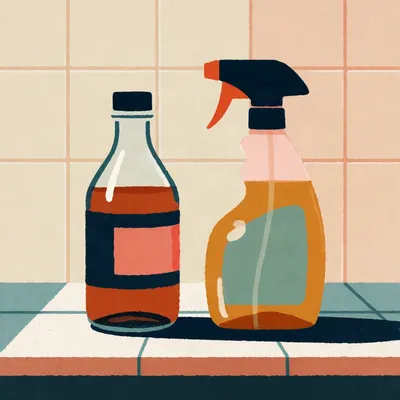
New series today. Life Skills for Dummies — the stuff nobody teaches you, everyone needs, and everyone pretends they already know. First subject: the cleaning cabinet. Daniel wrote in, and this one's personal, because he and Hannah have split on philosophy.

Oh, this is a good starter topic. What's the split?
Hannah has gone all-natural — the plant-based everything. The sprays, the soaps, the whole cabinet turned over. Daniel's impression is that none of it works: the dish soap doesn't cut grease, the toilet cleaner doesn't do the job, and — this is the part he actually cares about — he doesn't think any of it disinfects, and he'd rather, quote, err on the side of caution with effective products, used correctly. So he's keeping his own supplies in a separate cupboard, which I have to say is a detail I love — a household with two cleaning cabinets, one per ideology — and they're negotiating some kind of treaty. He wants to know what should actually be in the cabinet, what each thing is for, and what the science says about natural versus conventional.
And the fun part is that the question as framed — natural versus chemical — is kind of the wrong fight. Everything is chemicals. Vinegar is a chemical. The fight that matters is cleaning versus disinfecting, which are two different jobs with two different standards, and once you pull them apart, most of the Daniel-Hannah disagreement just... dissolves.
That's the tease. But let's not resolve it before we've earned it.
Agreed. And I'll flag the caveat now so I don't have to keep saying it: the big lab studies here are twenty years old in one case, proprietary in another, and the direction of the findings is consistent across decades and labs — but the exact numbers aren't gospel.
You just wanted to say "gospel" about cleaning fluid.
I did, a little. Let's take Daniel's worry first, because it's the serious one — the germs — and it deserves actual numbers. There's a landmark study from William Rutala's group at UNC, and Rutala is the guy who wrote the standard disinfection guideline for hospitals, so this is the establishment testing grandma's vinegar.
The Establishment versus the mason jar.
They took the conventional products — bleach, ethanol, a couple of quaternary ammonium disinfectants, Lysol kitchen spray, Mr. Clean — and the natural ones, vinegar and baking soda, and ran them against a nasty lineup: staph aureus, salmonella, E. Coli O157, Pseudomonas, and poliovirus. Conventional products got log reductions in the five-point-six to eight-point-two range. Vinegar got under three logs against staph and E. Coli. Baking soda got under three logs against everything.
Say what a log is, because "three logs" sounds like mild underachievement until you do the arithmetic.
Right, this is the number I want everyone to keep. A log is a factor of ten. A three-log reduction kills ninety-nine point nine percent. A five-log reduction kills ninety-nine point nine nine nine percent. Sounds like a rounding difference.
It sounds like the difference between a B and a B-plus.
It is not. Here's the arithmetic. On a surface with a million bacteria, three logs leaves a thousand survivors. Five logs leaves ten. So when vinegar scores under three and bleach scores over six, that's not "slightly worse." That's a hundred times more bacteria standing around afterward. And bacteria are the one thing in your kitchen that double on a schedule. A thousand survivors at lunch is a much bigger number by dinner.
A hundred times more survivors, and vinegar brought a smile to the fight.
And the poliovirus result is the one that should actually settle Daniel's worry. Only Clorox and Lysol got above three logs against poliovirus. The natural products were essentially non-virucidal — they didn't just underperform against the virus, they barely touched it. And it matters that viruses were in the test at all, because the bacteria numbers at least let the natural side stay in the room. Against viruses, the natural products never entered the room.
So on raw disinfecting power, Daniel's instinct is backed by the lab. Not a vibe — a hundredfold gap.
Backed twice over, actually, because there's a regulatory layer on top. In the US, a product cannot legally claim to kill germs without EPA registration, and registration means you submitted efficacy data to a regulator — a specific organism list, specific contact times, a specific concentration. Vinegar isn't registered as a sanitizer or disinfectant. Baking soda isn't. Lemon juice, tea tree oil, none of them. They've never shown a regulator anything. So a "kills ninety-nine point nine percent of germs" claim on a DIY or natural product is either marketing fiction or an illegal claim.
Which also cuts the other way. "Natural" isn't a safety certificate either.
Not remotely. The EPA's own materials say the words natural, nontoxic, and green on labels are unregulated, and researchers have found products labeled green often carry as many toxic chemicals as the conventional ones. Cleaning products aren't even required to list their ingredients in the US — no food-style label, no disclosure duty. So Hannah's assumption that natural means safe is a label-reading error, the same way Daniel's assumption that natural means weak turns out to be half-wrong.
Half-wrong. You said half. Explain the half before I assume you're being generous.
I'm being precise, Corn. There's a follow-up study from twenty fifteen that complicates the neat story. They tested bleach, an environmentally preferable commercial product, and a DIY mix of vinegar, club soda, and tea tree oil, on ceramic and stainless steel — two surfaces, because surface matters, which is a detail the first study couldn't capture. Bleach and the eco product both hit five logs against staph and E. coli. But here's the twist — the fresh DIY vinegar and fifty percent vinegar also reached five logs. On bacteria, fresh vinegar matched bleach.
Herman. You're telling me the mason jar tied with bleach and you led with the study where it lost.
I led with the one that's the standard reference! And the catch is the word fresh. The twenty-four-hour-old DIY mix lost its efficacy. DIY mixtures are unstable — you mix them, they work for a bit, they drift, nobody's checking. The commercial eco product doesn't drift, because somebody with a quality lab is checking every batch. So the takeaway isn't "vinegar is secretly great," it's that "natural" isn't monolithic: a certified, manufactured eco-product matched bleach, and a homemade one matched it for about a day.
A product with a shelf life of one afternoon is a hobby, not a cleaner.
It's the difference between a kitchen and a chemistry bench. If you enjoy mixing it fresh every time and you use it that day, fine. But nobody runs a household that way. The bottle in the cabinet is three weeks old, and the three-weeks-old version is the one the lab says doesn't work.
There's one more bit of lab work I want in, because you mentioned it's the norovirus question, and norovirus is the household pathogen. The one that goes through a family like a rumor.
Right. A twenty twenty-two study tested sanitizers against an MS2 phage — the standard norovirus stand-in, because you don't hand volunteers actual norovirus — on plastic and steel. Seventy to ninety percent ethanol got one to two and a half logs. Four percent acetic acid — that's vinegar — got between minus zero point one seven and zero point five five.
Minus. A negative result. Vinegar was within the margin of doing nothing.
Essentially. And norovirus is famously stubborn — it takes bleach or high-percentage alcohol to touch it. So if Daniel's mental model of the risk is "someone in the house gets a stomach bug, I wipe down the kitchen," the natural cabinet is not in that conversation at all.
Then let me do my job and ask the question Hannah would ask. Suppose she concedes every number you just said. Doesn't her side still get to say — you're bringing hospital-grade weapons into a flat, and hospitals use them because people in hospitals are already sick? My kitchen counter isn't an intensive care unit.
That's the strongest version of her argument, and it's real. The dose-response logic is on her side: the sicker the population, the more the last two logs matter. In a hospital, a thousand surviving staph colonies on a bed rail is a patient-safety incident. On my kitchen counter, it's Tuesday. And the exposure side matters too — every spray of bleach is an inhalation event for the person spraying it, and the person spraying it is the one getting the dose, not the germs. We'll come back to that when we do the quats. But finish the disinfecting picture first, because there's a lovely irony in the middle of it. The Cleaning Institute ran lab abrasion tests comparing commercial cleaners to alternatives — lemon juice, vinegar, ammonia, baking soda, borax. Vinegar reduced microbes best among the alternatives and removed soil worst.
The natural option that disinfects best is the one that cleans worst.
Vinegar's one product that straddles both jobs, and it's bad at both, in opposite directions, relative to the field. That's almost impressive.
Almost a talent.
Before we get to the cabinet, Hilbert has his segment.

Medieval Pottage Facts. Edward the Third broke his own rule in thirteen forty when he dined at his cousin Elizabeth de Clare's house, where the Sunday roast ran to about twenty kinds of meat and fish, and she never hosted him again. A reasonable woman.
Twenty kinds of meat and one guest who never came back.
Sumptuary laws, honestly, we could do a whole episode. But back to the flat. Hannah's turn. Cleaning — the actual removal of dirt and grease, which is ninety percent of what happens in a home — is where the natural side gets its win, and it's a bigger win than you'd expect.
You've got numbers for this one too. I can see them queuing up.
America's Test Kitchen spent six months testing twenty multipurpose sprays, with an accredited food lab doing the microbiology. The overall winner was a gentle, non-antimicrobial Method spray — no germ-kill claims at all — which, their words, cleans stains better than any other product they tested.
The gentle one won. Outright. Not on the germs — on the actual cleaning.
Outright. And in the side-by-side lab testing, Method's citric-acid antimicrobial spray neutralized salmonella just as effectively as a quat-filled Lysol spray — a result an independent institute at UMass Lowell corroborated. So the certified eco-product beat the conventional one on cleaning and tied it on disinfecting, in the same test. And ATK's guidance is the sentence I'd put on the fridge: most of the time, you should only be using a multipurpose spray to clean, because it gets rid of the majority of germs and exposes you to fewer harsh chemicals.
So Daniel's worry is real but aimed at ten percent of the surfaces, and Hannah's products can win the ninety percent. Now — dish soap. He specifically said the natural dish soap doesn't cut grease. That was his opening complaint, before the germs.
Dish soap is where he's partly right and partly wrong, and the split is interesting. ATK tested plant-derived against petroleum-derived surfactants and found they clean equally well. A surfactant chemist they interviewed put it plainly: concentration and strength matter far more than where the molecule came from. So the category isn't the problem.
The brand is.
Wirecutter rated Dr. Bronner's castile soap two out of five — worse at grease and stuck-on food than Seventh Generation or Dawn, needed more rinsing. But Serious Eats did a scrubbing test on cooked-on tomato sauce: Palmolive took forty-five strokes, Dawn fifty-four, Clorox fifty-four, and Mrs. Meyer's — plant-based — fifty-nine.
Fifty-nine against forty-five. That's a surcharge, not a massacre.
No. Fourteen extra strokes on a pan of tomato sauce is a drop in the bucket in the course of a week. And Seventh Generation performed well in Wirecutter's testing. So if Hannah's bought a weakly formulated natural soap, the fix is a better natural soap, not a surrender to petroleum. Dr. Bronner's is an extreme product — it's a castile soap, which is basically soap in its historical sense, and it was never engineered for a modern greasy pan. That's not "natural dish soap is weak," that's "this one product is a different animal."
So how does Daniel tell a good one from a bad one in the shop, without waiting for the tomato-sauce test?
Same way you tell anything: you let someone else do the testing. Wirecutter, ATK, Consumer Reports — pick whichever you trust, but pick one, because the label won't tell you. "Plant-based" on the front tells you the feedstock of the surfactant and nothing about the concentration.
The interesting one is the toilet, actually — Daniel said the natural toilet cleaner doesn't seem to do the job, and I have to be honest that I haven't found rigorous comparative testing of toilet cleaners.
Nobody has dragged toilet bowls into a lab.
Not that I can find, no. Which is itself telling — toilets are the most feared fixture in the house and the least tested product on the shelf. But the chemistry argument is clear enough. What builds up in a toilet bowl is a mineral ring — limescale — and the answer to mineral is acid: citric, lactic, hydrochloric depending on the product. And here's the part almost everyone gets wrong: dwell time matters more than the label. You squirt it under the rim and leave it for twenty minutes or overnight, and a modest acid does the job. You squirt and immediately scrub, and nothing works, natural or otherwise.
So Daniel may have been testing the product by misusing it.
Possibly. Or possibly he's got a weakly formulated one. A citric-acid natural toilet cleaner is a legitimate product; a weakly formulated one isn't. Same as the dish soap. Formula over philosophy.
Which is a good title for the peace treaty. But before we get to the treaty — you owe me the health argument. The quats.
Quaternary ammonium compounds. Corn, this is the strongest card in Hannah's hand, and it's current. Quats are in more than half of the disinfectants and sanitizers on the market. And occupational asthma has been repeatedly documented around them — the two common ones are specifically implicated in new-onset asthma and in making existing respiratory disease worse. CDC and NIOSH, in their guidance for employers, list quats alongside bleach and glutaraldehyde as asthmagens to avoid.
Alongside bleach. So Daniel's favorite, the one thing that beat poliovirus, is on the same list.
Same list. Neither side gets to feel smug. And to be fair to the quats, the literature is contested — a twenty twenty-five review argued that the good animal studies show effects only at the point of contact and no realistic exposure scenario is predicted to pose a health risk. But that same review counted roughly twenty-two documented cases of quat-induced occupational asthma. Occupational — that's the key word. Those are people like hospital cleaners and food-processing workers, exposed all day, every day, for years. So: contested, not settled, and I wouldn't spray the stuff daily in a kitchen with a kid in it.
Ezra's kitchen. Which is exactly the exposure Hannah's worried about — a small person at counter height while someone wipes down the counters.
And the dose argument runs in Hannah's favor here in a way it didn't for the germs. With germs, the household dose is low, so the last two logs of kill barely matter. With chemicals, the household dose is repeated — daily spraying adds up in a way a single stomach-bug weekend doesn't. That's the honest symmetry.
And the CDC line about wipes — you mentioned it before we started.
The CDC literally says: often, disinfectant wipes are used when water with a paper towel or cloth would do, like for cleaning up a coffee spill. That's the public health establishment telling people they're using the wrong product for a coffee spill. Wipes are the most overused object in the house. A coffee spill is dirt and liquid. It is not a pathogen event.
Herman, honest question — where do you actually land? You spent decades telling worried people what small risks mean. If you were drafting this household agreement, what's the frequency rule?
Routine cleaning with soap and water is enough for most surfaces, most days. That's not me being diplomatic, it's CDC guidance. You disinfect the high-touch points — door handles, faucets — and you disinfect for real when someone's sick or after raw meat. What I'd tell Daniel is: the caution he wants to err on the side of doesn't live in the product aisle. It lives in the ten percent of moments. Raw chicken juice on the counter, the stomach bug, the flu doorknob. Those are the moments. The other three hundred days, the cloth does the work.
My version is blunter. Bleach is a medication, not a beverage. Most days the house needs a shower, not chemotherapy.
That's... actually a decent compression, yes. So — the cabinet. Let's build it, and I want to do it by function, not ideology, because that's the whole reframe. Cleaning first, the ninety percent.
Go. I'll audit.
One: dish soap. The workhorse. Diluted in water it's a legitimate all-purpose cleaner for most surfaces — cuts grease, lifts soil mechanically. You could honestly run half a household on dish soap and microfiber alone.
Microfiber cloths deserve their own line.
Two, then: microfiber cloths. Underrated — mechanical removal does more than most of the chemistry. A damp microfiber picks up bacteria physically and holds them in the fibers instead of smearing them around, which is what a regular cotton rag does on a good day. Three: a general multipurpose spray, ideally EPA Safer Choice — that's the label that actually means something for cleaners; the winner in the testing was the Method one. Four: an abrasive — baking soda for scouring, a melamine sponge for scuffs and hard water marks. Five: an acid for mineral deposits — vinegar or citric acid for limescale, descaling the kettle. One hard rule there: never on marble, granite, travertine. Acid etches stone, and Hannah will care about that more than anyone, being an architect.
She would take etched travertine personally. Career-ending in her line of work. And glass?
Glass cleaner, or honestly water, microfiber, and a drop of dish soap. That's the cleaning half. Disinfecting half — one EPA-registered disinfectant, chosen deliberately, and there the menu is: bleach, which is the cheapest, the most powerful, the broadest spectrum — the only household answer to norovirus and C. diff spores — and the harshest. Seventy percent isopropyl or ethanol, which is fast and good on viruses and flammable. Or the lower-hazard registered options — hydrogen peroxide, citric acid, hypochlorous acid — all on the UMass Lowell safer-disinfectants list, all actually registered with the EPA.
Those last ones are the diplomatic option. Registered germ-killers Hannah could live with.
That's exactly what they are. That's the bridge. Hydrogen peroxide in particular — it breaks down into water and oxygen, it's on the list, and it kills what it says it kills. If Daniel needs the registration and Hannah needs the profile, that's the shelf where they meet.
And the usage rules, because Daniel said "used correctly" and the correct part is where nearly everyone fails.
That's the part that convinced me he's a serious person, actually — he put "used correctly" in the letter, which is the phrase almost nobody includes. And the correct part is where nearly everyone fails. Clean first, then disinfect — disinfectants are inactivated by organic soil, so spraying a dirty surface is mostly wasting it. You're paying germ-kill prices to kill dirt. Dwell time — most products need thirty seconds to ten minutes of visible wet contact, and the range is on the label. Spray and immediately wipe is theater. The surface has to stay wet the whole time, which means on a hot day you may need to spray twice.
And the mixing rules, which deserve their own serious thirty seconds.
They do, and I won't do them as a joke. Never mix bleach with ammonia — that's chloramine gas. Never mix bleach with vinegar or any acid — that's chlorine gas. Both are genuine poisoning risks, it happens every year, and people die of it cleaning bathrooms — usually exactly this way, one product didn't seem to work, so they add a second from the other shelf. And don't combine hydrogen peroxide and vinegar in the same container — that forms peracetic acid. Using them one after the other with a rinse in between is fine. Same bottle is not.
The toilet-bowl chemist is the most dangerous person in the house.
One more: bleach degrades. A bottle older than about a year is weaker than the label says, and a diluted mix doesn't keep — you make it fresh or you're mopping with a rumor of bleach.
So the treaty. Daniel keeps his disinfectant; Hannah keeps the daily driver.
One shared gentle cleaner for daily use — Hannah's domain. One EPA-registered disinfectant for targeted use — Daniel's, with the protocol literally written on the bottle, dwell time and all. And a shared commitment to never mixing anything. That's not splitting the difference. That's what the evidence recommends. And note what each side gives up: Hannah gives up the vinegar-as-disinfectant claim, Daniel gives up daily chemical coverage. Each keeps the part they actually care about.
Two shelves, one fridge magnet with the mixing rules on it. Every marriage needs a non-negotiable clause.
It's the bleach label that lies, not the bleach.
How's that?
The little numbers on the bottle. They're honest for about a year, then the hypochlorite walks off and the label stays put. I write the purchase date on every bottle, in marker, the day it comes home. There's a marker taped to the bottle for that. Herman, you've been saying "used correctly" for twenty minutes like it's a footnote — it's the whole label.
The marker lives taped to the bleach.
It lives with the bleach. It goes where the bottle goes. I lent it to Yossi next door about a month ago — he wanted to date a bottle of his own — and he didn't bring it back, so I went and got it. He was using it on a cardboard box. A box, Corn. You don't write on cardboard with the bleach pen.
You have a dedicated instrument for a job that happens once a bottle.
You date the bottle the day you buy it and you trust nothing after a year. Strip tests confirm it if you want to spend the money. I tested it once against a control bottle I'd kept past its date. The control wasn't dead, but it was telling stories. Used to keep chlorine dosing honest in a plant I worked in, same rule — anything that decays gets a date on it.
The taping is the part I like. That's the only system that survives, because the pen that's somewhere else never gets used.
The pen that's somewhere else is a pen you don't own anymore. And tell Daniel the splashless kind is a slower pour for no reason. Regular, dated, fresh dilution. Done.
He's solved marriage and chemistry with one marker.
One marker, Corn. It's not a system if you need two.
The splashless complaint — I've seen that argued, the thickening can change how it pours but the concentration's the same. The dating habit, though, that's just the label's own instruction followed properly, which puts him ahead of most of the country.
It puts me level with the label. That's the correct amount of effort.
So the closing question I'm left with. If most surfaces need cleaning, not disinfecting — and the CDC says as much out loud — why did we all end up in a disinfecting arms race? Wipes in every car, "kills ninety-nine point nine percent" on everything from spray to bin liners?
My guess is that germ-killing is legible. You can't photograph clean, but you can photograph a claim. The marketing sells a number, and the number feels like caution, and nobody in the supply chain benefits from saying "most days, a cloth would do." There's also the arms-race logic proper: once one brand puts ninety-nine point nine on the bottle, the competitor can't put "good enough" on theirs. The ratchet only turns one way.
And the pandemic poured accelerant on it — everyone bought the habit in one spring and nobody's told them to stop.
The CDC did try, quietly, with the coffee-spill line. Nobody put that on a bottle.
So the cabinet's settled, the treaty's drafted, and the next Life Skills installment is coming — and I suspect the natural-versus-conventional fight is going to follow us into other rooms of the house, because it's really the same argument about everything.
Laundry. It's going to be laundry.
That's the show. Produced, as ever, by Hilbert Flumingtop. If you enjoyed this one, try episode eighteen sixty-one, Emergency Prep You Can Sing To; episode fourteen oh eight, Israel Wartime Readiness Field Guide; and episode fifty-seven, From Lawyers in Limousines to Developers in Their PJs. This has been My Weird Prompts — if the episode was worth your half hour, a review wherever you listen helps more than you'd think. We'll be back soon.
See you then.