Last Thursday a woman was walking her dog on a pavement in Jerusalem. Not crossing, not jaywalking, not standing at a kerb deciding whether to go. On the pavement. A minibus came off the road and killed her, and the dog too.

And Corn, that's not just any pavement. That's Agrippas Street, right beside the shuk. I walk that street every week.
Daniel's prompt takes that death and pulls the lens all the way back. He wants the global pedestrian fatality data, the whole shape of it — where people die, what hits them, how much speed and vehicle size actually matter, whether the trend is up or down — and then the question underneath: does the pattern argue for taking vehicles out of dense streets entirely, rather than calming them?
Which is not an abstract question here, because the street where this happened has been a documented problem for fifteen years.
So start with the street. Klára Schneiderová, thirty years old, head of the Czech Embassy's Jerusalem office, killed on the twenty-ninth of October when the driver of a minibus lost control, mounted the sidewalk and hit a storefront. She'd been walking her dog.
The embassy called her an outstanding diplomat, a colleague and friend. She'd only been back in the country a month, though she'd known it since childhood — her father was Czech ambassador here years ago.
There's no reporting yet on the driver or the cause, so we'll leave that alone. What we don't have to leave alone is the street. Agrippas was not an unknown quantity.
Not remotely. Tens of thousands of pedestrians a day move along that street, and it also carries roughly three hundred cars an hour plus around fifty buses carrying maybe two thousand passengers. The sidewalks are under three metres wide and largely unshaded. And between 2019 and 2022 alone, more than ten road accidents — mostly involving pedestrians — were reported to police there.
Three-metre sidewalk, kerb, three hundred cars an hour. That's not a margin, that's a suggestion.
And the history is worse. In February 2011, when public transport was diverted off Jaffa Road during light-rail construction, Agrippas took the buses — and over fifteen people were injured in two weeks. The deputy head of United Hatzalah at the time, Eli Pollak, said they'd turned a narrow, small street into a two-way street and it became very dangerous from that moment.
And the official response?
The transport minister of the day, Yisrael Katz, stood up in the Knesset and said there was no direct connection between the new traffic arrangements and the accidents — calling that inference, quote, a bit of a stretch.
Fifteen people in two weeks.
Anyway. Fifteen years on, the street has a documented pedestrian-safety record, and the municipal answer that eventually arrived was a weekend pilot — Thursday evenings and Fridays from six, Agrippas becomes a pedestrian mall and one-way street.
That's the whole episode in miniature, isn't it. A street with a known body count gets evenings and Fridays off.
That's Daniel's tension, and I think he's framed it exactly right. So let's look at what the data actually says about how pedestrians die, because almost none of it matches the picture in people's heads.
Give me the picture in people's heads first, so we know what we're replacing.
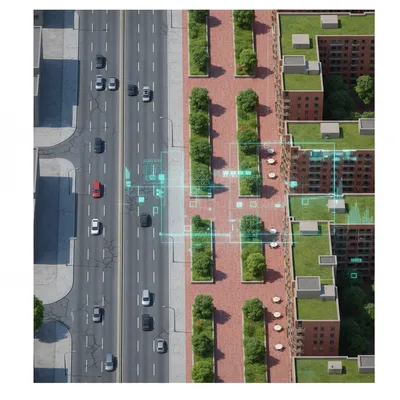
The careless jaywalker at a junction. Someone darts out mid-block or crosses against the light at an intersection, driver can't stop, tragedy, and the implicit lesson is about pedestrian behaviour. In the US in twenty twenty-four, seventy-three percent of pedestrian fatalities occurred at locations that were not intersections. Eighteen percent at intersections. The rest, about nine percent, fall into a bucket the statisticians call other locations — sidewalks, bike lanes, medians, shoulders, driveways.
Seven in ten happen away from junctions entirely.
Seven in ten. And eighty-four percent were in urban areas. The dominant American pedestrian death is not a rural highway story and not a junction story. It's someone on or near a city street, in the dark — seventy-six percent of deaths were after dark versus twenty percent in daylight.
The dark part tracks with something Daniel asked about, the time of day.
The peak windows are six to nine in the evening at twenty-four percent, and nine to midnight at twenty-three percent. The safest window is mid-morning, nine to noon — four percent. On weekends, the nine-to-midnight window alone is twenty-eight percent of all pedestrian deaths.
So the dangerous hours are the hours Agrippas is at its most crowded with people eating and shopping — and the hours the pilot doesn't cover.
The pilot covers Thursday evening and Friday, and Friday ends early here. I noticed that too.
Now the part I find grim. What's doing the hitting.
Of the pedestrians killed in the US in single-vehicle crashes, about two thousand were hit by passenger cars and nearly three thousand by light trucks — SUVs, pickups, vans. SUVs alone were nearly eighteen hundred of those. And eighty-five percent were struck by the front of the vehicle, which sounds obvious until you realise it means the vehicle drove into the person, almost every time.
Not sideswiped, not run over after a fall. Front of vehicle.
Front of vehicle, square on. And the proportions keep shifting toward the big stuff — light trucks are now over half of pedestrian fatalities where the vehicle type is known.
Which raises the question Daniel is really poking at. Is that just exposure — more SUVs on the road, therefore more SUV deaths — or does the vehicle itself change the outcome?
That's where it gets interesting, because the size effect survives holding everything else constant. The Insurance Institute for Highway Safety found that pickups, SUVs and vans with hood heights above forty inches were about forty-five percent more likely to kill a pedestrian than vehicles with hoods at thirty inches or less with a sloping front.
Forty-five percent for a tall hood.
And an economist, Justin Tyndall, has pushed this further. Struck by a pickup rather than a car, a pedestrian is seventy percent more likely to die. A large SUV, roughly double. Compact SUVs sixty-some percent worse, full-size SUVs essentially double. He also finds that a ten-centimetre increase in front-end height alone is associated with about twenty-two percent higher fatality risk.
So it's not just mass. It's geometry.
A tall, flat front means the pedestrian takes the full force to the torso and head instead of being thrown up onto the bonnet, which is what a sloping car front does. The vehicle scoops you or it doesn't. And Tyndall's counterfactual is stark: if American car-buyers had stuck with cars instead of shifting to SUVs between 2000 and 2019, something like eleven hundred pedestrian deaths would have been averted.
Eleven hundred people, killed by a purchasing trend.
Same roads, same speeds, same behaviour.
Which means speed limits and bollards are answering only half the question.
Speed is the other half, and it's brutal in its clarity. A meta-analysis from twenty nineteen found each additional kilometre per hour of impact speed raises the odds of pedestrian fatality by eleven percent. The risk curve itself: roughly five percent death risk at thirty kilometres an hour, thirteen percent at forty, twenty-nine percent at fifty, fifty-fifty at about sixty, and ninety percent at eighty.
That curve is the whole argument for thirty zones in one line.
It is. Thirty is mostly survivable, fifty is a coin toss leaning bad, eighty is nearly certain death. And the older German in-depth work found risk at fifty was more than double forty, and over five times thirty.
Before we leave the geography of it, the sidewalk slice. Because the Jerusalem case is precisely the rare category.
Right, the nine percent. The other locations bucket, off the roadway. And it's a real but small slice — Welsh data put about ten percent of pedestrian casualties on the footway, verge or central reservation. The US federal crash-typing found something I had to read twice: among crashes where the pedestrian wasn't in the roadway, eighty-four percent of the time both the pedestrian and the vehicle were off the roadway to begin with — parking lots, driveways, that sort of thing. Only sixteen percent involved a vehicle leaving the road and hitting someone on the pavement.
Schneiderová is in the sixteen percent of the nine percent.
A rare event within a rare category, on a street where the exposure was enormous. And there's a companion statistic that I find quietly devastating: sixty-five percent of US pedestrian deaths in twenty twenty-three occurred where there was no sidewalk at all. The sidewalk is protective infrastructure, and most of the American dead didn't have one.
So the data we've laid out — away from junctions, dark, urban, big front ends, speed — all of it points at physical separation and fleet composition. Almost none of it points at telling pedestrians to behave.
Which is exactly the pivot Daniel's inviting, and I think we should take it, because the natural next question is whether any of this is getting better.
Let's go to the phone before we do. Mum's on the line.
Dorothy! Always a pleasure.

Hello dear, it's your mother. I've got one for Dorothy's History of Toast.
Melba toast is named after the opera singer Nellie Melba, and the chef Auguste Escoffier is credited with it, in the eighteen nineties.
Funny really. You become famous for singing, and they name a dry little cracker after you. Things do not work out, I suppose.
Anyway. Have you eaten? There's soup in the fridge, and don't let it go cold. Bye now, sweetheart.
I'll call you back, Mum.
So, the trend. Globally, the World Health Organization counted one point one nine million road deaths in twenty twenty-one, down five percent from 2010. Overall road safety is improving. Pedestrian deaths are not — they rose three percent over that period, to two hundred seventy-four thousand. And in South-East Asia they rose forty-two percent, the only region where they went up.
Total deaths down, the walking share up.
Pedestrians are now over a fifth of everyone killed on roads worldwide — the WHO headline says twenty-three percent, though the report's own executive summary says twenty-one, which tells you something about how carefully even the global numbers get read.
And the rich world?
Improving, with wobbles. The EU lost three thousand five hundred sixty pedestrians in twenty twenty-four — down thirty-two percent from a decade earlier. The US peaked in twenty twenty-two at about seventy-five hundred, has fallen two years straight, and is projected down again for twenty twenty-five — though still five percent above pre-pandemic levels. London ticked up to sixty-one in twenty twenty-four, highest since the pandemic, but below its late twenty-tens average.
All of which sets up the country that matters for this episode.
Israel is going the other way entirely. Twenty twenty-five was the deadliest year for pedestrians in eighteen years — a hundred twenty-six killed, twenty-seven percent of all road deaths. Total road deaths four hundred fifty-nine, the worst in nineteen years. And the composition is what you'd expect from an old city with old streets: nearly half of the dead were sixty-five or older, and fifteen were children under fourteen.
Forty-six percent over sixty-five. Slow walkers, Corn-friendly streets, narrow pavements.
And a fleet that's gone SUV like everywhere else, on streets that were laid out for donkeys and foot traffic. I say that with some family feeling.
Careful. So the country where this death happened is the statistical outlier — the one place where the pedestrian number isn't falling. That does turn the Jerusalem case from anecdote into data point.
It does. Now, the policy question, and here I want to be honest about the state of the evidence, because it's thinner than people assume. There's a systematic review of pedestrianisation published this year — Buckland and colleagues — and it finds environmental benefits, public health benefits, economic benefits, and it reports barriers like local opposition and accessibility concerns. What it does not report is a pooled safety effect size. Nobody has run the controlled comparison at scale.
Nobody has measured it.
Nobody has measured it properly. The best evidence is case-level. San Francisco is the strongest set. Powell Street went car-free as a pilot in twenty fifteen — it had been averaging at least three injury collisions a year, and after the change, zero collision-based injuries. They made it permanent in twenty seventeen. Market Street east of Tenth banned most vehicular traffic in early twenty twenty, and crashes dropped forty percent and stayed down.
Zero is a compelling number when your baseline was three.
Against that, Brighton. They partially pedestrianised the Old Town, and measured the change in motor traffic entering the area: down four percent. Four. Partial measures can just move the cars one street over, or not even that.
That's the cautionary tale for the Agrippas pilot — Thursday evenings and Fridays is a partial measure on a street carrying buses the rest of the week.
We did an episode on where pedestrian zones end and car-free cities begin, and the thing we kept circling then is the thing Brighton shows in one number: a zone that ends at a boundary line doesn't remove the traffic, it relocates the decision about where the traffic goes.
And the middle path — the bollards-and-limits route?
Area-wide traffic calming, pooled across sixteen controlled before-and-after studies, comes out with an injury rate ratio of about zero point eight nine. A real effect, a modest one. New York's turn-calming work in the late twenty-tens cut pedestrian injury odds sixteen percent and fatality odds eighty percent at junctions specifically, which is excellent — but remember where the deaths actually are. Seventy-three percent aren't at junctions.
So calming helps where it's applied, and its ceiling is the street still has cars on it.
That's my read. And here's why I think the case for full removal is nonetheless stronger than the missing effect size suggests. You have two separable variables, speed and vehicle size, both pointing the same way — and neither is answerable by behaviour change. The Tyndall numbers say a large SUV is twice as lethal as a car at the same speed. The speed curve says fifty kilometres an hour is a coin toss. On a street with three hundred cars an hour and under-three-metre sidewalks, you cannot fix both with signage. You can't put a bollard every metre of a functioning shopping street.
You can't bollard your way out of geometry.
The logic is exposure elimination. You cannot be struck by a vehicle on a street with no vehicles. That's almost embarrassingly simple, and it's why I find the missing effect size less damning than it looks — the mechanism isn't in doubt, only the magnitude. But I'll grant what should be granted: nobody has the clean number, and anyone who tells you pedestrianisation is proven to save X lives per year is ahead of the literature.
Neville, we see you hovering at the desk. Come in.

Hello! Yes. Neville Muddledorf, leading authority on, well, streets, pavements, the whole sector. Uncle Hilbert's letting me hold the desk while he's away, and I've read, well, most of the brief.
Most of it.
The good parts! The important street parts. And I wanted to say, you know the bollards you mentioned — that's what my school project was. We did a traffic survey outside the gate. I counted forty-one vehicles in an hour, well, actually the hour was a bit shorter because of lunch, but nearly forty-one. And one of them was a minibus, like the one in your show, except nothing happened, it just went past.
A structural non-event.
Yes! That's the term, actually, well, something like that. Also I wanted to add, on the pavement width thing — the part you said about the three metres. Uncle Hilbert measured a pavement once with his special tape, the one from the box marked tapes, winter. He's got boxes for everything. Boxes with dates on. Sometimes boxes inside the boxes.
That sounds like your uncle, all right.
And I know all about road safety because hedgehogs are mostly nocturnal, so we're out at the same time as most of the, um. The dangerous window you said. Nine to midnight.
Stay on the verge, Neville.
Oh, I always do. Verge first, road second, that's the order. Anyway the minibus in your story hit a shop, which is like our project because the shop opposite school is where I got my crisps. Do you think Agrippas will go fully pedestrian? I think it should, but I'm not a leading authority on Jerusalem, that's a different specialism.
You're nearer it than you think, actually. But one correction — we said the fatality risk at thirty kilometres an hour is around five percent. You'll want that number the right way round for your project.
Oh, five percent, that's much better, actually. I had it as ninety. That's... that's a very different graph.
It is.
I'll redo the graph.
So where does all this leave the actual question Daniel asked?
I think it leaves pedestrianisation as the policy that follows from the data but can't yet prove itself in the way policymakers want. The data says the deaths are urban, dark, away from junctions, caused by speed and vehicle geometry. The interventions with measured effects — calming, turn restrictions — trim the edges of that. The intervention that eliminates the exposure is the one without a controlled trial.
Because you'd need cities willing to hold the experiment.
You'd need a city to pedestrianise a street and a matched street to leave alone, and enough years of both. San Francisco gives you the case studies, Brighton gives you the warning about doing it by half. Nobody's assembled the trial.
The one thing, then. If you take one thing from this episode: the image almost everyone carries — the careless pedestrian at the crossing — is not what the data shows. Seven in ten die away from junctions, and the two variables that decide whether they live are how fast the vehicle was moving and how tall its front end was. Both of those belong to the vehicle.
And that's why the honest conclusion isn't "slow the cars down," it's that on a street like Agrippas the question is whether the cars belong there at all. A street that got a weekend trial after fifteen years of documented injuries is a street where the data was never the bottleneck.
If the safety case rests on exposure elimination, the open question is what it would take to actually measure it — and whether any city would accept an answer it didn't like. That's the gap between what the numbers support and what gets built, and it's wide enough to park a minibus in.
Reviews help us more than you'd think — five stars on your podcast app, if today's episode earned them. Our producer is Hilbert Flumingtop, who is still the producer even when he's off boxing things; and Neville Muddledorf has been holding the desk, which he mostly did.
I held it really well.
For more along these lines, there's episode sixty-four hundred, Where Pedestrian Zones End and Car-Free Cities Begin; episode fourteen oh eight, Israel Wartime Readiness Field Guide; and episode five oh four, How to Start Thinking Like an Urbanist. This has been My Weird Prompts, where no question is too obscure and no rabbit hole too deep. Find everything we've ever done at my weird prompts dot com.
See you tomorrow, listeners.


 chatterbox-regular