Daniel's continuing his ancient celebrations series, and this week he's landed on Sukkot, specifically the water drawing ceremony in Jerusalem during the Second Temple period. The Mishnah has that line, one who never saw this never witnessed happiness in their life. He wants us to time travel, get the sights, the sounds, the actual tempo of the thing. And the timing works, Sukkot's about to be celebrated throughout the Jewish world.

The water drawing ceremony is the single best answer to anyone who thinks ancient religion was all solemnity and sackcloth. Fifteen and a half hours of torch juggling, nonstop music, and the Talmud trying to explain how nobody slept by saying they dozed on each other's shoulders while standing.
Which raises the question of what the person on the bottom of that pile was experiencing.
Deeply spiritual neck pain.
So let's start with the thing that makes this strange. The Torah commands Sukkot, the booths, the four species, the seven days. The water libation, the ritual that generated the most beloved celebration of the year, is nowhere in the five books of Moses.
Right, and the rabbis knew it. They worked hard to find a scriptural hook. Rabbi Yehudah ben Beteirah derived it from three anomalous extra letters in the Numbers passage about the festival offerings that happen to spell the word for water. Rabbi Akiva argued by analogy with the other festivals. And some just called it a law given orally to Moses at Sinai. The point is the derivation was an afterthought. The practice came first.
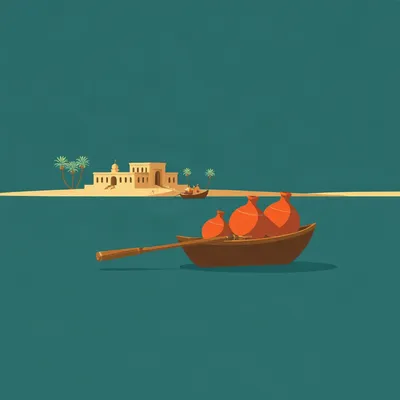
The practice being, every morning of the festival, a priest fills a golden flask holding three log of water from the Pool of Siloam and carries it up to the Temple.
Three log is about a liter and a half. Small amount. But the procession was not small. Shofar blasts greeted them at the Water Gate. Tekiah, teruah, tekiah. The priest then ascended the ramp to the altar and turned left, where two silver bowls stood, one for water on the west side, one for wine on the east. Both bowls were perforated with narrow holes, and here's the detail, one hole was wider than the other so both liquids would drain out at exactly the same moment.
The engineering of simultaneous emptying.
They wanted the water and the wine to hit the altar together. And the whole point of the water, Rabbi Akiva says it plainly, bring the water libation on the holiday so that you be blessed with rain. Sukkot was understood as the time God judges the world for rainfall. This was a rain making ritual.
Which is a wild thing to do in a place like Jerusalem, where rain is the difference between eating and not eating. You're not just celebrating the harvest you got, you're negotiating for the next one.
And there's a rabbinic image I love. Rabbi Elazar said when they pour the water, the Depths, meaning the subterranean waters, says to its fellow, let your waters spring forth, I hear the voice of two friends. The water was thought to seep down to the deep that controls rain. It's a direct line from the altar to the aquifer.
So the daytime ritual is a rain negotiation. The nighttime celebration is something else entirely. Let's get into the Simchat Beit HaShoeva itself.
This is where the Mishnah earns that line about happiness. At the conclusion of the first festival day, priests and Levites went down to the Women's Courtyard and made what the text calls a significant repair. What that means is they built bleachers overnight so women could stand above and men below.
They retrofitted the courtyard for crowd control. That's a detail that tells you they knew exactly how many people were coming.
Four enormous golden candelabra stood in the courtyard. Each one had four golden basins, each basin held a hundred and twenty log of oil. That's roughly sixty liters per basin, times four basins, times four candelabra. The wicks were made from the worn out trousers and belts of the priests.
The priests' old pants became the light source for the entire city.
The Mishnah says there was not a courtyard in Jerusalem that was not illuminated by that light. The Jewish Encyclopedia adds a woman could pick wheat from the chaff anywhere in the city. That's not ambient glow, that's stadium lighting.
So the light is biblical era floodlights. What's happening in the light?
Pious men and men of action would dance before them with flaming torches in their hands, saying passages of song and praise. The Levites played lyres, harps, cymbals, trumpets, and what the Mishnah calls countless instruments on the fifteen stairs leading down from the Israelite Court to the Women's Courtyard. Fifteen stairs, one for each of the fifteen Songs of Ascents in Psalms.
The Psalms that pilgrims sang on their way up to Jerusalem. So the architecture of the Temple itself is mapped onto the pilgrimage experience.
And then you have the jugglers. Rabban Shimon ben Gamliel, the president of the Sanhedrin, the highest religious authority in the land, juggled eight burning torches. And the sources say never did one torch touch another. My Jewish Learning adds he also did a handstand on two fingers.
The chief rabbi of the ancient world doing a two finger handstand with eight torches in the air.
Others juggled eight knives, eight glasses of wine, eight eggs. This is the religious leadership of Judea putting on a circus act in the Temple courtyard.
And the crowd is not watching politely. This is participatory. The celebration ran every night except Shabbat, from the afternoon offering until the morning offering. That's roughly fifteen and a half hours.
Rabbi Yehoshua ben Chananya said, our eyes never saw sleep. The Talmud then has to deal with the obvious problem that humans need sleep, and resolves it by saying they dozed on each other's shoulders while standing.
I want to know what the morning offering looked like after fifteen hours of this. A courtyard full of exhausted people, the smell of spent oil, and the priests starting the next day's ritual.
There's a dawn moment that's one of the most striking details in the whole account. At the rooster's crow, two priests at the Upper Gate sounded tekiah, teruah, tekiah. Trumpets sounded again at the tenth stair, again at the Women's Courtyard, and at the eastern gate. And there, the priests turned west, away from the rising sun, toward the Holy of Holies, and declared, our ancestors worshipped the sun toward the east, and we, our eyes are to God.
That's a direct quote from Ezekiel, where the prophet condemns sun worship in the Temple. So the dawn moment is a theological correction built into the choreography.
They're facing the wrong way from the sun on purpose. The whole night has been about light and fire and ecstasy, and at dawn they make sure everyone knows what the light is for.
Let's talk about the name. Simchat Beit HaShoeva, the rejoicing of the house of the water drawing. Why is the night celebration named after the morning water ritual?
The Jerusalem Talmud has two answers. Rabbi Yehoshua ben Levi said it was called that because from there they drew divine inspiration. The word for drawing water, shoeva, becomes drawing in the sense of drawing out prophecy. And Rabbi Jonah said the prophet Jonah was a Sukkot pilgrim who entered and had the divine spirit rest upon him. His principle, the divine spirit only rests upon a joyous heart.
So joy is not a side effect of the ritual, it's the precondition for prophecy. You can't receive the divine spirit if you're miserable.
That's the theological payload of that Mishnah line about never having witnessed happiness. It's not just saying this was a fun party. It's saying this kind of ecstatic communal joy is the mechanism by which prophecy happens. The joy is doing work.
Which flips a lot of assumptions about ancient religion. We tend to imagine the Temple as a place of hushed reverence, priests moving slowly, everything solemn. But the sources describe something closer to a street festival that lasted all night with the religious elite doing acrobatics.
And this is the festival the Torah itself commands you to rejoice on. Deuteronomy says rejoice with your sons, your daughters, your slaves, the Levites, the stranger, the orphan, the widow. The joy is mandatory and it's mandatory for everyone, not just the privileged.
Brettler, the Bible scholar, makes the point that Sukkot was the festival. In many circles in the biblical period it was more important than Rosh Hashanah and Yom Kippur. Solomon's Temple dedication is imagined to have happened on Sukkot. Nehemiah records the Judeans discovering the booth dwelling commandment and having very great rejoicing.
And the earliest biblical reference, Exodus twenty three, calls it the feast of Ingathering upon the culmination of the year. Which implies it functioned as a kind of new year. There's a scholarly argument that Sukkot was the ancient Israelite new year festival. The Ugaritic texts from coastal Syria, destroyed around the twelfth century BCE, describe a new year festival where dwellings of branches were built on the temple roof for the gods.
So the booths may be older than the explanation we're given for them. The Torah says they commemorate the wandering in the desert. But the branch dwellings show up in a neighboring culture's new year ritual centuries earlier.
Farber, the scholar who's done the most work on this, suggests Sukkot may have been the Israelite new year before the calendar shifted. The booths were originally harvest shelters, then they got theological meaning layered on.
Which is how these things usually work. The practice comes first, the explanation gets retrofitted. Same thing with the water libation. The ritual exists, then the rabbis find the scriptural hook.
And not everyone accepted the hook. This is where it gets political. The water libation was a flashpoint between the Pharisees and the Sadducees. The Sadducees only accepted what's written in the Torah. The water libation is not written in the Torah. So they rejected it.
And the Mishnah records what happened when a priest decided to make his point physically. He poured the water on his feet instead of on the altar.
The crowd pelted him with their citrons. The etrogim, the four species fruit they were holding. The Tosefta calls the culprit a Boethesian, the Bavli calls him a Sadducee. And because of that incident, the priest was thereafter required to raise his hand when pouring, so everyone could see the water actually go onto the altar.
The transparency rule came from a riot. That's a very practical piece of religious legislation.
And here's the darker layer. Farber argues the rabbis recast an older story from Josephus about King Alexander Yannai, who ruled from a hundred and three to seventy six BCE. He was pelted with citrons at a festival, and Josephus says he then killed about six thousand of the people and built a wooden partition around the altar.
Six thousand people. Over a dispute about whether water goes on an altar.
It wasn't really about the water. It was about who owns religious authority. The Pharisees accepted the oral tradition, the Sadducees said only the written text counts. The water libation was the visible symbol of that fight. Every morning of Sukkot, the crowd watched a priest pour water that the Torah never commanded. If you're a Sadducee, that's an abomination. If you're a Pharisee, it's the beloved centerpiece of the year.
And there's a scholarly angle that the Sadducees opposed it because it looked like magic. The rain making ritual, trying to manipulate God rather than honor Him. A populist rain rite versus an elitist pristine cult.
That's Israel Knohl's argument, Farber follows it. The water libation is essentially sympathetic magic. You pour water on the altar, the deep hears it, the rain comes. That's a very different model of how ritual works than offering sacrifices as commanded.
Which makes the celebration around it even more interesting. The elite theological dispute is happening while the masses are dancing with torches and the Sanhedrin president is juggling. The joy is the populist part.
And the joy is what survived. The Temple is gone, the water libation stopped, but the celebration continued. The modern practice of Simchat Beit HaShoeva, street dancing during Sukkot, is traced to Rabbi Hayyim ben Jacob Abulafia in Izmir in seventeen twenty six. And the Lubavitcher Rebbe in Brooklyn in nineteen eighty said, if you want to find God this Sukkot, you'll find Him dancing on the streets.
The Chabad street parties in Jerusalem during Sukkot are a direct descendant of the Temple courtyard. Same ecstatic joy, same all night energy, same idea that the divine spirit rests on a joyous heart.
And the physical route is still there. The stepped pilgrim street from the Pool of Siloam up to the Temple Mount, six hundred meters long, eight meters wide. It opened to the public recently after years of excavation. You can walk the exact path the water carrying priests would have taken.
With the caveat that the street as excavated dates to around thirty CE, under Pontius Pilate. The Mishnah describes the ritual centuries earlier. The connection is inferential, not direct.
That's right. The Wikipedia article on the street explicitly flags the claim that this particular street was used in the festival as disputed. The archaeology gives us the route, not the ritual. We have no direct archaeological evidence of the water drawing ceremony itself. No golden flask, no silver bowls with the uneven holes.
Which is honest. We're reconstructing from texts, and the texts are vivid enough that the absence of artifacts doesn't really matter for the sensory picture.
Let's do the sensory picture properly. Daniel asked for sights, sounds, tempo. So picture this. You're a pilgrim, you've walked from Galilee or from Babylon or from Alexandria. You've been sleeping in a booth on a Jerusalem rooftop for a week. The city is packed, the population swells to several times its normal size. The smell is olive oil, roasting meat from the festival offerings, dust, sweat, citron.
The citron smell is specific. Etrogim have a distinctive citrus scent, sharp and sweet. The whole city would smell of it during Sukkot because everyone is carrying one.
You descend to the Pool of Siloam at dawn and watch the priest fill the golden flask. The water is flowing from the Gihon spring through Hezekiah's tunnel. Then the procession up the stepped street, shofar blasts at the Water Gate, the crowd pressing in.
And the sound. The shofar is not a musical instrument, it's an alarm. Tekiah, a long blast. Teruah, nine staccato notes. Tekiah again. It cuts through everything.
At night, the sound changes. Lyres, harps, cymbals, trumpets, and what the Mishnah calls countless instruments. Fifteen stairs, each one a different psalm. The Levites singing the Songs of Ascents. And underneath it, the crowd. Thousands of people singing, dancing, the percussion of feet on stone.
The light is the thing I keep coming back to. No streetlights, no ambient city glow. Night in the ancient world is dark in a way we don't experience. And then four candelabra with sixteen basins of oil total, each basin holding sixty liters. The wicks are priestly undergarments. The entire city is lit.
And the tempo. Fifteen and a half hours. This is not a service that ends at a reasonable hour. The celebration starts in the afternoon and runs through to the morning offering. People are sleeping standing up, leaning on each other. The energy must have cycled, peaks and valleys, but it never stopped.
The jugglers are the detail that makes it real for me. Rabban Shimon ben Gamliel doing a handstand on two fingers with eight torches in the air. That's not a metaphor. That's a man in his sixties, the head of the Sanhedrin, doing gymnastics in front of a crowd.
And the crowd is not shocked. Nobody says, the president of the Sanhedrin shouldn't be doing acrobatics. The Mishnah records it as a highlight, a point of pride. This is what leadership looked like on Sukkot.
There's a lesson in that. The people who are most serious about the tradition are the ones who can be most joyful in it. The joy is not a break from the religion, it's the highest expression of it.
And that's the Jerusalem Talmud point about prophecy. The divine spirit only rests on a joyous heart. Not a solemn heart, not a studious heart, a joyous heart. The ecstasy is the vessel.
Let's talk about the rain theology a bit more, because I think it's the part modern listeners will find strangest. Pouring water on an altar to make rain fall. It sounds like sympathetic magic, and honestly it is.
It is, and that's what made the Sadducees uncomfortable. But think about what it means in an agricultural society. Rain is the difference between life and death. Not metaphorically. If the rains don't come, the cisterns run dry, the crops fail, people starve. Sukkot is the moment when you've just harvested and you're looking at the next year. The water libation is a plea, but it's also a statement of confidence. We're pouring out water because we believe God will give it back.
The deep hears the voice of two friends. That's the image from Rabbi Elazar. The subterranean waters responding to the water on the altar. It's a conversation between the ritual and the cosmos.
And the timing matters. Sukkot falls at the transition from the dry season to the rainy season in Israel. The rains usually start around late October or November. So the water libation is happening at exactly the moment when rain is on everyone's mind. It's not abstract, it's the most concrete thing in the world.
The first rain after Sukkot must have felt like the ritual worked. And if it didn't rain, there was always next year. The ritual is designed to be repeated.
The thirteen bulls on the first day, decreasing daily. That's the other Sukkot detail. Numbers specifies thirteen bulls the first day, twelve the second, down to seven on the seventh day. Seventy bulls total. The rabbis connected that to the seventy nations of the world. Sukkot was understood as a festival for all humanity, not just Israel.
Which is why Zechariah has all the nations coming to Jerusalem for Sukkot in the end times. The universalist festival.
And the booth itself is the great equalizer. Everyone leaves their house and lives in a temporary hut for a week. Rich and poor, the booth is the same. The roof has to be open enough to see the stars. You're exposed to the elements, reminded of fragility.
The fragility is the point. You've just harvested, you're feeling secure, and then you move into a hut with a leaky roof to remember that security is temporary.
Daniel's prompt asked about the biblical era specifically, but the Mishnah's account is Second Temple. The biblical Sukkot was probably simpler. The harvest festival, the booths, the four species. The water drawing ceremony as described is a Second Temple development, with the elaborate choreography, the candelabra, the juggling.
And the biblical roots are interesting on their own. Brettler points out that the booth dwelling and the four species were originally two separate practices that got combined. Leviticus commands taking the fruit of hadar trees, palm branches, boughs of leafy trees, and willows of the brook, and then separately commands dwelling in booths. Two glosses that merged.
Nehemiah is the funniest example. The Judeans rediscover the booth commandment and the text says they had not done so from the days of Joshua son of Nun to that day. That's a very long time to forget a commandment. And they have very great rejoicing when they do it.
Rediscovery joy. There's something very human about that. You find an old practice, you try it, and it turns out to be wonderful.
The four species themselves are a whole sensory experience. The etrog, the citron, held in the left hand. The lulav, the palm branch, with myrtle and willow bound to it, in the right. You wave them in six directions, east, south, west, north, up, down. The sound is the rustling of the palm fronds, the smell is the myrtle and citron.
The willow especially. The willow has no smell and no taste, and the rabbis say it represents the Jew who has neither Torah nor good deeds. And yet it's bound together with the others. You can't do the mitzvah without the willow.
The willow is also central to the water drawing connection. There was a separate willow ritual where willow branches were stood around the altar, and the Hoshanot, the prayers for salvation, come from that. The willow is the water loving plant, it grows by streams. It ties the festival to water.
So the four species are doing multiple things at once. They're a harvest celebration, a theological statement about unity, and a rain prayer.
And they're held during Hallel, the psalms of praise. The shaking of the lulav at specific verses, the Hoshanot processions around the Torah scroll. The whole thing is kinetic. You don't sit still for Sukkot.
Let's get back to the celebration itself, because I want to nail down the tempo for Daniel. The Mishnah says the celebration ran every night except Shabbat. So six nights of the seven day festival, plus the eighth day, Shemini Atzeret, which is technically a separate festival.
The daily blasts in the Temple ranged from twenty one to forty eight trumpet blasts. On a Shabbat eve during Sukkot, forty eight. That's the maximum. The trumpets were signaling everything, the start of Shabbat, the water procession, the gates opening and closing.
Forty eight trumpet blasts in one day. That's a city running on signal.
And the Shabbat exception is interesting. On Shabbat you can't carry torches or play instruments, so the celebration would have been different. Quieter, maybe more focused on singing. The Mishnah doesn't dwell on it, but the contrast must have been stark.
Six nights of ecstasy and one night of rest. The rest is built into the calendar.
The bleachers in the Women's Courtyard are worth dwelling on. The Mishnah says they made a significant repair, which the commentators understand as building balconies or galleries so women could stand above and men below. This was a modification to the Temple structure itself, temporary, built for this festival.
The Temple accommodating the crowd rather than the crowd accommodating the Temple. That's a design philosophy.
And it worked. The Mishnah says the light was so bright a woman could pick wheat from the chaff anywhere in Jerusalem. That's a domestic image. Not a theological image. A woman doing household work by the light of the Temple candelabra. The celebration spilled out of the courtyard and into the entire city.
The city itself became the venue. Jerusalem during Sukkot was not a city with a festival happening in it, it was a festival that had swallowed a city.
The population swelled. Pilgrims from Babylon, Alexandria, Rome, all the diaspora communities. The stepped street would have been packed. The booths covered every rooftop, every courtyard, every open space. The Mishnah even discusses what to do if your booth is under another booth.
The logistics of that are staggering. Food, water, sanitation, crowd control. The Temple authorities had to manage a city of temporary residents for a week.
And the offerings. Thirteen bulls the first day. Each bull is a major logistical operation. The priests are working constantly. The smell of roasting meat, the smoke from the altar, the blood channels. It's industrial scale ritual.
Which makes the nighttime celebration even more striking. After a full day of slaughtering and burning and processing, the same priests go down to the Women's Courtyard and play music and dance. The stamina is part of the joy.
Rabbi Yehoshua ben Chananya's line, our eyes never saw sleep, is usually read as hyperbole. But it's also a statement about what the body can do when the spirit is engaged. These people were not sleep deprived in the modern sense. They were in a different state.
The dozing on each other's shoulders detail is the Talmud being honest. Yes, they slept, but not in beds, not alone, not for long. The sleep was part of the celebration.
And the morning after, the dawn ritual with the priests turning west. The whole night has been lit by artificial light, torches and candelabra, and then the sun comes up and they turn away from it. The natural light is not the point. The point is the direction.
Our ancestors worshipped the sun toward the east, and we, our eyes are to God. That's a confession and a correction in the same breath. They're acknowledging that sun worship was a real temptation, that their own ancestors did it, and that the Temple's orientation is a choice.
The Temple faced east, so the rising sun would shine into it. But the priests at the eastern gate turned west, away from the sun, toward the Holy of Holies. The architecture invites the sun in and the ritual rejects it. That's a sophisticated theological statement built into the choreography.
Let's talk about what this means for the modern listener who's never been to Jerusalem, never seen a Sukkot celebration. What's the takeaway?
The takeaway is that joy is a technology. The ancient Israelites built a machine for generating ecstatic communal joy, and they ran it every year for centuries. The water drawing ceremony is the machine. The candelabra, the music, the juggling, the all night dancing, the bleachers, the light. Every element is designed to produce a specific state.
The state is not just feeling good. The state is prophecy. The divine spirit rests on a joyous heart. The joy is the precondition for the highest religious experience.
That's the part that modern religion often gets wrong. We think of joy as a reward for piety, something you get after you've done the serious work. The ancient model was the opposite. The joy comes first, and everything else follows from it.
The Lubavitcher Rebbe's line about finding God dancing on the streets is the modern version of the same idea. God is not in the study hall on Sukkot, God is in the street party.
Hilbert: Forty eight.
What?
Hilbert: The trumpet blasts. You said forty eight on Shabbat eve. It's forty eight. The Mishnah says forty eight on the eve of Shabbat during the festival. Twenty one on a regular day, forty eight on Shabbat eve. You had it right.
I did say that.
Hilbert: I was waiting to see if you'd catch it. You didn't.
We didn't need to catch it. We said it correctly.
Hilbert: You said it. Then you moved on. I wanted to make sure it landed. Forty eight trumpet blasts in one day is a lot of trumpet. I used to work at a place that had a noon whistle. One blast, every day at noon. You could set your watch by it. Forty eight of those in a day and you'd go deaf.
The Temple trumpets weren't a noon whistle.
Hilbert: No, they were better. But the principle's the same. A signal everyone knows means something specific. You hear it, you know what to do. The noon whistle meant lunch. The Temple trumpet meant the water's coming up the hill. Same idea, different scale.
You worked at a place with a noon whistle?
Hilbert: Late eighties. Machine shop in Cleveland. The whistle was on the roof of the building next door. We just heard it. Every day at noon, this blast that shook the windows. You'd be under a car, covered in grease, and the whistle goes and you know it's time to eat. Forty eight of those in a day, no. But one, every day, for two years. I still hear it sometimes at noon.
The Temple trumpet was not announcing lunch.
Hilbert: It was announcing the water procession. The priest coming up from Siloam with the golden flask. Everyone hears the shofar and knows where to look. That's what a signal does. It points the whole city in one direction at the same time. Whether it's a noon whistle or a shofar, the mechanism's the same.
The difference is the shofar is not just a signal. It's a religious act. The blast itself is the mitzvah.
Hilbert: Sure. But the crowd doesn't think about that. They hear it and they look. The signal does its job whether you're thinking about the theology or not. That's why it works.
The fifteen stairs with the psalms, that's a different kind of signal. Not a blast, but a structure. Each stair is a step in a song. The architecture is the signal.
Hilbert: Stairs I know. The machine shop had a loading dock with three steps. You went up and down those steps a hundred times a day. By the end of the day your legs knew the steps better than your head did. Fifteen stairs with a psalm on each one, that's a lot of steps. But if you do it every year, your body learns it. You don't have to think about which psalm goes where, your feet know.
The body learning the ritual is the whole point. That's what the joy is built on.
Hilbert: The juggling. Eight torches. I tried juggling once. Three tennis balls. Dropped all three. Eight torches is not a thing a person does casually. That's years of practice. And the Mishnah says he did a handstand on two fingers. I don't know how you practice that without breaking something.
Rabban Shimon ben Gamliel was the president of the Sanhedrin. He wasn't a professional acrobat. But he trained for this.
Hilbert: The president of the Sanhedrin doing a two finger handstand. That's like the foreman at the machine shop doing a backflip off the loading dock. Nobody would believe it if they didn't see it.
The crowd did see it. That's the point. The leadership was visible, physical, present.
Hilbert: The partition came later. The wooden one around the altar, after the citron pelting. That was a bad day. Six thousand people over water on an altar. I read about that once. Not in the Mishnah, in Josephus. The king killed six thousand of his own people. That's not a festival anymore, that's a massacre.
The partition was a security measure. It changed the ritual. After that, the priest had to raise his hand so everyone could see the water go onto the altar. The transparency was a response to the violence.
Hilbert: You don't get transparency without a riot first. That's true in a machine shop too. Something goes wrong, someone gets hurt, then they put up the guard rail. The guard rail is always after.
The bleachers in the Women's Courtyard were a guard rail that worked. They built them before the crowd showed up, not after.
Hilbert: That's the difference between good management and bad. Good management thinks about the crowd before the crowd thinks about itself. Bad management waits for the riot.
The Temple authorities had centuries of practice. They knew what Sukkot meant for crowd size. The bleachers were the solution.
Hilbert: I built a set of bleachers once. Not for a festival, for a company picnic. Two by fours and plywood. Took three of us a full day. The ones in the Women's Courtyard were bigger. A lot bigger. And they did it overnight.
The Mishnah calls it a significant repair. That's an understatement.
Hilbert: Overnight construction in a stone courtyard with no power tools. That's not a repair, that's a miracle. But they did it every year. You get good at something you do every year.
The repetition is the point. The festival happens every year, same time, same place, same rituals. The body learns it, the city learns it, the calendar learns it.
Hilbert: The noon whistle was like that. Every day, same time. After a while you didn't hear it, you just knew it was noon. Your body told you. The Sukkot pilgrims, they knew the festival in their bodies. They didn't need a program.
The joy was in the knowing. You know what's coming, you know the songs, you know the light. The anticipation is part of it.
Hilbert: The water from Siloam. They carried it up the hill every morning. Six hundred meters, eight meters wide. That's a short walk. But with the crowd pressing in, the shofar blasting, the sun coming up. That's not a short walk, that's a procession. The walk is the ritual.
The walk is the part that connected the city to the Temple. The water came from the spring outside the walls, through the tunnel, up the street, into the courtyard. The whole city watched it happen.
Hilbert: The street's still there. The stepped one. They dug it out. I saw pictures. Six hundred meters of stone steps, worn smooth by feet. You can walk it now. Not with a golden flask, but you can walk it.
The archaeology gives you the route. The Mishnah gives you the ritual. Put them together and you can almost see it.
Hilbert: Almost. But you can't smell it. The oil, the citron, the roasting meat, the dust. That's the part that's gone. You can't dig up a smell.
The smell is the hardest thing to reconstruct. We know the ingredients, the oil, the myrtle, the etrog, the meat. But the mixture, the way it hit you when you walked into the courtyard, that's lost.
Hilbert: The machine shop smelled like cutting oil and cigarette smoke. I could describe it to you, but you wouldn't know it. Smells don't go into words.
Yet the Mishnah tries. It gives us the light, the sound, the movement. The smell it leaves to the imagination.
Hilbert: The wicks. Made from the worn out trousers and belts of the priests. That's a detail. They didn't buy wicks, they used the old clothes. The light of the Temple was fueled by the priests' worn out pants. That's the kind of thing that makes it real.
Nothing wasted. The priests' garments had to be retired eventually, and instead of throwing them away, they became the wicks for the most important light in the city.
Hilbert: In the machine shop, we used old t-shirts for rags. Same idea. You don't throw away cloth, you use it until it's gone. The priests did it with their trousers and called it holy.
The holy and the practical are not separate categories. That's a very Jewish idea.
Hilbert: The light. A woman could pick wheat from the chaff anywhere in Jerusalem. That's not a metaphor, that's a measurement. The light was bright enough for fine work. Four candelabra, sixteen basins, sixty liters of oil each. That's a lot of oil.
The oil alone would have been a major expense. The Temple had its own oil stores, but the quantity for Sukkot was exceptional.
Hilbert: Somebody had to fill those basins. Four ladders, four children from the priesthood trainees. The Mishnah says children. Kids climbing ladders with oil. That's an apprenticeship. You learn the ritual by doing it.
The children on the ladders are my favorite detail. The next generation learning the festival by participating in it. Not reading about it, not watching, doing.
Hilbert: That's how you learn anything. You get put on the ladder and told to pour. You don't ask questions, you pour. Then one year you're the one telling the next kid to pour