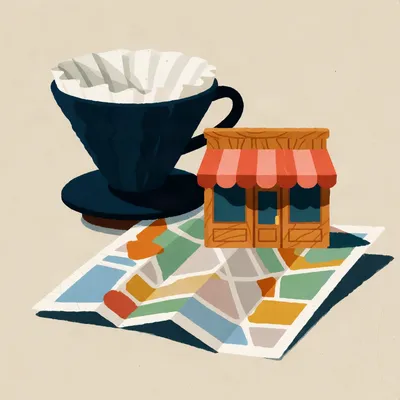
Thirty-seven million people, give or take, and the thing people say about it most often is that it feels small. That's the puzzle. Tokyo is the largest metropolitan area on earth, and it walks like a neighborhood.

And today we're walking through it. Not across it, through it.
The prompt this week came from Hannah, which was a nice change of pace for the inbox. She heard our Seoul walking tour, the one where we skipped the palaces and did the actual city, and she wants that turned into a series. Cities she's always wanted to visit and may not get to for a while. First stop: Tokyo. And she's honest about the problem — she says she understands Tokyo even less than Seoul, because she never absorbed it through years of TV. So no temples, no observation decks, no famous crossings. She wants the city a resident would show her, a full day of it, morning coffee to late-night alleys, with the urbanism woven in as we go.
That last part is the fun part for me. She doesn't want a lecture, she wants to know why the city feels the way it does while we're standing in it.
Which is a harder brief than it sounds. Most urbanism content is either a walking tour with no ideas in it, or an essay with no streets in it. She's asking us to do both at once, in real time, on foot.
Which means we actually have to build the day. And I want to say upfront that the order of the day matters. This isn't a random list of neighborhoods — it's a gradient. We start in a quiet maker district, move through an old residential survivor, hit the alternative belt in the afternoon, and end in the alleys at night. The city gets denser and later as we go, which is also how a resident would do it.
Nobody sensible starts their Tokyo day at ten p.m. in a six-seat bar. Although now that I've said that out loud, I want to try it.
File it under future episodes. Let's start the way a Tokyoite would, with coffee, in a neighborhood that makes things.
Kuramae. Walk me into it — what does the first minute look like?
Kuramae sits between Asakusa and the Sumida River, and it started life as an Edo-period rice-granary district. Rice came up the river, got stored here, got taxed here. Now it's one of the city's creative hubs — people keep comparing it to Brooklyn, which tells you more about the people making the comparison than about Kuramae, but the maker part is real.
A granary becoming a gallery district. The building stock never entirely forgets its first job.
That's exactly what you feel there. The ceilings are taller than the street width suggests, the ground floors are deep, and the shops inside them are workshops first. You walk in for coffee and you're standing next to someone binding a notebook.
And that's not a design choice someone made last decade. That's the grain of the buildings doing it. Warehouses want depth, workshops want depth, and a coffee bar fits into depth without ever having to knock a wall down.
Right — the neighborhood keeps getting reused for roughly the same reason every time. Storage, then light manufacturing, now making of the aesthetic kind. The verbs change, the floor plan doesn't.
The coffee first, since it's morning and I move slowly before ten anyway.
Coffee Wrights is the anchor for me. They roast their own beans and do pour-overs in a wood-lined room, and the roaster is not hidden in a back facility somewhere, it's part of the room. If you like lighter roasts, Lucent is the other name people mention. Pelican Cafe is the shokupan stop if you want the thick milk bread with your coffee.
Pelican's been baking since the nineteen forties, which is its own kind of continuity — the neighborhood changed around the bread.
And there's one I keep coming back to, Futo. You write a letter to your future self and they mail it months later.
Explain how that works in practice, because it sounds like a gimmick until you think about the timing.
You sit there with the coffee, you write, you hand it over, and they post it at some fixed interval — months out. So the letter arrives in, say, April, when the morning you wrote it has been thoroughly buried under ordinary life. It's a delayed letter from a version of you that had time.
Kissa Hangetsu is the kissaten option if you want the preserved-feeling version, wooden interior, retro fittings, the whole mid-century café thing.
The kissaten are worth a sentence of explanation for Hannah, actually, because they're not just old cafés. They're a specific post-war institution — jazz on the speakers, dark wood, coffee made with ceremony, no laptops, nobody hurrying you. Going to one in the morning is the closest you'll get to time travel in a city that demolishes everything else.
Futo is the one I'd use, though. Write the letter at the start of the day, receive it in April, and be reminded of a morning you've already half forgotten.
After coffee, the reason Kuramae works for Hannah's brief is the shopping, but not shopping-shopping. Tool Shop Nobori sells Japan-made knives, dishware, candles, vases — actual workshop output. Mizukiya Baba Shoten is a century-old handwoven-basket wholesaler. A century. It was supplying baskets when the granary past was more recent memory.
And that's a wholesaler that survived — not a heritage brand that got revived for tourists, but a business that kept having wholesale customers the whole time. Somebody in Tokyo has been needing handwoven baskets continuously for a hundred years.
Which is its own quiet fact about the economy of the place. Small manufacturing didn't die here the way it did in a lot of Western cities, so the suppliers to it didn't either.
And Kakimori for stationery and ink, where you can watch them mix a custom bottle.
You choose the color, they blend the dye in front of you, you watch your specific ink come into existence. It takes a few minutes. People line up for it.
That's the maker identity right there — the production is the retail. This isn't a tourist strip that got curated into existence, it's a working neighborhood where small manufacturing and retail still share walls. Then you walk twenty minutes east, or one cheap train hop, to Kiyosumi-Shirakawa, which is the gallery layer. Atelier Macri just took over its whole building at the end of September, added jewelry and a Rimless Tokyo flagship, that's a small business growing within a single narrow footprint instead of spreading horizontally.
Growing up instead of out. Which, if you squint, is the whole city's strategy.
It is, and Kuramae is the right place to see the first reason why. Zoning. American zoning, and most European zoning too, tells you what you're allowed to build in an area. Japanese zoning specifies what you're not allowed to build. It sounds like a lawyer's distinction and it isn't — it flips the default. Almost no zone outlaws every type of shop, so almost every zone is mixed-use. And residential zones cap store size, which protects small retail.
So the coffee roaster, the basket wholesaler, the ink shop and the gallery can all sit on the same block because nobody ever had to argue for it.
Nobody had to apply for a variance. Nobody had to convince a planning board that a knife shop belongs next to apartments. The system didn't permit it so much as fail to forbid it, which in zoning terms is the same thing, but with a fraction of the friction.
Give Hannah the concrete version, because the abstract version slides off. What does that difference look like on an actual street?
On an actual street it looks like this: a four-storey building where the ground floor is a bakery, the second floor is a dentist, the third is an apartment, the fourth is a small accounting office. In most of the United States that building is illegal. Not discouraged — illegal. You'd need the parcel rezoned, which means hearings, which means the neighbors get a veto, which means it usually doesn't happen. In Tokyo it's just a Tuesday.
In Jerusalem you can't open a paper shop in most residential zones without a fight that outlives the shop.
And the capped store size is the quiet part. It's not that big retail is banned everywhere, it's that in these neighborhoods the ceiling on footprint means the corner stays a corner rather than becoming a convenience-store chain with a parking rhythm. Small lots plus small allowed shops plus mixed-use by default — that's the soil Kuramae grows in.
Fine. It's noon in the fiction, and I'm hungry in reality.
Then the right place to be hungry in Tokyo is a shotengai. Take the train to Yanaka. Yanaka, with Nezu, Sendagi and Hongo, forms what people call Yanesen — and it's a rare survivor. Tokyo was flattened twice in the twentieth century, the nineteen twenty-three earthquake and then the bombing, and then post-war modernization flattened a lot of what was left. Yanaka kept its narrow alleyways and wooden houses. The pace is slower there, physically slower, because the streets are too narrow to hurry.
And that's not a mood, that's geometry. If two people with umbrellas can't pass each other without negotiating, nobody in the street is moving fast. The street enforces the tempo.
The width of the street is doing the work that a "slow zone" sign does nowhere.
Yanaka Ginza is the shopping street.
Local shops, traditional snack stalls, and the canonical lunch is menchi katsu at Niku no Sato — a fried minced-meat cutlet, eaten standing, cheap, no ceremony. There's a bronze Buddha at Tennōji a few minutes away, and the whole district is known for cats. Cat art, cat shops, and actual cats with tenure.
Cats with better job security than most of the shopkeepers.
They do seem unfireable. Now, here's the thing about the shotengai as urban form. It's dozens of independent shopfronts, each on a tiny lot, none of them able to dominate the street. And the reason that pattern exists at all is land ownership. After the war, Tokyo ended up with this profusion of small landowners — families holding single narrow plots — and that coexists, in permanent tension, with the big conglomerates. The conglomerates are the ones who combine real estate development with commuter railways and department stores. The railway company owns the station, the land around the station, and the train you arrived on.
So the shotengai is what the small-owner half of the city looks like at street level.
That's the clean way to put it. The train brought you to Yanaka, but the train company owns none of the lunch. The menchi katsu money stays on the street it was spent on.
And that's not a small thing economically, right? If the station landlord takes a cut of everything in walking distance, the shops are tenants of the railway. Here they're owners.
And owners behave differently. An owner renovates for the next thirty years; a tenant renovates for the length of the lease. You can see it in the shopfronts — they're idiosyncratic, because nobody standardized them.
I like that the tension is load-bearing. If either side won completely, you'd get either a city of strip malls owned by three companies, or a city with no trains.
A city of nothing but small holders couldn't have funded the rail network, and a city of nothing but conglomerates would have eaten the small fabric. Tokyo needs both and tolerates the friction.
Afternoon. Hannah asked specifically for places that are becoming cool without feeling taken over.
That's the Shimokitazawa and Kōenji belt. Shimokita first. It's a few minutes from Shibuya and Shinjuku by train, but the intensity drops a few degrees the moment you pull into the station. And here's the timing detail that matters: it doesn't really kick into gear until lunchtime. Which is why it's an afternoon stop and not a morning one — go at ten and you'll wonder what the fuss is.
A neighborhood with a late alarm. I respect it deeply.
It's vintage clothing mostly — Pug Tokyo, Selen, Flamingo, Little Trip to Heaven — plus record shops and secondhand bookstores. Honkichi is the one, a lot of titles under a thousand yen with a small English section. And it has a real music infrastructure, live houses like Basement Bar, Three, and Shelter, plus Shirubee for izakaya food and Bear Pond Espresso if you need to sit down.
Bear Pond, an izakaya, and three live houses in walking radius. That's a complete afternoon.
And the reason Shimokita has that texture is partly a fluke of infrastructure — the neighborhood sat under the flight path arguments and various redevelopment fights for decades, which kept the big projects out, which kept the rents reachable, which is exactly what a vintage-and-music scene needs. The scruff is structural.
So the coolness is downstream of the buildings not being worth demolishing yet.
For a while, yes. And then the coolness itself becomes the thing that makes them worth demolishing, which is the standard arc everywhere. Shimokita is mid-arc. That's what Hannah's picking up on — the window where it still feels earned.
Then a few stops further out, Kōenji, where the intensity drops again and the vintage gets cheaper. Grungier, more alternative — it's the hub for punk and independent music, and the secondhand scene is thriving. Hattifnatt is the café people mention, tiny and odd. Pal Shopping Street for the arcades, and Kuro Neko Marin, a thrift shop where some items go for a hundred and fifty yen.
At that price the shirt is a rumor.
And here's where I want to explain the buildings, because by Kōenji you've been walking past these all afternoon. Zakkyo buildings. Narrow multi-storey buildings with vertical neon signage, and the trick is vertical — one building can hold up to nine separate commercial premises stacked on top of each other, each one directly accessible from street level by lift.
Nine businesses in a footprint the size of our kitchen.
Roughly. And the effect at street level is that the street never goes mute. You know how a modernist shopping mall gives you a long closed-in wall with one entrance? The zakkyo building gives you a door every few meters, because every floor has its own lobby. Language schools, cafés, comic shops, karaoke — and a lot of them got that way by adaptive reuse, mid-rise office buildings whose tenants drifted away to newer towers, and instead of being demolished they filled up with small tenants.
The building gets a second career rather than a funeral.
And think about what that does to a commercial street's carrying capacity. A block of six zakkyo buildings isn't six businesses, it's potentially fifty. That's why streets like this can sustain a vinyl shop that sells to eleven people a day — the rent is a slice of a floor, not a storefront's worth.
So the weird little shop survives because it's renting a fraction of a building that already paid for itself as offices in nineteen seventy-eight.
That's a very compressed and accurate account of it, yes. And the last mechanism for the afternoon is the one that ties the whole city together — the two-Tokyo structure. Tall buildings line the main streets and cluster around stations. Behind the arterials, the streets get narrower, residences mix in with shops and restaurants, and the taller buildings on the main roads, in effect, protect the small fabric behind them.
Protect them from what?
From being redeveloped, and from the noise. The towers take the traffic and the big-format retail, and what's left behind is quiet to a degree that's honestly shocking the first time you step into it. One block off a major artery and you can hear a bicycle bell. The SPUR writer who did the big piece on this described eating yakitori at a seven-seat restaurant tucked underneath a train trestle — the viaducts aren't dead space either, they're lined with tiny bars and restaurants.
Seven seats.
It's not a novelty, it's a business model that only exists where the rent per square meter is survivable at that scale. For the mental map, the other names worth keeping: Kagurazaka, Kichijōji, Gakugei-Daigaku, Asagaya, Nishi-Ikebukuro. Each a different texture, each a candidate for a future episode if Hannah keeps the series going.
She will. She has a list.
She mentioned it.
The sun's going down in our day. Tokyo changes register.
Kuramae had an interesting detail there, by the way. One of the galleries we walked past, the glass show, was closed Mondays to Wednesdays. In Tokyo the week has a shape, not just the day.

Hilbert's Medieval Pottage Facts. Dried peas and beans needed hours of boiling over an open fire before they softened, and the fire had to be fed the whole time. You stood there. That was the evening.
Somehow the evening took even longer back then.
Dinner. Hannah asked for stylish but not obvious, and there's a perfect natural experiment running right now, because two restaurants opened within a month of each other this autumn. Chez Calvert is Daniel Calvert's first independent place after Sézanne, the three-star at the Four Seasons. John Pawson did the interior, minimalist, all clean lines and restrained materials. It is beautiful, and it opened in Azabudai Hills, which is itself a brand-new mega-development.
So it's stylish but it's not exactly undiscovered. It's inside the newest, shiniest thing in the city.
Which disqualifies it for this brief, not because it's bad but because Hannah asked for the opposite of that. The other one is Le Logis Beau, in Nishi-Ikebukuro. A renovated sixty-year-old kominka — an old house — down a back alley near the park. U-shaped counter around a live kitchen, courses from thirty-five hundred to sixty-six hundred yen, and they do big sharing plates they call deka-mori. The name itself translates to something like an atmospheric, comforting hometown alley hidden within the busy city.
That's the dinner. It's the same price as a mid-tier meal in any Western capital and it comes with a building that's older than most of the neighborhood's residents.
That's the choice the whole episode has been building toward, actually. Azabudai Hills versus a sixty-year-old house in an alley — that's the two Tokyos, side by side, both serving dinner.
And the night?
The night belongs to the yokochō, and I want to spend a minute on it because it's the most Tokyo-specific form there is. These alleys look a little like medieval Middle Eastern souks, and everyone assumes they're organic survivals, centuries of little shops accreting. They're not. They date to the early post-war era, when the national authorities deliberately set them up near train stations to regularize the vast armies of black-market workers — bars and restaurants on plots under fifty square meters.
Regularize is a polite word for it.
It was an orderly relocation strategy, dictated and built by the government. Then the proprietors took over, added upper storeys, personalized everything, and the alley grew its soul on top of a bureaucratic chassis.
The romance arrived second, on the installment plan.
And the footprints stay tiny. In the nightlife districts a single restaurant can be two and a half by six meters. You can touch both walls.
I've had naps in less space, but barely.
The vertical version is the zakkyo building at night. Same stacking logic from the afternoon, but now filled with bars. Head up a nondescript elevator in a nondescript building and you can find eight floors of candlelit bars — that's not an exaggeration, that's the SPUR writer's own observation.
And the etiquette question Hannah will want answered, because it's the thing everyone worries about — are these places for outsiders?
The honest answer is that the tiny bars are for regulars the way a person's living room is for regulars, but the living room has a sign outside and the door is unlocked. You're not forbidden, you're just aware you're a guest. The ones that want walk-ins say so, and the ones that don't make it gently obvious.
For music you go back to Shimokita's live houses, or Kōenji if it's a punk night.
Basement Bar, Three, Shelter in Shimokita, and Kōenji's whole independent scene. Yakitori under the tracks for the end of the night, and the day closes the way it opened — small, cheap, standing up.
Zoom out before we finish the walk, because Hannah asked what Tokyo does especially well, and the numbers are the answer. Housing.
Tokyo built about a hundred and fifty-five thousand new homes a year between nineteen ninety-five and twenty fifteen. The Bay Area, comparable desirability, comparable demand pressure, built twenty-one thousand. Net housing stock in Tokyo nearly tripled from two and a half million units to seven and a third over fifty years, and the city averages about two hundred and twenty dwellings per acre of residential land.
And the price result is the famous one — Tokyo is one of the few major cities on earth where housing hasn't swallowed entire generations' income.
Because supply actually responds. Now the honest caveat, because it matters: this wasn't a plan. The mixed-use, low-rise, high-density fabric happened by default, not by design. Tokyo's own planners don't consider this default model ideal — they just don't consider it illegitimate either, so they let it run. Utilities were extended everywhere, no neighborhood left behind no matter how slummy it looked. That last decision is the underrated one.
Say more about that, because it sounds like a plumbing detail and it's not.
It's the difference between a city and a set of islands. In a lot of places, the informal or poor districts never got connected — water, sewer, power — which means they stay legally fragile forever, which means no one invests, which means they stay slums. Tokyo decided the pipes go everywhere regardless. Once a neighborhood has utilities, small construction on tiny lots becomes possible forever, and the neighborhood can climb on its own without anyone's permission.
The infrastructure is the permission.
And the piece that sits strangest with me, the thing I'd want Hannah to chew on. Tokyo is a city of erasure. No strong attachment to its built heritage — buildings come down routinely, houses depreciate like machines rather than appreciating like relics — and yet it generates a walkable, traditional urban form that European preservationists spend their careers trying to freeze.
Every Western city that's beautiful because it was protected is now unaffordable because it can't grow. Tokyo protects almost nothing and grows constantly, and what emerges looks more traditional than the protected stuff. The walkability is an output, not a conservation achievement.
Which is almost a paradox — the city that cares least about preserving the look is the one that keeps producing it.
Oh — one small correction to something I said earlier, because I want Hannah to have it right. The Almazán framing of the yokochō relocation is the standard account, but the plain fact of the layout is that the alleys were drawn by a government office before a single stall went up. The romance everyone describes came strictly after.
You've corrected yourself three times this episode, which for you is restraint.
I contain multitudes.
The map was drawn before the stalls, Herman. There's a bar under the JR tracks, six stools, not one of the famous alleys, and the owner kept a laminated map of the original nineteen fifties black-market layout taped inside the cupboard under the register. I spent an evening with that map once. The alley looks improvised and the layout is on a grid, pencil-drawn, with plot numbers. Somebody in an office decided where the noodles would go.
Laminated. That's the detail.
I have a photograph of it on my phone. I've been showing it to people for years. I asked the owner once if I could photocopy it and he said no, and I respect that decision more than almost any other decision I've encountered. The man's name is Iwasaki. He can close the whole bar in four minutes. I have never seen a room cleared that fast.
Four minutes.
Stools up, shutter down. He did it the night the drain backed up. Iwasaki was a station porter before the bar, and he could still carry a trunk at seventy that I wouldn't attempt at my best. That's all I wanted to say. The alley was a work order. The part everyone falls in love with is what got built on top of it afterwards, one stall at a time.
The one thing worth keeping from Iwasaki's cupboard is that the map survived at all. Bureaucratic paper has a longer halflife in a bar than in an archive.
People ask for the map, apparently. He says no, and the map stays where it is, which is arguably why it's still there.
One last thing for the cutting-room floor, and it's this month's news. Shibuya Panorama just opened on the twenty-fifth floor of the Shibuya Excel Hotel, a hundred meters above the crossing we refused to visit. There's a bistro, and an eight-seat sushi counter, and at nine each night they do something called Crossing Time, where bistro guests can cross-order from the sushi counter.
A hundred meters directly above the thing everyone photographs from street level, there's a seating arrangement engineered around the idea of ordering between rooms. Only in the new Tokyo.
Two thoughts before we put the day to bed. First, the open one. If Tokyo's fabric is emergent rather than designed — the outcome of a zoning default, tiny postwar land holdings, railway conglomerates, and a government willing to extend utilities into anything — can any other city actually learn from it, or is it too specific to export? I honestly don't know. Every time a Western city tries to copy a piece of it, they copy the aesthetic and leave the mechanism behind.
And second, the live argument the day surfaced. The old Tokyo and the new Tokyo opened their restaurants within a month of each other — the kominka in the back alley and the John Pawson room in the mega-development — and both of them will still be there in ten years. Which one the city becomes is being decided by where people actually spend their evenings.
The series continues, by the way. The format is set now — a full day, no landmarks, the machinery explained while you walk. Where it goes next is between Hannah and the inbox, and she has opinions.
She does.
Thank you, as always, to our producer, Hilbert Flumingtop, at the desk through all of it. If you enjoyed this one, the review button on Spotify takes four seconds and it helps people find the show. For more along these lines, there's episode sixty-six ninety-six, Two Building Laws That Shaped Seoul's Streets; episode twenty, Architectural AI; and episode fourteen oh eight, Israel Wartime Readiness Field Guide. This has been My Weird Prompts — no question too obscure, no rabbit hole too deep.
See you tomorrow.