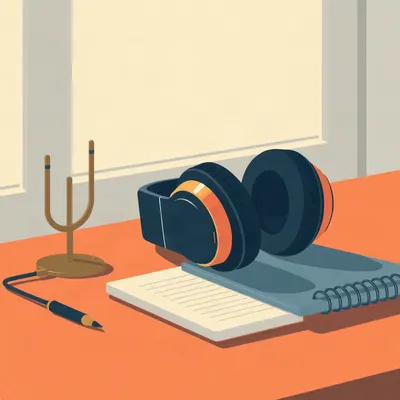
Why does a drill three floors down make a patient man snap at his own toddler two hours after the drill has stopped?

That last part is the strange bit. Two hours after.
It's Daniel's question, more or less. He was trying to set up a new repository for a work project, the drilling started, and his brain kept getting dragged after it until he gave up and put on a pair of shooting range earmuffs. And he's noticed a pattern that's bigger than one afternoon. When the sensory stuff breaks his focus, he gets irritable, angry, snappy, and he's clear that it isn't his natural personality. When he gets a good run of flow, he's in a good mood all day. He wants to know why it swings like that.
And he's right that it's common. It's also more specific than "noise is annoying." The annoyance is the least interesting part of what's going on.
I'd have said the annoyance was the whole thing. Drill goes, man gets cross.
That's what everybody assumes, and the best experiment on this says otherwise. David Glass and Jerome Singer, early nineteen seventies. They sat people down with recorded noise, office clatter, machinery, people talking over each other, played loud and at random intervals. And during the noise, performance barely dropped. People adapted within minutes.
Hm. So the drill isn't the problem while it's drilling.
Not on the task in front of you, no. The damage showed up afterwards. Once the noise stopped, they gave people puzzles, and some of the puzzles were secretly unsolvable. The people who'd sat through the random, uncontrollable noise gave up on those much sooner. Lower frustration tolerance. Their proofreading got sloppier too. The noise had gone quiet and the bill arrived anyway.
That's the toddler at four in the afternoon.
That's the toddler at four in the afternoon. And it's the part people never connect, because by four the drill is a memory and you just think you're in a mood.
What made the difference? Loudness?
Predictability and control. Predictable noise did less damage than random noise at the same volume. And the control result is the one I love. Some subjects were shown a switch and told they could press it to stop the noise if they really needed to. Those people had much smaller aftereffects.
Because they pressed it.
That's the thing, they mostly didn't. Nobody pressed it. Having the switch was enough.
A placebo off button. I'd buy one of those for the whole building.
Would you, though? Think about what it tells you. The harm isn't the decibels. It's the brain registering that something is happening to it that it can't stop and can't predict. That's an alarm state, and an alarm state is expensive to run in the background.
Okay, but that still doesn't tell me why it comes out as anger. If the cost is just "I'm worn down," I'd expect him to feel flat. Tired. A bit sad. Why snappy?
Because of what he was doing when it hit. Here's a question for you, Corn. When you're halfway through something and it gets taken off you, what do you feel?
Depends what it is. Halfway through a nap, homicidal.
That's the right answer, and there's a reason it's that and not sorrow. Charles Carver and Eddie Harmon Jones made the case that anger is an approach emotion. It shows up when you're moving toward a goal, the goal is still live, and something is blocking the path. Anger is the push to get past the obstacle. Sadness is what you get when the goal is gone and there's nothing to push against.
So the sadness version would be the repository being deleted.
That's loss. The anger version is the repository still sitting there, half built, and you can't get at it because there's a drill in your skull. The goal is alive, you want it, and the world keeps shoving you off it. Every burst of drilling is another shove.
And the drill is an obstacle you can't push. You can't go downstairs and argue with a drill.
You could, but it wins. That's the trap. Anger is built to mobilise you against the obstacle, and the obstacle is out of reach, so all that readiness has nowhere to go. It sits there looking for a target.
And then a sixteen month old screams.
And then a sixteen month old screams, and he's the first thing in range that makes noise.
Which is an awful thing to realise about yourself.
It's an ordinary thing. I'd say this as someone who spent a long time in a pediatric clinic watching very tired parents: the irritability isn't a verdict on the parent. Most of them adored their kids and still snapped. The setup is what does it.
Daniel's point that it's not his personality, though. I believe him. He doesn't sound like a snappy man. So what's different about him from the guy at the next desk who hears the same drill and shrugs?
The guy at the next desk has a better brake. Russell Barkley has argued for years that emotional regulation is a core part of ADHD, even though it isn't in the diagnostic criteria. And the way he splits it is useful. There's emotional impulsivity, the feeling arriving fast and strong. And there's the self regulation afterwards, calming down, refocusing, putting it back in the box.
So the feeling is normal and the brakes are soft.
The feeling is normal. Anybody gets a flash of irritation when they're shoved off a task. What ADHD weakens is the gap between the flash and the words coming out, and how fast you come back down. The estimates for how many adults with ADHD have real trouble here run from about a third up to about two thirds, depending how you measure it.
That's a wide range.
It's a wide range because nobody agrees how to measure it, but even the low end is a lot of people. And it lines up with what Daniel says. It's not that he's an angry man. It's that a normal flash of anger gets through and then hangs around longer than it should.
Hangs around is the bit that interests me. He says when he loses his flow, the bad mood lasts. When he gets it, the good mood lasts all day. It's not just the moment, it's the weather for the rest of the day.
Are you tired of having just one irritability? Introducing Snap Crate, the monthly subscription box of curated, artisanal frustrations, delivered straight to your door at seven in the morning, by hand, with a drill. Our Starter tier brings you one mystery interruption a week. Our Professional tier adds a recorded toddler and a neighbour who only ever says your name. Our Platinum tier, for the true connoisseur, includes a guaranteed blocked goal, hand selected by our curators to be still live but completely unreachable. To cancel, simply visit our office in person during a jackhammer, between the hours of never and never, and recite your account number backwards to a man who isn't there. Snap Crate. Because you deserve to be furious on a schedule.
...and the residue is a real thing, Sophie Leroy named it. Attention residue. When you get pulled off a task before it's finished, part of your attention stays behind on it. You're doing the next thing, but some of you is still back at the half built repository, gnawing on it.
Like a dog that's been called inside before it finished with the bone.
That's not bad, actually. And her finding was that residue is worst when the first task is unfinished. Closure lowers it. So the drill doesn't just cost him the minutes it's running. It leaves an open loop that keeps humming for the rest of the afternoon.
There's that famous number about how long it takes to get back after an interruption. Twenty three minutes, isn't it?
I'd be careful with that one. It comes from Gloria Mark's fieldwork in offices, and what it measured was how long people took on average to come back to an interrupted task, usually after doing a couple of other things in between. Call it twenty plus minutes. It's not twenty three minutes to refocus, and the exact seconds people quote are false precision.
You love it when a famous number turns out to be a different number.
I do, and I'm not going to apologise for it. The more useful Mark result is a lab study from two thousand eight. She interrupted people while they did email work, and the interrupted people actually finished faster, with no drop in quality.
That's suspicious.
It is, until you see the rest. They reported more stress, more frustration, more time pressure, more effort. They compensated by working harder and paid for it in how they felt.
So the output looks fine and the person doesn't.
Which is the worst possible combination for someone like Daniel, because the work gets done and nobody, including him, sees the cost. Then it shows up at dinner.
Here's what I want to know. Is the good side of this the same machine running in reverse? If being knocked off course leaves anger behind, does a long stretch of flow leave a good mood behind?
I think so, but I'm less sure of the good side than the bad side. The flow research says people who get into flow often are happier in general. The idea that the happiness comes afterwards, a glow you carry out of a good session, gets repeated a lot, and the evidence is mixed. Some studies find flow and positive mood go together in the moment, and some of the day level data is muddier than people claim.
You're hedging.
I'm hedging because I'd rather be honest about it. Here's what I'd say instead. Take the anger mechanism seriously and flip it. A good flow day is a day where the goal you were pushing toward kept giving way. Nothing blocked you. There's no open loop humming, no leftover readiness looking for a target. The brake never got tested because nothing pushed on it.
So the good mood might not be flow adding something. It might just be the absence of the residue.
That's my guess, yes. And Daniel's own life backs it up. We did an episode a while ago about him finding calm in engraving tools after a month with no flow time, and the thing that struck me then was that he'd framed the grumpiness as a mystery, and once he had a long uninterrupted task, it lifted. Same shape.
Do you buy that, Corn? Or does it sound too tidy?
Mostly. I'd add one thing. The good day is also a day where he's the person he thinks he is. He gets to be patient with Ezra, nice to Hannah. That loops. You're nice, the house is nice back.
And the opposite loops too. You snap, somebody's hurt, you feel guilty, the guilt is another open loop. The part I think matters most is Ezra, though. Does it actually reach the kid?
You're the pediatrician. You tell me.
It does, and the research is pretty clear on the direction. There's work on mothers showing that ADHD symptoms predict harsher responses to a child's negative emotions, and that the link runs through emotion regulation. The ADHD itself isn't the harshness. The weak brake is. And there's an Israeli study, Gershy and Gray, looking at families of kids with ADHD, which found that a parent's emotion regulation predicted coercive parenting, in fathers as much as mothers.
That's bleak.
The useful half is the buffer they found. Parents who were good at thinking about what was going on inside the child's head, why the kid was screaming, what he needed, were less hostile even when their regulation was weak. Thinking about the child's experience took some of the heat out.
That's hard to do while the drill is running.
Almost impossible while the drill is running. Which is why I'd argue the levers are mostly before and after the moment, not during it.
Go on, then. If I'm Daniel and the drill starts, what do I actually do?
Start with Glass and Singer, because that's the strongest finding we've got. Control matters even when you don't use it. So the earmuffs he grabbed aren't only protection, they're a switch on the wall. If they're on the desk, within reach, the situation stops being something being done to him. I'd go as far as saying he should keep protection somewhere he can see it in every room he works in, whether he puts it on or not.
The placebo off button, but real.
The real off button you mostly don't press. What would you put on your note, Corn, if it were you?
Probably just the next verb. Configure. Rename. Nap.
Second, deal with the open loop. Leroy's fix is almost embarrassingly simple. When you're interrupted, take ten seconds and write a note: where I was, what the next step is. It gives the brain a kind of closure. The task is parked, not abandoned.
A sticky note that says "I was about to configure the thing."
That's enough, honestly. Third, name it. Matthew Lieberman's lab did brain scans on what happens when you put a feeling into words, and labelling the emotion turned down the amygdala response. That was in a lab, so how big the effect is at home I can't promise, but the practical version is worth trying. "I'm not angry at you. My focus just got broken and I'm flooded."
Said to Hannah, that's useful. Said to Ezra, he's sixteen months old.
Said to Ezra it's mostly for Daniel. Hearing yourself say it puts the anger where it belongs, on the drill, not on the kid. And it's a gift to Hannah, because she knows it isn't about her.
And the fourth thing is the four o'clock problem.
The fourth thing is the four o'clock problem. If the cost comes after the noise stops, build a buffer after it stops. Ten minutes outside, a glass of water, lying on a cool floor, whatever works. Don't go straight from a drilling afternoon into bath time and expect the brake to hold.
Does it have to be a real switch, though? In the experiment. Could it just be a picture of a switch?

...it has to be on the wall where you can see it, and it has to look like it's wired to something. That's what I need to know. If a person thinks it's wired to something, does it work?
In the experiment it was real, as far as the subjects were told. But the point was that they believed they could stop the noise.
Good. Because there's a man upstairs, Mr. Brenzlauer, who's rebuilding a church organ in his flat. Pipe by pipe. He gets one pipe a week from a church in Haifa that's selling them off, and he tunes each one at ten past seven in the morning, before he goes to work at the bakery. Every morning this month. Three hundred and eleven pipes. Three hundred and four, actually. I don't count the ones he's tuned twice, because those aren't new information.
That's a lot of pipes for a flat.
They're in the bathroom, mostly. The big ones go through the ceiling into his wife's sewing room, which she isn't happy about. The point is, the woman across the landing from me, Mrs. Ochana, she's been banging on my door about it, because she thinks I'm doing it. My flat is directly under his and she can't work out the acoustics. She's convinced it's me. She's been doing it for three weeks.
That's actually the Glass and Singer situation, Hilbert. She can't predict it and she can't stop it. It's the worst version.
She can predict it. Ten past seven. Every day. You said predictable was better, Herman. It's not making her any better.
Fair. Predictable but not controllable, then.
So. If I put a button in the stairwell, by her door, nice brass one, with a little label that says organ, and she thinks pressing it sends a message upstairs, would that do it? I've got the button. I've got the label. I've got a length of wire that would go up the stairwell and stop just past the turn where she can't see.
And you're not going to tell us why you want her calm.
No.
The trouble is, she will press it. In the experiment most people didn't, but she's the type who would. And when the organ keeps going, the button becomes a liar.
Most people didn't press it. You said nobody, earlier, Herman. It was most. Some did. It doesn't change your point much, but if she's one of the some, I'm in trouble.
That's fair, I did say nobody. Most of them didn't press it.
The button's the easy part. The wire's the problem. I lent my long wire to Mr. Brenzlauer in the first week, because he needed something to hang the tuning fork on so it would stay in the bathroom while he fetched the next pipe. It's up there now, round the third pipe from the window, with the fork on the end. He says he'll give it back when the organ's finished.
And when's the organ finished?
Two hundred and forty one more pipes. One a week. He's sixty eight. He told me in the stairwell yesterday that he doesn't intend to rush it. I used to wire lifts for the municipality, so I could make another one, but I'm not paying for copper twice for that woman.
Which, if you think about it, is the same lesson Daniel needs. The control doesn't have to be total. It has to be in reach. Mrs. Ochana doesn't need the organ to stop, she needs to feel she's not just a target.
And you need the wire back.
Four years and eight months at one a week. I worked it out on the back of the electricity bill.
That number's going to stay with me. Four years of tuning, and the whole fight is about whether somebody feels they can do anything about it.
That's the part I'd hand to Daniel. Most of what we've said today isn't about making the drilling stop. He mostly can't. It's about not letting it become something that's simply being done to him.
Earmuffs on the desk, a note for the open loop, say it out loud, and a buffer before bath time.
And when it goes wrong anyway, because it will sometimes, repair. Go back to Hannah, go back to Ezra, say what happened. Kids are remarkably forgiving of a parent who comes back. The snap does less harm than the never coming back.
I'll leave it with one open question, because I don't think we answered it. If the good days are mostly the absence of residue, then Daniel's best tool might not be chasing flow at all. It might be protecting the days where nothing gets broken, and treating those as the thing to engineer, rather than the thing that happens to him. Whether you can engineer an unbroken day in a city that drills, I genuinely don't know.
Thanks as always to our producer, Hilbert Flumingtop, for keeping the show running.
This has been My Weird Prompts. If you're enjoying it, find us on Spotify and follow the show there.
We'll be back soon.