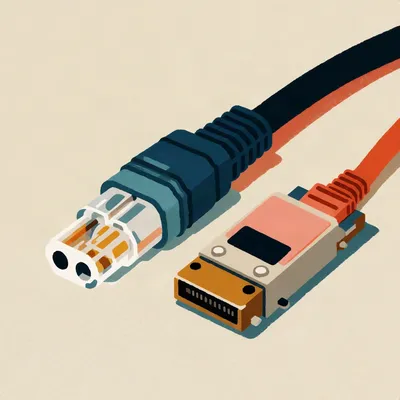
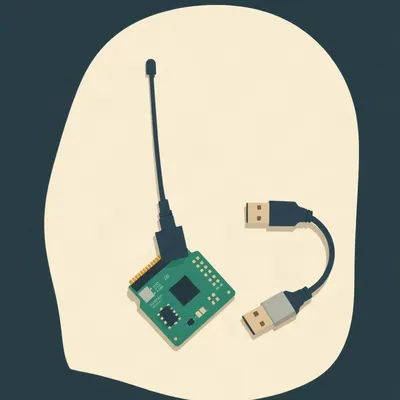
Daniel's fiber saga has a new chapter. The run between the two adjoining rooms still won't link, he's been pulling the cable, re-seating the connector in the transceiver, the transceiver in the SFP port, the whole diagnostic dance. Somewhere in the middle of it he noticed the sticker on the gear. Risk of eye damage, do not look into fiber. And he got to wondering, quite reasonably, whether he'd been gambling with his retinas the whole afternoon.

Knowing Daniel, he was holding the cable about four inches from his face while wondering that.
That's the exact ambiguity he's asking us to resolve. Can looking at the cable itself hurt you? Can checking the seating hurt you? Where is the line? He wants it concrete, and he explicitly doesn't want alarmism. His framing, which he's used before, is that understanding the risk precisely is what lets you use the thing responsibly without being needlessly worried.
Then the honest place to start is the sticker itself, because the sticker is where the confusion begins. Pull any piece of fiber gear out of a box and you'll find two statements sitting side by side that sound like they contradict each other. Class one laser product. And then, in the warning section: invisible laser radiation, do not stare into the beam or view directly with optical instruments.
So the box says it's safe and also says it can blind you.
Both are true, and that's exactly why the label is useless to a homeowner. Class one doesn't mean there's no laser. It means the system is eye-safe under normal operation. Nokia's documentation puts it as plainly as any vendor ever has: in its normal operating mode, an optical fiber telecommunication system is totally enclosed and presents no risk of eye injury. The plastic sheath around the glass is, legally speaking, the protective housing.
The insulation Daniel was worried about looking at is the safety feature.
It is. SENKO, one of the big connector manufacturers, has an application note that frames it the same way: the end-to-end system is Class one because the emissions are completely enclosed. It is not until the fiber is broken or a connector is unplugged that a person may be exposed. That's the whole key. The warning label isn't describing the product you bought. It's describing the one moment where the product stops being the product you bought.
And the Fiber Optic Association, the training body, is even blunter about the mental image people carry. Everyone pictures a laser burning holes in metal.
They do, and the FOA says that image has little relevance to fiber communications. Eye safety is an issue, but usually not from light in the fiber. Which is a strange thing for the industry's own safety page to say, and it's where the interesting part starts. The risk is real, but it's narrow and specific, and the edges of it are non-obvious.
So let's find the edges. Start with why a comms laser is a different animal from the laser pointer Ezra is definitely not allowed to have.
Beam geometry. A laser pointer is collimated. The beam leaves the diode, goes through a lens, and comes out as a parallel pencil that stays roughly the same width over the whole distance of a room. The irradiance, the power per area hitting your eye, barely drops with distance. The lasers used in lightwave systems are the opposite. They have a large beam divergence, typically ten to twenty degrees. The moment the light exits the fiber end it spreads out like a flashlight, and irradiance obeys the inverse square law. Double the distance, quarter the intensity. Six inches away you're getting crumbs.
So the fiber optic cable by itself, from across the room, is the flashlight, not the pointer.
Right. The FOA actually makes the comparison directly: a typical laser pointer at visible wavelength is probably more danger to the retina than a fiber optic link. The thing Daniel already lets his kid wave around is worse than the thing with the scary sticker. That tells you something about the stickers.
It tells me the stickers were written by lawyers who never had to rank hazards.
Careful, my profession writes warning labels fondly. But Nokia does give one concrete number the generic label never does: inadvertently viewing an unterminated or damaged fiber with the unaided eye at distances greater than five to six inches normally will not cause eye injury, provided the power in the fiber is under a few milliwatts at near-infrared wavelengths. Five to six inches, unaided eye, low power. That's an actual line you can stand behind.
All of it. We'll come back to it, because it's the trap. First there's a stranger problem, which is wavelength. This is the part nobody tells homeowners. Telecom fiber transmits in roughly the eight hundred to sixteen hundred nanometer range. All of it invisible. Your eye's blink reflex is triggered only by visible light, so with infrared there is no flinch. Nothing tells you you're being exposed.
The eye doesn't even know it's being attacked.
It gets worse. SENKO's note says a pop or click noise emanating from the eyeball may be the only indication that retinal damage has occurred. That's the sound of retinal tissue heating. You'd find out from a sound effect inside your own head.
Cheerful industry.
Here's where it splits, and this surprised me when I first read it. The retinal hazard band is four hundred to fourteen hundred nanometers. That's the window where light passes through the cornea and lens and reaches the retina, which is the tissue you really can't repair. Above fourteen hundred nanometers, the energy gets absorbed by the cornea and the aqueous humor before it ever reaches the retina. You'd get corneal or skin effects, not retinal damage, and the injury thresholds up there are much higher.
And home fiber sits on both sides of that line.
On a residential GPON setup, it sits exactly on it. Your ONT, the box on the wall, transmits upstream at thirteen ten nanometers. That's inside the retinal-hazard window. The ISP's downstream signal comes to you at fourteen ninety, which is absorbed before the retina. So the same patch cord is two different injuries depending on which end you're looking at. Not just two severities. Two mechanisms.
Which end of the link was Daniel peering at?
Well, the one in his hand. And at home-transmit powers, the thirteen ten hazard is mostly theoretical anyway, which we'll put numbers on. But the wavelength point matters for how you read any warning. When Cisco says invisible laser radiation may be emitted from disconnected fibers, they're not describing a beam of death. They're describing a few milliwatts you can't see and can't flinch away from, from a source that spreads out fast.
Now the dark fiber question, because this is the one Daniel is really asking. The cable he's holding. If it's not connected to anything, is it dangerous?
The glass is inert. A fiber that's disconnected at both ends, or fed by an unpowered transceiver, emits nothing. There is no radiation stored in the cable. Looking at it is looking at glass. The hazard isn't the cable. The hazard is the possibility of an unseen live source at the far end. And the brutal part is that you cannot tell by looking, because the light is infrared. A fiber carrying a live signal looks exactly like a dead one.
So it looks dark whether it's dark or not.
Perfectly dark either way. The FOA's rule is that you never look into the end of a fiber until you're positive there's no light source at the other end, and you confirm it with a fiber optic power meter. Not your eye. The instrument. In Daniel's case, the far end was a transceiver sitting on his desk that he could see was unplugged, so his exposure was probably zero. But the rule exists because in any real network you don't always know what's on the other end of that strand.
His original problem was that the link wouldn't come up, so at least the failure was informative for once.
Ha. Although that's the other trap, isn't it. The link won't come up, so the natural next move is to bring the connector up close and examine the endface. Is it seated, is it clean, is it scratched. And that's where the five to six inch safety margin goes to die.
The unaided word.
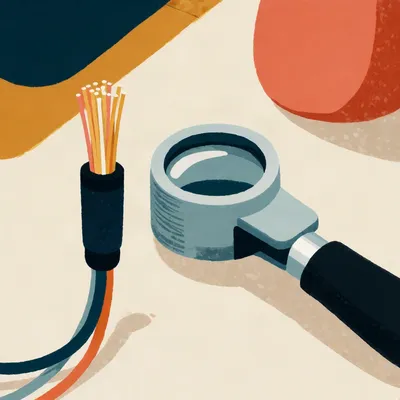
The loupe. Every fiber tech carries a little magnifier for inspecting connector endfaces, and the moment you put any optical instrument, a microscope, a magnifying glass, an eye loupe, between your eye and an energized fiber end, you've defeated the geometry that made it safe. Nokia's number is that the focused eye can concentrate intensity on the retina up to a hundred thousand times the level at the cornea. SENKO puts it at two hundred thousand. The units almost don't matter. The point is the difference between a crumb and a meal.
So the one tool specifically designed for looking at fibers is the one thing you must not point at a live fiber.
With an unfiltered instrument, yes. There's a whole classification for this. When you see Class one M or Class two M on a port or a test gadget, the M is the magnification warning. It means an unfiltered magnifying device must not be used. The German occupational safety guidance goes further and says at those levels you use filtered instruments or indirect viewing, a camera and a screen, instead of your eye. Nobody's eyeball gets to attend.
The safe way to inspect a connector is to make a picture of it and look at the picture.
That's how the careful shops do it. Or you confirm the fiber is dead with a power meter first, and then a loupe is just a loupe. The rule isn't never look. The rule is never look through glass at glass that might be lit.
Herman, honest question. When you were practicing, if a parent came in having stared at something like this, what would you actually have been worried about?
Honestly? At home fiber powers, almost nothing, and I'd have told them that. We'd have examined the retina to be thorough, but the realistic exposure from a patch cord is a fraction of what the injury literature involves. The cases in the literature are industrial and medical lasers. There's a case report of an engineer repairing an industrial YAG laser, retinal injury. There's the surgical illumination literature, fiber optics placed inside the eye during ophthalmic surgery. High power, deliberate, close range. I have not seen a single published case of a telecom technician taking a retinal injury at thirteen ten or fifteen fifty nanometers from a patch cord.
The industry that handles this stuff daily, at scale, for decades, has no case reports.
That absence is the strongest anti-alarmist fact in this whole episode. Millions of connectors unplugged every year by people leaning over them, and the injury literature is silent. The hazard is engineered down to nearly nothing and the numbers confirm it. Let me put the home numbers on it. A typical home ONT, say Nokia's G-010G-T, launches at plus one to plus five decibels referenced to a milliwatt. That's roughly one point three to three point two milliwatts. FiberHome and Iskratel boxes list similar figures.
And the hazard threshold?
The IEC fiber standard puts the Class one limit for single-mode fiber at thirteen ten nanometers at around a hundred and sixty-six milliwatts. Your home box is pushing three. Two orders of magnitude of headroom, on the wavelength that's the risky one. The sticker is telling a homeowner not to stare at something that's a hundred times weaker than the level the standard already calls safe.
It's like the seatbelt light coming on in a car that's parked.
The car is parked and the seatbelt light has been lit since the factory. Now, none of this means DIY fiber work is risk-free. It means the light is not the risk. Ask the FOA what actually sends fiber people to the hospital and they don't say laser. They say shards. When you cleave and terminate fiber, you're constantly producing little scraps of bare glass, thinner than a hair, with ends sharp enough that they penetrate skin and break off. If one gets in your eye, it's very hard to flush out and will probably mean a trip to the emergency room. They fall on the floor, they stick in carpet, they travel on socks. The actual mitigation is safety glasses and a piece of tape for the scraps.
The thing nobody puts a warning label on is the thing that gets you.
Because the label is about liability for the laser, and nobody's liable for your carpet. To be fair, the engineers did think about exposure. The gear has controls built in. Optical ports have shutters. There's automatic power reduction, where the transceiver dials down when it detects an open link, and automatic power shutdown, where it cuts the laser entirely. The laser modules sit recessed inside the ports, which physically limits how close anything gets. And there are shuttered adapters and connectors, E-2000 and the shuttered SC types, designed exactly for the reality that dust caps go missing the moment a connector's been installed once and the patch cable gets moved.

Hilbert's Mid-Show Haiku. Untitled. Snow on the router. The little light stays unlit. I check the cable again.
Every winter in that flat, I fear.
The other thing worth saying is that test gear is its own category. The rules tighten the moment you're not just plugging in. Most infrared test sources and those visible light fault locator pens are Class one. But some of the higher-power fault locators are Class two M, which brings back the magnification warning. And Nokia is blunt about the serious instruments: under no circumstances scan a fiber with a test set without verifying every laser source on the fiber is turned off. OTDRs and loss test sets are for trained personnel. Those actually pulse real power.
The OTDR is the interesting one, because it works by firing a laser down the fiber and reading the reflections. If you're holding the far end of a fiber someone is testing, you're holding the business end. And up at the ISP level, Raman amplifiers and EDFA optical amplifiers in long-haul plant reach Class four. That's the laser that burns. None of it is in a home.
Which is the pattern, isn't it. The farther from the street cabinet, the more dangerous the light. Your GPON box is a candle. The undersea cable is a kiln.
There's one more layer that tells you how to read all these labels, which is that the labels themselves can't agree. Cisco's safety docs cite the FDA's Laser Notice fifty-six, from twenty nineteen, with the current edition of the IEC laser standard. Juniper's docs for the same class of transceivers still cite Laser Notice fifty, from two thousand and one. Same product category, different vintage of compliance language. The current fiber-specific standard, the one that governs the hazard levels we've been quoting, is the twenty twenty-one edition of IEC 60825-2, and it requires each optical port's hazard level to be individually assessed.
So when the box says Class one, it's citing a standard that has been revised since, under a notice that may be twenty years old, for a port that technically needs its own assessment.
It means Class one is a floor, not a sermon. Fine for the buyer, but it's part of why the sticker reads so strangely. It's compliance language layered across decades, not advice written for a person.
Then let's land the practical rules as conclusions rather than a lecture, because they all fall out of the physics. Unaided eye past five or six inches is fine at home powers. Never add a loupe or magnifier to an end that might be live. Confirm dark with a power meter, not your eyes, because dead and live look identical. Keep ports capped or shuttered. Wear safety glasses, not for the light, for the glass. And treat test gear with more respect than patch cords. That's the whole discipline. Narrow, specific, followable.
And notice none of it is don't touch the cable. Daniel can handle his patch cord all afternoon. The cable is the safest part of his link.
It's not a dust cap.
Sorry?
Dust cap. You both keep saying it. It's a protective cap. Dust is one thing it keeps out. The industry called them dust caps and that's why they end up in a drawer, because nobody respects a thing named after dust. I sold industrial connectors for six years, Herman, ending in two thousand and eight. Nobody once called the cap anything but the cap. The dust was the least of it. I had a supplier, Marash over on the industrial side of Talpiot, late two thousands, and he was the one who told me a scratched endface is a link that doesn't work and you can't tell why. That's Daniel's whole problem, and it isn't the laser's fault.
You think it's the endface.
I think a cap went missing and nobody recorded which one. I keep mine in a pill organizer, one compartment per connector type, and I can tell where a cap came from by the wear on the rim. The rim tells you everything. Marash thought that was funny. He stopped laughing when I brought back the LC caps sorted. The ones I've retired, the ones that have done their service, go in a jar, because one of them will be the exact fit for something I haven't bought yet. You don't throw out a cap that fits.
How many compartments in the organizer?
Seven, and the seventh is a spare, which is the correct number because it's the claw that keeps it shut. A latch made for fingers doesn't hold with a claw. I had to put a rubber band on it in two thousand and nine and the band is still there.
The band from two thousand and nine.
Good band. Marash's caps were the good ones too. The rim went a certain way, yellowish, and you could match it by eye at a counter. Nobody matches anything by eye anymore. It's all dust, all the way down.
The wear-pattern thing is more real than it sounds, by the way. Endface damage from a missing cap is exactly the kind of fault that produces a link that fails at high loss with no visible cause. You'd want an inspection scope, camera-mediated of course, to see the scratch.
He's had the diagnosis since Talpiot and we spent an hour on the laser. Anyway. The misconception, before we go. The one I'd name is that a fiber cable is basically a laser pointer that will burn your retina from across the room.
And the correction is that a comms laser is the opposite of a pointer. Ten to twenty degrees of divergence, inverse square falloff, a couple of milliwatts, and a threshold a hundred times above it. The laser pointer is the dangerous one. In this pairing, the toy outranks the telecom.
Which leaves the question I'd sit with. Consumer fiber keeps spreading, and the standards keep drifting, Cisco citing one notice, Juniper another. Will the labels ever get specific enough that a homeowner can read the box and know what he's holding? Or do we keep getting Class one and invisible laser radiation on the same square inch of plastic, and everyone guesses, like Daniel did?
My guess is the guessing continues. Labels trail the standards by a decade at best. But if today did anything, it gave him a better question than is this dangerous. Which end is this, is anything magnifying it, and is there glass on the floor.
Producer credit to Hilbert Flumingtop, who keeps this desk running and apparently seven compartments of caps besides. If this was your kind of episode, go back for episode sixteen, On Deepfakes, SynthID, And AI Watermarking; episode thirty-five, The Privacy Gap; and episode eighteen sixty-one, Emergency Prep You Can Sing To. This has been My Weird Prompts. You can find us at my weird prompts dot com. We'll be back soon.
See you then. Keep your caps accounted for.


 chatterbox-regular