Three and a half MADRS points in twenty-four hours. That's the number that upended about forty years of psychiatric doctrine, and it's not even a big number.

It's three and a half points on a scale where remission is under ten. For a drug acting on a patient who's already failed two or more antidepressant trials, moving that needle in a day was like watching a glacier change its mind.
That's the shape of what Daniel sent us. Ketamine and esketamine, Spravato, for depression. Why it works, and specifically why it works so fast when everything else in the cabinet takes weeks. Whether the trials actually back that up, how long the benefit lasts, and what's still unresolved. He framed it the way I would, which is: this drug broke the rules. Did breaking the rules help?
It's the right question, because the speed is the whole story, and the speed is also the problem. Let's start with the mechanism, because everything else falls out of it.
Go.
For decades the field had one timeline in its head. You take an SSRI, serotonin goes up within hours, and the patient feels nothing for weeks. That delay was treated as a law of nature. Ketamine walked in and ignored the law completely. A subanesthetic dose, so a fraction of what you'd use for anaesthesia, can lift mood within hours. Not "begins to work within hours," lifts mood within hours, in people who've failed multiple conventional trials.
And roughly a third of people with major depression end up treatment-resistant, so this isn't a corner of the field. It's a third of the field.
Right, around thirty percent. These are the patients who cycle through drug after drug, each ineffective trial making the next one statistically less likely to work. That's the population where "works in hours" stopped being a curiosity and became the most important fact in psychopharmacology.
Before you get into the receptor, one grounding question. When you say subanesthetic, what are we actually talking about, dose-wise, relative to the anaesthetic use?
A fraction of the anaesthetic dose, delivered either by slow IV infusion or, with esketamine, intranasally. The anaesthetic dose puts you under. The subanesthetic dose leaves you awake, dissociated, monitored, and, in a meaningful fraction of cases, measurably less depressed by the next morning. The same molecule, two entirely different jobs, depending entirely on how much of it there is.
So the mechanism. Start at the receptor, because the receptor detail is strange.
It is. Ketamine is an open-channel blocker of the NMDA receptor. NMDA receptors are one of the main receptor types for glutamate, which is the brain's principal excitatory neurotransmitter. And the "open-channel" part is the strange bit: ketamine physically plugs the channel pore, but it can only get in when the channel is open. It's a cork that only fits while the wine is pouring.
A polite blocker.
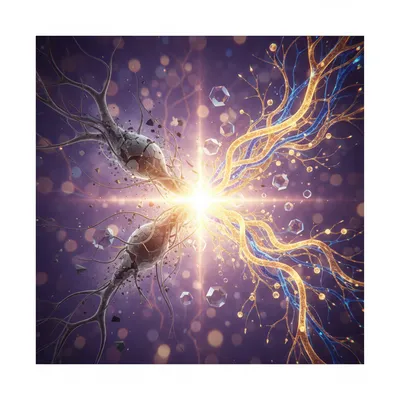
A use-dependent blocker, and that detail matters later. Now, the leading circuit-level account, the one people call the disinhibition cascade, goes like this. Your cortex has two main kinds of neurons: pyramidal cells, which are the excitatory output neurons, and GABAergic interneurons, which are the brake. They inhibit the pyramidal cells. Ketamine prefers to block NMDA receptors on the interneurons. So the brake gets quieter, the engine gets louder, and you get a burst of glutamate release in the prefrontal cortex. You block an inhibitory thing, and excitation goes up.
Block the blocker of the engine.
That's the cascade. Then downstream of that glutamate surge, the AMPA receptors, the other main glutamate receptor type, get activated. That leads to BDNF release, then mTOR signalling, then enhanced AMPA receptor trafficking and the growth of dendritic spines, the little protrusions where synapses form. And this is the part I find beautiful: that's not a neurotransmitter tweak. That's structural remodelling. New synaptic hardware.
That's the step I want to slow down on, because I think it's what actually explains the speed.
I agree, and here's how. SSRIs work upstream. They raise serotonin and then wait, weeks, for the downstream adaptations to accumulate: receptor desensitisation, transcriptional changes, slow synaptic remodelling. It's like raising the water pressure and waiting for the garden to reorganise itself. Ketamine acts directly on the glutamate system and triggers the plasticity cascade, the spine growth, within hours. Same destination, maybe, but one route starts at the synapse and the other starts three streets away.
Give me a concrete picture of what a dendritic spine actually is, for the listener who's never held a neuron.
Imagine the pyramidal neuron as a tree. The dendrites are the branches, and the spines are the little knobs sticking off the branches, thousands of them per neuron. Each spine is essentially a docking pad for incoming connections from other neurons. In the animal models of depression, chronic stress literally shrinks and drops these spines in the prefrontal cortex, the circuits that regulate mood and motivation go thin. And you can image it: after ketamine, new spines appear on those same branches within hours, and they're the ones that appear to carry the antidepressant effect. The disease prunes the tree, the drug buds it back.
And depression itself is now being framed to match. Not "low serotonin," but impaired excitatory synapses in the prefrontal cortex, an excitation-inhibition imbalance in corticolimbic circuits. The drug and the disease model grew toward each other.
They did, and Liao's group in Nature Reviews Neuroscience pulled together fifteen years of preclinical work showing you can literally watch this, dendritic spines on cortical pyramidal neurons growing after ketamine. But there's one more piece that explains the duration question, and it's my favourite idea in this whole literature. Metaplasticity.
Say what it means before you say why you love it.
Because it explains the thing that otherwise makes no sense. Ketamine clears the body in hours. The antidepressant effect lasts days to weeks. So the drug cannot be doing the work directly. Brown and Gould's argument is that ketamine is a "metaplastogen": it doesn't just cause plasticity, it primes neurons so that later plasticity responses are altered, in duration, direction, or magnitude. The drug leaves, but it's set the terms under which the brain does its own remodelling afterwards.
It hands the brain a note on the way out.
That's roughly the picture. And they say it plainly: this "resulted in a paradigm shift in the conceptualization of how rapidly and effectively depression can be treated." Which it did.
Okay. Now the part that keeps you honest. All of that is the leading account. Not the settled one.
Correct, and I want to be careful here, because the textbook diagram is cleaner than the field. Lewandrowski's group said it flat out this year: despite multiple hypotheses supported by preliminary data, "there is no consensus regarding its definitive mechanism of action." There are rival candidates. HCN1 channel antagonism. Dopamine D1 and D2 modulation. Epigenetic neuroadaptation. And the hydroxynorketamine metabolite, HNK, which was proposed as an antidepressant mechanism that doesn't involve NMDA receptors at all, which would scramble the whole story if it held up. There's even a suggestion the drug concentrates inside cells and messes with intracellular signalling after a single dose.
So the cascade is the front-runner, not the winner.
Front-runner with good form. And here's what I think is the deepest open question in the mechanism, the convergence problem. Ketamine blocks NMDA receptors. ECT is electricity. rTMS is magnetic fields. Psilocybin hits serotonin 2A receptors. Four wildly different doors, and they all produce antidepressant effects on overlapping timescales, and they all seem to enhance plasticity in the same cortical circuits.
Four doors, one room.
Then the question isn't "what does ketamine do." It's "what's in the room, and why does depression block it". Liao's review ends on exactly that note: the forms and mechanisms of plasticity that link these interventions to restored excitatory synaptic function "are still unknown." Which, for fifteen years of work, is a remarkable thing to still be saying.
Before we get any deeper into the clinical side, I believe we have a call from Dorothy. Mum, you're on.
Hello dear, it's me, Dorothy, with Dorothy's History of Toast.
They call raising a glass a toast because people used to put a piece of spiced toast in their wine or ale. And Falstaff asks for a quart of sack with a toast in it, in Shakespeare's The Merry Wives of Windsor.
Which is a bit sad really, dear. You raise a glass to someone and there's a soggy bit of bread in it. Nothing ever quite turns out the way you plan.
Anyway, I've got a loaf proving on the radiator, so I'd better go and see to it. Bye bye, sweetheart.
Mum's Shakespeare game is stronger than mine, I'll admit that.
And "nothing ever quite turns out the way you plan" is accidentally the thesis of the durability literature we're about to hit.
Accidentally and precisely. The mechanism explains the speed. The question is whether the speed helps patients, and that's where the trial evidence comes in.
Give me the acute picture.
This year's meta-analysis, Saun and colleagues, nine randomised trials of intranasal esketamine plus an oral antidepressant. On the MADRS depression scale, esketamine beat placebo by three point four four points within twenty-four hours. Statistically solid, the confidence interval sits well away from zero. But hold it against the response rates and what people expect from the word "breakthrough," and it's a modest separation, especially against a strong placebo response, which is a chronic problem in depression trials with subjective endpoints.
Three and a half points. The mood cure in a nasal spray, measured in points you could argue about.
And the harms tell you why the regimen looks the way it does. Same -analysis: elevated blood pressure, relative risk about three. Dissociation, relative risk nearly six. The FDA boxed warning covers sedation, dissociation, respiratory depression, abuse and misuse, and suicidal thoughts and behaviours. You're monitored for at least two hours after each dose, and the label says you don't drive until the next day after a restful sleep. This is not a take-home medication. It's a clinic-with-chairs medication.
Two hours of monitoring, times twice a week during induction. The pharmacology is fast and the logistics are slow.
That's a good way to put the economics of it. Now, the real-world picture is better than the trial separation suggests, I think. There's a retrospective cohort from this year, Bellanti's group, a community psychiatric clinic, sixty-three patients, thirty-seven on esketamine, twenty-six on IV racemic ketamine. Baseline PHQ-9 around eighteen, which is severe. Mean improvement: about ten points on esketamine, nine and a half on IV. The difference between routes was nothing, statistically.
So the fancy nasal spray and the old IV drip land in the same place.
On response and remission, indistinguishable. Response, meaning meaningful improvement, about two-thirds in both arms. Remission, meaning roughly well, a quarter to a third. And that gap between response and remission is the real headline. Two-thirds get meaningfully better. Only about one in three gets well. For a population that has failed everything else, that's a serious drug. For a headline that says "cure," it's not that.
And I want to be fair to what a ten-point PHQ-9 drop means for a person, not a statistic. If you walk in at eighteen, severe, and you walk out around eight, that's the difference between not leaving the house and answering the phone. That's not nothing, even if it's not remission.
Right, and it cuts the other way too. If you're the one in three who doesn't respond at all, you've spent weeks of clinic visits and dissociative afternoons for nothing. The averages hide both of those patients.
There's a regulatory detail I nearly missed and I suspect most prescribers did too.
I know which one you mean, and yes. The Spravato label, as of late September this year, permits it as monotherapy for treatment-resistant depression, not just as an add-on to an oral antidepressant. The original approval was adjunct-only, which was always an odd ask, honestly. Take our new drug with your old drug that already failed you twice. Monotherapy status changes what it's competing with.
The label quietly admitting the oral antidepressant wasn't earning its place on the prescription.
Whether that was clinical reasoning or commercial reasoning, the data won't tell you. Speaking of commercial versus clinical, the enantiomer question. Esketamine is just the S-enantiomer of ketamine, half the molecule, patented, approved. Racemic ketamine, the whole molecule, is off-label, generic, and far cheaper. And in that Bellanti cohort, the two are statistically indistinguishable on every outcome they measured.
Half the molecule, several times the price.
Now, the durability part, and this is where I'd want a listener to slow down. Vasudeva's systematic review, forty-three studies, search through March this year. The finding is consistent: sustained improvement while treatment continues. The randomised trials show reduced relapse with continued treatment. And relapse is common following discontinuation. Stop the drug, the benefit drains out. The observational studies are messier, some show sustained improvement, some show the benefit attenuating over time, and the long-term outcomes are explicitly "not uniform."
So the maintenance answer is: keep coming.
Keep coming, at some dose, at some frequency, for some duration, all three of which nobody has settled. There's even a head-to-head question with ECT now. Chang, Young and Juruena did the first systematic review comparing average time-to-relapse between ECT and ketamine in treatment-resistant depression. Thirteen studies. Both show sustained benefit. ECT is possibly associated with longer remission, and that's the polite version of the finding, given the caveat stack: heterogeneous dosing, short follow-up, small samples. What does seem to prolong remission is more treatment. Higher dose, more frequency, maintenance sessions, and continuing oral antidepressants on top.
The strongest predictor of staying well is not stopping. Which is an observation, not a schedule.
And that's exactly how Serretti framed it this year, in a paper whose title is basically the field's confession: treatment-resistant depression in the post-ketamine era, unmet needs beyond rapid response. His line is that the advance "has not resolved the clinical problem of TRD. Rather, it has shifted the field's most important unmet needs from the induction of short-term symptom improvement to the management of what follows." Ketamine didn't solve the problem. It moved the problem.
From the door to the hallway.
And his list of what's still open is everything we've been circling. How durable is the initial benefit. How do you prevent relapse. What's the maintenance structure, how do you taper, does feeling better translate into functioning better, which is a different endpoint nobody's measuring well. Which patients benefit, because there are no predictive biomarkers despite everyone looking. Long-term safety of repeated glutamatergic dosing, which nobody knows, because nobody's followed these patients long enough.
You've spent a career in clinics. When a drug keeps working only while it's being taken, is that a cure or a subscription?
Depends entirely on the harm profile of the subscription. Insulin is a subscription and nobody blinks. The difference is we've had a century of insulin. We've had a few years of repeated ketamine dosing, and the honest answer on cognitive effects is that a systematic review this year concluded they "remain unclear." Then there's the double bind. Lewandrowski's group describe an emerging crisis in non-prescribed ketamine use, the same molecule being studied as a treatment for substance use disorders on one bench while being flagged for abuse and misuse on the other. Somebody called it the ketamine paradox: treating addiction with an addictive drug.
The boxed warning and the prescription sitting in the same sentence, taking opposite sides.
What do you actually make of the durability problem, though? You were the one who kept pulling me back on this when we did the episode on whether brain changes from therapy or pills actually last.
I keep coming back to the comparison nobody wants to make. Every antidepressant is a subscription. The SSRI literature has the same shape: relapse rates jump after discontinuation, which is why you taper over months. The difference is the ketamine subscription is expensive in a way pills aren't. It costs two monitored hours a session and a clinic visit, so the durability problem isn't just biological, it's logistical. People will relapse because the bus to the clinic stopped coming, not because the drug failed.
That's a fairer version of the point than most of the reviews make. The relapse data conflates pharmacology and attendance.

Herman's wrong about the monitoring, by the way. It's two hours on paper.
I rang Ibrahim at the pharmacy while you two were going on about corks and wine. I've dealt with the man eleven years, he's the one who told me my blood pressure cuff was reading high because of the cuff, not me. The Spravato course, induction, comes to more than you'd guess, and I got him to read the monitoring requirement off the label, which he did, at dictation speed.
The two hours is the minimum. The actual figure is until the patient is stable, and the clinic near me keeps them three. Ibrahim says the chairs in the recovery room were bought from a dentist who closed down. That's the part nobody puts in the -analysis. Also the nasal spray is no use to me, the nozzle's the wrong shape entirely, so I'd be the IV, and I priced that too. Wrote both figures on the back of a delivery slip. I keep those.
The "until stable" reading matches the label, actually. Two hours is the floor in the text, and the flexibility is exactly where a cautious clinic goes longer. Three hours a session, twice a week for the induction weeks.
Which takes the subscription cost and roughly triples the chair time per month. Ibrahim's chairs from the dentist are the real-world price tag the trial data never carries.
The dentist charged him forty a chair. He told me that without my asking.
That number I can't verify and don't need to. The forty-three-study review and the dentist agree on the substance: what's being sold is induction, and what's being paid for, by everyone involved, is the follow-through.
So where's the research heading? Because the pipeline looked crowded to me.
Crowded and pointed at the same room. Almost everything in development aims at that convergent pathway. Dextromethorphan plus bupropion, which is Auvelity. Esmethadone. Nitrous oxide, the same one from the dentist. A whole family of NMDA positive allosteric modulators, rapastinel, zelquistinel, apimostinel, which nudge the receptor instead of blocking it. AMPA receptor modulators like osavampator and tulrampator. The shared thesis is AMPA activation, BDNF release, mTOR signalling, spine formation. The same cascade we walked through, entered by different doors.
Four doors before, now there's a queue.
Plus the adjacent classes, the neuroactive steroids like zuranolone hitting GABA instead, which argues the room is even bigger than the glutamate story. And the combination work, people trying esketamine stacked with accelerated theta-burst stimulation, magnetic stimulation on top of the spray. Early, single cases, hypothesis-generating. But it tells you the field's bet: if plasticity is the common pathway, then combinations should be additive.
And every one of those candidates inherits the same unanswered question. Not "does it act fast" but "what happens in month three."
Month three, and year two. The part of the map that's still blank.
The misconception before we go. People hear "ketamine cures depression in hours" and think miracle drug. The numbers say two-thirds respond during induction, a quarter to a third remit, and relapse is common once treatment stops. It's a meaningful option for people who've run out of options, not a cure.
The second misconception hides inside the first: that it's just an SSRI that works faster. It's a different route entirely. The monoamine story raises serotonin upstream and waits weeks for the brain to adapt. This acts on glutamate, straight at the synapse, spine growth within hours. Different road, possibly the same destination, and the fact that both roads arrive is itself the biggest open question in the field.
Where I'd leave it is the question Liao ended on, that we still don't know what plasticity actually links any of these interventions to recovery, or why depression blocks the pathway in the first place. Ketamine proved the block is removable, in hours. Nobody yet knows how to make it stay removed, and the answer probably looks less like a better drug and more like knowing which patient, which maintenance, which taper, which we don't. In the meantime, three hours a session in a dentist's chair turns out to be the real dosage.
That's the show, folks. Thank you to our producer, Hilbert Flumingtop, for keeping this thing on the air and the chairs accounted for.
If you want more of this, try episode twenty-five twenty-seven, Do Brain Changes from Therapy or Pills Actually Last; episode eight forty, Why Antidepressants Take Weeks to Work; and episode twenty-five twenty-nine, Depression Subtypes. This has been My Weird Prompts. If today was useful to you, a review wherever you listen helps other people find the show, and everything we make lives at my weird prompts dot com.
We'll be back soon. See you then.
See you.