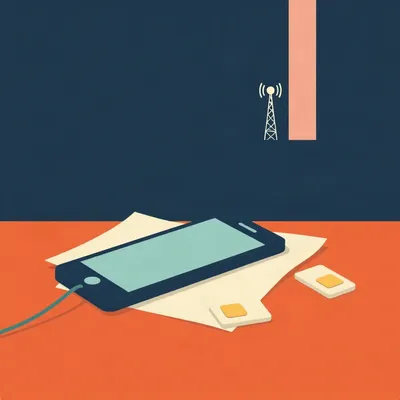
Daniel's been deep in the telephony weeds, and what he's surfaced with is basically a manifesto for why phone numbers are broken. He runs dual SIMs, business and personal, and he's been staring at Twilio's capabilities thinking — wait, why am I carrying two carrier contracts when I could route everything through SIP and demote the SIM to a dumb data pipe? The stretch goal is a quality data plan with a local Israeli number for backup, but the real vision is SIP-first, where the cellular subscription exists only to provide data and a number that's verifiably not virtual. And that's the catch — if virtual numbers could reliably receive SMS, you wouldn't even need the SIM. There's also a server-side SMS angle he's keen on, where an email relay handles messages without depending on flaky device apps. But implementing this is a headache. So his questions are: beyond the understandable fraud concerns, what's actually standing in the way of reliable SMS receipt on virtual numbers? And then the bigger one — in a world of digital nomads and remote work, wouldn't it make more sense if we all had globally unique phone numbers, like IPv6 addresses, instead of this geographic prefix system that ties your number to where you bought the SIM?

The IPv6 comparison is the right instinct. And the fact that he lands there tells me he's already figured out that the problem isn't technical — it's institutional. But let's start with what actually happens when an SMS tries to reach a virtual number, because that's where the whole thing gets weird.
Let's do it.
The current telephony system is built on something called E.164, the ITU standard that assigns country codes and defines how phone numbers are structured globally. That number isn't just an address — it's a statement about jurisdiction. It tells the network where the subscriber line was purchased. And for most of telephony history, that was a reasonable proxy for where the person actually was.
Because people stayed put.
You bought a SIM in Chicago, your number started with plus one, and you were probably in Chicago. The entire routing infrastructure — the SS7 signaling network, the billing systems, the fraud detection layers — was built on that assumption. And now we have someone like Daniel, who might have a US number, live in Jerusalem, and be in Bangkok next week. The system has no category for that person.
And the failure mode is specific. It's not that everything breaks — it's that the thing that breaks is the thing you can't afford to lose.
Roaming data works. You land in another country, your phone negotiates with a local tower, and your data packets get tunneled back to your home network over IP. That's relatively modern infrastructure. But SMS still travels over SS7, the signaling system designed in the nineteen seventies. It's a completely separate path. When you're roaming, your home network has to coordinate with the visited network to deliver that SMS over SS7. If the visited network doesn't have a proper roaming agreement for SMS with your home carrier, the message just... vanishes. No bounce, no error.
And that's the two-factor authentication code you needed to log into your bank.
You're standing at an ATM in Tel Aviv, your US bank sends a code to your US number, and the SMS never arrives — not because the technology failed, but because some carrier in the middle didn't have the right peering agreement. And that's for a real SIM. For a virtual number, it's worse.
Walk me through that. Why is a virtual number different?
A virtual number — a Twilio number, say — lives in the cloud. It's not attached to a physical SIM card. When someone sends an SMS to that number, the originating carrier looks up where to deliver it. That lookup goes through databases and aggregators that determine: is this a mobile number? Which carrier owns it? And here's the thing — Twilio and other VoIP providers don't own number ranges the way Verizon or Orange do. They lease them. So the routing tables that carriers maintain have to explicitly know that this particular number range is served by Twilio's SMS gateway, not by a traditional mobile network operator.
And not every carrier has that entry.
Not even close. The major US carriers and large European operators have peering arrangements with the major VoIP providers. But a small regional carrier in rural Poland? Or a mobile virtual network operator in Southeast Asia? They might not have any idea where to route an SMS destined for a Twilio number. Their routing table just doesn't have an entry for it.
So the message dies in a routing gap, and the sender sees "sent" while the recipient sees nothing.
But that's just the routing problem. The fraud angle is the real blocker. And I want to be careful here — it's easy to frame this as "carriers are lazy" or "banks are stupid." They're not. Virtual numbers are genuinely a massive vector for fraud. If you can spin up a hundred Twilio numbers in five minutes, you can run SMS verification attacks, impersonate businesses, do all kinds of things that are much harder with physical SIMs. So the entire financial ecosystem has built countermeasures.
What do those look like?
When a bank sends an SMS, they're often using an aggregator like Twilio or Sinch or Vonage, and those providers maintain risk scores on destination numbers. Is this number associated with a physical SIM? Has it been ported recently? Is it in a number range known to be used by VoIP services? If the risk score is too high, the SMS provider can refuse to deliver — not because the technology can't do it, but because their fraud model says "this looks like a burner number."
So the unreliability is a feature, not a bug. From the bank's perspective, they'd rather lock out a legitimate user than let a fraudster through. The asymmetry is enormous — a locked-out user is an angry customer service call; a fraudster who gets through is a six-figure loss and a regulatory filing.
And it's not just banks. Any service that uses SMS for two-factor authentication is potentially affected. Some providers explicitly block virtual numbers, some throttle them, some deliver with enough delay that the code has expired by the time it arrives.
Daniel mentioned the email relay idea as a workaround. Server-side SMS to email sounds simple — Twilio can absolutely do that, you set up a webhook, incoming SMS triggers an email. But he says implementing it is a headache. What breaks?
Two things. First, the same delivery problem. If the SMS never reaches Twilio because some carrier in the chain doesn't route to virtual numbers, your elegant email relay has nothing to relay. The webhook never fires. Second, the apps that try to do this on the device side — SMS forwarding apps — are flaky because mobile operating systems increasingly restrict background processes. An app that worked fine on Android nine might silently fail on Android fifteen because the OS kills its background service to save battery.
So the server-side approach is the right instinct, but it inherits the same delivery problem upstream. You've moved the failure point but haven't eliminated it.
The SMS still has to traverse the carrier network and land on Twilio's gateway. If that traversal fails, nothing downstream matters.
Let me pull on a thread here. You said the SS7 network was designed in the seventies. That's fifty years ago. We've rebuilt the internet's routing infrastructure multiple times since then. Why is telephony still running on this?
Because it works for the thing it was designed for — connecting phone calls between people who mostly stay in one country. The carriers have no incentive to rebuild it. Replacing SS7 with an IP-based signaling system — which does exist, it's called Diameter, used in 4G and 5G networks — requires every carrier in the world to upgrade. And the carriers that serve small markets or developing countries have exactly zero budget for that. So SS7 persists because the network effect is enormous and the cost of replacement is astronomical.
And nobody wants to be the first one to flip the switch and discover that calls to half of Africa suddenly don't connect.
There's a version of this where regulators mandate a timeline for SS7 sunset, the way they did for analog TV. But telephony doesn't have a single global regulator. It's got the ITU, which sets standards but has no enforcement power, and then every country has its own telecom regulator with its own priorities.
Which brings us to Daniel's bigger question. The IPv6 thought experiment. What if phone numbers were globally unique, not tied to geography?
The technical layer could do this tomorrow. SIP already treats phone numbers as addresses, not locations. A SIP URI is essentially "sip colon slash slash user at domain" — it looks like an email address. The number itself is just a label. There's nothing in the SIP protocol that requires a plus one or a plus nine seven two. Those prefixes are a legacy of the E.164 numbering plan, designed for a circuit-switched world.
So we could assign every person on earth a unique number, no country code, and route calls over IP. What stops this?
Let me count the ways. First, the ITU's E.164 standard is embedded in every piece of telecom equipment on the planet. Changing it requires a treaty-level agreement among the ITU's hundred and ninety-three member states. That's diplomacy, not a technical negotiation. And the countries that benefit from the current system — the ones whose carriers collect roaming fees, whose regulators control number allocation, whose fraud systems depend on geographic prefixes — they have no reason to vote yes.
The roaming fee point is underappreciated. Carriers make real money when you travel.
International roaming is a high-margin revenue stream. If your number isn't tied to a country, there's no "home network" and "visited network" distinction. The whole concept of roaming charges evaporates. Carriers would have to compete purely on service quality and data speeds, and they've spent decades fighting that exact outcome — the entire history of mobile network operators is a story of trying to avoid becoming commodity bandwidth providers.
They'd be dumb pipes. Literally.
Literally. What about number portability? We already have that within countries. Why can't we extend it across borders?
Because number portability is a regulatory construct, not a technical one. When you port a number from Verizon to AT&T, regulators have mandated that Verizon must release the number and AT&T must accept it. There's a central database — the Number Portability Administration Center in the US — that tracks who owns which number. But that database is national. If you want to port a US number to an Israeli carrier, there's no legal framework that compels the US carrier to release it, and no database that tells the world's carriers where to route calls to that number now.
So the number is stuck in its country of origin by regulation, not by physics. The packets don't care what country the number is from. SIP doesn't care. The only things that care are the billing systems, the fraud systems, the regulatory frameworks, and the international treaties.
This is where the IPv6 comparison gets really sharp. IPv4 addresses had geographic meaning — you could roughly tell where a server was from its IP. IPv6 broke that assumption entirely. An IPv6 address tells you nothing about geography. And the internet didn't collapse — it thrived. But the difference is that the internet's governing bodies — the IETF, the regional internet registries — were designed for global coordination from the start. Telephony was built on the opposite assumption: that borders are fundamental, and the network respects them.
And emergency services. Nine one one routing depends on knowing where you are.
That's actually the strongest argument for keeping geographic numbers. When you dial nine one one, the network uses your phone number to look up your registered address. If numbers aren't geographic, that lookup breaks. Now, there are technical solutions — your phone knows its GPS coordinates, it could transmit those — but that requires rebuilding the entire public safety answering point infrastructure. Every PSAP in every country would need to handle location data differently. Solvable with investment that nobody wants to make.
And that's really the theme here. Every technical problem in this space has a solution. SIP can route calls. Virtual numbers can receive SMS. Globally unique identifiers can work. The problems are all in the institutional layer — the treaties, the regulations, the business models, the fraud detection assumptions. Those are much harder to change than any routing protocol.
Let's talk about who this actually affects. Daniel framed it around digital nomads and travelers, but I think the category is bigger than that.
It's enormous. Anyone who moves countries — immigrants, refugees, students studying abroad, people who take jobs in different countries — they all hit this. You move from India to Canada, and suddenly your Indian number, which is tied to your bank, your government ID, your family's contact list, becomes a liability. You can't port it. You can keep it active with international roaming, but that's expensive and SMS might not work. So you end up with two SIMs, two numbers, two contracts, and a constant low-grade anxiety about which number is tied to which service.
And the two-SIM solution is itself fragile. Daniel's been doing that for years, and he's still hitting walls.
Dual SIM phones are a band-aid. They solve the problem of having two numbers active at once, but they don't solve the underlying issue that one of those numbers is tied to a country you no longer live in. If that number stops working — if the carrier changes its roaming policy, if the SIM gets damaged, if the number gets recycled because you missed a payment — you lose access to every service that uses it for verification. And good luck proving your identity to a bank in a country you left five years ago.
The number becomes a single point of failure for your entire digital life. And it's a point of failure you don't control. You don't own that number. The carrier owns it. They can take it back, change its terms, go out of business. You're renting your identity from a telecom company.
That's the argument for SIP-first. Take back control. Your number lives in Twilio, you own the configuration, you decide where calls and messages go. And you can move it — if Twilio changes its pricing, you can port the number to another SIP provider. The reality, as we've been discussing, is that the ecosystem hasn't caught up. But the direction is clear.
Let me ask you something. You've been in medicine. You've seen systems that evolved organically over decades and ended up with weird, brittle architectures because nobody ever sat down and redesigned them from scratch. Does telephony remind you of anything?
Electronic health records. Same story. Every hospital built its own system, every vendor used different data formats, and now your medical records from one hospital can't talk to the system at another hospital. The technology to fix it exists — FHIR, HL7, these are standards that work — but the institutional inertia is staggering. Telephony is the same thing at global scale.
The difference being that your medical records don't lock you out of your bank account while you're standing in a foreign country.
No, but they could kill you if they're not available in an emergency. Different stakes, same structural problem.
So where does this leave Daniel's vision? SIP-first, carrier-minimized, virtual numbers treated as first-class citizens. Is this a five-year thing, a twenty-year thing, or a never thing?
I think it's a gradual erosion, not a revolution. The value of a phone number is shifting. It used to be about voice calls. Then it was about SMS. Now it's increasingly about identity — the number is the thing that proves you're you. And as that shift continues, the pressure to make numbers portable, reliable, and platform-independent grows.
The banks are the leverage point, aren't they? If banks start supporting proper two-factor authentication that doesn't depend on SMS — TOTP, hardware keys, passkeys — then the SMS delivery problem becomes less critical.
That's the real solution, and it's happening, just slowly. SMS-based two-factor is terrible security anyway — vulnerable to SIM swapping, to SS7 interception, to all kinds of attacks. The move to WebAuthn and passkeys is the right direction. Once your bank lets you authenticate with a hardware key or a platform authenticator, the phone number becomes just a contact method, not a security credential. And contact methods can be unreliable without locking you out of your money.
So the authentication problem and the telephony problem are tangled together. Fix one and you reduce the pressure on the other.
And I think Daniel would agree — he mentioned that the two-factor lockout reflects poor authentication planning by institutions. The bank chose the cheapest, laziest verification method and externalized the risk onto the customer. That's not a telephony problem, fundamentally. That's an institutional failure that telephony happens to expose.
But even if we fix authentication, the number system itself is still a mess for anyone who moves.
It is. And I don't see the E.164 system changing in my lifetime. The coordination problem is just too big. What I do see is a world where the phone number becomes less important over time. You already see this with the younger generation — they don't make phone calls, they use WhatsApp and Signal and FaceTime. The phone number is becoming a legacy identifier that you need for banks and government services, while your actual communication happens on platforms that don't care what your number is.
That's a weird end state. The number persists as the most important thing — your identity anchor — but it's attached to the oldest, most brittle infrastructure. Simultaneously more critical and more fragile.
The worst of both worlds. So Daniel's SIP-first approach is essentially a way to manage that fragility. Take the number out of the carrier's hands, put it somewhere you control, and accept that the ecosystem is going to be hostile to it in certain ways, but at least you're not at the mercy of a roaming agreement you didn't sign. The trade-off is that some SMS messages won't arrive. For some people, that's unacceptable. For others, the control is worth the occasional missed message.
What's your threat model? You've advocated for a hybrid approach before — keep a traditional line for the things that absolutely need it.
I still think that's the pragmatic choice for most people. Keep one carrier number for banking and government two-factor, and route everything else through SIP. It's not elegant, but it works. The elegant solution — pure SIP with globally unique numbers — requires changes that are beyond any individual's control. You can't personally renegotiate the ITU treaty framework.
No, but you can route around it. That's the internet playbook — don't wait for the institutions to catch up. Build the thing that makes them irrelevant.
And that's what's happening. Slowly. Twilio, Vonage, the whole CPaaS industry — they're building the alternative infrastructure. The question is whether they can reach the critical mass where carriers and banks have to treat virtual numbers as legitimate because too many real customers are using them.
The IPv6 story again. It took twenty years from standardization to meaningful adoption. And even now we're not at a hundred percent.
But nobody questions that IPv6 is the future. The transition is happening, it's just slow. Telephony might follow the same curve. We're in the early adopter phase, where people like Daniel are building SIP-first setups and documenting what breaks. In ten years, that might be the default.
And in the meantime, the dual-SIM phone with a Twilio number and a prayer.
A backup email relay that might or might not fire.
The future is unevenly distributed.
Always is.
Hilbert: I want to push back on something you've both been nodding along with for the last ten minutes. The idea that the geographic prefix system is obsolete and should be replaced. I'm not sure it's that simple.
Go on.
Hilbert: The geographic system gives regulators a handle on things that actually matter. Consumer protection, for one. If a telecom company in France is screwing over its customers, the French regulator can do something about it. If phone numbers aren't tied to jurisdictions, which regulator has authority? The one where the company is incorporated? The one where the customer lives? You've just created a jurisdictional nightmare that makes every consumer complaint into an international legal case.
That's a fair point. The regulatory framework assumes geography.
Hilbert: Emergency services — you mentioned it, but I think you underplayed it. When someone dials one one two or nine one one, seconds matter. The current system routes that call to the nearest PSAP based on the cell tower, but it also uses the number to pull up the caller's registered information. If numbers aren't geographic, you need a real-time location system that works everywhere, in every building, in every country, with zero latency. That's not a small engineering project. That's a moonshot.
You're saying the geographic system is doing important work that we'd have to replicate from scratch.
Hilbert: I'm saying it's doing work we take for granted because it's been there for fifty years. And the other thing — the fraud heuristic. You framed it as a problem, and for Daniel it is a problem, but for the billions of people who aren't digital nomads, that heuristic works. It catches scammers. It makes SMS-based fraud harder. The fact that it also catches a small number of legitimate users is, from the system's perspective, an acceptable trade-off.
Acceptable to the system, not to the people it catches.
Hilbert: Sure. But every system has false positives. The question is whether the cost of eliminating those false positives — rebuilding global telephony, renegotiating treaties, retraining every fraud model on the planet — is worth it for a population that's still a small fraction of total users.
I think the population is bigger than you're giving it credit for. Remote work fundamentally changed how many people live across borders. It's not just the digital nomad with a laptop in Bali. It's the immigrant sending remittances, the student doing a semester abroad, the retiree who splits time between two countries. These aren't edge cases anymore.
Hilbert: They're still a minority. A growing minority, I'll grant you. But the system was built for the majority, and the majority still lives and works in one country. Rebuilding for the minority is expensive, disruptive, and creates new failure pattern we can't predict.
The counterargument, which I think is where Daniel lands, is that the minority is the canary in the coal mine. The failures they're hitting today are the failures everyone will hit as mobility increases. Fixing it now, while the pressure is manageable, is smarter than waiting until it's a crisis.
Hilbert: Or you could argue that the market is already solving it. Dual SIM phones are standard now. eSIM makes it trivial to add a local data plan when you travel. The hybrid approach you described — one carrier number for critical services, SIP for everything else — works today. Maybe the system doesn't need to be rebuilt. Maybe it just needs better workarounds.
Workarounds are fragile. They depend on individual knowledge and effort. Daniel can build a SIP-first setup because he's technically sophisticated. The retiree splitting time between Florida and Ontario can't. She's stuck paying roaming fees and hoping her bank's SMS codes arrive.
Hilbert: That's a real problem. I'm not denying it. I'm questioning whether the solution is to blow up the numbering system rather than to fix the specific failure points — mandate SMS delivery to virtual numbers, require banks to support non-SMS two-factor, improve roaming agreements. Those are incremental changes that don't require a global treaty.
I think you're right that incremental change is more likely, and probably more practical. But I also think Daniel's question is worth taking seriously as a thought experiment. If we were designing telephony from scratch today, nobody would propose geographic prefixes. They'd propose a flat namespace with cryptographic identity binding. The fact that we're stuck with the legacy system doesn't mean the legacy system is good. It just means it's entrenched.
Hilbert: Entrenched and functional for most people most of the time. That's not nothing.
It's not nothing. But "functional for most people most of the time" is also what people said about the IPv4 address space in nineteen ninety-five.
Hilbert: Fair.
The misconception most people have about virtual numbers is that they're unreliable because the technology is broken. The technology works fine. The unreliability is deliberate — it's fraud prevention systems treating virtual numbers as suspicious by design. That's not a bug. It's a policy choice, and it's one that could be changed if the incentives shifted.
The bigger misconception is that the geographic prefix system exists because of technical limitations. It doesn't. SIP and IP routing could support globally unique numbers tomorrow. The constraints are regulatory, commercial, and political. The technology is ready. The ecosystem isn't.
That gap is where the frustration lives. And it's also where the opportunity lives, for anyone building the next layer of communications infrastructure.
The practical takeaway isn't a checklist. It's a mindset. Treat your phone number as a service you control, not a contract you're stuck with. That might mean a hybrid setup today. It might mean pushing your bank to support proper two-factor. It might mean accepting that some things will break and having a backup plan. The technology exists. The question is how long the institutions take to catch up.
Thanks to Hilbert Flumingtop for producing, and for making us earn our conclusions.
This has been My Weird Prompts. If you want to reach us, the website is my weird prompts dot com, or email the show at show at my weird prompts dot com.
We'll be back soon.