...and what I keep coming back to is that the tool you actually reach for is almost never the tool with the most features. It's the one that does one thing.

Which is a real pattern, and it shows up everywhere. The multi-tool is the classic case. You carry it for a year and you use the scissors and the blade, and the nine other implements are just weight.
Right, so Daniel's belt. He's talked before about that modular carry belt he's built around parenting and DIY, and one thing he never wanted on it was a Swiss Army knife. His words were something like, he's inherently skeptical of any tool that tries to do too many things at once.
Sensible man.
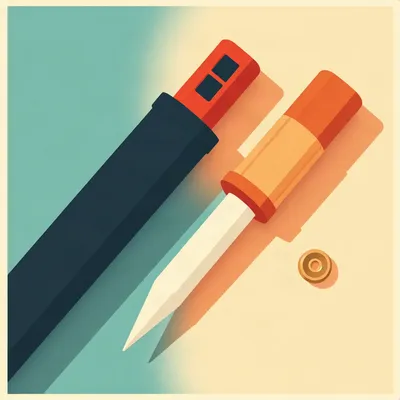
Instead he went with a quality folding utility knife. Calls it one of the best little purchases he's ever made. Uses it basically daily, opening packaging, cutting cable ties. And he's a firm believer in the kitchen truism that the most dangerous thing in a kitchen is a dull blade. A sharp knife handled with care, that's the effective tool.
Good, yes, and I want to come back to that truism later, because there's something worth saying about it.
So he asks: can utility knives even be sharpened? He went looking and found there are small whetstones made for exactly that. Separately, back when he was getting into cooking, he picked up a Victorinox chef's knife, a honing steel, and a knife sharpener. And he formed the impression that the whetstone is the professional's choice. Which he says he'd like to get into, because there's a lot of spec to it. So, three things. Basic knife care for a household with a couple of good cooking knives and a couple of small pocket knives in the toolbox. Storage. And basic safety for a household with a toddler, where making sure no knife is ever reachable is the priority.
There's a lot in there, and one of the things I want to do today is push back on part of that framing. Because his instinct about whetstones being the professional's choice is broadly correct. And it might still be the wrong tool for the knife he actually asked about.
That's the whole episode right there, isn't it. The pro tool and the right tool diverge.
They diverge, and the reason they diverge is mechanical, so let's start there. What is actually happening at an edge.
Sharpen versus hone.
Sharpen removes metal to create a new edge. Hone realigns the edge that's already there, without removing metal. That's the whole distinction, and everything else grows out of it. The image Borough Kitchen uses is that the edge is a row of teeth. Use misaligns those teeth. A sharpening fixes nicks and chips. A honing puts the teeth back into a neat row.
So honing is realignment, not restoration.
Realignment. You can hone without sharpening, and plenty of chefs hone after every single use. What you should not do is the reverse. Sharpening a knife without honing it leaves you with an edge that's free of nicks but still misaligned. Their line is, you should never sharpen a knife without honing it, because sharpening fixes the nicks but does not reinstate the edge. Those aren't alternatives. They're sequential.
And there's a practical test for which one you need.
The tomato. Try to slice a tomato. If it slices neatly, hone. If the tomato squishes and splutters juice, the edge is gone and you need to sharpen. That's it. That's the whole diagnostic, and it's better than anything you'll read on a product page.
A tomato as a diagnostic instrument. I like that. Cheaper than a microscope.
And it's useful, because most people can't tell by looking. An edge that's misaligned still looks like an edge.
So walk me through the tools, because this is where Daniel's instinct about the whetstone being the pro choice either holds up or doesn't.
Three categories, and the cleanest way to order them is by how much metal they remove, which is almost the inverse of how much skill they demand. Whetstone at one end. Pull-through at the other. Honing steel in the middle.
Start with the stone.
Whetstone removes the least metal of anything, and it respects the blade's shape because you're matching the knife's own angle rather than forcing the knife into a fixed one. That's the whole advantage and the whole difficulty. It's the same property. It preserves the edge because you're following it, and it demands skill for exactly the same reason.
And grit.
Grit is just abrasiveness. Lower number, coarser, more abrasive. Under a thousand grit for a very blunt or damaged blade. Around a thousand to bring back something dull but usable. Above a thousand for honing and finishing. Most stones you'll buy are combination stones, coarse on one side and fine on the other. Stones get sold up to six thousand grit.
Six thousand. What's the point of that?
Finish. You're polishing the edge rather than cutting it. For hard Japanese steel in the VG10 range, which runs about sixty to sixty-one on the Rockwell C scale, or AUS-10 at fifty-eight to sixty-one, the recommendation is a combination waterstone around a thousand grit to do the actual sharpening and then three thousand to eight thousand to finish. You sharpen on the coarse and you refine on the fine.
Sixty on the Rockwell scale. That's hard steel.
It's hard steel, and hold that number, because it comes back and bites you in a minute.
Soak times. I remember water stones need soaking.
Five to ten minutes, until no more bubbles come out. That's the signal. When it stops bubbling, it's saturated. And then the time commitment, which is where people fall off. Budget about fifteen minutes just for the soak. Then you sharpen one side, flip, hone the other side. For a dull knife you're looking at at least half an hour start to finish.
Half an hour.
Their editor, who cooks every day, uses a whetstone about once a month. And that's the actual cadence for someone who cares. Not weekly. Monthly, plus honing in between.
So the stone is a monthly ritual, not a daily one.
Monthly for the stone, and the steel does the daily work. Which is the honing steel's whole job. It maintains the edge between stone sessions. It sheds more metal than a whetstone, but far less than a pull-through. And here's the trap nobody mentions.
Go on.
Do not use a honing steel on Japanese knives.
Say that again.
The hard, brittle steel of a Japanese blade can chip against a metal steel. Especially the diamond-coated ones. Sixty Rockwell is hard enough that it will hold an edge beautifully and shatter rather than deform. A Western blade at fifty-four, fifty-five Rockwell is soft, so it rolls and dents and a steel can push it back into line. A Japanese blade doesn't roll. It chips.
So the harder, better steel is the one that breaks.
Stronger and more brittle are the same property. It's not a design flaw. It's the trade you make for edge retention. And the extra twist is that steels marked diamond aren't honing steels at all. Diamond is an abrasive. Diamond removes metal. If it says diamond on the handle, you're sharpening, not honing, whether you meant to or not.
The thing has one word on it that means the opposite of what people think it means.
It's the worst-labeled tool in the kitchen.
Pull-throughs.
Fastest, most popular, and they shed the most metal of the three. That's what they do. Most have two preset slots, one for sharpening and one for honing, and the advice is to match the brand to the knife and use it sparingly. But the honest version is blunter than that. Popular Mechanics called a pull-through a blunt instrument, and said it will ruin your pocketknife if used regularly. Not might. Will.
Ruin.
Every pass takes metal off the whole edge, including the parts that were fine. Do it weekly for a year and you've moved the edge back toward the spine. That's the mechanism. It works, in the sense that the knife cuts again afterward.
It works the way a haircut works. Of course it's shorter afterward.
It solves the symptom and shortens the life of the blade.
So back to Daniel's assumption. Whetstone as the professional's choice.
Supported, on the whole. If you want the keenest edge and the least metal removed, the stone wins and nothing else is close. But here's where I'd push on the frame. That's true for a chef's knife you'll own for thirty years. It's not obviously true for the thing on Daniel's belt.
Which we should get specific about. But one more thing first, because you said there's something about the way the workflow is ordered.
The sequencing. Sharpen, then hone, every time. That reframes the whole thing, because most people think of sharpening and honing as two options on a menu. Pick one. They're two steps in one process. The sharpening fixes the damage. The honing reinstates the edge. Skip the second step and you've done half the job and can't work out why the knife still drags.
So the people who sharpen and then complain it didn't help are skipping the step that would have made it help.
Every time.
Tool landscape. Now the utility knife. Daniel asked a direct question, can you sharpen a folding utility knife, and he found small whetstones made for that purpose. But I want to give the uncomfortable answer first.
The uncomfortable answer is that a utility knife may not be a sharpening problem at all. Utility blades are very often disposable, replaceable. That's the design intent. You dull it, you pop in a new one, you move on. It's a consumable.
And then there's ceramic.
There's ceramic, and it's a different maintenance model. Slice makes ceramic utility blades out of zirconium oxide. Their claim is eleven times the life of steel, it never rusts, and the edge is deliberately rounded. Finger-friendly, in their language. Which is a different philosophy. A steel blade is a razor you maintain. A ceramic blade is a tool you don't hurt yourself with, and you replace it.
Eleven times.
That's their marketing number, so take it as their number, not as a lab result. But the shape of the claim is the point. If a blade lasts eleven times as long, the economics of sharpening it change entirely.
So Daniel's instinct to sharpen a utility knife might be swimming against what the thing was designed to do.
Not entirely. Steel utility blades absolutely can be sharpened, and people do. But if you're going to, the tool for it isn't the tool Daniel has in mind.
This is the pivot. He said the whetstone is the professional's choice.
And for a folding utility knife specifically, Popular Mechanics says the opposite. Full-size whetstone kits are not built for smaller knives, and they have too much room for improvisation for a beginner. A knife that fits in your pocket needs a sharpener that fits in your pocket. They point at something like the Work Sharp Folding Field Sharpener. Under five ounces, a four-hundred-grit diamond plate on one side and a ceramic hone on the other.
So the pro tool is the stone and the right tool is the field sharpener.
For that knife, yes. And it's worth being clear about why. It isn't that the stone stops working at small sizes. It's that a small blade on a big stone gives you nowhere to rest your hands and no feedback about your angle. The stone is not worse. It's just wrong-sized for the object.
The tool that's better is better because it's smaller, not because it's better made.
Right. Size is the feature.
Then there's the burr, which I gather is the whole game on pocket knives.
The whole game. The rule is no burr, no sharp. You sharpen one side until you raise a burr. A burr is a thin lip of metal that folds over the far side of the edge when you've ground all the way through. You can feel it with a fingertip, or see it under a light. And the trick is that you count your passes.
Count them.
Count them so you can repeat the same number on the other side. Otherwise you're guessing, and you'll spend twice as long on one side as the other and end up with an asymmetrical edge that cuts in a curve. Sharpen one side until you get a burr, count the passes, flip, do the same number. That's the whole method.
And angles.
Most pocket knives are ground at twenty degrees per side, and a lot of simple sharpeners have a permanent twenty degree guide so you can't get it wrong. Work Sharp's sharpener guy, Kyle Owens, is blunt about the whole angle debate. Sharpen everything at twenty degrees. He says the average person will not notice a difference between twenty and fifteen.
And the mistake people make?
Raising the angle. David Bäckström at Casstrom says people often increase the sharpening angle too much, trying to feel a sharp edge forming quickly. Resist the urge. Because the feeling of a steep angle biting into the stone is satisfying and it's destroying your edge geometry while it satisfies you.
The feedback that feels best is the feedback that's wrong.
Constantly. It's the same problem as pressing harder on a screwdriver.
What grit for a utility knife?
Start coarse if it's dull. Two hundred twenty to three hundred twenty grit, then finish on something finer and hit it with ceramic. You don't need the six thousand grit finish on a blade you're using to cut zip ties.
The six thousand grit stone is for the chef's knife.
And even that's optional. The chef's knife is where the polishing earns its keep. Not on the thing that opens Amazon boxes.
What's the entry cost here? Because I suspect people assume sharpening is expensive.
Owens is good on this. Sharpening is cheap and easy to get into. Most people think it's more complicated than it is and get scared off by the intimidation of doing it. And his advice for beginners is to start on cheap knives with soft steel, because soft steel sharpens fast and you can't ruin anything you don't care about.
Learn on the knife you don't love.
And on price, Popular Mechanics says beginners needn't spend over a hundred and fifty dollars. The whole consumer category runs from about twenty dollars to a thousand, and the difference between twenty and a hundred and fifty is real, while the difference between a hundred and fifty and a thousand is mostly for people who already know what they're doing.
So Daniel doesn't need to think about this as a serious purchase.
He already owns a honing steel and a sharpener. He's closer to done than he thinks.
Storage and the toddler, then. Which is the other half of what he asked.
There are three rules that come up again and again, and they're all obvious and all get broken. Never leave a knife near the counter edge where a small hand can reach it. Never leave a knife in a wet sink. And never let knives roam free in a drawer.
The wet sink one, I hadn't thought about.
Two problems at once. Rust, which is bad for the knife. And a child reaching into murky water where they can't see what's in there. It's the combination that's dangerous. Either one alone you'd handle.
Roaming free in a drawer. Paint me that picture.
A loose pile of blades shifting against each other every time the drawer opens. They dull each other. And when a hand goes in, it doesn't know what it's meeting. The fix is a drawer insert with individual slots so each knife sits still and the edge touches nothing.
And then a latch on top.
A safety latch that can't easily be opened by an unsupervised child. That combination is the drawer answer. Slots so the blades don't touch each other, latch so the child can't get in.
There's a trade to compare here, isn't there. Between the storage options.
There is, and Oishya's comparison is the fair one. Drawers hide the knives, which is good, but the knives rattle, which isn't, so you need the insert and the latch together or you've only solved half of it. Non-magnetic blocks hide the blades, which is good, but the slots can't be cleaned, so you're growing whatever grows in a dark slot with food residue in it. And the slots are usually vertical, so the knife rests on its edge, which is the worst possible way to store one.
Blocks dull the knife they're holding.
If the knife hangs by its edge, yes. That's why sideways-storing blocks exist. The blade lies flat instead of standing on the thing you spent all that time sharpening.
And magnetic strips.
Sanitary, easy to clean, good for the knife because nothing touches the edge. But they're mounted on a wall, usually at eye level, usually where a child can see the shiny thing. So a magnetic strip only works if it's mounted out of reach, and if the magnets are embedded in wood rather than sitting proud, so the blade isn't scraped against bare magnet every time you put it up.
So the answer changes depending on which risk you're minimizing.
Which is the honest version. There's no storage method that's best at everything. Each one trades a different risk against a different risk.
And the gadget category. Lockable blocks.
They exist. KnifeLock is a solid wood block with a keyed latch. HOMWE makes a locking block with a child safety lock that runs about fifty to seventy dollars. And they work. But the most repeated advice I found, from people actually raising children around knives, was much simpler than that.
Which was?
A locked cabinet is my recommendation.
Just a cupboard with a lock on it.
Someone on the Kitchen Knife Forums put the whole problem better than any product page. Young children are relentless in exploring new ways to die.
That's the sentence.
It's the sentence. And the point of it is that a determined toddler defeats any mechanism you bought for the express purpose of being defeated. So the low-tech answer wins, because a locked cupboard in a kitchen is a locked cupboard in a kitchen, and nobody has to remember how it works.
The gadget assumes the child engages the mechanism the way the designer imagined.
And the child is not cooperating with your threat model.
There's one more thing, and it's the truism Daniel opened with. I want to be careful about this one, because he states it as a fact.
The most dangerous thing in a kitchen is a dull blade.
You said you wanted to come back to it.
I did, and here's the honest answer. I looked for a study. A real one, peer-reviewed, knife sharpness and kitchen injury risk. And I couldn't find one. The search came back empty.
Empty.
As far as I can tell it's widely repeated, it's in every knife guide and every kitchen safety page, and it is not an established finding. That's not the same as saying it's false. It's mechanistically plausible. A dull blade needs more force and more force slips. That's a real mechanism. I just can't hand you a number, and I'd rather say that than pretend.
So it's lore that happens to be well-reasoned.
It's conventional wisdom with a good mechanism behind it and no citation. Which is different from lore that's just wrong, and also different from a finding. I don't know how you'd design the study, honestly. You can't randomize households to dull knives.
You'd have to watch people cook and count injuries.
For years. And by the time you had an answer, everyone would be using ceramic.
Anything else worth flagging.
One small thing on storage that doesn't come up enough. Don't store camping knives with kitchen knives. Keep them with the camping gear, out of reach. Because the camping knife is the one that lives in the garage with the tools, where there's no child-proofing at all, and it's the one you forget is there.
The knife you forgot about is the one that counts.
It always is.
Hilbert: Nineteen ninety-nine, spring, a Sharpening Station in the back of a hardware store on Jaffa Road. Forty shekels, they'd do any knife in the shop while you waited.
Nineteen ninety-nine.
Hilbert: I was working deliveries then, don't ask me for which firm, and the driver's knife was a cheap thing, but it's the wrist that does it, not the grit. The man there, Avram, he'd test the edge on his thumbnail before you got it back. He'd push the blade across the nail and if it caught, that was done, and if it slid, it wasn't. He'd do it twice. Once coming out of the back room, once standing at the counter with you watching, so you'd seen him do it.
The thumbnail test.
Hilbert: He never once told me what he was checking for. I worked it out eventually. It's the same thing the burr is about. You're not looking at the edge. You're feeling whether it grabs.
So the test is older than the sharpener.
Hilbert: Everything's older than the sharpener. There's a fish shop off Machane Yehuda, the knife man there kept a stone in a bucket by the door. Not a fancy bucket. A cut-down plastic one. He'd soak in it and he'd wipe the stone on his apron and go back to work. Nobody had told him about soak times. He knew when it stopped bubbling.
Five to ten minutes.
Hilbert: He didn't count. He looked at the bubbles. That's the whole thing. You don't need a specification. You need to know what done looks like.
That's the part you can't buy.
Can't buy it, but you can get it from a fishmonger with a bucket.
Hilbert: Avram closed the shop. The landlord wanted more for the lease and he said it wasn't worth it for a place that mostly did knives for people who'd forgotten them. Last I heard he was doing irrigation repair.
Not knives.
Hilbert: Irrigation's the same wrist, honestly. You're just cutting pipe instead of steel.
Which means Daniel's tomato test isn't a lesser version of Avram's thumbnail. It's the same test, run by someone who cooks instead of someone who cuts.
Hilbert: Anybody who works with an edge develops a test. They just don't write it down.
So the storage question. You'd have said locked cabinet.
The low-tech answer stays the low-tech answer, and knowing why changes what you do with it. A lock on a cupboard isn't a product category. It's a decision to stop solving the problem with shopping.
And there's something uncomfortable in the knife-care question itself, which is that the best advice we've given is partly an argument against doing the thing Daniel asked how to do.
For one specific knife, yes. A utility knife is more often a replace-don't-sharpen object, and if he wants to sharpen one, a twelve-dollar field sharpener beats a stone he'd have to soak first. The chef's knife is a completely different answer. That one earns the stone.
So the split is by design intent, not by owner skill.
It's by role. The knife you own for thirty years is worth learning to sharpen. The knife you keep on your belt to cut zip ties is worth keeping sharp by other means.
Which leaves an open question, and it's the one I don't have an answer for. If a dull blade is the most dangerous thing in a kitchen, and we can't produce a study, what would it take to actually know? Because it's a claim that shapes how people behave, and it's resting on a mechanism and a reputation.
You'd have to follow households for years with tools that measured edge condition, and nobody's funding that. It's a real gap. The advice is probably right and the evidence isn't there. Both of those are true at once.
And then the longer question. If ceramic blades deliver on a fraction of the claims, the household whetstone becomes a specialist tool, something you keep because you like the knife, not because the knife needs you. The craft doesn't disappear. It stops being mandatory.
Which is a good place to leave it. With the craft, not just the spec sheet.
Thanks to our producer, Hilbert Flumingtop, for the thumbnail test and for nineteen ninety-nine.
This has been My Weird Prompts.
If you want to hear more, everything's at my weird prompts dot com. And you can email us at show at my weird prompts dot com.
We'll be back soon.