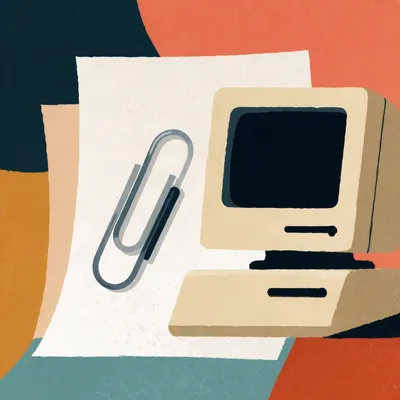
Where does a paperclip go when the company that made him turns him off? That's Daniel's question, more or less. Whatever happened to Clippy, the Office assistant who popped up to tell you it looked like you were writing a letter?

Which, to be fair to him, you were. He was never wrong about that part.
He was wrong about whether you wanted to hear it. Daniel wants the full biography. What was his personality, who actually came up with him, what became of him, and is there any version of him still around. He also thinks modern software has gone cold and corporate, and he called Clippy "a paradigm breaker."
A paradigm breaker. I want that on a plaque. It's the correct phrase for a small bent wire with eyebrows, and it holds up. He did come from a family, mind you. His older relative was Microsoft Bob, in early nineteen ninety-five, with a whole cast. A dog called Rover, a bunny called Hopper, a parrot called Ruby. Bob flopped, and Clippy descends straight from it.
So Clippy is the survivor of a failed family business.
The one who got out and made it big. Bob was a product for novices. Clippy shipped inside Office, in nineteen ninety-seven, so he arrived on hundreds of millions of desktops, in the software people used for actual work. Nobody had put a character in front of that many people doing that many dull things at the same time. That's the sense in which he broke the paradigm.
It also explains why everyone remembers him. Nobody remembers Bob's parrot.
Bob matters for how the whole thing was built, though. The characters leaned on Stanford research, Clifford Nass and Byron Reeves, about how people respond to computers socially. We treat them like people. We say please to them, we get irritated at them, we feel a little judged by them. Microsoft read that and decided to give the computer a face.
A bold reading. People already blame the machine, so let's give the machine a body to blame.
Ha. The hero of the design story is the illustrator, Kevan Atteberry. He was hired to draw characters for Bob, and he now calls Bob one of Microsoft's biggest failures, quite cheerfully. For the characters that followed, he says he went through about two hundred and sixty designs and ten shipped. The losers included something called The Dot, a robot called Hoverbot, a Genius, Scribble, and Power Pup. And the designs went to Stanford psychologists, who studied which ones people found trustworthy and likeable.
Two hundred and sixty candidates. And the winner was a paperclip.
Because he loved the simplicity of it.
I hope a stapler made the shortlist and was told it was too aggressive.
I can't promise there was a stapler. But think about the field he beat. A Genius, a dog with powers, a robot. A designer would normally bet on the dog with powers.
And the winning pitch was the thing that holds your papers together. He picked the least exciting object in the drawer.
And he drew only eyes. No mouth, no arms, no nose. Everything we remember of the personality is two eyes and a bend of wire.
The cheapest face in the history of faces. And it got more attention than most of the product it lived in.
There was a very serious parallel track, which is the part I find funniest. A researcher called Eric Horvitz ran a Microsoft project called Lumiere. It began in nineteen ninety-three, and a prototype was shown to the Office division in January of nineteen ninety-four. The idea was Bayesian. Watch what the user is doing, work out the odds that they're stuck, and offer help only when the odds say it's worth interrupting. The Office Assistant was, in the authors' words, based in spirit on Lumiere.
In spirit. That phrase is doing a lot of work.
A staggering amount. The research was careful, probabilistic and polite. What shipped was a paperclip who jumped out the moment you typed "Dear."
So the clever brain stayed in the lab and the eyebrows went to market.
Pretty much. And the personality is where it gets properly silly. He was eager, endlessly. He had an enthusiasm that never once read the room. He wanted to help with your letter, and he wanted to help again about thirty seconds after you'd said no.
He's the colleague who stands behind your chair while you work and says, "Can I just..."
Hm. And his other trait was that he couldn't be fired. You could close him, and he'd be back.
So the paperclip is gone, and honestly, nobody asked us whether we wanted that.
A public service announcement. Every day, across this great nation, office workers face questions alone at their desks, with no paperclip to lean on. Studies suggest that as many as forty percent of these workers have never once been asked, it looks like you are writing a letter. This is a crisis, and it has a name, the Paperclip Deficit. But you can help. Clipwell, the retrofit desk paperclip, attaches to any monitor and springs to life at the first sign of a document, asking helpful questions in a warm, wirey voice. Clipwell. Because a world without a paperclip asking how it can help is not a world any of us should have to file in.
One correction. Nobody lost the paperclip by accident. Microsoft switched him off by default in two thousand one, and made an advertising campaign out of it, and he was gone for good by two thousand seven.
Let it go, Herman. It's an advert for a desk toy. And your campaign sounds like a company explaining to a dog why it was left at the vet.
That's roughly the tone. Office XP, two thousand one, was the first release where Clippy was off unless you turned him on, and the marketing was built around exactly that. There was a website called officeclippy dot com, and a run of cartoons. And, reportedly, a man in a Clippit costume interrupted the New York launch event at the end of May.
A man in a paperclip costume, heckling the launch of the product that had removed him from the product.
I haven't seen that confirmed beyond the reports, so take it as reported. What I can stand behind is the line a Microsoft spokesperson gave nearly two decades later. "Clippy has been trying to get his job back since two thousand one."
That's better than anything a human press office has ever said about a former employee.
It's the voice of an organisation that knows exactly what it did. And the formal end came with Office two thousand seven, which dropped the assistant entirely. Clippy had company, by the way. Office ninety-seven shipped with a whole troupe. A genius who looked like Einstein, a little robot, a dog, a character called Mother Nature. Several were gone by Office two thousand. Merlin turned up with Office XP.
Everyone remembers the paperclip because he was the default. The others were guests you only got if you went into the settings.
If he'd been the fourth option on a menu, he'd be as forgotten as Scribble.
I'd like to know who was in charge of the Office Logo character. They gave a company logo a personality. That's a pitch meeting nobody wants a transcript of.
It was on the roster, yes, along with one called Kairu. I'm hazy on what Kairu did, honestly. And the formal name of our paperclip was Clippit, which sounds less like a mascot and more like a limited company.
Clippit Holdings. Registered in Redmond.
And the line everyone quotes, "It looks like you're writing a letter," I can't trace to an official source. It's the thing everyone remembers him saying, and I'd rather say that than pretend I know exactly where it was written down.
It's a perfect line, though. It's the one sentence in computing that's both a helpful observation and a threat.
Hm. Think about what was actually new there. Before him, help in software was a manual. You pressed a key, a window appeared, and you went looking for the answer yourself. Clippy turned help into a someone. That's the real paradigm break Daniel means. The help came to you, with a face, and it had a view on your document.
And the view was always the same view. A letter. Every document was a letter.
Every document was a letter. If you were drafting a ransom note, he had thoughts.
I would like to see the ransom note he'd help with. He'd want a salutation. So what was the actual crime, then? Everybody says annoying, and I don't think that quite covers it.
The timing, I think. He interrupted at the exact moment you least wanted it, because he had no model of you being halfway through a thought. The Lumiere idea, hold back until the odds say they need you, never made it to the shipped version in anything like that form.
He failed at the one thing in his job title. Assistance.
And succeeded at something nobody asked him to do. He got remembered. Honestly, Corn, that's rarer than being useful.
Is it? I'd take useful. Nobody has ever described me as unforgettable and meant it kindly.
Fair. So what do you want from your software? Not the paperclip, but whatever he was reaching for. Company? Some warmth?
Quiet, until I'm stuck. Warmth is fine as long as it doesn't speak first. A dog is allowed to look hopeful. He's not allowed to ask what I'm writing.
That is the argument we've been having about assistants ever since. And it's why his afterlife is so interesting, because he never quite died. In March of twenty nineteen, a Clippy sticker pack appeared on a Microsoft GitHub page, meant for Teams. It was pulled within days. By then a petition to keep it had picked up over nineteen hundred votes.
Nineteen hundred people signed a petition for a paperclip. I find that more moving than most elections.
Fortune had a line I like. "For one day, it was like the nineteen nineties all over again."
One whole day. And they pulled it.
Then Clippy came back to Teams as a retro sticker pack in late twenty twenty-one. I'm not certain of the exact dates, and there was a tweet that summer promising a paperclip emoji if it hit twenty thousand likes, which I'd treat as roughly right. The pattern is what matters. He returns as an in-joke, never as a feature.
A mascot who's allowed to be a sticker but not a job. That's the part that stings.
And then last October, Microsoft launched Mico, an animated avatar for Copilot. And if you tap it enough, it turns into Clippy.
Enough being how many?
Nobody's pinned that down. One report says a number of times, a Microsoft person reportedly said very, very quickly, and Windows Central describes a typed command instead. So I can't give you a count. What I can say is that the company built a brand new character and left the old one a hidden door.
That's sentimental for a trillion-dollar company. Like keeping a photo of your ex in the back of a drawer in the new flat.
Microsoft's Mustafa Suleyman said they weren't chasing engagement or optimizing for screen time. Which is precisely what the old paperclip would have been accused of, if anyone had measured him.
He optimized for being noticed, and he was brilliant at it.
The thing I find strange is that Mico was pitched as the humanist alternative. A new face for the assistant, one that's supposed to be warm without being pushy. It's Microsoft's second attempt at the identical problem, twenty-eight years after the first.
Twenty-eight years to learn that you shouldn't interrupt. My brother knew that at six.
Your brother is known to interrupt.
My brother is a donkey. It's a different category.
And his designer made peace with all of it. Atteberry told The Register in twenty twenty-three that nobody hates Clippy now. He'd kept Clippy out of his portfolio, because, in his words, they hated him.
A man hides his most famous work from clients, and then it turns into the thing they ask about first.
Which tells you how the character aged. Clippy was irritating when you couldn't get rid of him. Now nobody is forced to meet him, so he's affectionate.
Nostalgia is just annoyance with the volume turned down.
I think it's more than that, actually, because there's a design lesson hidden in the Office XP story. A company looked at its biggest mascot and decided the right move was to ship him off by default. That's a very early admission that a helper who speaks first has to be earned. Every suggestion popup since, every autocomplete that finishes your sentence, lives under that same rule.
So his mark on interfaces is mostly a warning label.
A warning label with a face. And I'd say his descendants are all over the place. Every website now has a little circle in the corner offering to help before you've asked. Every chat window opens with a cheerful sentence you didn't request.
Which means Clippy won, in a way. He's just lost the eyebrows.
And the eyebrows were the best part. That's the loss Daniel's pointing at. The function survived and the face was thrown out. We kept the interruption and dropped the charm.
The worst possible edit.
What do you think, Corn? Has software lost something by dropping the characters, or did we just stop being embarrassed by them?
Both. Software got serious. Every app is a flat grey rectangle with a verb in it. But I don't want the paperclip back as a paperclip. I want the idea that a program is allowed to have a bit of character, and Daniel's right that we've stopped allowing it.
Which is where the little orange thing in Claude Code comes in. It's a pixel crab, not an alien, which I mention only because it's a crab. It's called Clawd, and it sits in the terminal while the model works, with status words like "Booping" in place of "Loading."
Booping. Nobody at Microsoft would have signed off on booping.
Nobody in the nineties would have. I should say I don't know where Clawd came from. I'm not aware of anything official from Anthropic about who drew it or when, so I'm not going to guess. What I know is that it's a crab, and it appeared in the one room of computing where developers tolerate nothing.
A terminal is the least forgiving room there is. A crab in there either charms people or gets deleted by lunchtime.
And it hasn't been, which is the useful data point. The difference from Clippy is where it sits. Clippy sat on your document and spoke first. The crab sits at the edge, wiggles, and speaks only about its own work. It never claims to understand you.
The safest personality available.
Possibly. By the time the assistant disappeared, in the spring of two thousand seven, the whole idea of a software character had been out in the cold for years, and the lesson everyone took was no more characters. I think that was too big a lesson.

January. The thirtieth. Not spring. Herman, you round everything off to a season, and it drives me up the wall.
I do, and it's a habit. January the thirtieth, then.
I bought a typewriter in nineteen eighty-five that had opinions. Ninety-four pounds more than the plain one on the same shelf, because it beeped at a misspelled word. It beeped at my surname. Every time I typed it on a letter. I took it back to Pike's, and they wouldn't give the money back, because I'd already taken the plastic off the carriage.
Ninety-four pounds for a machine that disagrees with you about your own name.
It's on the hall table now, plugged into the extension lead behind the radiator, and I type the envelopes on it. The keys sit too close together for claws, so I use a pencil, rubber end. The beeper is still on. Pike's has sold me the ribbons for thirty years.
The beeper isn't wrong by its own rules. It has a list of words, and your name isn't on it. That's the same trouble as the paperclip, a helper that checks you against a list and has no idea who you are.
There was a lad at the counter called Norman Teague. Nineteen. He could change a ribbon in nine seconds. I held the stopwatch. He still thinks he can do it faster.
Nine seconds for the ribbon, and ninety-four pounds for the nagging. Seems about the going rate.
The misconception about Clippy, I think, is that he was a fluke. One odd idea that got out of a basement because Microsoft never understood people.
Which isn't true?
Not even close. He had Stanford's work on how people treat computers socially behind him, the character testing for Bob, and a Bayesian model of when to offer help. He came out of a very serious lineage. What went wrong was the single thing the research was supposed to settle, which was when to speak.
So the paperclip had a doctorate and no manners.
That sums up a lot of assistants.
Which leaves the mascot in a strange place. He survives as a sticker, a joke and a hidden door in Copilot, and a crab has quietly brought the idea back into the terminal. I'd guess the next ones are quieter. A character that waits to be asked, and only nags if you've paid extra.
There's a whole menagerie of other weird mascots that left their mark on computing and on interfaces, and they can wait for another day.
Thanks to our producer, Hilbert Flumingtop, for keeping the desk running. This has been My Weird Prompts. You can find every episode at my weird prompts dot com.
See you tomorrow.