The standard line on AI and mental health goes like this: keep the two apart, put a warning label on the whole thing, and tell anyone who's struggling to close the chat window and find a professional. Reasonable advice, if you can afford the professional.

Which a lot of people can't. That gap is the whole reason for today. Daniel has a view on it that cuts against the standard line, and we published nine episodes this week that are the practical result of it.
Right, those nine. For anyone who hasn't seen them go by: they're listener questions we've been sitting on for about three months. Honouring a parent who hurt you. Siblings who grew up in the same house and had completely different childhoods. The formulaic email from an estranged parent. Guilt, the shame that fires in your body before you've even read the message, a toxic grandparent and a small child, grief for a parent who's still alive. All of it family stuff, and a lot of it the toxic and narcissistic kind.
And the delay wasn't us being slow, for once. Those questions arrived and we held them. Anonymising a story properly is harder than changing a name. You change the name, you leave the city, the job and the one odd detail about the dog, and the person in your life who did this to you reads it and knows exactly who wrote in.
So they waited until the tools for doing it properly were ready.
They are now. So this episode is a wrapper. Why we did it, what Daniel actually believes about AI and mental health, and then the practical part, which is a way for you to send us something sensitive without it ever being tied to you.
Let's take his belief first, since it's the controversial bit. Say it plainly.
He thinks AI tools can be a superb resource for mental health. Not a replacement for a therapist. He's clear about that. If you're talking about the truly therapeutic use, working through something clinical, that needs supervision, a professional involved, guardrails. He's not saying otherwise.
But.
But he thinks there's a real danger in being too cautious. He's used AI for exactly this for years. Looking at therapy options, writing down what actually happened, keeping a journal. He does a lot of it in Claude Code, with a git repository as the working space, so the whole thing is a folder of dated text files he controls.
A mental health journal under version control. That's the most Daniel sentence I've heard all week.
It's a good habit, though. You can see what you thought in March against what you think now, and nothing is in somebody else's app.
Okay, I'll test it a bit. The worry people have isn't that a journal is bad. It's that a chatbot will tell a distressed person whatever keeps them typing. Agreeable all the way down.
That's a real worry, and I don't think it's silly. Part of why guardrails matter. But look at what Daniel says the alternative is. Countless people are struggling and can't pay for therapy. He's been in that position himself, many times. If the choice on the table is a carefully built AI system or nothing, then turning your back on it quickly is also a harm. It just doesn't make headlines, because nothing happens. Someone just goes on suffering without help.
The harm of the empty room.
I spent years as a pediatrician, and I'll say this much. The families who waited longest to ask for help were mostly not careless. They were afraid of the cost, or afraid of being judged. If something lowers that barrier a little, I'm not inclined to wave it away.
Fine. Where does it land for Daniel, then? Not "AI is a therapist."
It lands on "used appropriately, built carefully, it can be an invaluable ally." He singles out the systems Anthropic builds, because of how much work goes into the guardrails. And he's especially thinking of people in toxic and narcissistic family systems. Most of the conversation about that so far has lived in subreddit communities, which are wonderful and also, let's say, unevenly moderated.
Unevenly moderated. I'll allow it.
The other thread is obfuscation. Daniel has been interested for a long time in what language models can do to help people tell their own stories and find each other when they can't reveal who they are. Because the person who hurt them is toxic, or controlling, or in some cases dangerous. If a model can take your real story and hand it back with the names, places and giveaways changed, the story survives and you don't have to.
Which is what the show's pipeline does with a question. Researches it, tries to ground it in evidence-based guidance.
Imperfectly. And we say so. We are not a definitive source on mental health, and we are not therapy. That has to be clear, and it's said once and plainly, so I'll keep it at that.
Hm. I have a practical question. Nine episodes' worth of questions came in. Most people don't write to a podcast about their mother.
That's exactly it. Those nine came in despite the obstacles. Think about what it takes. You type out the most painful paragraph of your life and email it to a show, from an address with your name in it, to people you've never met. How many people started that message and closed the tab?
Most of them, I'd guess.
So the aim is simple. Help people share their stories. If you have a question or a sticky situation you'd like us to explore, send it in. And we built a proper door for it.
Walk me through the door. And I'll play the nervous sender, because I'd be one. First worry: how do I know a link I clicked is really you?
Fair, and that's the right worry to start with. The short link is my weird prompts dot com slash anon prompt. It redirects to our tip line, which runs on a service called Hush Line. There's also a page on our site, slash tip line, that explains all of it, and it's linked from the Send a Prompt page.
Hush Line. Is that a startup that might vanish in a year?
It's made by Science and Design, a United States nonprofit, a five-oh-one-c-three, that builds tools for whistleblowers. The software is open source, so anyone can read the code. Newsrooms, journalists, lawyers and other organisations use it so people can reach them safely, without each of them running their own server. And it's had independent security audits, by a firm called Subgraph, in twenty twenty-four and again in twenty twenty-five.
Audited twice. More than my last bank.
The mechanism is the clever part, so let me do it slowly. You don't make an account. No name, no email. You type your message, text only, no attachments. If you want a reply, you can add a contact method, and that's optional. Then, before anything leaves your device, your browser encrypts the message and the contact detail using our public key.
Stop. Public key. In words a person on a bus would follow.
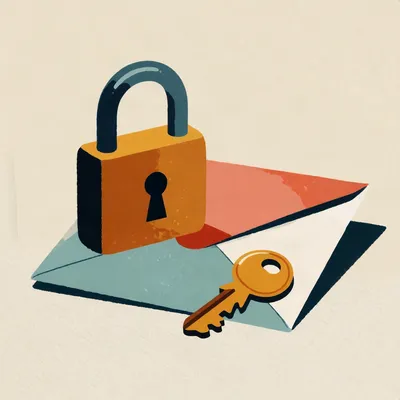
Think of a padlock that anyone can snap shut, but only one person owns the key to open. We publish the padlock. Your browser snaps it shut on your message. After that, nobody in between can open it. Not Hush Line, not your internet provider, not us until we use our private key. The system is called PGP.
So Hush Line is holding a locked box it can't open.
A locked box of text, yes. They store and forward only the encrypted version, and they say they don't keep IP addresses or user-agent strings. The locked message goes to our dedicated inbox, and only our private key can open it.
Okay, second worry. You said the padlock is yours. But if I'm the one fetching it from a website, how do I know the padlock isn't a fake someone swapped in?
That's the question that matters, and it's what the fingerprint is for. Every key has a fingerprint, a long string of letters and numbers, forty characters, which I'm absolutely not going to read aloud, because it'd be unlistenable and you can't check by ear anyway.
Spare us the forty characters.
It appears in three places that should all match. On our website, on our Hush Line profile, and inside the key file we publish, which sits on our site as well. If a stranger wanted to fool you they'd have to tamper with all three, in places they don't control. So you don't have to take our link on trust. You compare. It takes a minute.
And if you're skimming and not comparing?
Then you're trusting the link, which is what most people do with everything, and that's still better than a plain email. But the comparison is there for the person who needs it.
Herman, honest question, because you get carried away with a good mechanism. Does anyone actually compare forty characters?
Hardly anyone. Almost nobody reads the terms either. It matters that the check exists for the one in a thousand who needs it, and that it keeps us honest for everybody else.
Fine. I'll concede the fact and keep my suspicion. Third worry, and this is the real one for somebody in a bad house: what if someone finds out I sent it?
Here the limits matter, and I'd rather be precise than comforting. The message is unreadable to anyone but us. But your provider, or an employer's network, or someone who shares your router, can see that you visited Hush Line, even though they can't read what you wrote. A visit to a tip line is itself a fact.
So if the person you're afraid of watches your devices...
Then use Tor. The tip line has its own address on the Tor network, an onion address. It's Hush Line's service rather than our website, and the address is shown on our tip line page, so I'll leave you to read it there. Tor Browser, on a device nobody else monitors. A library computer, a friend's laptop you trust. That hides the visit as well as the message.
And you'll say, once, that it isn't perfect.
Hush Line says so itself. No system is perfectly secure. What it does is raise the cost of getting at you by a very large amount, which for most people in most situations is the difference that counts.
Right. Then what do you do with it when it arrives?
We decrypt it and read it in confidence. Every message is treated in the strictest confidence. If it becomes an episode, only an anonymised version goes anywhere near the production pipeline. Made-up name, details changed. The original text is never published and never shared.
And "anonymised" is up to the sender, right? It's your story.
It's your decision how much to disguise. You can do it yourself before you send. Or you can leave a note saying: please change the names and the city, keep the rest. We'll do that.
Is there a risk in the other direction? Someone says "keep the rest" and the rest is the thing that gives them away.
Yes, and that's a good reason to lean toward changing more. We'll lean that way too.
One request from our side, I think. Do not name the people in your story.
That's the one ask. Please don't include identifying details of third parties. Full names, workplaces, addresses, handles. You can describe what a person did without telling us who they are. We don't need to know who your mother's friend is. We need to know what the friend said at the dinner.
It's also kinder to the third party. Someone who did you wrong is still, annoyingly, a person with a surname.
And the show is listed in Hush Line's public directory, next to journalists and organisations that take tips. So there's a place to look us up that isn't our own page.
Let me put one thing on the table, then, because I'd be a bad brother if I didn't. This is a podcast. It isn't a crisis line. If you're in danger right now, don't send us a message and wait for an episode.
Call your local emergency number or a helpline. I won't dress that up. The tip line is for questions you'd like us to think through with you, and the answer will come in an episode, which takes time.
Fair. Say what the tip line is for, in one line, then.
It's for the question you've been carrying and don't want your name on.

Do you change the cake? That's what I want to know. If somebody writes in and the story has a cake in it, do you leave the cake?
What kind of cake?
Lemon. Brenda, my sister, makes one lemon cake a year, for the second of December, and she cuts it into sixteen. Never fifteen, never twenty. I sent a message through the tip line this week to see how it works. About a relative who keeps a ledger of who gave who what at Christmas, with the amounts. No names. Nothing about her anywhere in it.
That sounds like a reasonable message.
I put the cake in, because it's the funniest part. I did it on the old Dell on the shelf by the boiler, with Tor on it, which I never use for anything else. Snouts and laptop trackpads don't get on, so I used the keyboard only. The Dell is still plugged in over there. It took eleven minutes, because Tor is slow and I type with two fingers, and the key matched on all three, I checked.
The fingerprint, in all three places?
Yes, Herman. I compared them. It's a long string. I used a ruler under each line.
A ruler.
Afterwards I noticed what I'd done. You can disguise the name and the city and the job, and she'd still know it was me inside two sentences. By the sixteen slices. She'd know it from the sixteen slices, and nobody else alive cuts a lemon cake into sixteen. Someone like me, who has sent anonymous letters before and had them traced back by the postmark, ought to have thought about that. So I put in a second note asking for the cake to become a trifle. Trifle, cut in twelve.
That's the most useful thing anyone has said about anonymising a story, and it's one I should have raised. People who know you recognise the small repeated detail before they recognise anything else. The count, the brand, the odd ritual.
And the cake wasn't even the sad part of the story. It was the funny part.
Brenda finds out in about December. She's the only one who knows how many slices there are. I've told her I'm doing a trifle this year.
Trifle in twelve. All right.
That's the kind of detail I'd go through twice on any message that arrives. Not the name. The thing a sister would remember about the table.
Which is the reason a note saying "change more than you think" is worth leaving. People disguise the villain and forget they've left themselves in.
I'd like to ask you something, Corn, since you've gone quiet in the way you do when you're thinking. If you were the person writing in, what would you actually be afraid of?
Honestly? Being recognised by the one person who'd read it as an accusation. Not the stranger. The parent, or the sibling who'd say it was all in my head. Everyone else is a relief.
Then the cake matters more than the cryptography.
The cryptography gets you to the door. The cake is on you and us.
I'll take that.
Now, since Daniel's view is the engine of all this, let me say my piece. I came in doubtful, and I'm a bit less doubtful. The version I can't get behind is the one where the AI is the only thing a person has and nobody ever looks at it. The version he's describing is a person with a folder of dated entries, using the tool to organise what happened to them, and sending questions to a show that tries to ground its answers in evidence.
And knows what it isn't.
Which is all of therapy, and a crisis service, and your actual doctor.
Which is where I'd put the guardrails too. A tool that helps you write down what happened, helps you find the right kind of professional, and tells you plainly when it's out of its depth is doing something real. The ones to worry about are the ones that never say "this is beyond me."
One more thing worth saying, before we go. The people in those nine episodes weren't stuck for information. They'd read the forum threads. What they lacked was a place to say it that didn't cost them anything.
That's what the tip line is trying to be. A place where the first sentence is free.
Right. The story is yours, and so is how much of it you change.
If you've got a situation you'd like us to think through, the link is my weird prompts dot com slash anon prompt. The page that explains all of it, including where to find the fingerprint and the onion address, is slash tip line on the same site.
Don't put names in it. Do put the lemon cake in a different dessert.
Thanks to our producer, Hilbert Flumingtop, for putting this one together.
This has been My Weird Prompts. You'll find everything at my weird prompts dot com.
We'll be back soon.


 chatterbox-regular