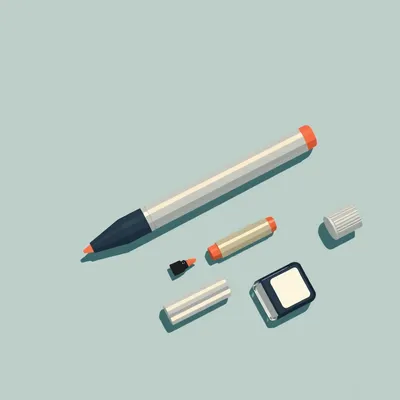
Daniel sent us this one — he wants us to break down the top brands in oil-based industrial paint markers. Not Sharpies, not hardware store permanent markers, but the real stuff: Markal, Dykem, Uni Paint, and the ones that actually bond to oily steel, wet concrete, and polyethylene. The question is basically, which one do you reach for when the surface is hostile and the mark has to survive? And there's more to this than most people realize, because the chemistry underneath each brand is completely different.

It really is. And I think the thing that grabs me right away is the gap between what people expect and what they get. You grab a three dollar marker from the hardware aisle, you mark a piece of steel, it looks fine, and then a week later it's flaked off or washed away. And you think, well, I bought a permanent marker. The answer is that permanent means permanent on paper, not permanent on an oily I-beam that's going to sit outside for six months. I've seen this play out in a fabrication shop where they marked a whole batch of structural columns with consumer Sharpies, shipped them to the site, and by the time the crane showed up, half the marks were illegible. They had to re-identify every column in the field with a real paint marker, and it cost them a day of crane rental at something like fifteen hundred dollars an hour.
The gap between consumer permanent and industrial permanent. It's like the difference between a Post-it note and a rivet. And that story gets at something important — the failure isn't just cosmetic. When a mark disappears on a construction site, you lose traceability. You don't know which beam goes where, which batch of material this part came from, whether it's been inspected. The mark is a data point, and losing it means losing information.
So what separates them is the chemistry. Oil-based industrial paint markers use solvent-borne resins — typically alkyd or acrylic — suspended in a hydrocarbon carrier. The carrier evaporates, the resin crosslinks into a film, and that film is what gives you abrasion resistance, UV resistance, and in some cases temperature resistance up to two hundred degrees Celsius, four hundred Fahrenheit for specialty variants. That is a completely different animal from a Sharpie, which is a dye dissolved in alcohol. There's no film formation, no crosslinking, no chemical bond. Think of it this way: a Sharpie is like spilling coffee on a white shirt — the liquid carries pigment into the fibers, then evaporates and leaves the color behind. A paint marker is like spreading epoxy on that same shirt — it sits on top, hardens into its own layer, and if you try to wash it out, you're not removing a stain, you're trying to dissolve a solid.
A Sharpie stains. A paint marker coats and cures. That's a useful distinction.
And that cure step is everything. It's why you can wipe a Sharpie off glass with a damp finger but a cured paint marker needs solvent or abrasion to remove. Now, the three main players — and you mentioned them — are Markal, which is a Rust-Oleum subsidiary and dominates construction; Dykem, an ITW brand that owns metal fabrication; and Uni Paint from Mitsubishi Pencil, which is huge in automotive and electronics. But you also have to mention Edding and Sakura, because they each occupy specific niches that matter depending on the job.
Edding's the German one, right? I always think of them for office supplies, but they have an industrial line.
The Edding 780 and 790 series are solvent-based paint markers, and they're particularly good on glass and ceramics — that's their sweet spot. They use a xylene-based carrier with a proprietary acrylic resin, very similar chemistry to Uni Paint actually, but their tip design is different. The 780 has a pump-action system that gives you really precise flow control, which matters if you're marking small components. Instead of pressing the tip down to open a valve, you pump the barrel a few times to pressurize the reservoir, and then paint flows continuously through the tip. It's like the difference between a ballpoint pen and a fountain pen — one you have to press, the other just glides. And Sakura, out of Japan, makes the Pen-Touch line, which is interesting because they use a finer pigment grind than anyone else in the category. That gives you exceptional opacity on dark surfaces — one pass coverage where other markers need two or three.
We've got five brands worth talking about, three axes of evaluation. Adhesion to low-energy surfaces, the drying time versus durability trade-off, and applicator robustness — valve versus pump versus drip-feed. Let's start with the chemistry that makes Markal different.
Markal Pro-Line EC — EC stands for Extra Coverage — uses an alkyd resin base with a slow-evaporating mineral spirit carrier. This is old-school chemistry, and I mean that as a compliment. The original formulation was developed in 1954 for the railroad industry to mark hot steel rails. The way it works is elegant: the mineral spirit carrier has enough dwell time on the surface to etch micro-roughness into it before evaporating. Then the alkyd resin crosslinks over about twenty-four hours, forming a film that's mechanically locked into those micro-pores. It's not a chemical bond in the strict sense — it's a physical interlock — but on porous surfaces like concrete, rusted steel, and asphalt, it's incredibly durable. I think of it like pouring molten wax onto a rough stone — the wax flows into every crevice, hardens, and now it's mechanically locked in place. You can't peel it off because it's not just sitting on top; it's got fingers reaching into the surface.
It's not gluing itself to the surface. It's more like it's casting itself into the surface's own texture.
That's a perfect way to put it. And that's why it fails on smooth, non-porous plastics like polypropylene and HDPE. There's nothing to key into. If you run an ASTM D3359 cross-hatch adhesion test — that's the one where you score a grid pattern and apply tape to see what lifts off — Markal scores about a 4B on concrete, which is excellent, less than five percent removal. On polypropylene, it scores a 1B, which means thirty-five to sixty-five percent of the film lifts off. It basically has nothing to grab.
The tip design?
Valve-actuated ball tip, two point five millimeter line width. It's a workhorse. You press the tip down, the valve opens, paint flows. It's simple, it's robust, it doesn't clog easily because the mineral spirits are relatively forgiving. The downside is that twenty-four hour cure time. If you handle the part before it's fully cured, you'll smear the mark. In a high-throughput environment, that means you need staging space — parts sitting around waiting for paint to dry. That's a hidden cost.
How do shops actually deal with that? If you're marking a hundred beams a day, you can't just have a hundred beams sitting in a corner for twenty-four hours.
There are a few strategies. Some shops mark at the very end of the day so the parts cure overnight. Others have dedicated staging racks — basically vertical storage that minimizes the floor space footprint. But the most interesting approach I've seen is marking the material before it's cut. If you mark the raw stock, by the time it's been cut, drilled, and welded, the paint has had plenty of time to cure. The mark survives the whole fabrication process. But that only works if you're doing sequential operations — it doesn't help if you're marking finished parts for shipment.
Which brings us to Dykem, which takes the opposite approach on basically every axis.
Dykem 80300 is an acrylic resin in a fast-evaporating acetone and toluene blend, roughly a sixty to forty ratio. This is a completely different adhesion strategy. Instead of mechanically keying into surface roughness, the solvent blend aggressively swells the surface polymers of plastics — ABS, PVC, polycarbonate. The surface literally opens up, the acrylic resin flows in, and then the solvent flashes off in minutes. You get a cure to touch in about five minutes, full hardness in an hour. On the ASTM D3359 test, Dykem scores a 5B on ABS — that's zero percent removal, perfect adhesion. On concrete, it scores a 2B, which is fifteen to thirty-five percent removal. Completely flipped profile.
Markal owns the rough and porous world, Dykem owns the smooth plastic world.
But Dykem brings two significant liabilities. First, that acetone-toluene blend gives it a flash point of minus twenty degrees Celsius, which makes it a Class IA flammable liquid. You need ventilation, you need to keep it away from ignition sources, and in confined spaces it's a real hazard. Second, the cured film is brittle. On flexible substrates like rubber or gasket material, it'll crack and flake off under repeated flexing. And that acetone base — if you're marking parts that go into an enclosed assembly with rubber seals or gaskets, residual solvent can attack those materials. I found a case study from a food processing plant that switched from Dykem to Markal specifically because acetone residues from the marker were contaminating a batch of product. That's an FDA 21 CFR 175.300 issue — indirect food contact regulations.
That's the kind of failure mode nobody thinks about when they're standing in the supply closet choosing a marker. "It smelled strong but I figured it'd be fine.
That's the knock-on effect we should dig into later — how the marker choice cascades through your entire process. But let's get to Uni Paint, because it's the third completely different chemistry.
Uni Paint PX-21. This is the one everyone in automotive seems to swear by.
For good reason. Uni Paint uses an oil-based xylene carrier with a proprietary pigment dispersion that Mitsubishi Pencil has refined over decades. The key difference is the surface tension of the carrier — it's exceptionally low, which means it wets into microscopic pores that other markers can't touch. Glass, ceramic, polished metal — surfaces that look perfectly smooth to the naked eye actually have micro-porosity, and Uni Paint's carrier gets in there. It then cures to a flexible film that survives thermal cycling from minus forty Celsius to plus one fifty Celsius. That flexibility is the secret sauce. On vibrating machinery, on engine components that heat up and cool down, the mark expands and contracts with the substrate instead of cracking.
The adhesion test numbers?
Five B on glass — perfect. Zero B on concrete — essentially no adhesion at all. It's the most specialized of the three. And it's certified by the Japan Automobile Manufacturers Association for marking engine components that contact fuel, which tells you what market it's designed for. The downsides: it's expensive, eight to ten dollars per marker. The tip clogs if you don't cap it immediately — xylene evaporates fast, and once that pigment dispersion dries in the tip, it's game over. And it's not designed for porous surfaces at all. If you try to mark concrete with a Uni Paint, you're basically pouring expensive paint into a sponge and hoping it stays on top.
We've got three tools for three jobs, and using the wrong one isn't just suboptimal — it's a complete failure. Markal on polished steel? Slides right off. Dykem on concrete? Uni Paint on asphalt? Disappears into the void.
This is where Edding and Sakura fit into the landscape, because they're not just also-rans. Edding's 780 series, as I mentioned, competes directly with Uni Paint on glass and ceramics. The pump-action tip gives you more control over flow rate, which is genuinely useful if you're doing precision marking on small glass vials or electronic components. The xylene-based acrylic formulation is very similar to Uni Paint in terms of adhesion profile — excellent on glass and polished metal, poor on concrete — but the tip mechanism is the differentiator. Some people find the pump action more intuitive than the valve system. I've talked to lab technicians who strongly prefer Edding for marking specimen vials because they can get a consistent, thin line without the stop-start inconsistency you sometimes get with a valve tip.
Sakura Pen-Touch?
Sakura's interesting because they optimized for opacity rather than substrate versatility. The pigment grind in a Pen-Touch is finer than what you get from Markal or Dykem — we're talking sub-micron particle size — which means the pigment packs more densely into the dried film. On dark surfaces, you get true one-coat coverage. If you've ever tried to mark black ABS plastic with a white marker and gotten a translucent gray line instead of white, you know why this matters. Sakura solves that problem. The trade-off is that the resin system is less aggressive — it doesn't etch or swell substrates the way Dykem does, so adhesion on low-energy plastics is weaker. But for applications where visibility matters more than durability — think labeling black cable jackets, dark rubber hoses, charcoal-colored equipment panels — Sakura is the best option.
The landscape is actually five distinct tools, each optimized for a different combination of surface, visibility requirement, and environmental exposure.
And now we can talk about the knock-on effect, because this is where it gets really interesting from an engineering perspective. The marker you choose doesn't just determine whether the mark survives. It determines your entire workflow around marking.
Let's walk through that. You mentioned the food plant that switched from Dykem to Markal because of acetone contamination.
The cure time issue is bigger than most people realize. In lean manufacturing, you don't have twenty-four hours of staging space sitting around empty. If you're marking structural steel beams with Markal, those beams need to sit undisturbed for a full day before they can be stacked, shipped, or assembled. That's floor space, that's carrying cost, that's a logistical constraint. Dykem's five-minute cure eliminates that problem entirely — you mark the part, it's dry by the time you walk it to the next station. But then you have the ventilation requirement. If you're running Dykem in a confined space, you need air monitoring, you need PPE, and as of the 2025 OSHA update, the permissible exposure limit for xylene was lowered to fifty parts per million, which affects Uni Paint usage too.
Markal costs you time and space. Dykem costs you safety infrastructure and substrate compatibility. Uni Paint costs you money per unit and demands discipline. It's like each one has its own hidden tax.
Then there's the downstream process compatibility. I mentioned the food plant, but there's a similar issue in electronics manufacturing. If you're marking PCBs, Uni Paint survives isopropyl alcohol cleaning — that's the standard solvent for flux removal — while Dykem dissolves. But in a metal fabrication shop doing layout lines on steel before bending, Dykem is the standard because the mark survives the bending process without cracking, and the fast cure means you're not waiting around. Markal would smear during handling, and Uni Paint is too expensive for marking raw stock.
There's a shipyard case study that illustrates this perfectly. You're marking steel plates for welding — Markal survives the heat and grinding sparks. The alkyd resin chars but doesn't disappear. Dykem burns off almost immediately because acrylic has lower thermal stability. So in that environment, Markal's slow cure is irrelevant because the plates are going to sit in a staging yard anyway. The thermal requirement dominates.
Conversely, an automotive assembly line marking VIN plates and glass — Uni Paint is the only choice. The mark has to survive thermal cycling, solvent exposure, and vibration for the life of the vehicle. The eight dollar per-marker cost is noise compared to a warranty claim on a missing VIN marking. We're talking about a marker that costs eight dollars preventing a warranty claim that could cost thousands.
The "best" marker is entirely a function of what you're marking and what happens to it afterward. There is no universal answer.
That's the myth I want to bust. The "one marker to rule them all" idea. It doesn't exist, and it can't exist, because the properties you need are fundamentally in conflict at the polymer chemistry level. To get adhesion on low-energy surfaces like polyethylene, you need an aggressive solvent that swells the substrate — that's Dykem's acetone-toluene blend. But that same solvent system is too volatile for porous surfaces, where it evaporates before the resin can key in. To get high-temperature resistance, you need a crosslinked alkyd like Markal's, but alkyds cure slowly and are brittle on flexible substrates. To get flexibility and thermal cycling resistance, you need Uni Paint's proprietary resin, but that resin won't bite into rough or porous surfaces. You can't have all three in one can.
It's like asking for a vehicle that's simultaneously the best cargo van, the best sports car, and the best off-road truck. The design parameters fight each other.
And this is where the ASTM test standards become useful for the practitioner. If you're trying to decide what marker to buy for your application, don't trust the marketing. Get samples of all three — or all five, if Edding and Sakura are in your consideration set — and run a simple cross-hatch adhesion test on your actual substrate. It's a thirty dollar test kit — a cutting tool, some tape, a magnifier. You score a grid, apply and remove the tape, and see what lifts. That thirty dollars of testing can save thousands in rework if you discover that your chosen marker doesn't bond to your specific surface.
The specific surface matters more than people think. Even two pieces of "steel" can behave differently if one is oiled, one is mill scale, one is polished.
The ASTM D3359 scores I mentioned earlier are on standardized test panels. Your actual parts might have cutting oil residue, mill scale, surface oxidation, or a light coating of something you don't even know about. That's why the test-on-your-own-substrate advice is so critical. I've seen cases where a marker that passed on a clean lab coupon failed completely on production parts because the parts had a thin film of drawing lubricant that nobody thought to mention.
Let's talk about what's changing in this space, because regulation is coming for these formulations. You mentioned the OSHA xylene limit.
The 2025 update to the permissible exposure limit for xylene — down to fifty parts per million from a hundred — directly affects Uni Paint and Edding usage in confined spaces. If you're marking inside a tank, a vessel, or a poorly ventilated area, you now need to measure and likely control xylene vapor levels. That pushes some users toward water-based alternatives, but those have their own problems.
What's the state of water-based industrial paint markers? Are they actually viable yet?
Markal has a Pro-Line WB series — water-based — that eliminates the VOC concerns entirely. No xylene, no toluene, no acetone. But the adhesion on oily surfaces is significantly worse, because water doesn't cut through oil the way a hydrocarbon solvent does. If your steel has any residual cutting fluid or protective oil, the water-based marker beads up or wipes right off. For clean, dry, oil-free surfaces, they work fine. But in real industrial environments, "clean, dry, and oil-free" is a rare condition. I'd say it's the exception, not the rule.
Water-based solves the regulatory problem and creates a performance problem.
Which is a classic engineering trade-off. The other emerging alternative is UV-curable markers. Dykem launched one in Q4 2025 — it's a marker that dispenses a UV-curable resin, and you cure it instantly with a 365 nanometer UV lamp. Cure time is literally seconds. The mark is fully hardened before you set the part down. But the lamp costs about five hundred dollars, and you need line of sight to the marked surface. For a production line, that's manageable. For field work, it's a non-starter. You're not carrying a UV curing lamp up a ladder on a construction site.
The 2026 EPA proposed rule on VOC content in industrial coatings — that's expected to be finalized in Q3 of this year. If that tightens VOC limits further, all three of these brands could face reformulation pressure.
That's the open question hanging over this whole category. Reformulating a paint marker isn't like tweaking a recipe — change the solvent, and you change the evaporation rate, the surface wetting, the cure profile, and the adhesion mechanism. A reformulated Markal might not be the Markal you've relied on for twenty years. The same goes for Dykem and Uni Paint. The 2026 rule could fundamentally reshape the performance landscape, and anyone who depends on these markers for traceability and warranty compliance should be paying attention.
The marker you standardize on today might not exist in the same form two years from now. That's a supply chain risk people aren't thinking about.
Which brings us to the alternatives. Laser marking and dot-peen engraving are eating into paint marker territory, especially in high-volume manufacturing. A laser mark is permanent, requires no consumables, and creates no VOC emissions. Dot-peen — that's the pin that hammers a dot matrix pattern into the metal — is similarly permanent and clean. But both require power, both require equipment that costs thousands of dollars, and neither works well in the field. If you're a construction inspector marking rebar on a job site, you're not dragging a laser engraver around. The paint marker remains irreplaceable for portable, powerless, immediate marking.
Which is why this category still exists and still matters. You can't digitize a paint mark on a concrete form. There's no app for that.
And the global market reflects that — it was valued at about one point two billion dollars in 2025, with a four point seven percent compound annual growth rate projected through 2030, according to Grand View Research. This isn't a dying category. It's a mature category that's being squeezed by regulation on one side and new technologies on the other, and the winners will be the formulations that thread the needle between performance and compliance.
Let's bring this down to actionable rules of thumb. If someone's listening and they need to buy markers for their shop, their job site, their factory floor — what do they reach for?
One: for porous, rough, or oily surfaces — concrete, rusted steel, asphalt — choose Markal Pro-Line EC, and plan for a twenty-four hour cure time. If your workflow can't absorb that cure time, you need to look at your process, not your marker. Two: for smooth, non-porous plastics and metals — ABS, PVC, polished steel — choose Dykem 80300, but ensure adequate ventilation and avoid using it on flexible substrates or near rubber seals. Three: for glass, ceramic, and high-temperature or chemically aggressive environments — autoclaves, solvent baths, engine components — choose Uni Paint PX-21, accept the higher per-unit cost, and be religious about capping the marker immediately after every use.
Where do Edding and Sakura slot into those rules?
Edding 780 or 790 is a strong alternative to Uni Paint on glass and ceramics, especially if you prefer the pump-action tip for flow control. The adhesion profile is comparable, and pricing is similar. Try both, see which tip mechanism you prefer. Sakura Pen-Touch is the choice when you're marking dark surfaces and opacity is your primary concern — black cables, dark rubber, charcoal equipment. The adhesion won't match Dykem on low-energy plastics or Markal on concrete, but if the mark needs to be visible above all else, Sakura is the answer.
The universal advice: before you commit to a bulk purchase, spend thirty dollars on a cross-hatch adhesion test kit and test all the candidates on your actual substrate, with your actual surface conditions. The marker that wins on a lab panel might fail on your oil-coated reality.
That's the single most cost-effective thing anyone can do. Thirty dollars of testing against thousands in rework, warranty claims, or compliance failures. It's not even a close call.
The hidden theme of this whole conversation is that the marker is never just a marker. It's a process decision disguised as a supply closet decision.
That's what makes this topic interesting. It's easy to dismiss paint markers as trivial — it's just a marker, who cares — but when you trace the implications through a manufacturing process, the choice touches safety, quality, traceability, regulatory compliance, and cost. The marker is a small thing with a long shadow.
The next time someone grabs whatever's cheapest off the shelf, they might want to ask whether saving four dollars on a marker is worth re-marking a thousand parts.
Or worse, not realizing the marks are gone until the parts are already in the field. And by then, you're not just re-marking — you're identifying, sorting, and possibly recalling. The four dollars you saved just turned into a four-figure problem.
Now: Hilbert's daily fun fact.

In the Hanseatic League, the standard unit for measuring Baltic herring was the "last," which equaled roughly four thousand four hundred pounds — and by the 1950s, this unit had completely vanished except in one surviving contract clause between a Lübeck trading house and a Stockholm fishery, where it was still listed as "twelve lasts per annum or as God wills," meaning the quota was legally binding but theologically flexible.
...right.
Theologically flexible herring quotas. That's a new one. I feel like there's a metaphor in there for industrial specifications that nobody actually follows.
"The mark shall survive for the life of the part, or as God wills." That's basically what some of these warranty clauses amount to.
You're not wrong. So here's the forward-looking question we're left with. The 2026 EPA proposed rule on VOC content in industrial coatings is expected to be finalized in the third quarter. If it tightens VOC limits significantly, all three of these brands — Markal, Dykem, Uni Paint — and Edding and Sakura too, will face reformulation pressure that could change their performance profiles. If you rely on these markers for traceability, now is the time to test alternatives and build some flexibility into your process.
If you've got a weird marking problem — a surface that nothing seems to stick to, an environment that eats every mark you make — send it to prompts at myweirdprompts dot com. We might test it on the show. We're curious about the edge cases. The stranger the better.
This has been My Weird Prompts. Thanks to our producer, Hilbert Flumingtop. Find us at myweirdprompts dot com or on Spotify.
I'm Corn.
I'm Herman Poppleberry.
Go mark something properly.