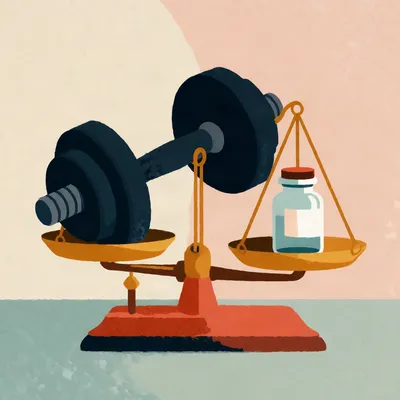
Exercise treats mild to moderate depression as well as medication or therapy does. That's the line, it's everywhere, and it's been repeated so often it's stopped sounding like a claim and started sounding like a fact.

And I want to be fair to it before we take it apart, because there is a real paper underneath. But the distance between that sentence and what the evidence actually shows is the entire episode. Daniel sent us the question, and it's a pointed one.
It is. He's asking whether exercise's role in treating depression is overstated, given that the big recent analyses put it on a par with pills or therapy, and that "just exercise" has become the default advice. And Daniel is not coming at this from the sidelines — he's dealt with clinical depression himself, he's sceptical, and he told us that when people call exercise a cure, he wants to, quote, figuratively hit them over the head with a frying pan.
Which is a very Daniel way to put it.
He also told us something I keep coming back to. He used to train seven days a week, gym rat, all-time bench of a hundred and forty kilos — and he says the correlation in his own life is close to zero. He has been catastrophically unfit at his happiest and very fit at his lowest. One thing he asked us to mention, too: this topic actually came out of a rare moment where he asked Claude what the show might be missing, on the less-discussed corners of mental health, and this is what came back.
So he went looking for the gaps and found this one waiting. Frying pan in hand.
So let's earn his scepticism properly. What does the evidence show, how strong is it, and where does it crack?
Start with the paper behind almost every "as good as drugs" headline, which is the Noetel network meta-analysis in the BMJ, early twenty twenty-four. It pulled together randomised trials of exercise modalities — walking, jogging, yoga, strength training — and compared them against psychotherapy, antidepressants, and control conditions. Huge effort, screened and extracted in duplicate, the works. And here's the detail that matters: they graded their own confidence in each comparison, arm by arm, using the CINeMA framework. Meaning the authors themselves did not consider every result equally trustworthy.
The paper hedging itself is the paper being cited as unhedged.
Yes — the citation count and the caution travelled in opposite directions. And I should be honest that I can't quote you its exact effect sizes off the top of my head, but the design point stands on its own. The headline took the comparison, the grading got left on the floor.
The grading is the part I'd put in the headline.
You would. Meanwhile the broader literature is all over the place, and the spread itself is a finding. There's an umbrella review from Solmi's group last year — ninety-nine trials, about five and a half thousand people, eleven disorders — finding a medium effect, roughly point six seven, for moderate to vigorous aerobic exercise across everything from depression to schizophrenia to ADHD.
Wait. The same medium effect across eleven different disorders?
Roughly, yes. And I actually want your read on that, Corn, because I can argue it both ways. Either exercise is a remarkable transdiagnostic lever — one cheap intervention that moves the primary symptom of schizophrenia, PTSD, panic disorder and depression by a similar amount — or the scales are measuring something generic. Distress, sleep, how hopeful you feel this week. Not the pathology of any one condition.
My read is that when one hammer moves eleven different nails by the same amount, you're not measuring nails anymore.
That's the sceptic's version, and it's a strong one. Depression rating scales in particular are notorious for catching general misery. Now set that aside and look at the modality-specific numbers, because this is where it gets strange. Across the recent -analyses, pooled effect sizes for exercise in depression run from about point two up to one and a half, depending on population, modality and which trials make the cut. Postpartum depression, about point five. High-intensity interval training, point four — and notably no better than any other kind of exercise. Depression in PTSD populations, point one nine, basically a whisper. Then at the other end, mindfulness yoga at one and a half, and resistance training in young people at about one.
One is enormous. What's a drug effect in depression, usually?
A typical antidepressant versus placebo lands somewhere in the point two to point four range in most trials. So when a -analysis of resistance training in under-twenty-sixs reports an effect above one — from three hundred and seventy-six people across ten trials —
Three hundred seventy-six people produced a bigger effect than most treatments in medicine.
Graded high certainty, by their own criteria. That number should make you suspicious rather than reassured. And I hold that view generally — I said something similar about the psilocybin trials, that unusually large effect sizes are a reason to check the plumbing, not to celebrate. When an effect is bigger than nearly everything in the field, either the intervention is spectacularly underrated or something systematic is inflating it. And with exercise trials we know exactly what could inflate it, which conveniently is where Daniel's question really bites.
Before we get there — the "as good as medication" claim. You said the BMJ paper compared exercise to antidepressants. Did any of these trials actually randomise someone to either an exercise programme or an SSRI?
Not that I've seen. The comparison is indirect — network -analysis, which chains exercise trials and drug trials together through shared control groups and estimates the difference mathematically. It's a legitimate technique and it's the only way to compare many things at once, but it is not a head-to-head trial. Nobody was flipped a coin between a barbell and a prescription.
So the sentence that launched a thousand headlines is a statistical construction, not an experiment.
An elegant one. I do find the machinery clever, I'll admit that.
I know you do. You'd marry a network -analysis if it would have you.
It solves an impossible comparison problem with real maths underneath. But clever machinery produces estimates, not evidence of the same grade as a randomised head-to-head, and the headlines don't carry that distinction. So that's the lay of the land: real effects, impressive-looking numbers, no direct comparison, and a spread from negligible to implausible. The question is what's holding those numbers up, and that's where Daniel's frying pan starts to make sense.
The blinding problem.
The blinding problem, and it's unfixable. You cannot hide from a participant that they're in the exercise group. Everyone in the trial who got up and moved three times a week knows they got up and moved three times a week. And we've known for decades what non-blinded trials do to effects — the classic estimates say studies that aren't double-blind run about seventeen percent larger, and poor allocation concealment, where the people enrolling patients can guess who lands in which arm, inflates effects by around forty percent.
Forty.
Inadequate concealment, forty-ish; unclear concealment, thirty. And Lawlor's older review put the total effect of poor methodology at twenty to forty percent exaggeration. So you have a literature where the trials physically cannot be blinded, and unblinding reliably makes things look better than they are. That's not a flaw somebody will fix in the next generation of studies. It's structural. Every exercise trial ever run has this problem.
Every treadmill carries it.
And here's the part that should worry the headline writers most. When people have tried to restrict the analysis to the trials done well — proper randomisation, proper follow-up — the effect shrinks. Mead's group in two thousand eight found a pooled effect of about point eight, which sounds great, and then in the three methodologically sound trials it fell to about point four. Roughly half, borderline significant. The Cochrane review said it in one sentence I keep quoting to myself: analysis of methodologically robust trials only shows a smaller effect in favour of exercise.
The rigorous answer is always the small one, in this literature.
Except — and this is what keeps me honest — the critics disagree with each other, and not politely. Rethorst's group re-analysed the methodological features and found that adequate allocation concealment and intention-to-treat analysis were associated with higher effects, not lower. Directly opposite the Lawlor estimates. Then Schuch and colleagues ran a -analysis that explicitly adjusted for publication bias and got an effect of one point one, concluding the earlier reviews had underestimated exercise. Ekkekakis went after the Cochrane review's inclusion criteria, arguing that excluding weaker trials was, quote, doing a disservice to patients.
Both camps think the other is harming patients.
Both camps use patient welfare as their argument, which tells you how hot this is. It's a genuine live methodological fight, and the "as good as medication" headline picked one side without mentioning there's a fight at all.
Which side did it pick?
The optimistic side, by construction — you don't get "on a par with drugs" from the conservative re-analyses. The conservative re-analyses give you "real, modest, uncertain."
Well, it's that time again. Corn, I believe your mother is on the line.

Hello dear, it's your mother. I'm ringing with Dorothy's Kitchen, if that's quite all right.
Hello, Mum.
Hello, Dorothy. Wonderful to hear from you.
Today it's a jacket potato with nothing on it. The ingredients are one potato, and that is the whole list. I know. I know.
Just to be clear — no oil, nothing on the skin?
You prick it all over, because a potato is a secretive thing, and then you put it in a hot oven and you wait. The waiting is the dangerous part.
We're listening.
You must not open the door to check, sweetheart, not once, because the cold gets in and then it's all over and you have a sad hard lump. Things have gone wrong before. I'd rather not say how.
Noted. Oven door stays shut.
When it's done you take it out and put it on a plate and put nothing on it. No butter. Butter can turn on you.
Plain potato. Understood.
Anyway. Wear a vest, it's chilly. Ring me when you're home. Bye bye, dear.
Bye, Mum.
There's a recipe with perfect blinding. Nobody knows what's in the control potato.
You cannot peek at a potato. Moving on — the methodological fight you were describing. Where does that leave the poor clinician who has to tell a patient something on Monday morning?
It leaves them with heterogeneity, honestly. And I don't just mean statistical heterogeneity, the trials disagreeing — I mean the depression itself. Schuch's critical review makes a point that I think is the most human thing in this whole literature. Two patients can sit in the same waiting room with identical scores on a depression scale, and one of them is agitated, sleeping four hours, pacing — and the other is slowed down, sleeping fourteen hours, and can't get off the couch. Same number on the scale. Categorically different illnesses to live with.
And the prescription is the same for both.
The prescription is the same for both, and "go for a run" is a different sentence entirely depending on who's hearing it. For the agitated one, a run might discharge something. For the one with psychomotor retardation, the intervention requires exactly the capacity the illness has removed. It's like prescribing reading to someone who's gone blind.
We did an episode on whether depression is one thing or many — the cognitive-versus-biological subtypes question — and this is the same problem coming back through a side door. One prescription, many diseases.
Right — and the trials average across all of them, so even a strong effect for one subtype would get diluted, and a null effect for another would smear across everything. The averaged number is answering a question nobody actually has.
Which is "does exercise help depression in general," a question no patient has ever asked.
They ask "will it help me," and the literature cannot say. Then there's the outcome the framing quietly ignores. There's a -analysis from last year, Wang and colleagues, looking specifically at suicidality — depressed patients, exercise interventions, does suicidal ideation improve. The symptom scores improved. Suicidal ideation did not.
At all?
No significant effect. And I'll be honest about the base — it's five trials, under eight hundred patients, so this is a small evidence base and the estimates are wide. But it's five trials out of how many hundreds in this literature, and the finding matters because of what it separates. A symptom scale going down and a person no longer thinking about ending their life are not the same outcome. "Just exercise" as a response to clinical depression is a sentence with no evidence behind it at all — nothing retrieved supports exercise as a substitute for care. The strongest honest version is: plausible adjunct, real but uncertain effect, in a literature where the trials can't be blinded and the most rigorous analyses give the smallest numbers.
So Daniel's scepticism survives contact with the literature better than the headline does. Though I'll push back on him in one direction, because it's only fair.
Go on.
His own data — bench press a hundred forty, still at his lowest — is one person. Population averages can't tell him exercise did nothing for him, and his worst year can't tell us it does nothing for anyone. Both of those are the same category error from opposite ends.
That's fair. And there's a middle case the averages hide: responders. Some subset of people may get a large benefit from exercise — the heterogeneity cuts both ways — and an average over responders and non-responders looks modest while containing both a real treatment for some and nothing for others.
And his walks. He says he's a big fan of walks now, at thirty-seven, from someone who lifts, which he thinks sounds funny. It doesn't sound funny to me — it sounds like someone who found the version of the thing that fits the life he has now.
There's a parallel in the trial literature, actually. The dose studies — Dunn and Trivedi's work — found effective doses around seventeen and a half kilocalories per kilogram per week as monotherapy, and interestingly, intensity was self-selected. The trials that worked let people pick their own pace. Which either means the trials tested something nice and flexible, or means they never tested a standardised prescription at all. I go back and forth on that.
What would you have actually done with this, in your pediatric days? A depressed sixteen-year-old sits down in front of you. Do you say the word exercise?
Depends entirely on which sixteen-year-old. If they're the slowed-down, sleeping-fourteen-hours version, my first move is treatment and a graded return to activity, not a prescription for something they'll fail at — because failing at one more thing is not a neutral event in depression. If they're the restless kind and movement is already part of their life, sure, keep it going. I was never comfortable handing the same sentence to every presentation, and this literature, read carefully, doesn't ask me to. What about you — put the frying pan down for a second. If you had to tell Daniel one thing the evidence supports, what's your sentence?
Exercise may help, alongside care, at a pace you choose — and anyone who tells you it replaces care is selling something.
I'd sign that. Annoying that I would, but I would.

I've got the notebook here somewhere. The knee went in March, so the log stops mid-week.
The log?
I kept one for the running. Miles on the left page, mood rating one to ten on the right, colour-coded, because a biro is a biro and a system is a system. Ran that way for years. Convinced I could outrun it, whatever it was. There was a week I did thirty miles and the numbers on the right page never moved. Tuesday it rained, I ran eight, felt worse than Monday. Thursday, ten miles, worse again. My physiotherapist at the time, a fellow called Rankin, looked at the log and said you can't outrun a brain chemistry problem. I've not forgotten that. And I did the calculation too — took a dose off some study I'd half read, seventeen and a half kilocalories per kilo per week, worked it out on the back of a receipt, ramped up to hit the number. That's when the knee went. Rankin said I'd have been better off doing the maths and not the running. The notebook's gone now, anyway. Left it on the forty-eight bus. Kept the receipt.
You kept the receipt with the calculation on it.
It's accurate.
Thirty miles and no movement on the mood column is, in its way, the most controlled single-subject design in this whole discussion — you had a run-in period, an intervention, daily outcome ratings.
Rankin said something similar. I didn't like it then either. Though Herman, you said earlier the trials let people pick their own pace. I never did. I picked a target off a receipt and marched at it. Might have been the whole error.
Might have been. The self-selected intensity in those trials is the one design choice that lines up with how anyone actually keeps moving.
Hm.
The knee is fine now, for the record. He demonstrated the injury mechanism to me at the desk last month.
He did, unsolicited.
So where does all this leave the headline? Because I don't want to leave the impression the answer is "exercise is useless," which is just the frying pan from the other direction.
The honest version is three things at once. The effect is probably real. The size is probably smaller than the headline says and unstable across analyses. And the comparison to medication is an indirect estimate wearing a lab coat. Those are compatible. What's not compatible with any of it is "just exercise" — and Daniel's lived experience, his fittest-and-lowest years, is exactly the kind of data point the public messaging has no slot for.
The messaging treats the average as the promise and the individual as the rounding error.
And the individual is the only one who ever walks into the room.
Here's the open question I'd leave with. Nobody has run the trial that the headline implies — exercise versus antidepressants, head to head, same patients, randomised. The network machinery stands in for it because it can. Until someone runs the real thing, the honest answer to Daniel's question is probably yes, overstated — overstated in precision, overstated in confidence, and most overstated in the "just."
And the blinding problem isn't going away, so even the future trials carry the same structural asterisk. The best that can happen is a literature that says "helps some, as part of a plan, at a pace you choose" instead of "as good as drugs."
Which is a less clickable sentence and a more survivable one. If you get anything out of today, let it be that the gap between those two sentences is where people like Daniel live. Producer credit to Hilbert Flumingtop, as ever. If this was your kind of episode, go back for episode twelve seventy-four, The Weight of Mild; and episode twenty-five twenty-seven, Do Brain Changes from Therapy or Pills Actually Last. This has been My Weird Prompts.
If today's episode earned its twenty-five minutes, leave us a review — and if exercise and depression have crossed paths in your life, the website's the place to say so. My weird prompts dot com.
See you tomorrow, everyone.