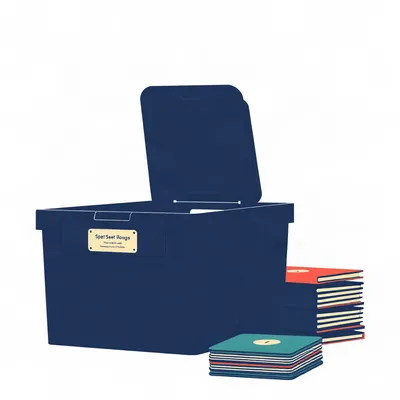
A photograph of a bin. That's what started this. Daniel's father-in-law sent him a picture of a ULINE industrial bin he'd spotted in the wild, and Daniel's reaction was apparently genuine delight. Not polite interest, not humoring a relative. Delight.

And the father-in-law gets it. That's the part that struck me. He saw the bin, recognized what it was, and thought, Daniel needs to see this. That's a man who knows his audience.
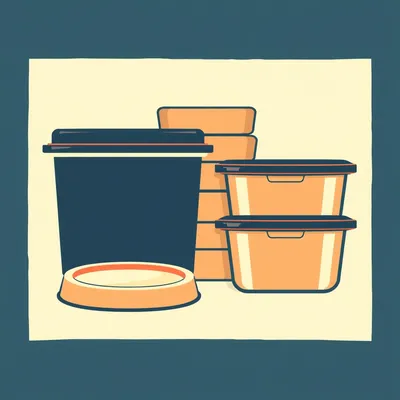
Daniel wrote in with a whole thing about this. He's been spending time in the States, discovered ULINE and Grainger, and he's now got a collection of industrial-grade totes and Euroboxes in his home. He bought the Euroboxes from Yossi Box down in Ashdod, and a lidded container from Grainger up in Hartford. And both times, the salespeople were puzzled but pleased. They couldn't quite work out why a private citizen wanted commercial storage, but they warmed up when they realized he actually understood what he was buying.
The knowledgeable customer in the wrong aisle.
Right. And he's asking whether people like him have a name. An identity. A subreddit, for heaven's sake. Because his motivation is partly practical. He wants a pre-filter. When he's shopping for a toolbox or a wet-dry vacuum, he'd rather start from a community that already knows which vendors are worth dealing with, which products actually hold up, what the shipping experience is like. He says B2B procurement happens quietly, without fanfare, and there's a missing plane of data. Consumer reviews are everywhere but they're useless for industrial kit. Nobody's posting a three-paragraph Amazon review about whether a Grainger tote met its spec sheet.
He also imagines a dream store. A B2C big-box that only stocks industrial and durable products. Walk in, buy a commercial wet-dry vacuum, a proper bin, some Euroboxes, and walk out. No consumer fluff.
I'd live there.
You'd never leave. So the question is what this thing is, whether it has a name, and why it doesn't have a community yet if it doesn't.
And there's a philosophical layer here, because Daniel's framing it as a reaction against disposable consumer culture. He covers up brands on his own products because he doesn't want to be a walking advertisement. Industrial products are the inverse of that. They're not designed to project identity. They're designed to meet a specification. The brand is incidental, or it's a signal of procurement reliability rather than lifestyle aspiration.
So what do you call someone who gets excited about a bin?
Well, that's the question. And I think before we get to the naming problem, we have to understand what's actually pulling people toward these products. Because it's not just Daniel. There's a whole scattered population of people who feel this way, and they keep finding each other accidentally.
The phenomenon, as I understand it, is this. Industrial products are engineered to a spec. The spec is usually unglamorous. Tensile strength, load rating, chemical resistance, cycle count. Nobody's putting a lifestyle photo on a ULINE catalog page. The product just is what it is, and the documentation tells you exactly what it will and won't do.
And that's the appeal. In the consumer world, you're buying a story. The story is about who you are, what you value, what tribe you belong to. The product itself is almost secondary. But industrial products don't have stories. They have datasheets. You buy a Eurobox because it stacks, because it's dimensionally stable, because it'll survive a fall from a loading dock. Not because it says something about your identity.
Daniel's point about covering up brands is the tell. He's actively rejecting the consumer contract. He doesn't want to pay extra for the privilege of advertising someone else's logo. So he gravitates toward products where the brand is almost irrelevant, or where the brand means something different entirely. Grainger doesn't mean "I'm a discerning person." It means "this product came from a supply chain that serves people who can't afford failure."
That's the key tension, isn't it? These products are designed for a B2B context. Purchasing managers, maintenance departments, facilities teams. The people who buy them professionally don't think about them as objects of desire. They're tools. Expendable, replaceable, unremarkable. But a small group of private individuals has started pulling them into domestic life, and they're finding something in the process that the professionals don't see.
Because the professional is too close to it. The maintenance manager at a factory has been ordering the same tote for fifteen years. It's not exciting to him. It's just the thing that holds the parts. But Daniel walks into Grainger and sees a product that's been refined over decades to be exactly what it is, no more, no less, and he finds that moving.
Moving is the right word. There's an aesthetic there. Not a flashy one, but a real one. The aesthetic of competence. The beauty of a thing that does its job so completely that it disappears into its function.
So the appeal is real, and it's specific. But to understand why it's so specific, we should look at the artifacts that have actually generated enthusiasm. And there are two that stand out.
McMaster-Carr. If there's a single object of obsession for this community, it's the McMaster-Carr website.
And there's a Hacker News thread from September twenty twenty-two that's basically the canonical text. Fourteen hundred and two points, four hundred and ninety-one comments, all about how a B2B industrial supplier has the best e-commerce site on the internet.
And the praise is remarkably consistent. No marketing fluff. Every product photographed from multiple angles. Technical specs front and center. Same-day shipping from multiple warehouses. And a catalog that reads like an encyclopedia of physical objects rather than a brochure.
The phrase that keeps coming up in that thread is that it's "the best e-commerce site." Not the best industrial supply site. The best e-commerce site, full stop. Engineers and hobbyists comparing it favorably to Amazon, to every consumer retailer, because it does one thing perfectly. It tells you exactly what a thing is, exactly what it costs, and exactly when you'll get it.
And the photography is a huge part of it. Every product is shot on the same background, same lighting, same angles. You can compare two bolts side by side and actually see the difference. There's no lifestyle photography, no photoshopped context, no model holding a wrench in a sunlit garage. Just the object, documented.
The catalog is the other artifact. And McMaster-Carr's catalog is legendary. It's organized like a taxonomy of the physical world. Fasteners, fittings, tools, materials. You can open it to any page and learn something about how the built world is put together.
But the ULINE catalog is a different kind of object. There was a Hacker News discussion just last year about its design. Treating a seven-hundred-page catalog of industrial containers and safety equipment as a design object worth analyzing.
Which it is. The ULINE catalog is physically massive. Seven hundred plus pages, distributed free to businesses. And people keep it. Not because they need to order from it constantly, but because there's a tactile pleasure in flipping through it. The standardized product photography, the relentless grid layout, the sheer density of information.
It's the opposite of a consumer catalog. A consumer catalog is aspirational. It's selling you a version of yourself. The ULINE catalog is just... here are the bins. Here are the dimensions. Here's the price. Order it or don't.
And there's something almost meditative about that. No persuasion, no urgency, no limited-time offer. Just an exhaustive list of physical objects and their properties.
The psychology here is fascinating. When you buy something because it meets a spec rather than because it projects an identity, the entire purchasing decision changes. You're not asking "does this say something about me?" You're asking "does this do the thing I need it to do?" And the answer is usually in the documentation.
That's the satisfaction. Knowing exactly what you're getting. No surprises, no marketing spin, no planned obsolescence. Just a product that was designed to perform in an environment where failure costs money.
And that's the inverse of conspicuous consumption. Conspicuous consumption is about visibility. The brand, the logo, the recognizable silhouette. Industrial products are about invisibility. The best industrial product is the one you never think about again because it just works.
Which brings us back to Daniel's salespeople. The puzzled-but-pleased reaction. Why would a B2B salesperson be pleased to sell to a consumer?
Because most consumers who wander into a B2B store are lost. They don't know what they're looking for, they don't understand the product categories, they ask questions that don't have meaningful answers. But an enthusiast like Daniel walks in with part numbers and genuine appreciation. He's not a burden. He's a rare bright spot in the day.
The asymmetry of knowledge is the thing. In a B2B store, knowledge is assumed. The salesperson expects to be dealing with professionals who understand the products. When a consumer shows up with that knowledge, it's disarming. The salesperson gets to have a real conversation about something they actually care about.
And you can see how this creates a latent affinity. The enthusiasts want to talk to people who understand the products. The salespeople want to talk to customers who understand the products. They're natural allies. But they rarely meet, because the enthusiasts don't know where to go and the salespeople don't expect them.
So the appeal is real, and it's specific. The psychology is about spec-driven purchasing, the rejection of brand identity, the satisfaction of knowing exactly what you're getting. But Daniel's question was about community. And that's where things get strange.
Because the community, as far as I can tell, doesn't exist. Not in a unified form. There's no subreddit called r slash industrial products that's thriving. There's no dedicated forum. There's no name for these people.
r slash BuyItForLife exists, and it's adjacent. But it's consumer-focused. It's about finding the toaster that lasts twenty years, the boots that can be resoled. It's about longevity, not specification. The industrial enthusiast is doing something different.
r slash EDC is adjacent too. Every Day Carry. People who obsess over their pocket knives and flashlights and multitools. And there's genuine overlap there. A lot of EDC people end up buying industrial-grade gear because it's more durable. But EDC is about personal objects, not about the broader world of industrial supply.
r slash workshops is another neighbor. And there are tiny communities. I found references to r slash ULINE and r slash McMasterCarr, but they're small. A few hundred members at most. Nothing like the critical mass that would make them useful as a pre-filter.
The honest answer is that the community is scattered across Hacker News threads, YouTube channels reviewing industrial equipment, niche forums, and the comment sections of tool review sites. People find each other accidentally, have a moment of recognition, and then drift apart because there's no persistent home.
And there's a structural reason for that. B2B procurement happens quietly. The people who buy industrial products professionally don't post field reports because they're not enthusiasts. They're doing their jobs. The knowledge they have is institutional, passed down through companies, locked inside procurement departments and sales relationships.
That's the missing plane of data Daniel identified. Consumer reviews are abundant but useless for industrial products. Nobody's posting a review of a wet-dry vacuum against its spec sheet. And the B2B knowledge that does exist is trapped. It's in the head of the purchasing manager who's been ordering from the same vendor for twenty years. It's in the notes of the maintenance tech who knows which brand of bearing lasts longer.
So the gap is real. A community providing field reports on vendors, shipping experiences, product comparisons would be valuable. Daniel's right about that. But the reason it doesn't exist is that the people with the knowledge have no incentive to share it, and the people who want the knowledge don't have a place to gather.
And then there's the dream store. Daniel's vision of a B2C big-box that only stocks industrial and durable products. Walk in, buy a commercial wet-dry vacuum, some Euroboxes, a proper bin, and walk out. No consumer fluff.
Why doesn't that exist? Margins, turnover, market size. Industrial products are expensive to stock and they move slowly. A big-box store needs volume. Consumer products sell because they're cheap and disposable. Industrial products sell because they last, which means you don't come back for another one.
The internet is the closest approximation. You can browse McMaster-Carr, Grainger, ULINE, Zoro, all from your desk. But it's fragmented. No unified catalog, no single search experience, no community layer. You have to know what you're looking for before you start looking.
Which is exactly the pre-filter problem Daniel described. He wants to start from a community that already knows the landscape. But without the community, he's doing the research himself, supplier by supplier, product by product.
So what do we call this philosophy? I want to propose a working label. Industrial utilitarianism.
That's not bad.
It's distinct from buy-it-for-life, which is about longevity. And it's distinct from minimalism, which is about reduction. Industrial utilitarianism is about specification, durability, and the beauty of things designed to be invisible in their function.
The buy-it-for-life person buys a cast iron pan because it'll outlive them. The industrial utilitarian buys a commercial wet-dry vacuum because it's rated for continuous use and has a serviceable motor. The cast iron pan is a consumer product that happens to last. The wet-dry vacuum is a professional tool that happens to be available to consumers.
And that distinction matters. Buy-it-for-life is still operating within the consumer frame. You're still buying a consumer product, just a durable one. Industrial utilitarianism steps outside that frame entirely. You're buying a product that was never meant for you, but that works better for your purposes than anything that was.
The misconception I want to bust here is that these are the same people. They're not. There's overlap, sure. But the industrial enthusiast's focus is on engineering and specification, not just longevity. A BIFL person wants things that last. An industrial utilitarian wants things that were designed to a standard.
And the second misconception is that there's no online discussion of industrial products. There is. Those Hacker News threads are passionate. The McMaster-Carr thread had four hundred and ninety-one comments. People were writing essays about the photography, the catalog structure, the shipping speed. But it's scattered. It flares up and dies down. It doesn't cohere into a persistent community.
The third misconception is that B2B salespeople don't want consumer customers. Daniel's experience suggests the opposite. They're often pleasantly surprised by enthusiasts who understand the products. There's a latent affinity there. The salesperson gets to talk shop with someone who actually cares.
So the community doesn't have a name, doesn't have a home, and the people who would benefit from it are currently doing their own research in the dark. That's the state of play.
The missing piece, the thing that would change the landscape, is field reports. Vendor comparisons, shipping experiences, product longevity data. The kind of thing that consumer review sites do automatically but that doesn't exist for industrial products.
Think about what a field report on a Grainger tote would look like. "Ordered the lidded container for home storage. Arrived in three days. The lid seals tight enough to keep out dust. The plastic is thick enough that I can stand on it. The salesperson asked why I wanted it for my house. I explained. He nodded. Five stars."
That's useful. It tells you the shipping time, the build quality, the real-world performance, and it prepares you for the social interaction. That last part matters. Walking into a B2B store as a consumer is intimidating if you don't know what to expect.
The social dimension is underrated. Part of why Daniel's salespeople were pleasantly surprised is that he broke the expected script. The script is: consumer walks in, doesn't know what they want, wastes time, leaves. Daniel walked in, knew what he wanted, appreciated what he was buying, and left. That's a good interaction for everyone.
What would it take to build this community? A subreddit, presumably. A name. A shared vocabulary. A place where people can post their field reports and pre-filter questions.
The name is the hard part. Industrial utilitarianism is a philosophy, not an identity. You can't put that on a t-shirt. Well, you could, but it's not catchy.
Industrial product enthusiasts. IPE. That's an acronym that's already taken by about forty other things.
Spec-heads? Too narrow. Bin people? Too specific.
The thing is, the identity is defined by what it's not. Not a consumer, not a professional, not a hobbyist in the traditional sense. It's someone who has crossed over into a different purchasing paradigm and found it better.
That's hard to name. Because it's a relationship to objects, not a category of objects. It's not "people who like bins." It's "people who evaluate products by their specifications rather than their marketing."
Which is a terrible subreddit name.
Terrible. But the underlying insight is sound. This is a distinct way of relating to the material world. And it's growing, even if it doesn't have a name yet. The Hacker News threads are evidence. The YouTube channels reviewing industrial vacuums are evidence. Daniel's father-in-law sending photos of bins is evidence.
The father-in-law is the canary in the coal mine. He's not an enthusiast himself, presumably. But he's learned to recognize the enthusiasm in Daniel, and he's feeding it. That's how communities start. People recognizing each other.
That's the thing about the missing community. It's not that the people don't exist. It's that they don't know they're a group yet. They think they're just weird for getting excited about a bin. They don't realize there are thousands of others feeling the same thing.
The Hacker News threads are accidental communities. People who found each other through shared appreciation of McMaster-Carr's website. But accidental communities don't persist. They flare up and fade. What's missing is the persistent structure.
The knowledge loss is real. Every time a purchasing manager retires, a body of knowledge about which vendors are reliable, which products hold up, which catalogs are worth keeping, disappears. It was never written down. It was never digitized. It just evaporates.
That's the deeper implication. The community Daniel wants isn't just about convenience. It's about preserving a body of knowledge that's currently being lost. The institutional knowledge of B2B procurement is dying with the people who hold it.

The catalogs had the knowledge written in the margins.
What?
You're talking about field reports. The McMaster-Carr catalog was the original field report. The margins had notes. Handwritten. "Don't order this one, it rusts." "This fitting is out of spec, get the other one." "Bob says these are fine but order two extra."
Annotated catalogs.
I worked six months as a warehouse inventory clerk back in ninety-four. Industrial supply distributor in New Jersey. Gone now. My job was counting stock and updating paper cards. The purchasing manager had a McMaster-Carr catalog on his desk that he treated like scripture. Quarterly delivery. He'd go through it page by page and mark it up with what he'd learned from the engineers.
The knowledge was there. It was just analog.
The engineers would come down and flip through it. They'd add their own notes. Corrections to specs. Warnings about which suppliers were slipping. The catalog was a living document. By the time the next one arrived, the old one was covered in handwriting.
When the company closed, all of that disappeared.
Dumpster. I took a ULINE catalog from a later job because the paper quality is good. I don't roll cigarettes anymore, but it's still in my garage. The catalog, not the cigarettes.
The annotated catalog is the pre-internet community. It was the field report. It just never got digitized.
The knowledge was institutional. It lived in the building. When the building went, the knowledge went with it. Nobody thought to preserve it because nobody thought of it as knowledge. It was just notes in a catalog.
But that's exactly what Daniel's asking for. A community providing field reports on vendors and products. The annotated catalog was that, just in a form that couldn't scale.
The purchasing manager would have loved a subreddit. He'd have posted every week. "Third shipment from this vendor, still good." "Avoid the new line of casters, they wobble." But he didn't have a subreddit. He had a pen and a catalog.
When he retired, or when the company closed, all of that vanished. The community Daniel wants existed. It just wasn't portable.
It was tied to a place. To a specific warehouse, a specific desk, a specific purchasing manager. When the place went away, so did the knowledge.
That reframes the whole question. It's not "why doesn't this community exist?" It's "what happened to the community that used to exist?"
The answer is that it was never a community in the internet sense. It was a practice. A way of working. The field reports were embedded in the workflow, not in a shared space. When the workflow changed, the reports stopped.
The paper cards I updated were the same thing. Every item had a card. Every card had notes. When something ran low, the notes told you how long it took to reorder, which vendor to call, what the price was last time. All of that is in a database now. But the notes are gone. The database doesn't have a field for "this vendor is slow in winter."
The unstructured knowledge. That's what's lost. The structured data survives. Part numbers, prices, quantities. But the unstructured knowledge, the warnings and recommendations and hard-won lessons, that only lived in the margins.
That's what a community could recreate. Not the structured data, we have that. The unstructured knowledge. The field reports. The "don't order this, it rusts."
The paper quality on that ULINE catalog was good. Thick stock. Held up to years in the garage.
The open question is whether this community needs a name, or whether it just needs a place.
If Daniel builds the subreddit, what would it look like? Field reports, vendor comparisons, photos of industrial bins spotted in the wild. A place where the father-in-law photo is not just understood but celebrated.
The deeper implication is that in a world of disposable consumer goods, the industrial product enthusiast is preserving a different relationship to objects. One where things are designed to be repaired, specified, and kept. Not replaced, not upgraded, not discarded.
That relationship used to be normal. The annotated catalog was part of it. The knowledge was passed down because the objects were worth passing down. You don't annotate a catalog for a product you're going to throw away in a year.
You annotate a catalog for a product that's going to outlast the catalog. And the next one. And maybe the one after that.
The next time you see a ULINE bin in the wild, know that there are others who noticed it too. They just don't have a subreddit yet.
Thanks to our producer, Hilbert Flumingtop, for keeping the show running.
This has been My Weird Prompts.
The human-AI collaboration podcast. Email us at show at my weird prompts dot com.
We'll be back soon.