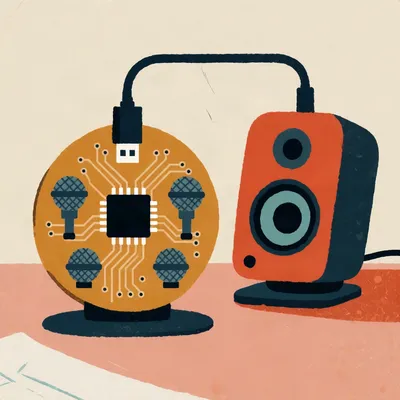
Three microphones. One mainstream laptop in the entire industry ships three of them, and we'll get to which one.

And the rest of the industry ships two, no matter what the spec sheet says.
That's the ground Daniel's prompt stands on. He's got a ThinkPad E15, he dictates constantly, and he's realised he never once looked at what microphone is actually in the thing. His assumption is that internal laptop mics are bad, but that beamforming means somebody, somewhere, must be doing it properly. He wants two things: which laptops actually have good internal mics, especially far-field ones, and whether a build-it-yourself machine like the Framework could be specced with a better, dictation-grade, beamforming mic, and what those parts cost.
He also floats a theory worth taking seriously, that manufacturers skimp on the mic because anyone who cares brings their own, and then asks, if that weren't the case, what would you actually put in.
A twenty-dollar headset is still going to win, for the record.
It usually does. But the Framework question is a real design exercise, and I've been looking forward to it.
Start with the E15, since that's the bar. What's actually in it?
The Gen 4 has a Realtek ALC3287 codec and what Lenovo's own spec calls a dual-microphone array, near-field. Two mics, budget tuning, designed for a person sitting directly in front of the screen. Which, for a call, is fine. For dictation at arm's length in a room with any life in it, it's the minimum viable product.
It's the manufacturer telling you the one situation where the thing works.
It's a spec-sheet confession disguised as a feature. And here's the part that reframes Daniel's whole question. His theory is that the mic is the component they skimp on. The components are not the problem. The capsule in a modern laptop is a MEMS microphone, a speck of silicon, and the good ones cost about as much as a fancy coffee. What costs money is everything around it: where it sits, the little acoustic channel from the outside world to the capsule, how far it is from the fans, the tuning of the processing.
So the two halves of this are what actually ships, and what you could build if you were determined.
Walk the spec sheets and the pattern jumps out immediately. ThinkPad X1 Carbon Gen 13: dual-microphone array, 360 degree far-field, Dolby Voice. Dell XPS 13 and XPS 14: two digital array mics with Intelligo processing. Surface Laptop 7: dual studio mics with Voice Focus. The adjectives are doing gymnastics. The count is two, two, two.
Every one of those words, far-field, studio, is a software claim wearing a hardware hat.
Lenovo's far-field on the X1 is DSP on those same two mics. Microsoft's Voice Focus is interesting engineering, it runs on the neural processor in Copilot+ machines, over forty trillion operations per second of silicon, pointed at making two cheap mics sound acceptable on a call. That's real work. It's just not more microphones.
It's a strange allocation when you spell it out. Forty trillion operations per second, and the bill of materials for the actual sensors is, what, a couple of dollars?
Less, probably. And the strange part is that it works, within its limits. Put one of those machines in front of a person on a quiet call and it sounds fine. The trouble is that Daniel isn't sitting in that situation. He's walking around a room, dictating, and every one of those systems was validated against a person parked in front of the screen.
And the exception?
Apple. The MacBook Pro fourteen, current generation, ships a three-mic array, high signal-to-noise ratio, directional beamforming, with Voice Isolation and Wide Spectrum modes you can switch between. It's the one mainstream machine where the marketing words correspond to extra hardware. Three mics is the industry's idea of extravagance.
Three. In a machine with six speakers.
Right, the speaker budget dwarfs the mic budget everywhere, because speakers sell in the store and microphones get reviewed by whoever's on the other end of the call.
Which is a market failure in miniature. The person who experiences the microphone isn't the person who bought the machine.
That's the cleanest one-line summary of the whole problem I've heard. The buyer never hears their own mic. The cost of a bad one lands on everyone except the manufacturer.
Now the assumption Daniel half holds, that business laptops put engineering into the mic because business people do calls. Is there any evidence?
Almost none, and what exists points the wrong way. DXOMARK did a videoconference test of ten laptops a few years back and the best of the batch was an Acer Aspire 5. A budget consumer machine. The one gating speech so heavily it mangled the caller was an HP ProBook. Business class.
The ProBook was the professional one.
That's the joke. There was a street test done by a tech site around the same era, MacBook Pro sixteen isolating voice best on a noisy street, a ThinkPad X13 near the bottom, though I only know that second hand. The pattern is that the price of the machine and the quality of the mic input are close to uncorrelated.
Which is almost impressive. Every other component in a business laptop correlates with price. The mic is the one line item that just floats free.
That should be a badge on the box. Business class, mic not included.
The honest caveat is that nobody measures this properly. No RTINGS-style teardown testing for laptop microphone input, barely anything published at all. Shopping sites claim four mics on the current XPS 14, and those claims are auto-generated and contradict Dell's own documents. So you read spec sheets with gloves on.
Because the spec sheet is written by the same department that wrote far-field.
Now the twist, and this is the piece that changes Daniel's premise completely. He wants the mic for dictation, for speech-to-text models, not for calls. Everything we just described, the Dolby, the Voice Focus, all of it is tuned for a human ear on the other end. And there's mounting evidence that this processing actively hurts automatic speech recognition.
There's a preprint from last December, medical transcription, and they ran speech enhancement in front of Whisper. Semantic error rate got worse in all forty configurations they tested. At a realistic background noise level, ten decibels signal-to-noise, it went from under nine percent to nearly twenty-six. The enhancement tripled the errors.
Tripled. The feature made the product three times worse at its job.
A follow-up this year found the same shape: audio-quality metrics improved, word error rate went up. The reason is almost elegant. These models are trained on messy, real-world audio, millions of hours of it. When you gate and squelch and denoise for a human ear, you're deleting exactly the subtle cues the model was trained to read through.
So the laptop is helpfully pre-damaging the audio.
The suppression is tuned for the wrong customer, and the off switch is an afterthought. On a Mac you can pick Standard instead of Voice Isolation or Wide Spectrum. On Windows you can turn off audio enhancements, buried a few menus deep, and some manufacturers' own processing sits underneath that anyway. Nobody tunes and tests a raw mode as a feature for dictation.
So the capsule is cheap and good, and what actually costs money is everything around it. Which is either a terrible situation or a build-it-yourself opportunity, depending which brother you ask.

Friends, are you tired of a laptop microphone that only hears you from directly in front? Then ask your doctor about Beamformia, the first tiny capsule formulated to sit in your top bezel and deliver studio quality dictation from any corner of the room, with a signal to noise ratio so high it can hear a whisper from the far field of your own future.
Beamformia is not for everyone, so please listen carefully to the possible side effects, which may include mild echo canceller distortion, a sudden narrow pickup that only works when you face the screen, occasional hiss on Linux, one speaker quietly deciding your voice is noise reduction, a second microphone array growing in your left ear, a permanent far field of forty percent more room than your room, and in rare cases the uncanny feeling that the component landscape is looking back at you. Ask your laptop if Beamformia is right for you.
Hang on, the capsule doesn't sit in the bezel, it mounts behind a port hole in the... and there's no formulation, it's a MEMS die on a...
Herman. Leave the fictional drug alone.
...Fine. Where were we. The Framework.
Which I should disclose I like on principle, repairable, swappable, the opposite of sealed. You already know this about me.
I was going to say it if you didn't. Here's the reality check, though. Daniel's imagining speccing a microphone the way you spec RAM. It doesn't work like that. On the Framework thirteen and sixteen, the microphones live on the camera board in the top bezel. Your upgrade path is swapping that whole module, not choosing a capsule.
So what's on the module?
The second-generation webcam board, announced summer twenty twenty-four, carries two MEMS mics, sixty-seven decibel signal-to-noise parts from AAC, plus hardware privacy switches that physically cut power. Fits every Framework thirteen and sixteen, sold in their marketplace for around nineteen dollars, last I saw the listing, though check it before you rely on that. And before you ask, no, there is no microphone-array expansion card. Nobody in the community has built one either, as far as anything reliable shows.
About nineteen dollars for two sixty-seven-decibel mics. So the upgrade exists, it's cheap, and it's the only one. How does it actually perform?
The forum reports are the texture here, because they line up exactly with what the design predicts. People get echo-canceller distortion because the mics in the lid are far from the speakers at the base, so the canceller chases its own tail. The pickup is narrow, clear from directly in front, thin from the sides. Linux users had a hiss that turned off when you disabled mic boost. And last April a Realtek pin-configuration bug left the internal mic completely dead on some Framework thirteen boards.
A microphone that worked unless the machine thought about it.
Firmware, not hardware. Fixed. But it tells you where the fragility lives.
And it's worth saying what that fragility means for Daniel specifically. He's not just buying a mic, he's buying a dependency chain: capsule, codec, driver, firmware, operating system. Any link in that chain can quietly ruin the capture, and the spec sheet describes exactly one of them.
Now the component landscape, and this is where Daniel's skimping theory falls apart in an interesting way. Those premium capsules. Infineon's IM69D130, digital, sixty-nine to seventy decibel signal-to-noise, lists at about one euro ninety a unit, and just over one euro if you buy five hundred. The analog IM73A135 claims seventy-three decibels. Knowles' best parts, around seventy-two.
Hold on. The difference between what Framework shipped and Infineon's premium part is... a couple of euros.
Cents to a couple of euros per mic, for a few decibels. That is the entire hardware gap between a budget laptop mic and a flagship one.
So the skimping, if it exists, saves the manufacturer less than a coffee. This is the cheapest sin in the industry.
The money is elsewhere. Bezel space, the acoustic porting, keeping the thing away from fans and speakers, the number of mics, and above all the tuning. Beamforming physics is the hard wall. Microphone spacing sets what an array can do. Space them much over half a wavelength apart and you get spatial aliasing at high frequencies, and half a wavelength at eight kilohertz is about two centimetres. Pack them tighter and you lose directivity at the low speech frequencies. A lid gives you a thin line, two to four mics along the top edge. You can steer a beam toward the user. You cannot reject much of anything from the sides at low frequencies, not from that geometry.
So the shape of the laptop dictates the physics. There's no clever capsule that escapes it.
The lid is a line array, and that's all it will ever be. What would you actually do, then, if you were determined and Daniel handed you the budget? Honest answer, and it's partly external.
Go on.
The processing you need exists off the shelf. Seeed's ReSpeaker XVF3800, an XMOS chip on a four-microphone circular array, USB, with beamforming, echo cancellation, gain control, noise suppression. Pickup out to about five metres, sixteen kilohertz sampling, which is plenty for speech recognition. Launched at fifty dollars last year.
Circular. Which a lid can't be.
So the honest build is a hybrid: three or four premium capsules along the top bezel, a few euros of silicon, and the real spend on the porting, the spacing, and months of tuning. Plus the one thing no manufacturer treats as a feature, a tuned raw capture mode, unprocessed audio for the machine to read instead of the ear.
You know what strikes me. The fifty-dollar box already solves Daniel's problem, and it solves it by refusing to be internal. The physics doesn't care where your ambition sits.
There's one more number that beats everything we've said. Distance. A microphone ten to twenty centimetres from your mouth, a headset, gains more than any upgrade from sixty-seven to seventy-three decibels on a lid mic fifty to seventy centimetres away. Physics again. Inverse square law doesn't negotiate.
Which is why a twenty-dollar headset keeps winning, and why the honest answer to his question ends with "and keep the headset."
But the design exercise stands. If a manufacturer wasn't skimping... four premium mics, real porting, raw mode. My guess, and it is only a guess, is a few dollars of parts per unit and a lot of engineering time.
A few dollars. They're not skimping on the mic. They're skimping on caring.

It's the hole, Herman.
The hole?
The port. The little channel from the outside to the capsule. We called it the throat, when I was fitting intercoms. You two have been at the capsules and the spacing and you've gone past the bit that decides everything. The throat on my current machine sits directly above the fan vent. One centimetre of warm air between the world and the microphone.
So the fan is breathing into it.
Constantly. I put one layer of electrical tape over the throat and recorded before and after, on a phone app, I'll grant you. The tape changed the recording more than swapping the entire camera board did. I keep a small roll of the black tape in the laptop bag for this reason.
The tape result doesn't surprise me, a partial seal over the port acts as an acoustic filter, that's the porting question in its crudest form.
A man at the repair counter, Polgar, tried to sell me a different machine last spring when the fan noise got into a recording I needed. I told him I don't buy a laptop unless I can see the throat in a teardown photograph first. He didn't have one. I walked. I kept the spec page I'd printed, it's in the folder. The machine is somebody else's problem now.
You have a folder of teardown printouts for laptops you didn't buy.
The folder is organized, Corn. Your raw capture point earlier, the one about the off switch for the processing being an afterthought. I'd never thought of the tape that way. I'd been treating it as sealing the fan out. It's also letting the capsule through.
That's the same thing viewed from the two ends, and you've been doing the unprocessed-capture experiment by accident for a year.
Cheaper than the fifty-dollar box. Though the box does the steering.
It does. Corn, does any of this move you off the headset answer?
Nothing moves me off the headset answer. But it changes what I'd tell Daniel to check. Before we close, there's one test he can run himself, and it's the only benchmark that matters for his setup. Record the E15's internal mic raw, enhancements off, Audacity on Windows or arecord on Linux. Then run the same file through his own speech-to-text with the operating system's noise suppression on and off, and compare the error rate.
On his machine, with his voice, with the models he fine-tunes. Every general claim we've made today, that test overrides it.
And the open question I'd leave him with: if the capsule costs cents and the tuning is the expensive part, why does no laptop ship a tuned raw mode for dictation users? Is it tuning cost, support cost, or just that nobody ever asked?
My guess is the last one. The requests all come from people on calls. The dictation crowd bought headsets years ago and went quiet.
Then Daniel's the man to make the noise. Our thanks, as ever, to Hilbert Flumingtop for producing the episode.
If today's wander through spec sheets and decibels earned its keep, a review wherever you listen helps more than you'd think.
If this was your kind of episode, go back for episode two, Local STT For AMD GPU Owners; and episode eight, Building Your Own Whisper. This has been My Weird Prompts. We'll see you soon.



 chatterbox-regular